.avif)
You're probably in the middle of the same decision most homeowners reach after choosing a vanity or plumbing fixture. The room is taking shape, yet the tile still feels unresolved. Maybe you've saved images of quiet spa bathrooms, crisp patterned floors, and glossy handmade walls, but translating those references into one coherent plan is harder than it looks.
Beyond the Surface: A Guide to Thoughtful Tile Selection. The tile in a bathroom does more than protect walls and floors from moisture; it sets the room's foundational character. It is a canvas for color, a medium for texture, and a testament to craftsmanship. At Jennifer Gilmer Kitchen & Bath, we approach tile selection not as a finishing touch, but as an integral part of the design narrative. This guide explores nine distinct approaches to bathroom tile, moving beyond fleeting trends to focus on ideas that offer enduring style, function, and a sense of personal refinement.
For homeowners gathering inspiration, this overview pairs enduring design principles with practical trade-offs, much like this look at London bathroom tile materials and styles. The difference is in the lens. Jennifer Gilmer Kitchen & Bath serves the Washington DC, Maryland, and Virginia area with a full design process that carries clients from concept through installation, so every suggestion here is grounded in how bathrooms are built, used, and lived in.
Table of Contents
1. Large-Format Porcelain Tiles
A compact bath can feel calm and architectural, or busy and cut up. Large-format porcelain usually sets that tone first. At Jennifer Gilmer Kitchen & Bath, we often start here when a client wants a room that feels custom-designed, quiet, and lasting rather than trend-driven.
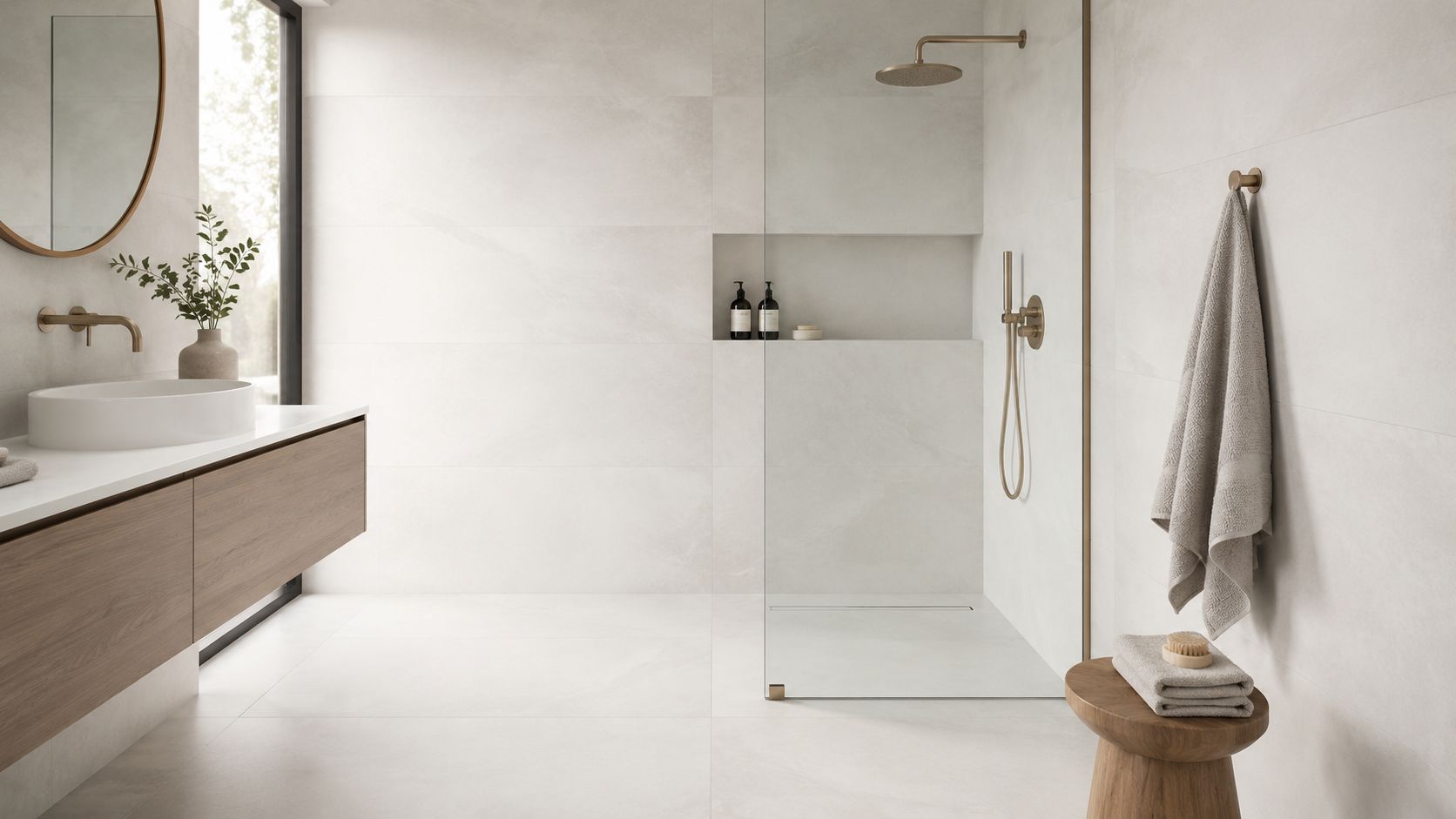
Used well, oversized porcelain gives the room a continuous visual read. A primary bath wrapped in floor-to-ceiling porcelain with a soft limestone or marble look feels composed and expensive because the surface is carrying the architecture. In a powder room, a pale gray 24x48 tile can create a gallery-like envelope that lets the vanity, mirror, and lighting take focus. For clients comparing stone looks, our guide to Carrera vs. Calacatta marble helps clarify which veining style translates best into porcelain.
Why scale matters
Large-format tiles are generally 24x24 inches or larger. The appeal is straightforward. Fewer grout joints give the eye fewer stopping points, so walls and floors read more clearly and the room often feels larger. Belk Tile also notes that porcelain remains a strong choice for bathrooms because it resists water well and can offer dependable slip performance, which matters in spaces that need to be both polished and hardworking (large-format bathroom tile guidance from Belk Tile).
Practical rule: If you want the tile to feel architectural rather than decorative, keep the grout close to the body color of the tile.
There is a trade-off. Bigger tile is less forgiving. Uneven walls, out-of-level floors, poor layout decisions, and sloppy cuts show immediately, especially with rectified edges and narrow grout joints. That is why this material depends as much on preparation and installation as on the tile itself. At Jennifer Gilmer Kitchen & Bath, we treat substrate work, layout planning, and setting discipline as part of the design, because that is what gives large-format porcelain its refined effect over time. For homeowners weighing finish options, our guide to timeless bathroom materials for Maryland homes is a useful companion to this approach.
2. Subway Tiles with Varied Grout Colors
Subway tile remains useful because it's familiar without being fixed. A simple white or cream field can lean traditional, refined, modern, or softly historic depending on proportion, sheen, and most of all, grout color. That flexibility is why it still appears in so many successful bathroom tile design ideas, even as designers become more selective about how they use it.
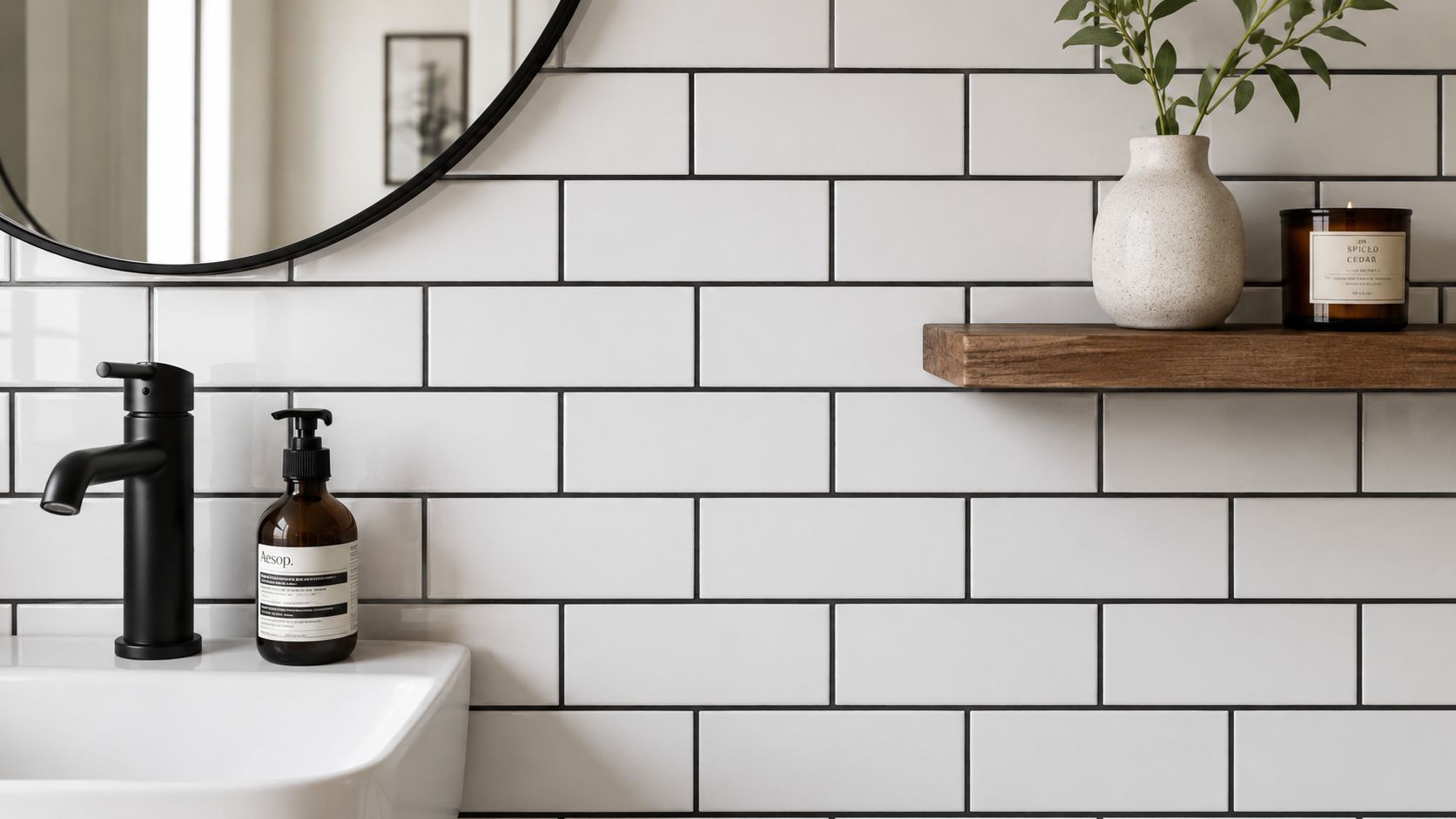
A Victorian-inspired bath with white subway tile and charcoal grout has a crisp architectural rhythm. A quieter version, with warm white tile and matching grout, lets brass fittings and painted cabinetry speak more softly. Both can work. The mistake is treating grout as an afterthought.
Grout changes the entire reading of the room
There's an active debate around contrast. One side favors tonal grout for serenity. The other uses contrast to celebrate the pattern. There's room for both. A nuanced analysis from Cle Tile notes that in small bathrooms, contrasting grout can make small tiles such as penny rounds or hexagons pop by up to 30% in visual prominence, while also increasing perceived wall-surface complexity by 25% (small bathroom shower tile ideas from Cle Tile).
That doesn't mean every white subway wall needs dark grout. In fact, a 2026 contractor consensus cited a decline in high-contrast grout, with 72% of professional contractors recommending grout colors within the same tonal family as the tile for a more integrated finish, and subway tile usage reportedly down by 35% in major markets as textured stone, Zellige, and 3D-effect surfaces gain favor (2026 tile trend discussion on YouTube). The takeaway isn't that subway tile is dated. It's that the old black-grid formula can feel too assertive when used without context.
- Choose contrast intentionally: Dark grout is strongest in powder rooms, secondary baths, or feature walls where graphic structure adds energy.
- Seal colored grout carefully: The bolder the grout, the more discipline maintenance requires.
- Pair classic with quiet: Subway tile looks better when the vanity stone, metal finish, and lighting bring a sense of maturity.
3. Natural Stone with Proper Sealing
Natural stone asks more of the homeowner, but it gives more back. Marble, limestone, slate, and granite each carry variation that manufactured surfaces still struggle to imitate convincingly. Veining, fossils, mineral movement, and tonal shifts create depth that feels collected rather than produced.
In a primary bath, honed marble on the walls paired with a simple shower floor can feel restrained and enveloping. A limestone powder room has a softness that suits older homes beautifully. Slate, when specified carefully, gives a shower enclosure a grounded, tactile quality.
Where stone rewards the investment
The current mood has moved beyond pale, safe surfaces. In 2025 bathroom design, natural stone is leaning darker and more atmospheric, with oxblood, burgundy, bold marbles, and earthy tones shaping a more dramatic palette, alongside the rise of material drenching across walls, floors, and even ceilings for a unified spa-like effect (2025 bathroom trends from Roper Rhodes). That direction can be beautiful, but it only succeeds when the room has enough restraint elsewhere.
Natural stone shouldn't compete with too many other statements. Let the slab or tile do the talking, then simplify the rest.
The practical side matters just as much. Stone needs the right sealer for the specific material, and cleaning products have to be chosen with care. Marble and limestone can etch. Some slates cleave naturally. Granite is more forgiving, but it still benefits from thoughtful maintenance. Jennifer Gilmer Kitchen & Bath often guides clients toward stone where its character will be appreciated and maintained, not solely because it sounds luxurious. For anyone comparing white marbles in particular, this look at Carrara vs. Calacatta marble is worth reading before selections are finalized.
4. Textured and 3D Tile Finishes
Texture gives a bathroom something flat tile can't. It catches light, softens broad surfaces, and adds depth even in a limited palette. In rooms that rely on neutrals, that can make the difference between serene and lifeless.
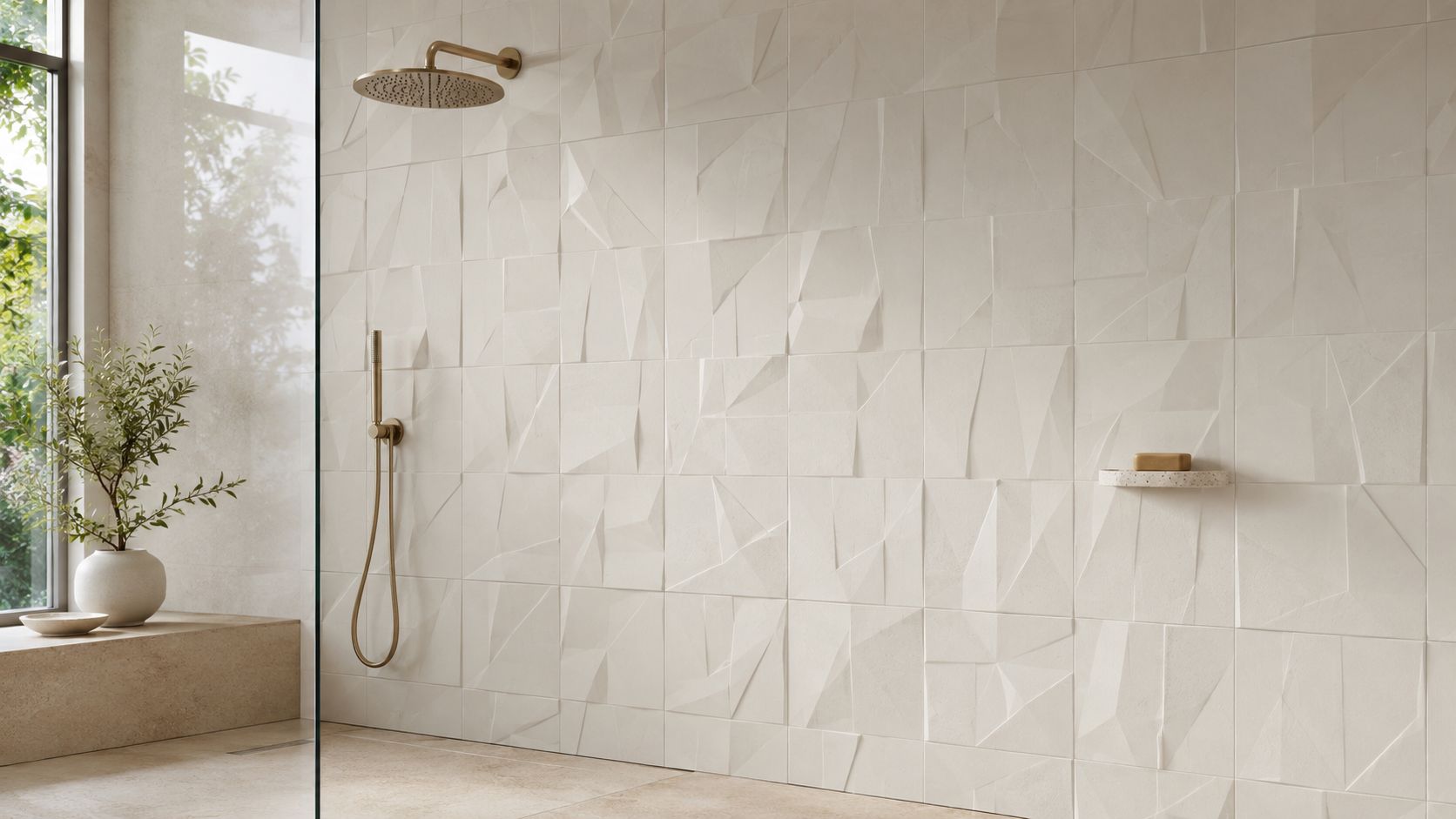
A fluted wall behind a freestanding tub, a geometric relief in a shower surround, or a softly rippled field tile behind a vanity introduces movement without relying on bold color. That's one reason textured surfaces have become so relevant in high-end bathrooms. They add richness while preserving calm.
Use texture where light can find it
Textured tile works best when it has room to breathe. Covering every wall in heavy relief usually makes a bath feel busy, not refined. A better approach is to pair one dimensional surface with simpler field tile in a related tone. The contrast comes from shadow and surface, not from a clash of materials.
House Beautiful's 2025 bathroom tile coverage also points to textured tiles as a modern addition to minimalist spaces, especially when paired with a large-format tile in the same color family to build depth in monochromatic rooms (2025 bathroom tile trend ideas from House Beautiful). That's a smart formula for homeowners who want personality without visual noise.
A short visual reference helps here:
Cleaning is the trade-off. Tile with significant surface variations can trap residue more easily than a flat surface, so it's best reserved for walls, vanity backdrops, or shower zones that don't require constant scrubbing underfoot.
5. Handmade and Artisanal Tiles
Handmade tile introduces the kind of irregularity that makes a room feel alive. Slight variation in glaze, edge, and tone brings warmth that machine-perfect material rarely has. In a powder room, that quality can be enchanting. In a primary bath, it can make a shower wall feel curated rather than overly polished.
Here, design becomes more personal. Jennifer Gilmer, CKD, has long favored materials that reveal the hand behind them when the architecture is otherwise disciplined. A hand-glazed tile in a blue-green mineral tone, or a softly varied off-white Zellige-style wall, can anchor the room emotionally without overwhelming it.
Character needs restraint
The most successful artisanal installations usually balance one expressive tile with simpler companions. A hand-painted accent inside a niche, a glazed field on one wall, or a band of handmade tile above a stone vanity is often more enduring than covering every surface. Variation reads as character only when the eye has moments of rest.
Customized tile choices are also part of a broader movement toward personalization. A 2025 trend overview notes growing interest in small batch runs, hand-painted options, and custom-made tile, alongside integrated storage and wellness-focused bathrooms that feel suited to daily life (2025 bathroom trend video overview). That combination makes sense. Clients increasingly want rooms that reflect their routines and their taste, not just a market trend.
- Order extra material early: Handmade lots vary, and matching a later order can be difficult.
- Use artisans with proven standards: Beauty still needs proper firing and moisture suitability.
- Place it where it matters most: Powder rooms, feature walls, and shower accents often deliver the best return in character.
6. Encaustic and Patterned Cement Tiles
Patterned cement and encaustic-style tiles bring narrative into a bathroom. They reference travel, craft traditions, and decorative history in a way plain field tile never will. Used well, they can give a powder room charm or turn a bath floor into the visual anchor of the entire design.
The key is scale and restraint. A full room of dense pattern can tire quickly. A framed floor, vanity wall, or contained shower detail is usually more refined. At Jennifer Gilmer Kitchen & Bath, Nancy McCarren, AIA, LEED AP, often approaches these materials architecturally. Pattern needs boundaries. It should feel placed, not scattered.
Pattern works best with boundaries
Current color direction supports this approach. BuildMyPlace's 2025 trend forecast highlights ocean-inspired neutrals such as taupe, deep blues, and warm gray, while also embracing jewel tones, terra-cotta reds, darker yellows, color blocking, and pattern drenching through framing techniques rather than uniform coverage (2025 bathroom tile trends from BuildMyPlace). That framing instinct is especially useful with patterned cement tile.
A jewel-toned encaustic wainscot in a powder room can feel intimate and memorable. A geometric floor paired with plain plaster walls can feel rooted and elegant. But once patterned tile starts competing with busy wallpaper, ornate mirrors, and dramatic stone, the room loses discipline.
Design note: Patterned tile needs at least one quiet partner, whether that's a painted wall, a plain field tile, or simple cabinetry.
For a sense of how focal materials can be integrated into a refined bath composition, the Easton bath project offers a useful point of reference.
7. Wood-Look Porcelain Tiles
Some homeowners want the warmth of wood in a bathroom but know the room won't be kind to real hardwood. That's where wood-look porcelain earns its place. It brings the grain, rhythm, and visual softness of planks into a wet environment without the same vulnerability to moisture.
This material works particularly well when a bathroom opens directly off a bedroom with wood flooring. A porcelain plank in a compatible tone creates continuity while respecting the functional demands of the bath. It also helps transitional and contemporary bathrooms feel less cold.
Where this material excels
Wood-look tile is most convincing when the color is believable and the finish is matte. Overly glossy plank tile tends to read artificial immediately. Longer plank formats in warm oak, pale ash, or medium walnut tones usually feel more natural than exaggerated rustic patterns.
This category also aligns well with the broader move toward extending tile beyond the shower. House Beautiful notes a 2025 trend toward using a single tile across walls and floors for a unified look throughout the bathroom, along with combining two tile types in the shower and layering texture into monochromatic schemes. That same logic applies to wood-look porcelain when it's paired with a quieter wall tile already discussed earlier.
A few combinations consistently work well:
- Light ash plank with warm white wall tile: Clean, soft, and easy to live with.
- Medium oak plank with limestone-look porcelain: A balanced mix of warmth and structure.
- Honey-toned plank with painted vanity cabinetry: Useful when the room needs a more residential feeling.
The caution is visual authenticity. Repetition in the printed pattern, poorly handled transitions, or grout that contrasts too sharply can break the illusion.
8. Terrazzo Tiles and Inlays
Terrazzo has returned to residential bathrooms because it offers complexity without fussiness. The aggregate brings motion, sparkle, and color variation, yet the overall surface can still read as refined. It suits clients who want something more expressive than plain stone but less ornamental than a heavy pattern.
In a high-end primary bath, terrazzo flooring can ground an otherwise restrained palette of painted millwork, polished nickel, and quiet wall tile. In a powder room, a terrazzo vanity top or inset floor panel can become the one memorable gesture that makes the room feel bespoke.
How to keep terrazzo refined
The best terrazzo applications are edited carefully. Aggregate size, base color, and finish all matter. Fine, tone-on-tone terrazzo feels elegant and architectural. Larger, more colorful chips create a playful mood that's better suited to a secondary bath or a client who wants a stronger design statement.
Material drenching and continuous surface treatments have helped reopen interest in richly unified bathrooms, including stone-forward schemes and personalized finishes, as noted in the broader 2025 trend conversations cited earlier. Terrazzo fits naturally into that environment because it can bridge modernism and warmth at the same time.
A few practical decisions shape the outcome:
- Choose a honed floor finish: It feels softer visually and is more appropriate underfoot than a highly polished surface.
- Coordinate the fleck colors: The aggregate should speak to the vanity, hardware, and paint palette.
- Keep neighboring materials simple: Terrazzo becomes more elegant when paired with quiet companions.
Marie-Josée Parisi often treats terrazzo as a balancing material. It can hold color, texture, and movement in one surface, which means the rest of the room can be composed more lightly.
9. Mosaic and Mixed-Media Tile Compositions
A guest opens the powder room door and pauses at the wall behind the vanity. The room is otherwise restrained. Quiet paint, bespoke millwork, disciplined lighting. Then the tile catches the eye. A mosaic or mixed-media composition can do that in a way few other surfaces can, provided it is edited with precision.
The strongest installations use mosaic as a focal material with a defined job. A shower niche, a vanity backdrop, an inset panel, or a narrow field inside a larger tile layout all make sense. Small pieces carry a high amount of pattern, color, and reflectivity, so placement matters as much as selection.
A jewel-toned glass mosaic inside a niche can bring depth to a calm shower wall. A stone and glass blend can pick up water, sky, or sand tones without pushing the room into a themed look. In a compact powder room, a mixed-media feature wall can add richness and individuality that would feel excessive in a larger bath.
Small scale, strong impact
Mosaic often earns its place where the room needs finer grain and more texture than field tile can provide. That is especially true on shower floors, curved surfaces, and architectural moments that benefit from detail. The trade-off is maintenance. More joints mean more grout, more cleaning, and a greater need for careful installation.
Restraint is what keeps it elegant.
Use mosaic in one primary location, or at most two closely related ones. Repeat the same material thoughtlessly across the niche, shower floor, accent band, vanity wall, and backsplash, and the composition loses hierarchy. Every surface starts asking for attention at once.
Material pairing deserves close scrutiny here. Glass introduces light and movement but can read cold under blue LEDs. Natural stone adds softness but needs proper sealing and consistent upkeep. Metallic pieces can be beautiful in a powder room, though I use them sparingly in wet zones where water spots show quickly.
Lighting changes everything. Reflective glass, honed stone, and mixed finishes all read differently from morning to evening, and a tiny sample rarely tells the full story. At Jennifer Gilmer Kitchen & Bath, we prefer to review these assemblies in person and at meaningful scale so clients can judge depth, sheen, and color balance before the installation begins. That discipline is what turns a decorative gesture into a lasting design decision.
Bathroom Tile Design: 9-Item Comparison
| Tile Type | Implementation Complexity 🔄 | Resource Requirements & Cost ⚡ | Expected Outcomes ⭐📊 | Ideal Use Cases 💡 | Key Advantages ⭐ |
|---|---|---|---|---|---|
| Large-Format Porcelain Tiles | Moderate–high; skilled install needed to avoid lippage | Higher material cost; heavy tiles require proper substrate and quality thinset | Seamless, contemporary look; fewer grout lines and easier cleaning | Small bathrooms, floors & walls, radiant-heated floors | Minimal grout lines, durable, moisture-resistant |
| Subway Tiles with Varied Grout Colors | Low–moderate; straightforward for experienced installers | Low–medium cost; widely available, grout color may need sealing | Timeless, defined grid; customizable contrast or seamless look | Backsplashes, shower walls, transitional to vintage schemes | Versatile, cost-effective, highly customizable with grout |
| Natural Stone with Proper Sealing | High; requires professional specification and installation | High material and ongoing maintenance cost; periodic resealing required | Unique, luxurious appearance with natural veining and depth | High-end primary baths, spa-like settings, statement walls | Timeless beauty, personalized character, perceived value |
| Textured and 3D Tile Finishes | Moderate–high; careful layout and grout planning essential | Medium–high cost; limited stock for specific patterns; deeper cleaning needs | Adds tactile depth and shadow play; improved slip resistance | Feature walls, shower surrounds, slip-sensitive floors | Visual texture, safety benefits, layered sophistication |
| Handmade and Artisanal Tiles | High; variation in size/color demands skilled installation | High cost and lead times; limited availability and need for extras | One-of-a-kind, craft-driven character and warmth | Powder rooms, bespoke accents, artisan-driven projects | Authenticity, unique variations, supports artisans |
| Encaustic and Patterned Cement Tiles | Moderate; requires thoughtful placement to avoid visual overload | Medium–high per-tile cost; careful sourcing for quality | Bold patterned focal points with cultural/historical reference | Accent floors, niches, powder rooms, borders | Distinctive patterns, strong focal impact |
| Wood-Look Porcelain Tiles | Low–moderate; standard tile installation, attention to plank layout | Medium cost; choose high-resolution prints for realism | Warm hardwood aesthetic with porcelain durability in wet areas | Bathrooms seeking organic warmth, floors, showers | Wood appearance without moisture issues; low maintenance |
| Terrazzo Tiles and Inlays | High; custom casting or specialized tile installation | Very high cost; heavy material needs proper substrate and sealing | Luxurious, jewel-like aggregate with deep visual complexity | High-end powder rooms, feature floors, custom vanities | Highly customizable, premium visual richness |
| Mosaic and Mixed-Media Compositions | High; design and installation are labor-intensive and precise | High labor and design cost; may require mosaic artist or sheets | Artistic, personalized focal elements with fine detail | Shower niches, accent walls, curated feature areas | Custom artistry, controlled bold color/pattern use |
Bringing Your Vision to Life with Expert Guidance
Selecting tile well isn't about chasing the newest finish or copying a photo that looked good on a screen. It's about proportion, maintenance, mood, craftsmanship, and how each surface relates to the architecture of the room. The best bathroom tile design ideas hold all of those considerations at once. They feel composed because they are composed.
That's where professional guidance matters. At Jennifer Gilmer Kitchen & Bath, every bathroom begins with the way clients live. A family bath has different priorities than a primary suite. A historic home in Washington DC asks for a different material language than a newer residence in Northern Virginia or a waterfront property on Maryland's Eastern Shore. The tile should answer those conditions, not ignore them.
The team's work is grounded in thoughtful space planning and a refined material sensibility. Jennifer Gilmer, CKD, Nancy McCarren, AIA, LEED AP, and Marie-Josée Parisi each bring a practiced eye to the decisions that most affect the longevity of a room. Scale, pattern, grout, edge conditions, transitions, and installation sequencing all matter. Clients often arrive focused on color alone, then realize the more enduring choices are about balance and execution.
There's also value in seeing materials firsthand. A porcelain that feels flat in a photograph may reveal beautiful mineral depth under showroom lighting. A handmade tile may look too irregular on a sample board, then become exactly right once it's paired with cabinetry, stone, and fittings. That tactile review is one reason Jennifer Gilmer Kitchen & Bath guides projects from concept through installation. Design decisions improve when they're made in context.
If you're planning a renovation in Washington DC, Maryland, or Virginia, it helps to approach tile as part of a complete design narrative rather than an isolated finish selection. The room should feel coherent from floor to vanity to shower enclosure. Even practical upgrades, such as integrated storage or more durable flooring, become more successful when they're tied to an overall vision. For homeowners also comparing renovation planning frameworks in other regions, this comprehensive guide for Florida homeowners renovating bathrooms offers a useful contrast in process.
Jennifer Gilmer Kitchen & Bath welcomes clients to explore materials and design possibilities in its showrooms in Chevy Chase, MD, Easton, MD, and Ashburn, VA. The goal isn't just to choose tile that looks current. It's to create a bathroom that feels personal, crafted, and lasting.
If you're ready to refine your bathroom tile design ideas into a room that feels cohesive and built for daily life, connect with Jennifer Gilmer Kitchen & Bath. The team serves homeowners across Washington DC, Maryland, and Virginia, guiding each project from concept through installation with a focus on thoughtful planning, craftsmanship, and materials that endure.