.avif)

Beyond the countertop, the primary challenge usually sits one layer deeper. The morning routine should be a moment of calm preparation, yet for many households it begins with rummaging through crowded drawers, shifting products around plumbing, and clearing a counter before there's room to begin. At Jennifer Gilmer Kitchen & Bath, we believe luxury comes from ease as much as finish selection. A vanity should support the way you move through the day.
That's why organization starts long before the accessories are chosen. Jennifer Gilmer, CKD, and Marie-Josée Parisi look first at habits, inventory, reach, and maintenance, then shape storage around those patterns for clients across Washington DC, Maryland, and Virginia. These bathroom vanity organization ideas reflect that design philosophy: thoughtful space planning, refined materials, and practical systems that feel composed every day.
Table of Contents
1. Drawer Dividers, Tiered Inserts, and Makeup Organizers
The most effective vanity drawers don't feel packed. They feel edited. Custom-fitted dividers, stepped inserts, and purpose-built makeup trays create zones for cosmetics, skincare, hair tools, and medications so you can open one drawer and see everything at a glance instead of excavating for one lipstick.
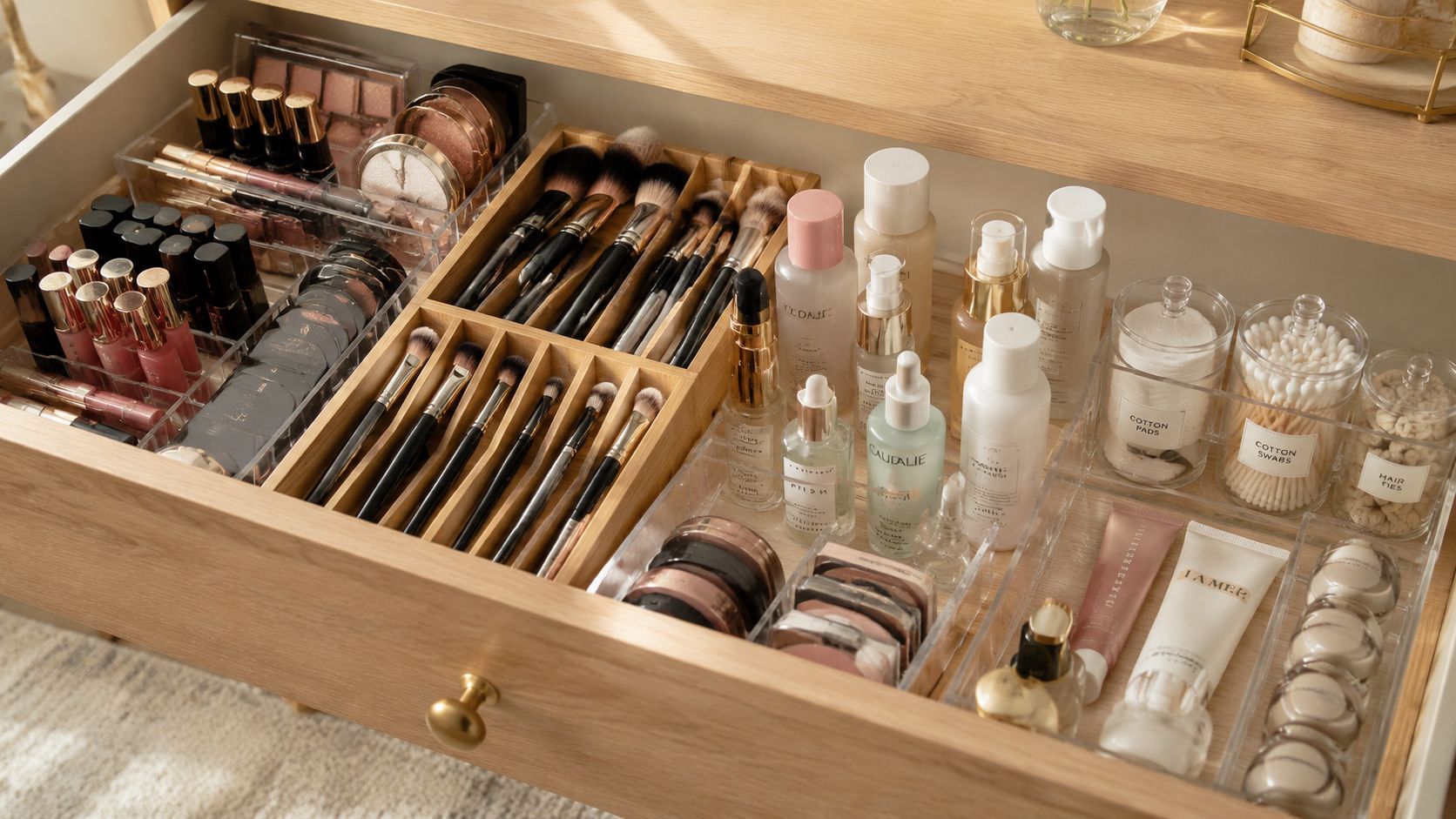
In a Chevy Chase primary bath, this often means separating lip products, eye products, and brushes into distinct compartments, then lifting taller skincare bottles on a tiered insert so labels stay visible. In a guest bath, the same idea can be quieter: one clean divider for the daily basics and nothing more. That restraint is part of what makes high-end storage work.
Map the drawer before you buy a single insert
A good system starts with exact dimensions, not guesswork. Measure the interior width and depth, but also note handle clearance, hinges, drawer glides, built-in outlets, and any cutouts that interrupt a perfect rectangle. If the drawer houses electric toothbrush charging, hot tool storage, or plumbing workarounds, those details matter.
A few rules consistently hold up:
- Start broad: Divide first by makeup, skincare, tools, and miscellaneous before refining into narrower categories.
- Protect brushes: Store brushes upright in a dedicated slot or in a compartment that keeps bristles from getting crushed.
- Leave flex space: One small open section prevents the whole drawer from failing the moment one new item arrives.
- Refine by season: If your routine shifts through the year, rotate products instead of forcing every item into permanent residence.
Practical rule: Declutter before you buy organizers. Keeping only the products you use often, then corralling visible items on a tray, creates a calmer counter and a more believable system, as noted in this bathroom organization guidance.
For clients who want a more customized interior, hardware quality matters almost as much as the organizer itself. Soft, stable glide systems keep acrylic trays from shifting and make daily use feel quieter. Jennifer Gilmer Kitchen & Bath often treats drawer interiors the way we treat cabinetry exteriors: carefully fitted, easy to maintain, and designed to age well. If you're refining the storage logic throughout the home, our guide to conquering clutter with better design decisions pairs well with a look at Neasden Hardware's drawer mechanisms for smoother operation.
2. Wall-Mounted Shelving and Open Display
Open shelving works beautifully in a bathroom, but only when it's selective. The shelf shouldn't become overflow storage. It should hold the items you reach for often enough to justify visibility, and it should do so in a way that gives the vanity breathing room rather than adding another layer of noise.
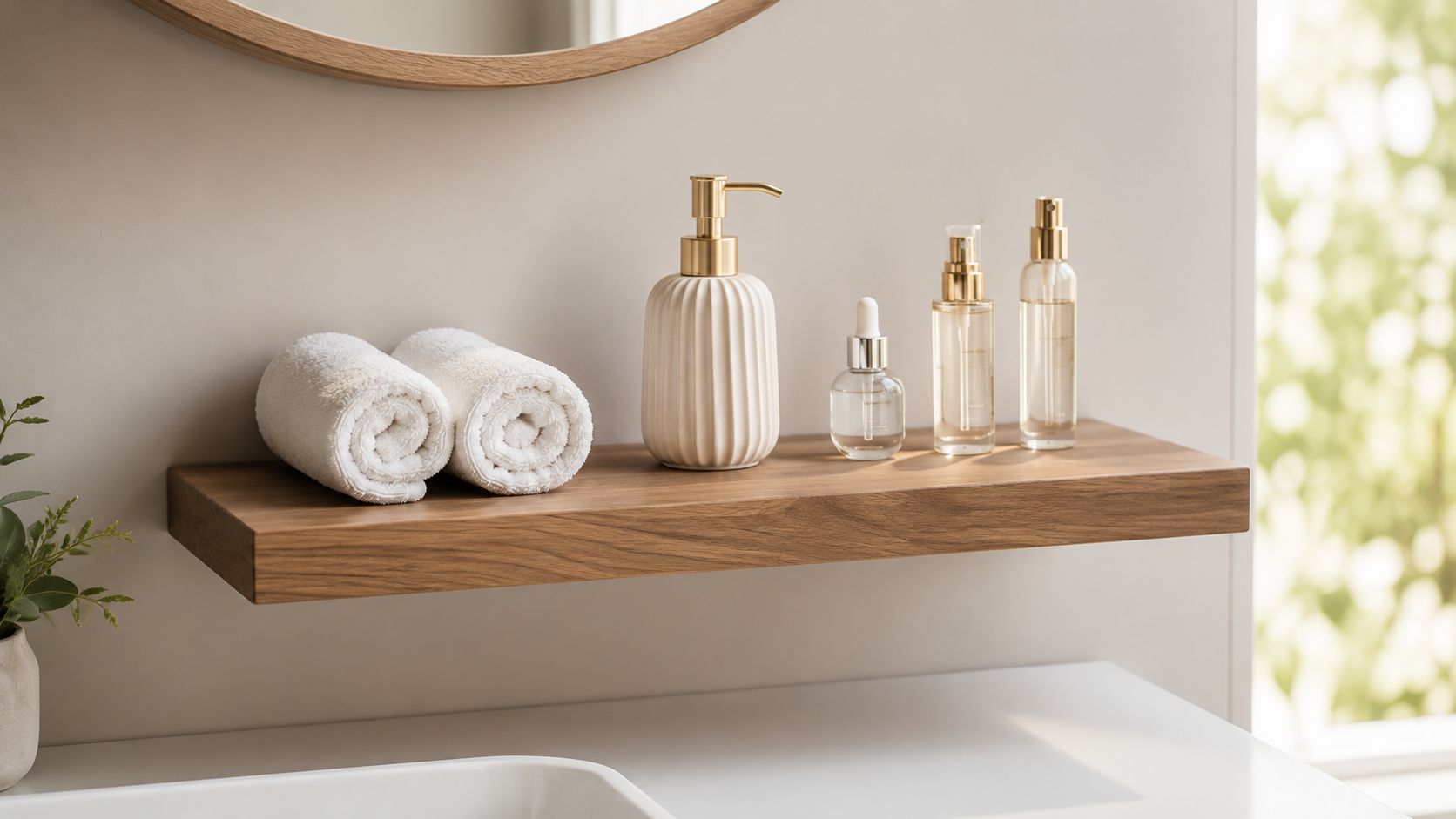
In a powder room, a pair of floating wood shelves can be enough for rolled hand towels, one handsome soap dispenser, and a discreet vessel for guest necessities. In an Easton bath, glass shelves above the vanity may hold skincare arranged by height and color so the display feels intentional rather than accidental. That distinction is what separates styled storage from clutter on a shelf.
Style less, edit more
There's a practical benchmark worth keeping in mind. Pinterest idea search data shows approximately 2,000 searches for bathroom vanity organization ideas, which tells you how often people are looking for visually pleasing solutions to a very functional problem. The strongest open-shelf arrangements answer both needs.
Use a limited palette and give each shelf one purpose. Morning essentials on one shelf, evening care on another, extra hand towels below. Install shelves high enough above the vanity to avoid splashing, and if the shelf is open, don't crowd it edge to edge.
Open display succeeds when negative space is treated as part of the composition, not wasted room.
A few details improve the result immediately:
- Group by routine: Keep products used together on the same shelf so the arrangement supports real movement.
- Anchor the composition: One darker or larger object helps the shelf feel settled.
- Keep the palette tight: Coordinated bottles, jars, and towels read cleaner than a mix of packaging styles.
- Choose shelves with restraint: A shelf should frame the objects, not visually compete with the vanity.
Jennifer Gilmer Kitchen & Bath uses open shelving best when it complements, not replaces, concealed storage. You can see that balance in this Easton bath project, where display and utility are handled with equal care.
3. Under-Sink Pull-Out Baskets and Slide-Out Storage
Under-sink storage fails when everything gets pushed to the back. Bottles disappear, backups multiply, and the space around the pipes becomes a blind spot no one wants to deal with. Pull-out baskets and slide-out storage fix that by bringing the contents forward, which is often the difference between a tidy vanity and one that gradually accumulates disorder.
A shared family bath benefits from this more than almost any other room. One pull-out can hold children's bath items, another can hold adult medications and hair tools, with categories labeled so everyone knows what belongs where. In a primary bath, a single well-planned pull-out may be enough for extra serums, beauty tools, and restock supplies that don't need to live on the counter.
Here's a useful visual reference for the mechanics of slide-out storage:
Work with the plumbing, not against it
Plumbing determines the layout. P-traps, shutoff valves, supply lines, and wiring cut into the usable box, so exact measurements come first. That's also why shallow pull-outs or split baskets often work better than one large tray.
Willow Bath and Vanity's storage guidance makes a smart point here: stackable plastic drawers are often more useful around pipes than lining products from front to back, because the latter hides items and wastes vertical space. Clear categories and labels also make it easier to notice expired products before they settle in for another year.
A few trade-offs are worth noting:
- Use lower levels for weight: Hair dryers and denser bottles belong lower for stability.
- Add interior dividers: Open baskets are convenient, but they need smaller containers inside or everything shifts.
- Reserve this zone for backup and awkward items: Daily-use pieces are usually better in a top drawer or on a controlled tray.
- Don't overspecify depth: A basket that clears the plumbing cleanly will outperform a deeper one that catches.
For cabinet planning, it helps to study practical approaches to under-sink bins and pull-out storage. The best bathroom vanity organization ideas don't fight the architecture. They adapt to it elegantly.
4. Vertical Mirrored Medicine Cabinets and Recessed Storage
A medicine cabinet is one of the most disciplined storage tools in the bathroom. It conceals visual clutter, keeps everyday items close to eye level, and gives medications, first-aid supplies, and skincare a defined home. Recessed versions are especially useful because they sit flush with the wall and preserve a cleaner profile around the vanity.

In a powder room, a slim brass-framed recessed cabinet can conceal the practical necessities guests don't need to see. In a Chevy Chase primary bath, a surface-mounted mirrored cabinet with integrated lighting may coordinate with the vanity hardware and support a more layered grooming routine. Both approaches work, but they serve different architectural conditions.
Concealed storage should still feel considered
The inside deserves as much attention as the exterior. Adjustable shelves help you fit bottles of different heights, and adhesive liners keep glass containers from sliding when doors close. Matte finishes are worth considering on the frame and nearby hardware because they tend to show less spotting and fewer fingerprints.
Keep only daily skincare and current medications in the cabinet. Backup inventory belongs elsewhere.
There's also a larger design context behind this choice. The projected bathroom vanities market growth to US$ 85.62 billion by 2035, with a 7.81% CAGR from 2026 to 2035 and 80% of renovators seeking adjustable storage modules reflects how strongly homeowners now value adaptable internal storage, not just vanity style. That aligns closely with how Jennifer Gilmer Kitchen & Bath approaches luxury bath design.
If you're evaluating the vanity as a complete system, our guide to high-end vanities for modern homes explores that relationship in more depth, and custom mirror options from AmeriGlass Industries can help when standard sizing doesn't suit the room.
5. Corner Carousels and Rotating Organizers
Corner storage can be useful, but it's rarely ideal for daily essentials. That's exactly why rotating organizers earn their place. A carousel lets you use the deep back portion of a corner cabinet without kneeling down and reaching blindly for something that's rolled out of sight.
In a shared family bath, a two-tier organizer works well when one level is assigned to children's products and the other to adult backups. In a Maryland primary bath, it might hold specialty serums, treatment masks, or eye creams that come out in the evening but don't need prime real estate in the main drawer. This is a support player, not the star of the vanity.
Use rotation for the things you don't reach for every morning
A carousel is only as good as what you ask it to hold. Lightweight items in grouped bins tend to stay upright and visible. Heavy, tall bottles can make the turn feel awkward and unstable unless they're placed low and arranged carefully.
The larger market also points toward more intentional internal storage. Strategic Market Research reports projected global bathroom vanities growth in the 6.8% to 7.4% CAGR range, with the market reaching USD 88.0 billion by 2033 and strong demand for built-in organizers, vertical dividers, and deep-drawer systems. That preference makes sense. Homeowners want vanities that do more than house a sink.
Keep these guidelines in mind:
- Assign by frequency: Reserve the carousel for weekly or specialty items, not the things you grab half-asleep every morning.
- Separate by user: In a busy household, each tier can belong to one person or one routine.
- Contain smaller pieces: Little bins prevent products from sliding during rotation.
- Maintain the mechanism: If the turntable starts dragging, a quick adjustment or appropriate lubricant keeps it useful.
The trade-off is simple. Carousels maximize awkward corners, but they won't replace a well-planned drawer. Use them for secondary storage and they work beautifully.
6. Clear Glass or Acrylic Containers with Labels
Some storage looks organized only when the cabinet is closed. Clear containers do better than that. They show what you have, how much is left, and whether a category has begun to sprawl. That visibility cuts down on duplicate purchases and makes even utilitarian supplies feel more considered.
A glass shelf with matching jars for cotton rounds, swabs, and remover pads can read almost like decor if the proportions are right. Inside an under-sink drawer, acrylic bins labeled for hair accessories, nail care, and first-aid supplies keep the practical side of the vanity from collapsing into one mixed category. This is one of the simplest bathroom vanity organization ideas, and it works in nearly every style.
Uniformity matters as much as visibility
The container itself influences the look of the whole bathroom. The Spruce's organization guidance points to wire baskets or neutral colors such as black, white, and brown for a more uniform appearance, and that advice holds up. Mismatched plastics may solve a storage problem, but they rarely solve the visual one.
Measure first, then buy in sets where possible. Consistent heights, repeated materials, and waterproof labels create a cleaner impression than a mix of jars collected over time with no common language.
A labeled bin is less about labeling the object than labeling the habit. It tells everyone in the room where the item returns.
A few practical notes make the system more durable:
- Keep medications in original packaging: Clear bins can hold them, but instructions should stay with the product.
- Choose sealed lids when humidity is a concern: Cotton goods and backup supplies stay cleaner.
- Refresh labels as routines change: Static labels on changing categories create quiet confusion.
- Match material to placement: Glass is elegant on open shelves. Acrylic is often safer inside busy drawers.
Jennifer Gilmer Kitchen & Bath often uses this approach to bridge beauty and maintenance. Clients appreciate that they can see their inventory without sacrificing order.
7. Multi-Functional Vanity Trolleys and Mobile Carts
Not every bathroom has generous cabinetry, and not every household wants to renovate immediately. A well-chosen trolley or mobile cart can solve that gap with surprising grace. It adds storage where there's dead space beside a vanity or near a corner, and it can disappear when guests arrive.
This is especially valuable in smaller homes, apartments, and secondary baths. A wood cart in a powder room may hold extra hand soap, guest towels, and toilet paper. In a primary ensuite, a wheeled cart can corral hair tools and styling products, then roll aside when the room needs to feel quieter.
A graceful solution when cabinetry is limited
Renter-friendly storage is often underserved, even though one source notes that over 40% of urban homeowners and nearly 50% of millennials are renters who may not be able to install permanent fixtures or modify cabinetry. That makes freestanding, stackable, and adhesive-based options more relevant than many design articles admit.
The cart works best when it looks intentional. Choose a finish that relates to the vanity, whether that means warm wood, painted metal, or a quieter neutral. Then treat each shelf with discipline so the cart doesn't become a catchall on wheels.
Useful rules for mobile storage:
- Dedicate tiers by function: Daily items on top, backup inventory below, occasional-use tools on the bottom.
- Use matching bins inside the cart: Movement is easier when small items are contained.
- Protect circulation: The cart shouldn't block cabinet doors, drawers, or the bathroom door swing.
- Choose locking wheels: A cart that drifts feels temporary in the wrong way.
This is one of the few storage solutions that can adapt as life changes. For clients testing a routine before committing to built-in cabinetry, that flexibility can be very helpful.
8. Vertical Wall-Mounted Rods, Hooks, and Pegboards
When the vanity feels full, look up. Vertical storage often solves what horizontal storage can't. Hooks, rods, and pegboards free drawers for smaller essentials while giving towels, robes, hair tools, and children's items a place that's visible and easy to maintain.
A brass rod above the vanity can hold rolled hand towels and a hanging basket in a neat way. In a family bath, a compact pegboard beside the mirror can support toothbrush holders, grooming tools, and hair accessories without asking the drawer to do everything. The key is assigning each mounted element a specific role.
Assign every hanging element a purpose
Placement matters. Test locations with painter's tape before installation so rods clear mirrors and splashing zones. For shared bathrooms, personal assignment matters just as much as physical placement. Lowe's inspiration content references a shared-bath challenge and notes data from the National Association of Home Builders showing 35% of new homes are built with 3+ bedrooms, which helps explain why multi-user bathroom systems deserve more thought than they usually get.
Other mechanics are straightforward but important. Kelley Nan's vanity organizing ideas highlight the value of using the back of cabinet doors for hooks or organizers, which expands storage without taking floor space. And for larger bath zones, a practical community tip still applies: install hooks on the wall or back of the door for towels and robes, and use drawer organizers for smaller items.
If more than one person uses the room, naming the storage often works better than simply categorizing it.
A few final details improve the result:
- Coordinate finishes: Hooks and rods should relate to faucet and hardware finishes.
- Manage cords: Adhesive cord clips keep hot tools safer and neater.
- Use proper anchors: Vertical storage only feels elegant when it's secure.
- Choose shelves with a retaining edge when needed: A front lip or rod helps keep items from falling, as suggested in this bathroom organization discussion.
8-Way Bathroom Vanity Organization Comparison
| Item | 🔄 Implementation complexity | ⚡ Resource requirements | 📊 Expected outcomes | Ideal use cases | ⭐ Key advantages |
|---|---|---|---|---|---|
| Drawer Dividers, Tiered Inserts, and Makeup Organizers | Moderate, accurate measuring; simple DIY or install | Low–Medium, organizers in wood/acrylic; no electrical/plumbing | High visibility and reachability; less breakage | Vanity drawers; daily makeup users; shared bathrooms | Customizable compartments; maximizes drawer space; prevents damage |
| Wall-Mounted Shelving and Open Display | Moderate, mounting and aesthetic curation required | Low–Medium, shelves, anchors, styling items | Increases perceived space; immediate access; needs upkeep | Small bathrooms, design-forward displays, weekly-use items | Creates openness; showcases curated items; easy to access |
| Under-Sink Pull-Out Baskets and Slide-Out Storage | High, plumbing coordination; precise install often pro | Medium–High, slides, soft-close hardware, possible pro labor | Excellent access to deep space; reduces reaching and clutter | Under-sink cabinets with plumbing; family bathrooms; backup storage | Reclaims hard-to-access space; organized pull-out access |
| Vertical Mirrored Medicine Cabinets and Recessed Storage | High, recessed framing and possible electrical for LEDs | Medium–High, cabinet unit, install, optional lighting | Concealed, climate-buffered storage; improved grooming light | Need for hidden storage, limited wall space, integrated lighting | Hides clutter; protects sensitive items; adds integrated lighting |
| Corner Carousels and Rotating Organizers | Medium, retrofit or specify in cabinetry; depth required | Low–Medium, rotating hardware; tiered trays | Makes corner space usable; brings back items forward | Corner cabinets ≥24" deep; backup or less‑frequent items | Maximizes corner capacity; smooth front-access rotation |
| Clear Glass or Acrylic Containers with Labels | Low, purchase, decant, and label | Low–Medium, containers, airtight lids, labeling system | High visibility; reduces duplicates; polished appearance | Open shelves, drawers, and inventory management | Transparent storage; cohesive look; protects from dust |
| Multi-Functional Vanity Trolleys and Mobile Carts | Low, assembly and placement; wheel selection matters | Low–Medium, cart purchase; floor space and quality casters | Flexible, movable storage; can be hidden when needed | Small bathrooms, rentals, seasonal or mobile needs | Portable and reconfigurable; hides clutter by rolling away |
| Vertical Wall-Mounted Rods, Hooks, and Pegboards | Moderate, secure mounting and layout planning | Low, hooks/rods/pegboards and anchors; adhesive options | Frees drawers; keeps tools visible and accessible | Hanging hair tools, towels, frequently used items | Optimizes vertical space; allows cooling/drying; highly adaptable |
From Ideas to Installation: Creating Your Organized Sanctuary
The best bathroom vanity organization ideas aren't decorative add-ons. They're part of the architecture of daily life. A drawer divider changes the feel of a morning routine. A recessed medicine cabinet keeps surfaces quieter. A pull-out beneath the sink prevents the slow return of clutter because the storage works with the room's constraints.
That principle matters even more as homeowners invest more thoughtfully in bath spaces. The Freedonia Group projects bathroom organization product sales to grow at an annual rate of 1.5% through 2025, reaching $298 million, reflecting sustained demand for functional storage solutions and a strong preference for using vertical space well. The interest is easy to understand. Bathrooms ask a great deal of very little square footage.
Still, products alone rarely create lasting order. What works is a system shaped around your habits, your inventory, and your tolerance for maintenance. Open shelving is beautiful if you're willing to curate it. Clear bins are helpful if categories stay current. Mobile carts are excellent in the right room, but built-in storage often feels calmer when a bathroom supports multiple users every day.
A full design process significantly alters the outcome. Jennifer Gilmer Kitchen & Bath approaches organization as part of the room's overall composition, not an afterthought added after installation. Designers such as Nancy McCarren, AIA, LEED AP, look at circulation, cabinet proportions, plumbing constraints, storage hierarchy, material selection, and daily rituals together, from concept through installation. That integrated approach is what allows a vanity to feel both polished and intuitive.
For homeowners in Washington DC, Maryland, and Virginia, the most successful bathroom is rarely the one with the most containers. It's the one with the clearest logic. Every item has a home. The countertop stays useful. The drawers open to exactly what you need. The room supports the pace of the day instead of resisting it.
If you're planning a renovation or trying to understand what better vanity storage could look like, visiting a showroom is often the clearest next step. Jennifer Gilmer Kitchen & Bath welcomes clients to Chevy Chase, Easton, and Ashburn to explore cabinetry, hardware, materials, and storage details in person. Seeing these ideas translated into finished spaces makes it much easier to decide which solutions belong in your own bathroom, and which ones don't.
Jennifer Gilmer Kitchen & Bath creates refined, highly functional bathrooms for homeowners throughout Washington, DC, Maryland, Virginia, and Delaware. If you're ready to bring these storage ideas into a space designed around the way you live, visit Jennifer Gilmer Kitchen & Bath to schedule a consultation and explore a project process that carries your bathroom from concept through installation.