<p>A rushed weekday morning reveals what bathroom cabinetry really does. One drawer opens cleanly and keeps daily items in reach. Another forces you to shuffle products across the counter, crowd the sink, and start the day irritated. Cabinet style shapes that experience just as much as it shapes the room&#39;s appearance.</p><p>In well-designed bathrooms, cabinetry sets the architecture at eye level. It establishes proportion, controls visual noise, and determines whether the room feels crisp, quiet, precise, or heavily detailed. I advise clients to treat style selection as an early planning decision, not a decorative finish choice, because door profile, drawer configuration, depth, and hardware all affect how the room functions over time.</p><p>At Jennifer Gilmer Kitchen &amp; Bath, we guide clients across Washington DC, Maryland, and Virginia through those trade-offs with equal attention to craftsmanship and daily routine. A family bath may need forgiving finishes, wide drawers, and a style that can handle visual activity without looking busy. A primary bath often benefits from stronger symmetry, calmer lines, and storage that supports a more deliberate routine. If you are weighing premium options, this guide to <a href="https://www.gilmerkitchens.com/blog/high-end-vanities-a-guide-to-luxury-bathroom-vanities-for-modern-homes">luxury bathroom vanities for modern homes</a> offers a useful starting point for understanding what separates a well-made vanity from one that only photographs well.</p><p>The styles below are popular for good reason. The right choice is the one that supports your habits, suits the architecture of the home, and still feels appropriate years after the renovation is complete.</p><h2>Table of Contents</h2><ul><li><a href="#why-it-works">Why it works</a></li></ul></li><ul><li><a href="#where-transitional-earns-its-keep">Where transitional earns its keep</a></li></ul></li><ul><li><a href="#where-craftsmanship-shows">Where craftsmanship shows</a></li></ul></li><ul><li><a href="#why-shaker-lasts">Why Shaker lasts</a></li></ul></li><ul><li><a href="#designing-for-calm">Designing for calm</a></li></ul></li><ul><li><a href="#how-to-keep-it-collected-not-cluttered">How to keep it collected, not cluttered</a></li></ul></li><ul><li><a href="#the-trade-offs-to-understand">The trade-offs to understand</a></li></ul></li><ul><li><a href="#how-to-keep-it-refined">How to keep it refined</a></li></ul></li><li><a href="#bathroom-cabinet-styles-8-style-comparison">Bathroom Cabinet Styles: 8-Style Comparison</a></li><li><a href="#begin-your-design-journey-with-a-trusted-partner">Begin Your Design Journey with a Trusted Partner</a></li><p><a id="1-modern-minimalist"></a></p><h2>1. Modern Minimalist</h2><p>Modern minimalist cabinetry asks every line to work harder. The profile is quiet, the surfaces are restrained, and the success of the room depends on proportion, finish quality, and disciplined storage planning rather than ornament. In a townhome primary bath or a compact powder room, that restraint can make the room feel composed instead of crowded.</p><p>Floating cabinets are especially relevant here. They&#39;re identified as the dominant style for 2025 and are often recommended for smaller bathrooms because the open floor area creates a lighter visual read, as noted in <a href="https://www.kavalancabinetry.com/top-bathroom-cabinet-trends-for-2025-styles-that-transform-your-space/">2025 bathroom cabinet trend guidance</a>.</p><p><img src="https://cdnimg.co/b78da3ac-486c-4ba2-8b92-e65823313a9e/caf7b194-9eec-44bd-bd13-a04f98fdbe38/bathroom-cabinet-styles-floating-vanity.jpg" alt="A modern, minimalist floating bathroom vanity with white cabinets, a shelf for towels, and a sleek mirror."></p><p><a id="why-it-works"></a></p><h3>Why it works</h3><p>Flat fronts, integrated pulls, and push-latch doors keep visual noise low. What matters then is warmth. White oak, warm gray lacquer, matte finishes, and a stone top with subtle movement can keep minimalism from feeling clinical.</p><p>This is also the style where poor planning shows immediately. A beautiful slab-front vanity with no dedicated drawer insert for grooming tools, cosmetics, or electric items starts to look untidy within days. Minimalist rooms need interiors that are more considered than the exterior suggests.</p><blockquote><p><strong>Practical rule:</strong> The simpler the cabinet front, the more carefully the cabinet interior should be planned.</p></blockquote><p>A few details make the difference:</p><ul><li><strong>Choose warmth first:</strong> Natural wood tones and soft mineral paint colors usually age better than stark white.</li><li><strong>Control reflection:</strong> Matte and low-sheen finishes tend to feel more refined in everyday use.</li><li><strong>Light the face evenly:</strong> Flat cabinets look best with layered light, not a single harsh overhead fixture.</li></ul><p>For homeowners drawn to a clean-lined bath with high-quality materials, Jennifer Gilmer Kitchen &amp; Bath often treats the vanity as custom furniture rather than a generic box. Their perspective on <a href="https://www.gilmerkitchens.com/blog/high-end-vanities-a-guide-to-luxury-bathroom-vanities-for-modern-homes">luxury bathroom vanities for modern homes</a> is useful if you want minimalism with depth, not just less detail.</p><p><a id="2-transitional"></a></p><h2>2. Transitional</h2><p>Transitional style is often the most useful choice in the Mid-Atlantic because so many homes sit between eras. A Colonial revival may call for some architectural softness, while the homeowners still want easier maintenance, simpler lines, and updated lighting. Transitional cabinetry holds that middle ground gracefully.</p><p>The style usually relies on modest panel definition, carefully selected hardware, and a finish palette that doesn&#39;t fight the architecture. In Washington DC, Maryland, and Virginia, this approach works particularly well when an older home needs a fresh bathroom that still feels consistent with the rest of the house.</p><p><a id="where-transitional-earns-its-keep"></a></p><h3>Where transitional earns its keep</h3><p>A well-done transitional vanity doesn&#39;t chase a trend. It supports a broad range of materials. Carrara marble, satin nickel, pale oak, painted cabinetry, and classic mirrors all sit comfortably here.</p><p>This is also a forgiving category for clients who want the room to feel current without becoming too sharp or too formal. In practical terms, transitional cabinets handle family use well because they tend to include familiar drawer-and-door configurations, straightforward cleaning, and finishes that don&#39;t show every fingerprint.</p><p>Designers often advise homeowners to coordinate rather than exactly match cabinetry across adjacent rooms. The useful part of that advice is the mindset. Repeating tone, proportion, or hardware character usually creates a better whole than forcing identical profiles from kitchen to bath.</p><p>A transitional bath might include:</p><ul><li><strong>A soft painted vanity:</strong> Dove gray, mushroom, or muted cream usually carries the look well.</li><li><strong>A restrained door profile:</strong> Enough detail to give shadow and depth, not enough to feel busy.</li><li><strong>Classic hardware:</strong> Knobs and pulls should feel intentional and substantial in the hand.</li></ul><p>At Jennifer Gilmer Kitchen &amp; Bath, transitional work often succeeds because the room is studied as part of the home, not as an isolated project. That&#39;s where thoughtful space planning matters most.</p><p><a id="3-traditional-raised-panel"></a></p><h2>3. Traditional / Raised Panel</h2><p>A traditional vanity changes how a bathroom is read the moment you enter. In a home with original millwork, paneled doors, or formal trim, raised-panel cabinetry helps the bath feel rooted in the architecture instead of treated as a detached update.</p><p>This style carries visual weight, so proportion matters. The panel profile, rail width, wood species, finish color, toe kick or furniture base, and hardware all need to support the same point of view. When those elements are chosen carefully, traditional cabinetry brings order, depth, and a sense of permanence that simpler door styles do not.</p><p><a id="where-craftsmanship-shows"></a></p><h3>Where craftsmanship shows</h3><p>Raised-panel vanities need room to breathe. In a compact bath, heavy moldings and deep profiles can crowd the space and make cleaning harder around corners and feet. In a larger primary bath or a period renovation, that same detail gives the room substance and supports richer materials such as honed marble, polished nickel, and framed mirrors with real presence.</p><p>Wood also feels most at home here, whether the finish is painted or stained. As noted earlier, wood continues to shape much of the category. In practice, that tracks with what designers and cabinetmakers see every day. Clients may ask for a painted vanity, but they still want the warmth, stability, and repairability that come with well-made wood construction.</p><p>Finish selection deserves more scrutiny than many homeowners expect. Very dark, flat paint can blur the panel shape and hide the quality of the joinery. A softer painted finish, a hand-applied glaze, or a stain with enough contrast to catch light usually shows the door detail more clearly.</p><p>Traditional cabinetry performs best when its construction is visible.</p><p>Function matters just as much as appearance. A raised-panel front can look formal and still work hard, with deep drawers for daily tools, pullouts for backup supplies, and sink-base storage planned around plumbing instead of surrendered to it. Homeowners who want that classic look without giving up convenience can borrow from these <a href="https://www.gilmerkitchens.com/blog/8-expert-bathroom-vanity-organization-ideas">bathroom vanity organization ideas</a>, which help a traditional cabinet serve modern routines with far less compromise.</p><p><a id="4-shaker"></a></p><h2>4. Shaker</h2><p>Shaker style is one of the few cabinet languages that can move comfortably between a farmhouse bath, a transitional renovation, and a more refined family home. Its five-piece door has enough structure to feel crafted, but not so much detail that it dominates the room. That balance explains why it remains such a dependable choice.</p><p>A painted Shaker vanity in white, pale gray, or soft putty feels clean and familiar. In natural maple or white oak, it gains warmth and a more furniture-like presence. Because the door style is disciplined, the finish quality becomes highly visible.</p><p><a id="why-shaker-lasts"></a></p><h3>Why Shaker lasts</h3><p>Shaker works best when the rest of the room carries some of the decorative weight. A terrazzo top, hand-formed tile, aged brass hardware, or a framed mirror can give the bath personality without asking the cabinetry to do all the talking.</p><p>This is also a smart style for homeowners who want broad resale appeal while still making thoughtful design decisions. It doesn&#39;t read as starkly contemporary, and it doesn&#39;t rely on overt nostalgia either. That flexibility makes it particularly useful when the bath needs to relate to several adjoining spaces.</p><p>A few choices keep Shaker from feeling ordinary:</p><ul><li><strong>Use a strong countertop:</strong> Simple cabinet fronts benefit from a surface with texture or subtle movement.</li><li><strong>Select better hardware than you think you need:</strong> On quiet doors, hardware carries more visual importance.</li><li><strong>Watch the rail widths:</strong> The proportions of the Shaker frame matter. Too wide, and it starts to feel heavy.</li></ul><p>At Jennifer Gilmer Kitchen &amp; Bath, designers such as Jennifer Gilmer, CKD, and Marie-Josée Parisi often focus on these proportional subtleties because they determine whether Shaker feels custom or commonplace.</p><p><a id="5-spa-wellness-inspired"></a></p><h2>5. Spa / Wellness-Inspired</h2><p>Spa-oriented bathroom cabinet styles are less about a single door profile and more about the atmosphere the cabinetry helps create. The room should feel quiet, tactile, and easy to maintain. Cabinets in warm oak, pale gray, or soft white often work best because they recede enough to let texture, lighting, and natural materials shape the mood.</p><p>The broader market is moving in that direction. Bathroom furniture design has shifted toward organic textures and minimalist silhouettes associated with Japandi and modern Mediterranean aesthetics, and the global bathroom furniture market was estimated at USD 136.20 billion in 2024 and projected to reach USD 195.27 billion by 2030, according to <a href="https://www.linkedin.com/pulse/top-10-bathroom-vanities-market-share-company-ai-world-trends-k5ecf">bathroom furniture trend reporting</a>.</p><p><img src="https://cdnimg.co/b78da3ac-486c-4ba2-8b92-e65823313a9e/2785c414-aef6-435e-9ac9-a0c264b50264/bathroom-cabinet-styles-modern-vanity.jpg" alt="A modern luxury bathroom featuring wooden cabinetry, a white vessel sink, and ambient under-cabinet lighting."></p><p><a id="designing-for-calm"></a></p><h3>Designing for calm</h3><p>A spa bath needs concealed storage. Bottles on every surface, visible cords, and overfilled drawers work against the point of the room. Quiet-close hardware, integrated outlets, and dedicated zones for skincare, towels, and daily tools make the space feel settled.</p><p>Counter height matters here too. Counter-height vanities at 36 inches are an important ergonomic consideration, especially for adults who use the space every day, as discussed in <a href="https://www.instagram.com/reel/DOoWdxMDj6F/">guidance on vanity height and coordination</a>. A wellness space shouldn&#39;t ask you to stoop every morning.</p><p>For a sense of how calm and material richness can come together, the <a href="https://www.gilmerkitchens.com/project/easton-bath">Easton bath project by Jennifer Gilmer Kitchen &amp; Bath</a> shows how cabinetry, lighting, and architectural restraint can support a more restorative room.</p><p>A short visual look at spa-oriented thinking can help:</p><div class="w-richtext"><div class="w-embed w-iframe"><iframe width="100%" style="aspect-ratio: 16 / 9;" src="https://www.youtube.com/embed/vhy4SFEEw0Q" frameborder="0" allow="autoplay; encrypted-media" allowfullscreen></iframe></div></div><p>The practical side matters as much as the mood.</p><ul><li><strong>Hide daily clutter:</strong> Plan where every bottle, towel, and tool will live before finalizing the cabinet configuration.</li><li><strong>Favor tactile finishes:</strong> Matte wood, honed stone, and softly brushed metals tend to feel calmer than glossy surfaces.</li><li><strong>Keep operation quiet:</strong> Drawers and doors should open smoothly and close softly.</li></ul><p><a id="6-cottage-farmhouse"></a></p><h2>6. Cottage / Farmhouse</h2><p>Cottage and farmhouse cabinetry offers comfort first. Painted finishes, beadboard references, open shelves, and collected hardware can make a bath feel relaxed and personal in a way that more formal styles often don&#39;t. The best versions feel edited, not theatrical.</p><p>This style works especially well in older houses, weekend homes, and family baths where a little softness makes the room more inviting. Cream, muted blue, sage, and warm white are common choices because they support the informal character without making the space feel overly themed.</p><p><img src="https://cdnimg.co/b78da3ac-486c-4ba2-8b92-e65823313a9e/013ac83d-508c-4d1f-8609-34614fd3c8a7/bathroom-cabinet-styles-rustic-vanity.jpg" alt="A rustic cream-colored bathroom vanity cabinet with a wooden countertop in a sunlit vintage-style bathroom interior."></p><p><a id="how-to-keep-it-collected-not-cluttered"></a></p><h3>How to keep it collected, not cluttered</h3><p>The challenge with farmhouse baths is restraint. Open shelving can quickly become visible storage overflow. A few folded linens, a ceramic vessel, or a woven basket can be charming. Too much, and the room loses clarity.</p><p>That&#39;s why closed storage still matters. A cottage vanity should look easygoing, but it still needs to work hard. Drawers for grooming supplies and concealed storage for extra toiletries keep the charm from becoming maintenance.</p><blockquote><p>Open shelving should display what you want to see every day, not what you have nowhere else to put.</p></blockquote><p>This style tends to look strongest when there&#39;s some contrast in the room:</p><ul><li><strong>Pair paint with texture:</strong> Soapstone-look surfaces, aged brass, and simple tile add depth.</li><li><strong>Mix old and new carefully:</strong> Vintage mirrors and collected hardware work best when the scale is controlled.</li><li><strong>Avoid heavy distressing:</strong> Gentle wear reads as believable. Aggressive faux aging usually doesn&#39;t.</li></ul><p>Nancy McCarren, AIA, LEED AP, often brings this kind of balance to period-sensitive spaces. The room can feel relaxed without giving up good proportion or thoughtful planning.</p><p><a id="7-contemporary-flat-panel"></a></p><h2>7. Contemporary / Flat Panel</h2><p>Contemporary flat-panel cabinetry is sharper and more graphic than modern minimalist work. The doors are completely smooth, the geometry is crisp, and the material choices can push further into charcoal, matte black, lacquer, rift oak, or mixed finishes. This is a style for clients who want the bathroom to feel current and architecturally deliberate.</p><p>It&#39;s also one of the clearest examples of cabinet style affecting daily function. Existing vanity advice often catalogs forms such as freestanding or floating but doesn&#39;t help homeowners connect cabinet interiors to real routines. The gap is especially noticeable when storage pain points involve makeup, backup supplies, wet towels, or hair tools, as outlined in <a href="https://blog.litchfieldbuilders.com/common-bathroom-vanity-problems">this discussion of common vanity problems</a>.</p><p><a id="the-trade-offs-to-understand"></a></p><h3>The trade-offs to understand</h3><p>Flat-panel cabinetry shows fingerprints, alignment issues, and cheap hardware quickly. If the reveals are inconsistent or the finish isn&#39;t durable, the room can feel less polished than intended. This style leaves no decorative detail to soften mistakes.</p><p>It does, however, give you enormous freedom with configuration. Long drawers, integrated medicine cabinets, lighting within mirrors, and wall-hung compositions all pair naturally with flat fronts. Mirrored cabinets are also expected to lead the market by type in the years ahead, which reinforces the appeal of integrated storage in contemporary baths, as noted earlier.</p><p>The configuration should reflect use, not just symmetry.</p><ul><li><strong>Use drawers for categories:</strong> Deep lower drawers and shallow upper drawers usually outperform door-only bases.</li><li><strong>Think about grooming zones:</strong> Electrical access and divider inserts matter more in contemporary layouts.</li><li><strong>Be realistic about finish maintenance:</strong> High-gloss lacquer can brighten a room, but it asks for regular wiping.</li></ul><p>The most successful contemporary baths feel intentional from cabinet face to drawer insert. Without that full consideration, the style can look sleek in photographs and frustrating in daily life.</p><p><a id="8-industrial-modern-rustic"></a></p><h2>8. Industrial / Modern Rustic</h2><p>Industrial and modern rustic cabinet styles appeal to homeowners who want more material presence. Reclaimed wood, blackened steel, exposed brackets, concrete-look counters, and visible grain create a bathroom that feels grounded and architectural. It can be a compelling direction in lofts, renovated farmhouses, and newer homes that need a little roughness to avoid feeling overfinished.</p><p>This style is strongest when it balances honesty with refinement. A heavy timber vanity under a sleek mirror. A metal frame paired with warm lighting. A concrete surface next to soft towels and quiet plumbing fixtures. That tension keeps the room from becoming overly themed.</p><p><a id="how-to-keep-it-refined"></a></p><h3>How to keep it refined</h3><p>Moisture protection is the first issue. Raw wood and porous surfaces need proper sealing, especially around sinks and splash zones. What looks appealing in a dry showroom vignette may fail quickly in a busy family bath if the details aren&#39;t specified carefully.</p><p>Customization also matters here because industrial and rustic forms rarely follow standard storage logic well. The broader vanity market is projected to rise from US$43.15 billion in 2025 to US$85.62 billion by 2035, and within that projection, 60% of homeowners are interested in double-vanity setups while 80% prioritize customizable storage solutions, according to <a href="https://finance.yahoo.com/news/bathroom-vanities-market-projected-reach-123000712.html">bathroom vanities market projections and homeowner preferences</a>. That combination makes sense. Strong style still has to serve shared routines and practical organization.</p><blockquote><p>Raw materials belong in a bathroom only when the detailing is disciplined.</p></blockquote><p>A few principles keep industrial work usable:</p><ul><li><strong>Seal every vulnerable surface:</strong> Wood, concrete, and open metal finishes need bathroom-specific protection.</li><li><strong>Mix in softness:</strong> Mirrors, textiles, and lighting should temper the harder cabinet materials.</li><li><strong>Keep some storage closed:</strong> Industrial rooms need discipline, or they start to look improvised.</li></ul><p><a id="bathroom-cabinet-styles-8-style-comparison"></a></p><h2>Bathroom Cabinet Styles: 8-Style Comparison</h2><div style="overflow-x:auto;-webkit-overflow-scrolling:touch;width:100%;"><table style="min-width:600px;width:100%;border-collapse:collapse;margin-bottom:20px;"><thead><tr><th style="border:1px solid #ddd;padding:8px;text-align:left;background-color:#f2f2f2;white-space:nowrap;">Style</th><th align="right" style="border:1px solid #ddd;padding:8px;text-align:left;background-color:#f2f2f2;white-space:nowrap;">🔄 Implementation Complexity</th><th align="right" style="border:1px solid #ddd;padding:8px;text-align:left;background-color:#f2f2f2;white-space:nowrap;">⚡ Resource Requirements</th><th style="border:1px solid #ddd;padding:8px;text-align:left;background-color:#f2f2f2;white-space:nowrap;">⭐ Expected Outcomes</th><th style="border:1px solid #ddd;padding:8px;text-align:left;background-color:#f2f2f2;white-space:nowrap;">📊 Ideal Use Cases</th><th style="border:1px solid #ddd;padding:8px;text-align:left;background-color:#f2f2f2;white-space:nowrap;">💡 Key Advantages</th></tr></thead><tbody><tr><td style="border:1px solid #ddd;padding:8px;text-align:left;">Modern Minimalist</td><td align="right" style="border:1px solid #ddd;padding:8px;text-align:left;">Medium, requires precise installation and integrated hardware</td><td align="right" style="border:1px solid #ddd;padding:8px;text-align:left;">Medium, quality finishes, concealed hardware</td><td style="border:1px solid #ddd;padding:8px;text-align:left;">⭐⭐⭐⭐, Clean, spacious, timeless</td><td style="border:1px solid #ddd;padding:8px;text-align:left;">Small or contemporary homes, urban condos</td><td style="border:1px solid #ddd;padding:8px;text-align:left;">Easy maintenance; timeless look; pairs with modern fixtures</td></tr><tr><td style="border:1px solid #ddd;padding:8px;text-align:left;">Transitional</td><td align="right" style="border:1px solid #ddd;padding:8px;text-align:left;">Medium, balances subtle detailing with modern restraint</td><td align="right" style="border:1px solid #ddd;padding:8px;text-align:left;">Medium, quality hardware and finishes without excess</td><td style="border:1px solid #ddd;padding:8px;text-align:left;">⭐⭐⭐⭐, Versatile, balanced, broadly appealing</td><td style="border:1px solid #ddd;padding:8px;text-align:left;">Homes blending period architecture with updated interiors</td><td style="border:1px solid #ddd;padding:8px;text-align:left;">Broad appeal; adaptable to many rooms; approachable elegance</td></tr><tr><td style="border:1px solid #ddd;padding:8px;text-align:left;">Traditional / Raised Panel</td><td align="right" style="border:1px solid #ddd;padding:8px;text-align:left;">High, detailed joinery, moldings and finish work</td><td align="right" style="border:1px solid #ddd;padding:8px;text-align:left;">High, premium woods, custom millwork, ornate hardware</td><td style="border:1px solid #ddd;padding:8px;text-align:left;">⭐⭐⭐⭐⭐, Rich, crafted, timeless</td><td style="border:1px solid #ddd;padding:8px;text-align:left;">Historic homes, formal primary baths</td><td style="border:1px solid #ddd;padding:8px;text-align:left;">Strong craftsmanship; deep visual texture; enduring value</td></tr><tr><td style="border:1px solid #ddd;padding:8px;text-align:left;">Shaker</td><td align="right" style="border:1px solid #ddd;padding:8px;text-align:left;">Low–Medium, straightforward construction but finish-sensitive</td><td align="right" style="border:1px solid #ddd;padding:8px;text-align:left;">Medium, good materials and finish quality required</td><td style="border:1px solid #ddd;padding:8px;text-align:left;">⭐⭐⭐⭐, Simple, durable, timeless</td><td style="border:1px solid #ddd;padding:8px;text-align:left;">Farmhouse, transitional, versatile remodels</td><td style="border:1px solid #ddd;padding:8px;text-align:left;">Versatile across styles; easy to maintain; scalable cost</td></tr><tr><td style="border:1px solid #ddd;padding:8px;text-align:left;">Spa / Wellness-Inspired</td><td align="right" style="border:1px solid #ddd;padding:8px;text-align:left;">Medium–High, integrated lighting/storage and material coordination</td><td align="right" style="border:1px solid #ddd;padding:8px;text-align:left;">High, natural materials, specialty fixtures, spa amenities</td><td style="border:1px solid #ddd;padding:8px;text-align:left;">⭐⭐⭐⭐, Calm, restorative, high-end retreat</td><td style="border:1px solid #ddd;padding:8px;text-align:left;">Primary baths, luxury renovations, wellness-focused homes</td><td style="border:1px solid #ddd;padding:8px;text-align:left;">Promotes wellbeing; natural aging of materials; luxurious feel</td></tr><tr><td style="border:1px solid #ddd;padding:8px;text-align:left;">Cottage / Farmhouse</td><td align="right" style="border:1px solid #ddd;padding:8px;text-align:left;">Low–Medium, painted finishes, open shelving, casual detailing</td><td align="right" style="border:1px solid #ddd;padding:8px;text-align:left;">Low–Medium, painted cabinetry, vintage or mixed hardware</td><td style="border:1px solid #ddd;padding:8px;text-align:left;">⭐⭐⭐, Warm, lived-in, approachable</td><td style="border:1px solid #ddd;padding:8px;text-align:left;">Country homes, cozy powder rooms, casual family baths</td><td style="border:1px solid #ddd;padding:8px;text-align:left;">Warm and forgiving; budget-friendly options; personal character</td></tr><tr><td style="border:1px solid #ddd;padding:8px;text-align:left;">Contemporary / Flat Panel</td><td align="right" style="border:1px solid #ddd;padding:8px;text-align:left;">High, requires precision fabrication and flawless installation</td><td align="right" style="border:1px solid #ddd;padding:8px;text-align:left;">Medium–High, specialty laminates/finishes, integrated tech</td><td style="border:1px solid #ddd;padding:8px;text-align:left;">⭐⭐⭐⭐, Bold, sleek, modern statement</td><td style="border:1px solid #ddd;padding:8px;text-align:left;">New builds, design-forward renovations, modern townhomes</td><td style="border:1px solid #ddd;padding:8px;text-align:left;">Strong visual impact; easy-to-clean surfaces; finish flexibility</td></tr><tr><td style="border:1px solid #ddd;padding:8px;text-align:left;">Industrial / Modern Rustic</td><td align="right" style="border:1px solid #ddd;padding:8px;text-align:left;">High, sourcing and integrating raw materials; moisture protection</td><td align="right" style="border:1px solid #ddd;padding:8px;text-align:left;">High, reclaimed wood, metalwork, sealing and custom fabrication</td><td style="border:1px solid #ddd;padding:8px;text-align:left;">⭐⭐⭐, Distinctive, material-forward, character-rich</td><td style="border:1px solid #ddd;padding:8px;text-align:left;">Lofts, converted industrial spaces, bespoke custom projects</td><td style="border:1px solid #ddd;padding:8px;text-align:left;">Unique, authentic materials; ages well; highlights craftsmanship</td></tr></tbody></table></div><p><a id="begin-your-design-journey-with-a-trusted-partner"></a></p><h2>Begin Your Design Journey with a Trusted Partner</h2><p>Choosing among bathroom cabinet styles is often the moment a renovation becomes real. Once the cabinet language is clear, other decisions begin to fall into place. Tile has context. Hardware gains direction. Lighting can be configured for the way the vanity will be used. More important, the bathroom starts to reflect the routines and preferences of the people who live there, rather than a generic mood board.</p><p>That&#39;s where a thoughtful design process matters. A bathroom cabinet isn&#39;t only a finish decision. It shapes storage, ergonomics, circulation, and the room&#39;s long-term character. A floating minimalist vanity may give a smaller bath visual ease, but it also changes how cleaning happens and where towels are stored. A raised-panel cabinet may suit a historic home beautifully, but it needs the right scale and enough breathing room. A spa-oriented composition may look serene, but it only stays that way when the drawer interiors and concealed storage are planned with care.</p><p>At Jennifer Gilmer Kitchen &amp; Bath, that kind of planning is part of the work from the beginning. The firm serves homeowners throughout Washington DC, Maryland, and Virginia, and handles projects from concept through installation. That continuity is valuable. It means the cabinetry is considered alongside finishes, lighting, proportions, and how the room will be used every day. Designers such as Jennifer Gilmer, CKD, Nancy McCarren, AIA, LEED AP, and Marie-Josée Parisi understand that a well-designed bath needs both visual coherence and practical ease.</p><p>There&#39;s also real value in seeing cabinetry in person. Material tone, door profile, sheen level, and hardware scale are difficult to judge on a screen. Visiting a showroom allows homeowners to compare styles side by side, study craftsmanship closely, and have more productive conversations about what will work in their own homes. Jennifer Gilmer Kitchen &amp; Bath welcomes clients to its showrooms in Chevy Chase, Easton, and Ashburn, where those discussions can begin with real samples and informed guidance.</p><p>If your current bathroom feels unresolved, too cluttered, too formal, too plain, or not aligned with your home, the cabinet style is often the right place to start. Even homeowners exploring adjacent updates such as <a href="https://cabinetspainting.ca/">cabinet refinishing in Toronto</a> usually find that the larger question isn&#39;t only finish. It&#39;s whether the cabinetry itself expresses the right character and supports daily use.</p><p>A good bathroom should feel composed in the morning rush and quiet for relaxation. The right cabinet style helps make that possible.</p><hr><p>If you&#39;re planning a bathroom renovation in Washington DC, Maryland, or Virginia, <a href="https://gilmerkitchens.com">Jennifer Gilmer Kitchen &amp; Bath</a> offers a full-service design process that carries a project from concept and cabinetry selection through installation. A showroom visit is a practical way to compare bathroom cabinet styles, study materials firsthand, and discuss a layout that fits your home and routine.</p>

Explore 8 distinct bathroom cabinet styles, from modern minimalist to modern rustic. Find inspiration and expert tips from Jennifer Gilmer Kitchen & Bath.

8 Essential Bathroom Cabinet Styles for Your Home
<p>A rushed weekday morning reveals what bathroom cabinetry really does. One drawer opens cleanly and keeps daily items in reach. Another forces you to shuffle products across the counter, crowd the sink, and start the day irritated. Cabinet style shapes that experience just as much as it shapes the room&#39;s appearance.</p><p>In well-designed bathrooms, cabinetry sets the architecture at eye level. It establishes proportion, controls visual noise, and determines whether the room feels crisp, quiet, precise, or heavily detailed. I advise clients to treat style selection as an early planning decision, not a decorative finish choice, because door profile, drawer configuration, depth, and hardware all affect how the room functions over time.</p><p>At Jennifer Gilmer Kitchen &amp; Bath, we guide clients across Washington DC, Maryland, and Virginia through those trade-offs with equal attention to craftsmanship and daily routine. A family bath may need forgiving finishes, wide drawers, and a style that can handle visual activity without looking busy. A primary bath often benefits from stronger symmetry, calmer lines, and storage that supports a more deliberate routine. If you are weighing premium options, this guide to <a href="https://www.gilmerkitchens.com/blog/high-end-vanities-a-guide-to-luxury-bathroom-vanities-for-modern-homes">luxury bathroom vanities for modern homes</a> offers a useful starting point for understanding what separates a well-made vanity from one that only photographs well.</p><p>The styles below are popular for good reason. The right choice is the one that supports your habits, suits the architecture of the home, and still feels appropriate years after the renovation is complete.</p><h2>Table of Contents</h2><ul><li><a href="#why-it-works">Why it works</a></li></ul></li><ul><li><a href="#where-transitional-earns-its-keep">Where transitional earns its keep</a></li></ul></li><ul><li><a href="#where-craftsmanship-shows">Where craftsmanship shows</a></li></ul></li><ul><li><a href="#why-shaker-lasts">Why Shaker lasts</a></li></ul></li><ul><li><a href="#designing-for-calm">Designing for calm</a></li></ul></li><ul><li><a href="#how-to-keep-it-collected-not-cluttered">How to keep it collected, not cluttered</a></li></ul></li><ul><li><a href="#the-trade-offs-to-understand">The trade-offs to understand</a></li></ul></li><ul><li><a href="#how-to-keep-it-refined">How to keep it refined</a></li></ul></li><li><a href="#bathroom-cabinet-styles-8-style-comparison">Bathroom Cabinet Styles: 8-Style Comparison</a></li><li><a href="#begin-your-design-journey-with-a-trusted-partner">Begin Your Design Journey with a Trusted Partner</a></li><p><a id="1-modern-minimalist"></a></p><h2>1. Modern Minimalist</h2><p>Modern minimalist cabinetry asks every line to work harder. The profile is quiet, the surfaces are restrained, and the success of the room depends on proportion, finish quality, and disciplined storage planning rather than ornament. In a townhome primary bath or a compact powder room, that restraint can make the room feel composed instead of crowded.</p><p>Floating cabinets are especially relevant here. They&#39;re identified as the dominant style for 2025 and are often recommended for smaller bathrooms because the open floor area creates a lighter visual read, as noted in <a href="https://www.kavalancabinetry.com/top-bathroom-cabinet-trends-for-2025-styles-that-transform-your-space/">2025 bathroom cabinet trend guidance</a>.</p><p><img src="https://cdnimg.co/b78da3ac-486c-4ba2-8b92-e65823313a9e/caf7b194-9eec-44bd-bd13-a04f98fdbe38/bathroom-cabinet-styles-floating-vanity.jpg" alt="A modern, minimalist floating bathroom vanity with white cabinets, a shelf for towels, and a sleek mirror."></p><p><a id="why-it-works"></a></p><h3>Why it works</h3><p>Flat fronts, integrated pulls, and push-latch doors keep visual noise low. What matters then is warmth. White oak, warm gray lacquer, matte finishes, and a stone top with subtle movement can keep minimalism from feeling clinical.</p><p>This is also the style where poor planning shows immediately. A beautiful slab-front vanity with no dedicated drawer insert for grooming tools, cosmetics, or electric items starts to look untidy within days. Minimalist rooms need interiors that are more considered than the exterior suggests.</p><blockquote><p><strong>Practical rule:</strong> The simpler the cabinet front, the more carefully the cabinet interior should be planned.</p></blockquote><p>A few details make the difference:</p><ul><li><strong>Choose warmth first:</strong> Natural wood tones and soft mineral paint colors usually age better than stark white.</li><li><strong>Control reflection:</strong> Matte and low-sheen finishes tend to feel more refined in everyday use.</li><li><strong>Light the face evenly:</strong> Flat cabinets look best with layered light, not a single harsh overhead fixture.</li></ul><p>For homeowners drawn to a clean-lined bath with high-quality materials, Jennifer Gilmer Kitchen &amp; Bath often treats the vanity as custom furniture rather than a generic box. Their perspective on <a href="https://www.gilmerkitchens.com/blog/high-end-vanities-a-guide-to-luxury-bathroom-vanities-for-modern-homes">luxury bathroom vanities for modern homes</a> is useful if you want minimalism with depth, not just less detail.</p><p><a id="2-transitional"></a></p><h2>2. Transitional</h2><p>Transitional style is often the most useful choice in the Mid-Atlantic because so many homes sit between eras. A Colonial revival may call for some architectural softness, while the homeowners still want easier maintenance, simpler lines, and updated lighting. Transitional cabinetry holds that middle ground gracefully.</p><p>The style usually relies on modest panel definition, carefully selected hardware, and a finish palette that doesn&#39;t fight the architecture. In Washington DC, Maryland, and Virginia, this approach works particularly well when an older home needs a fresh bathroom that still feels consistent with the rest of the house.</p><p><a id="where-transitional-earns-its-keep"></a></p><h3>Where transitional earns its keep</h3><p>A well-done transitional vanity doesn&#39;t chase a trend. It supports a broad range of materials. Carrara marble, satin nickel, pale oak, painted cabinetry, and classic mirrors all sit comfortably here.</p><p>This is also a forgiving category for clients who want the room to feel current without becoming too sharp or too formal. In practical terms, transitional cabinets handle family use well because they tend to include familiar drawer-and-door configurations, straightforward cleaning, and finishes that don&#39;t show every fingerprint.</p><p>Designers often advise homeowners to coordinate rather than exactly match cabinetry across adjacent rooms. The useful part of that advice is the mindset. Repeating tone, proportion, or hardware character usually creates a better whole than forcing identical profiles from kitchen to bath.</p><p>A transitional bath might include:</p><ul><li><strong>A soft painted vanity:</strong> Dove gray, mushroom, or muted cream usually carries the look well.</li><li><strong>A restrained door profile:</strong> Enough detail to give shadow and depth, not enough to feel busy.</li><li><strong>Classic hardware:</strong> Knobs and pulls should feel intentional and substantial in the hand.</li></ul><p>At Jennifer Gilmer Kitchen &amp; Bath, transitional work often succeeds because the room is studied as part of the home, not as an isolated project. That&#39;s where thoughtful space planning matters most.</p><p><a id="3-traditional-raised-panel"></a></p><h2>3. Traditional / Raised Panel</h2><p>A traditional vanity changes how a bathroom is read the moment you enter. In a home with original millwork, paneled doors, or formal trim, raised-panel cabinetry helps the bath feel rooted in the architecture instead of treated as a detached update.</p><p>This style carries visual weight, so proportion matters. The panel profile, rail width, wood species, finish color, toe kick or furniture base, and hardware all need to support the same point of view. When those elements are chosen carefully, traditional cabinetry brings order, depth, and a sense of permanence that simpler door styles do not.</p><p><a id="where-craftsmanship-shows"></a></p><h3>Where craftsmanship shows</h3><p>Raised-panel vanities need room to breathe. In a compact bath, heavy moldings and deep profiles can crowd the space and make cleaning harder around corners and feet. In a larger primary bath or a period renovation, that same detail gives the room substance and supports richer materials such as honed marble, polished nickel, and framed mirrors with real presence.</p><p>Wood also feels most at home here, whether the finish is painted or stained. As noted earlier, wood continues to shape much of the category. In practice, that tracks with what designers and cabinetmakers see every day. Clients may ask for a painted vanity, but they still want the warmth, stability, and repairability that come with well-made wood construction.</p><p>Finish selection deserves more scrutiny than many homeowners expect. Very dark, flat paint can blur the panel shape and hide the quality of the joinery. A softer painted finish, a hand-applied glaze, or a stain with enough contrast to catch light usually shows the door detail more clearly.</p><p>Traditional cabinetry performs best when its construction is visible.</p><p>Function matters just as much as appearance. A raised-panel front can look formal and still work hard, with deep drawers for daily tools, pullouts for backup supplies, and sink-base storage planned around plumbing instead of surrendered to it. Homeowners who want that classic look without giving up convenience can borrow from these <a href="https://www.gilmerkitchens.com/blog/8-expert-bathroom-vanity-organization-ideas">bathroom vanity organization ideas</a>, which help a traditional cabinet serve modern routines with far less compromise.</p><p><a id="4-shaker"></a></p><h2>4. Shaker</h2><p>Shaker style is one of the few cabinet languages that can move comfortably between a farmhouse bath, a transitional renovation, and a more refined family home. Its five-piece door has enough structure to feel crafted, but not so much detail that it dominates the room. That balance explains why it remains such a dependable choice.</p><p>A painted Shaker vanity in white, pale gray, or soft putty feels clean and familiar. In natural maple or white oak, it gains warmth and a more furniture-like presence. Because the door style is disciplined, the finish quality becomes highly visible.</p><p><a id="why-shaker-lasts"></a></p><h3>Why Shaker lasts</h3><p>Shaker works best when the rest of the room carries some of the decorative weight. A terrazzo top, hand-formed tile, aged brass hardware, or a framed mirror can give the bath personality without asking the cabinetry to do all the talking.</p><p>This is also a smart style for homeowners who want broad resale appeal while still making thoughtful design decisions. It doesn&#39;t read as starkly contemporary, and it doesn&#39;t rely on overt nostalgia either. That flexibility makes it particularly useful when the bath needs to relate to several adjoining spaces.</p><p>A few choices keep Shaker from feeling ordinary:</p><ul><li><strong>Use a strong countertop:</strong> Simple cabinet fronts benefit from a surface with texture or subtle movement.</li><li><strong>Select better hardware than you think you need:</strong> On quiet doors, hardware carries more visual importance.</li><li><strong>Watch the rail widths:</strong> The proportions of the Shaker frame matter. Too wide, and it starts to feel heavy.</li></ul><p>At Jennifer Gilmer Kitchen &amp; Bath, designers such as Jennifer Gilmer, CKD, and Marie-Josée Parisi often focus on these proportional subtleties because they determine whether Shaker feels custom or commonplace.</p><p><a id="5-spa-wellness-inspired"></a></p><h2>5. Spa / Wellness-Inspired</h2><p>Spa-oriented bathroom cabinet styles are less about a single door profile and more about the atmosphere the cabinetry helps create. The room should feel quiet, tactile, and easy to maintain. Cabinets in warm oak, pale gray, or soft white often work best because they recede enough to let texture, lighting, and natural materials shape the mood.</p><p>The broader market is moving in that direction. Bathroom furniture design has shifted toward organic textures and minimalist silhouettes associated with Japandi and modern Mediterranean aesthetics, and the global bathroom furniture market was estimated at USD 136.20 billion in 2024 and projected to reach USD 195.27 billion by 2030, according to <a href="https://www.linkedin.com/pulse/top-10-bathroom-vanities-market-share-company-ai-world-trends-k5ecf">bathroom furniture trend reporting</a>.</p><p><img src="https://cdnimg.co/b78da3ac-486c-4ba2-8b92-e65823313a9e/2785c414-aef6-435e-9ac9-a0c264b50264/bathroom-cabinet-styles-modern-vanity.jpg" alt="A modern luxury bathroom featuring wooden cabinetry, a white vessel sink, and ambient under-cabinet lighting."></p><p><a id="designing-for-calm"></a></p><h3>Designing for calm</h3><p>A spa bath needs concealed storage. Bottles on every surface, visible cords, and overfilled drawers work against the point of the room. Quiet-close hardware, integrated outlets, and dedicated zones for skincare, towels, and daily tools make the space feel settled.</p><p>Counter height matters here too. Counter-height vanities at 36 inches are an important ergonomic consideration, especially for adults who use the space every day, as discussed in <a href="https://www.instagram.com/reel/DOoWdxMDj6F/">guidance on vanity height and coordination</a>. A wellness space shouldn&#39;t ask you to stoop every morning.</p><p>For a sense of how calm and material richness can come together, the <a href="https://www.gilmerkitchens.com/project/easton-bath">Easton bath project by Jennifer Gilmer Kitchen &amp; Bath</a> shows how cabinetry, lighting, and architectural restraint can support a more restorative room.</p><p>A short visual look at spa-oriented thinking can help:</p><div class="w-richtext"><div class="w-embed w-iframe"><iframe width="100%" style="aspect-ratio: 16 / 9;" src="https://www.youtube.com/embed/vhy4SFEEw0Q" frameborder="0" allow="autoplay; encrypted-media" allowfullscreen></iframe></div></div><p>The practical side matters as much as the mood.</p><ul><li><strong>Hide daily clutter:</strong> Plan where every bottle, towel, and tool will live before finalizing the cabinet configuration.</li><li><strong>Favor tactile finishes:</strong> Matte wood, honed stone, and softly brushed metals tend to feel calmer than glossy surfaces.</li><li><strong>Keep operation quiet:</strong> Drawers and doors should open smoothly and close softly.</li></ul><p><a id="6-cottage-farmhouse"></a></p><h2>6. Cottage / Farmhouse</h2><p>Cottage and farmhouse cabinetry offers comfort first. Painted finishes, beadboard references, open shelves, and collected hardware can make a bath feel relaxed and personal in a way that more formal styles often don&#39;t. The best versions feel edited, not theatrical.</p><p>This style works especially well in older houses, weekend homes, and family baths where a little softness makes the room more inviting. Cream, muted blue, sage, and warm white are common choices because they support the informal character without making the space feel overly themed.</p><p><img src="https://cdnimg.co/b78da3ac-486c-4ba2-8b92-e65823313a9e/013ac83d-508c-4d1f-8609-34614fd3c8a7/bathroom-cabinet-styles-rustic-vanity.jpg" alt="A rustic cream-colored bathroom vanity cabinet with a wooden countertop in a sunlit vintage-style bathroom interior."></p><p><a id="how-to-keep-it-collected-not-cluttered"></a></p><h3>How to keep it collected, not cluttered</h3><p>The challenge with farmhouse baths is restraint. Open shelving can quickly become visible storage overflow. A few folded linens, a ceramic vessel, or a woven basket can be charming. Too much, and the room loses clarity.</p><p>That&#39;s why closed storage still matters. A cottage vanity should look easygoing, but it still needs to work hard. Drawers for grooming supplies and concealed storage for extra toiletries keep the charm from becoming maintenance.</p><blockquote><p>Open shelving should display what you want to see every day, not what you have nowhere else to put.</p></blockquote><p>This style tends to look strongest when there&#39;s some contrast in the room:</p><ul><li><strong>Pair paint with texture:</strong> Soapstone-look surfaces, aged brass, and simple tile add depth.</li><li><strong>Mix old and new carefully:</strong> Vintage mirrors and collected hardware work best when the scale is controlled.</li><li><strong>Avoid heavy distressing:</strong> Gentle wear reads as believable. Aggressive faux aging usually doesn&#39;t.</li></ul><p>Nancy McCarren, AIA, LEED AP, often brings this kind of balance to period-sensitive spaces. The room can feel relaxed without giving up good proportion or thoughtful planning.</p><p><a id="7-contemporary-flat-panel"></a></p><h2>7. Contemporary / Flat Panel</h2><p>Contemporary flat-panel cabinetry is sharper and more graphic than modern minimalist work. The doors are completely smooth, the geometry is crisp, and the material choices can push further into charcoal, matte black, lacquer, rift oak, or mixed finishes. This is a style for clients who want the bathroom to feel current and architecturally deliberate.</p><p>It&#39;s also one of the clearest examples of cabinet style affecting daily function. Existing vanity advice often catalogs forms such as freestanding or floating but doesn&#39;t help homeowners connect cabinet interiors to real routines. The gap is especially noticeable when storage pain points involve makeup, backup supplies, wet towels, or hair tools, as outlined in <a href="https://blog.litchfieldbuilders.com/common-bathroom-vanity-problems">this discussion of common vanity problems</a>.</p><p><a id="the-trade-offs-to-understand"></a></p><h3>The trade-offs to understand</h3><p>Flat-panel cabinetry shows fingerprints, alignment issues, and cheap hardware quickly. If the reveals are inconsistent or the finish isn&#39;t durable, the room can feel less polished than intended. This style leaves no decorative detail to soften mistakes.</p><p>It does, however, give you enormous freedom with configuration. Long drawers, integrated medicine cabinets, lighting within mirrors, and wall-hung compositions all pair naturally with flat fronts. Mirrored cabinets are also expected to lead the market by type in the years ahead, which reinforces the appeal of integrated storage in contemporary baths, as noted earlier.</p><p>The configuration should reflect use, not just symmetry.</p><ul><li><strong>Use drawers for categories:</strong> Deep lower drawers and shallow upper drawers usually outperform door-only bases.</li><li><strong>Think about grooming zones:</strong> Electrical access and divider inserts matter more in contemporary layouts.</li><li><strong>Be realistic about finish maintenance:</strong> High-gloss lacquer can brighten a room, but it asks for regular wiping.</li></ul><p>The most successful contemporary baths feel intentional from cabinet face to drawer insert. Without that full consideration, the style can look sleek in photographs and frustrating in daily life.</p><p><a id="8-industrial-modern-rustic"></a></p><h2>8. Industrial / Modern Rustic</h2><p>Industrial and modern rustic cabinet styles appeal to homeowners who want more material presence. Reclaimed wood, blackened steel, exposed brackets, concrete-look counters, and visible grain create a bathroom that feels grounded and architectural. It can be a compelling direction in lofts, renovated farmhouses, and newer homes that need a little roughness to avoid feeling overfinished.</p><p>This style is strongest when it balances honesty with refinement. A heavy timber vanity under a sleek mirror. A metal frame paired with warm lighting. A concrete surface next to soft towels and quiet plumbing fixtures. That tension keeps the room from becoming overly themed.</p><p><a id="how-to-keep-it-refined"></a></p><h3>How to keep it refined</h3><p>Moisture protection is the first issue. Raw wood and porous surfaces need proper sealing, especially around sinks and splash zones. What looks appealing in a dry showroom vignette may fail quickly in a busy family bath if the details aren&#39;t specified carefully.</p><p>Customization also matters here because industrial and rustic forms rarely follow standard storage logic well. The broader vanity market is projected to rise from US$43.15 billion in 2025 to US$85.62 billion by 2035, and within that projection, 60% of homeowners are interested in double-vanity setups while 80% prioritize customizable storage solutions, according to <a href="https://finance.yahoo.com/news/bathroom-vanities-market-projected-reach-123000712.html">bathroom vanities market projections and homeowner preferences</a>. That combination makes sense. Strong style still has to serve shared routines and practical organization.</p><blockquote><p>Raw materials belong in a bathroom only when the detailing is disciplined.</p></blockquote><p>A few principles keep industrial work usable:</p><ul><li><strong>Seal every vulnerable surface:</strong> Wood, concrete, and open metal finishes need bathroom-specific protection.</li><li><strong>Mix in softness:</strong> Mirrors, textiles, and lighting should temper the harder cabinet materials.</li><li><strong>Keep some storage closed:</strong> Industrial rooms need discipline, or they start to look improvised.</li></ul><p><a id="bathroom-cabinet-styles-8-style-comparison"></a></p><h2>Bathroom Cabinet Styles: 8-Style Comparison</h2><div style="overflow-x:auto;-webkit-overflow-scrolling:touch;width:100%;"><table style="min-width:600px;width:100%;border-collapse:collapse;margin-bottom:20px;"><thead><tr><th style="border:1px solid #ddd;padding:8px;text-align:left;background-color:#f2f2f2;white-space:nowrap;">Style</th><th align="right" style="border:1px solid #ddd;padding:8px;text-align:left;background-color:#f2f2f2;white-space:nowrap;">🔄 Implementation Complexity</th><th align="right" style="border:1px solid #ddd;padding:8px;text-align:left;background-color:#f2f2f2;white-space:nowrap;">⚡ Resource Requirements</th><th style="border:1px solid #ddd;padding:8px;text-align:left;background-color:#f2f2f2;white-space:nowrap;">⭐ Expected Outcomes</th><th style="border:1px solid #ddd;padding:8px;text-align:left;background-color:#f2f2f2;white-space:nowrap;">📊 Ideal Use Cases</th><th style="border:1px solid #ddd;padding:8px;text-align:left;background-color:#f2f2f2;white-space:nowrap;">💡 Key Advantages</th></tr></thead><tbody><tr><td style="border:1px solid #ddd;padding:8px;text-align:left;">Modern Minimalist</td><td align="right" style="border:1px solid #ddd;padding:8px;text-align:left;">Medium, requires precise installation and integrated hardware</td><td align="right" style="border:1px solid #ddd;padding:8px;text-align:left;">Medium, quality finishes, concealed hardware</td><td style="border:1px solid #ddd;padding:8px;text-align:left;">⭐⭐⭐⭐, Clean, spacious, timeless</td><td style="border:1px solid #ddd;padding:8px;text-align:left;">Small or contemporary homes, urban condos</td><td style="border:1px solid #ddd;padding:8px;text-align:left;">Easy maintenance; timeless look; pairs with modern fixtures</td></tr><tr><td style="border:1px solid #ddd;padding:8px;text-align:left;">Transitional</td><td align="right" style="border:1px solid #ddd;padding:8px;text-align:left;">Medium, balances subtle detailing with modern restraint</td><td align="right" style="border:1px solid #ddd;padding:8px;text-align:left;">Medium, quality hardware and finishes without excess</td><td style="border:1px solid #ddd;padding:8px;text-align:left;">⭐⭐⭐⭐, Versatile, balanced, broadly appealing</td><td style="border:1px solid #ddd;padding:8px;text-align:left;">Homes blending period architecture with updated interiors</td><td style="border:1px solid #ddd;padding:8px;text-align:left;">Broad appeal; adaptable to many rooms; approachable elegance</td></tr><tr><td style="border:1px solid #ddd;padding:8px;text-align:left;">Traditional / Raised Panel</td><td align="right" style="border:1px solid #ddd;padding:8px;text-align:left;">High, detailed joinery, moldings and finish work</td><td align="right" style="border:1px solid #ddd;padding:8px;text-align:left;">High, premium woods, custom millwork, ornate hardware</td><td style="border:1px solid #ddd;padding:8px;text-align:left;">⭐⭐⭐⭐⭐, Rich, crafted, timeless</td><td style="border:1px solid #ddd;padding:8px;text-align:left;">Historic homes, formal primary baths</td><td style="border:1px solid #ddd;padding:8px;text-align:left;">Strong craftsmanship; deep visual texture; enduring value</td></tr><tr><td style="border:1px solid #ddd;padding:8px;text-align:left;">Shaker</td><td align="right" style="border:1px solid #ddd;padding:8px;text-align:left;">Low–Medium, straightforward construction but finish-sensitive</td><td align="right" style="border:1px solid #ddd;padding:8px;text-align:left;">Medium, good materials and finish quality required</td><td style="border:1px solid #ddd;padding:8px;text-align:left;">⭐⭐⭐⭐, Simple, durable, timeless</td><td style="border:1px solid #ddd;padding:8px;text-align:left;">Farmhouse, transitional, versatile remodels</td><td style="border:1px solid #ddd;padding:8px;text-align:left;">Versatile across styles; easy to maintain; scalable cost</td></tr><tr><td style="border:1px solid #ddd;padding:8px;text-align:left;">Spa / Wellness-Inspired</td><td align="right" style="border:1px solid #ddd;padding:8px;text-align:left;">Medium–High, integrated lighting/storage and material coordination</td><td align="right" style="border:1px solid #ddd;padding:8px;text-align:left;">High, natural materials, specialty fixtures, spa amenities</td><td style="border:1px solid #ddd;padding:8px;text-align:left;">⭐⭐⭐⭐, Calm, restorative, high-end retreat</td><td style="border:1px solid #ddd;padding:8px;text-align:left;">Primary baths, luxury renovations, wellness-focused homes</td><td style="border:1px solid #ddd;padding:8px;text-align:left;">Promotes wellbeing; natural aging of materials; luxurious feel</td></tr><tr><td style="border:1px solid #ddd;padding:8px;text-align:left;">Cottage / Farmhouse</td><td align="right" style="border:1px solid #ddd;padding:8px;text-align:left;">Low–Medium, painted finishes, open shelving, casual detailing</td><td align="right" style="border:1px solid #ddd;padding:8px;text-align:left;">Low–Medium, painted cabinetry, vintage or mixed hardware</td><td style="border:1px solid #ddd;padding:8px;text-align:left;">⭐⭐⭐, Warm, lived-in, approachable</td><td style="border:1px solid #ddd;padding:8px;text-align:left;">Country homes, cozy powder rooms, casual family baths</td><td style="border:1px solid #ddd;padding:8px;text-align:left;">Warm and forgiving; budget-friendly options; personal character</td></tr><tr><td style="border:1px solid #ddd;padding:8px;text-align:left;">Contemporary / Flat Panel</td><td align="right" style="border:1px solid #ddd;padding:8px;text-align:left;">High, requires precision fabrication and flawless installation</td><td align="right" style="border:1px solid #ddd;padding:8px;text-align:left;">Medium–High, specialty laminates/finishes, integrated tech</td><td style="border:1px solid #ddd;padding:8px;text-align:left;">⭐⭐⭐⭐, Bold, sleek, modern statement</td><td style="border:1px solid #ddd;padding:8px;text-align:left;">New builds, design-forward renovations, modern townhomes</td><td style="border:1px solid #ddd;padding:8px;text-align:left;">Strong visual impact; easy-to-clean surfaces; finish flexibility</td></tr><tr><td style="border:1px solid #ddd;padding:8px;text-align:left;">Industrial / Modern Rustic</td><td align="right" style="border:1px solid #ddd;padding:8px;text-align:left;">High, sourcing and integrating raw materials; moisture protection</td><td align="right" style="border:1px solid #ddd;padding:8px;text-align:left;">High, reclaimed wood, metalwork, sealing and custom fabrication</td><td style="border:1px solid #ddd;padding:8px;text-align:left;">⭐⭐⭐, Distinctive, material-forward, character-rich</td><td style="border:1px solid #ddd;padding:8px;text-align:left;">Lofts, converted industrial spaces, bespoke custom projects</td><td style="border:1px solid #ddd;padding:8px;text-align:left;">Unique, authentic materials; ages well; highlights craftsmanship</td></tr></tbody></table></div><p><a id="begin-your-design-journey-with-a-trusted-partner"></a></p><h2>Begin Your Design Journey with a Trusted Partner</h2><p>Choosing among bathroom cabinet styles is often the moment a renovation becomes real. Once the cabinet language is clear, other decisions begin to fall into place. Tile has context. Hardware gains direction. Lighting can be configured for the way the vanity will be used. More important, the bathroom starts to reflect the routines and preferences of the people who live there, rather than a generic mood board.</p><p>That&#39;s where a thoughtful design process matters. A bathroom cabinet isn&#39;t only a finish decision. It shapes storage, ergonomics, circulation, and the room&#39;s long-term character. A floating minimalist vanity may give a smaller bath visual ease, but it also changes how cleaning happens and where towels are stored. A raised-panel cabinet may suit a historic home beautifully, but it needs the right scale and enough breathing room. A spa-oriented composition may look serene, but it only stays that way when the drawer interiors and concealed storage are planned with care.</p><p>At Jennifer Gilmer Kitchen &amp; Bath, that kind of planning is part of the work from the beginning. The firm serves homeowners throughout Washington DC, Maryland, and Virginia, and handles projects from concept through installation. That continuity is valuable. It means the cabinetry is considered alongside finishes, lighting, proportions, and how the room will be used every day. Designers such as Jennifer Gilmer, CKD, Nancy McCarren, AIA, LEED AP, and Marie-Josée Parisi understand that a well-designed bath needs both visual coherence and practical ease.</p><p>There&#39;s also real value in seeing cabinetry in person. Material tone, door profile, sheen level, and hardware scale are difficult to judge on a screen. Visiting a showroom allows homeowners to compare styles side by side, study craftsmanship closely, and have more productive conversations about what will work in their own homes. Jennifer Gilmer Kitchen &amp; Bath welcomes clients to its showrooms in Chevy Chase, Easton, and Ashburn, where those discussions can begin with real samples and informed guidance.</p><p>If your current bathroom feels unresolved, too cluttered, too formal, too plain, or not aligned with your home, the cabinet style is often the right place to start. Even homeowners exploring adjacent updates such as <a href="https://cabinetspainting.ca/">cabinet refinishing in Toronto</a> usually find that the larger question isn&#39;t only finish. It&#39;s whether the cabinetry itself expresses the right character and supports daily use.</p><p>A good bathroom should feel composed in the morning rush and quiet for relaxation. The right cabinet style helps make that possible.</p><hr><p>If you&#39;re planning a bathroom renovation in Washington DC, Maryland, or Virginia, <a href="https://gilmerkitchens.com">Jennifer Gilmer Kitchen &amp; Bath</a> offers a full-service design process that carries a project from concept and cabinetry selection through installation. A showroom visit is a practical way to compare bathroom cabinet styles, study materials firsthand, and discuss a layout that fits your home and routine.</p>
July 11, 2026

A rushed weekday morning reveals what bathroom cabinetry really does. One drawer opens cleanly and keeps daily items in reach. Another forces you to shuffle products across the counter, crowd the sink, and start the day irritated. Cabinet style shapes that experience just as much as it shapes the room's appearance.

In well-designed bathrooms, cabinetry sets the architecture at eye level. It establishes proportion, controls visual noise, and determines whether the room feels crisp, quiet, precise, or heavily detailed. I advise clients to treat style selection as an early planning decision, not a decorative finish choice, because door profile, drawer configuration, depth, and hardware all affect how the room functions over time.

At Jennifer Gilmer Kitchen & Bath, we guide clients across Washington DC, Maryland, and Virginia through those trade-offs with equal attention to craftsmanship and daily routine. A family bath may need forgiving finishes, wide drawers, and a style that can handle visual activity without looking busy. A primary bath often benefits from stronger symmetry, calmer lines, and storage that supports a more deliberate routine. If you are weighing premium options, this guide to luxury bathroom vanities for modern homes offers a useful starting point for understanding what separates a well-made vanity from one that only photographs well.

The styles below are popular for good reason. The right choice is the one that supports your habits, suits the architecture of the home, and still feels appropriate years after the renovation is complete.

Table of Contents

  • Bathroom Cabinet Styles: 8-Style Comparison
  • Begin Your Design Journey with a Trusted Partner
  • 1. Modern Minimalist

    Modern minimalist cabinetry asks every line to work harder. The profile is quiet, the surfaces are restrained, and the success of the room depends on proportion, finish quality, and disciplined storage planning rather than ornament. In a townhome primary bath or a compact powder room, that restraint can make the room feel composed instead of crowded.

    Floating cabinets are especially relevant here. They're identified as the dominant style for 2025 and are often recommended for smaller bathrooms because the open floor area creates a lighter visual read, as noted in 2025 bathroom cabinet trend guidance.
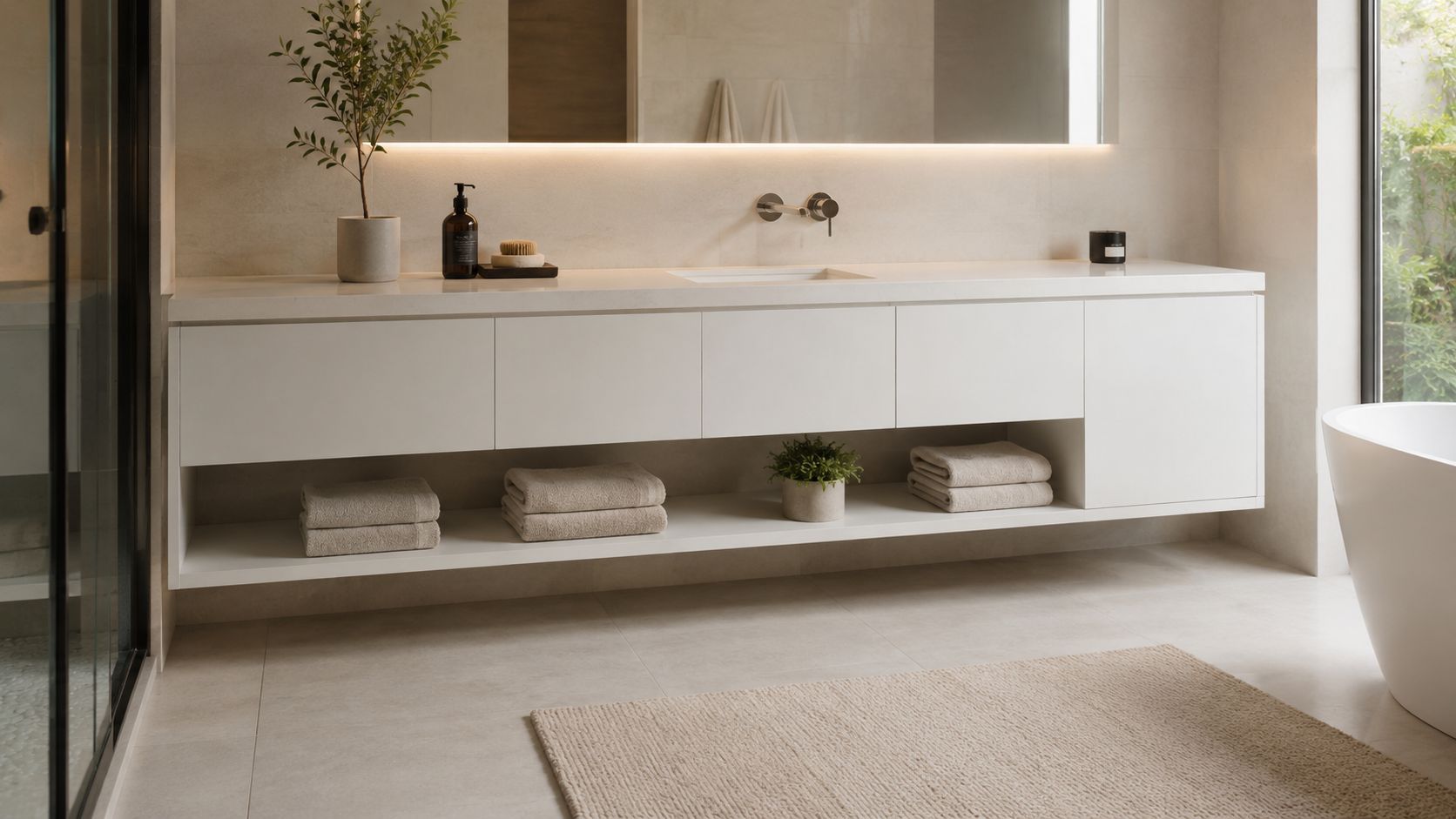
    A modern, minimalist floating bathroom vanity with white cabinets, a shelf for towels, and a sleek mirror.

    Why it works

    Flat fronts, integrated pulls, and push-latch doors keep visual noise low. What matters then is warmth. White oak, warm gray lacquer, matte finishes, and a stone top with subtle movement can keep minimalism from feeling clinical.

    This is also the style where poor planning shows immediately. A beautiful slab-front vanity with no dedicated drawer insert for grooming tools, cosmetics, or electric items starts to look untidy within days. Minimalist rooms need interiors that are more considered than the exterior suggests.

    Practical rule: The simpler the cabinet front, the more carefully the cabinet interior should be planned.

    A few details make the difference:

    • Choose warmth first: Natural wood tones and soft mineral paint colors usually age better than stark white.
    • Control reflection: Matte and low-sheen finishes tend to feel more refined in everyday use.
    • Light the face evenly: Flat cabinets look best with layered light, not a single harsh overhead fixture.

    For homeowners drawn to a clean-lined bath with high-quality materials, Jennifer Gilmer Kitchen & Bath often treats the vanity as custom furniture rather than a generic box. Their perspective on luxury bathroom vanities for modern homes is useful if you want minimalism with depth, not just less detail.

    2. Transitional

    Transitional style is often the most useful choice in the Mid-Atlantic because so many homes sit between eras. A Colonial revival may call for some architectural softness, while the homeowners still want easier maintenance, simpler lines, and updated lighting. Transitional cabinetry holds that middle ground gracefully.

    The style usually relies on modest panel definition, carefully selected hardware, and a finish palette that doesn't fight the architecture. In Washington DC, Maryland, and Virginia, this approach works particularly well when an older home needs a fresh bathroom that still feels consistent with the rest of the house.

    Where transitional earns its keep

    A well-done transitional vanity doesn't chase a trend. It supports a broad range of materials. Carrara marble, satin nickel, pale oak, painted cabinetry, and classic mirrors all sit comfortably here.

    This is also a forgiving category for clients who want the room to feel current without becoming too sharp or too formal. In practical terms, transitional cabinets handle family use well because they tend to include familiar drawer-and-door configurations, straightforward cleaning, and finishes that don't show every fingerprint.

    Designers often advise homeowners to coordinate rather than exactly match cabinetry across adjacent rooms. The useful part of that advice is the mindset. Repeating tone, proportion, or hardware character usually creates a better whole than forcing identical profiles from kitchen to bath.

    A transitional bath might include:

    • A soft painted vanity: Dove gray, mushroom, or muted cream usually carries the look well.
    • A restrained door profile: Enough detail to give shadow and depth, not enough to feel busy.
    • Classic hardware: Knobs and pulls should feel intentional and substantial in the hand.

    At Jennifer Gilmer Kitchen & Bath, transitional work often succeeds because the room is studied as part of the home, not as an isolated project. That's where thoughtful space planning matters most.

    3. Traditional / Raised Panel

    A traditional vanity changes how a bathroom is read the moment you enter. In a home with original millwork, paneled doors, or formal trim, raised-panel cabinetry helps the bath feel rooted in the architecture instead of treated as a detached update.

    This style carries visual weight, so proportion matters. The panel profile, rail width, wood species, finish color, toe kick or furniture base, and hardware all need to support the same point of view. When those elements are chosen carefully, traditional cabinetry brings order, depth, and a sense of permanence that simpler door styles do not.

    Where craftsmanship shows

    Raised-panel vanities need room to breathe. In a compact bath, heavy moldings and deep profiles can crowd the space and make cleaning harder around corners and feet. In a larger primary bath or a period renovation, that same detail gives the room substance and supports richer materials such as honed marble, polished nickel, and framed mirrors with real presence.

    Wood also feels most at home here, whether the finish is painted or stained. As noted earlier, wood continues to shape much of the category. In practice, that tracks with what designers and cabinetmakers see every day. Clients may ask for a painted vanity, but they still want the warmth, stability, and repairability that come with well-made wood construction.

    Finish selection deserves more scrutiny than many homeowners expect. Very dark, flat paint can blur the panel shape and hide the quality of the joinery. A softer painted finish, a hand-applied glaze, or a stain with enough contrast to catch light usually shows the door detail more clearly.

    Traditional cabinetry performs best when its construction is visible.

    Function matters just as much as appearance. A raised-panel front can look formal and still work hard, with deep drawers for daily tools, pullouts for backup supplies, and sink-base storage planned around plumbing instead of surrendered to it. Homeowners who want that classic look without giving up convenience can borrow from these bathroom vanity organization ideas, which help a traditional cabinet serve modern routines with far less compromise.

    4. Shaker

    Shaker style is one of the few cabinet languages that can move comfortably between a farmhouse bath, a transitional renovation, and a more refined family home. Its five-piece door has enough structure to feel crafted, but not so much detail that it dominates the room. That balance explains why it remains such a dependable choice.

    A painted Shaker vanity in white, pale gray, or soft putty feels clean and familiar. In natural maple or white oak, it gains warmth and a more furniture-like presence. Because the door style is disciplined, the finish quality becomes highly visible.

    Why Shaker lasts

    Shaker works best when the rest of the room carries some of the decorative weight. A terrazzo top, hand-formed tile, aged brass hardware, or a framed mirror can give the bath personality without asking the cabinetry to do all the talking.

    This is also a smart style for homeowners who want broad resale appeal while still making thoughtful design decisions. It doesn't read as starkly contemporary, and it doesn't rely on overt nostalgia either. That flexibility makes it particularly useful when the bath needs to relate to several adjoining spaces.

    A few choices keep Shaker from feeling ordinary:

    • Use a strong countertop: Simple cabinet fronts benefit from a surface with texture or subtle movement.
    • Select better hardware than you think you need: On quiet doors, hardware carries more visual importance.
    • Watch the rail widths: The proportions of the Shaker frame matter. Too wide, and it starts to feel heavy.

    At Jennifer Gilmer Kitchen & Bath, designers such as Jennifer Gilmer, CKD, and Marie-Josée Parisi often focus on these proportional subtleties because they determine whether Shaker feels custom or commonplace.

    5. Spa / Wellness-Inspired

    Spa-oriented bathroom cabinet styles are less about a single door profile and more about the atmosphere the cabinetry helps create. The room should feel quiet, tactile, and easy to maintain. Cabinets in warm oak, pale gray, or soft white often work best because they recede enough to let texture, lighting, and natural materials shape the mood.

    The broader market is moving in that direction. Bathroom furniture design has shifted toward organic textures and minimalist silhouettes associated with Japandi and modern Mediterranean aesthetics, and the global bathroom furniture market was estimated at USD 136.20 billion in 2024 and projected to reach USD 195.27 billion by 2030, according to bathroom furniture trend reporting.
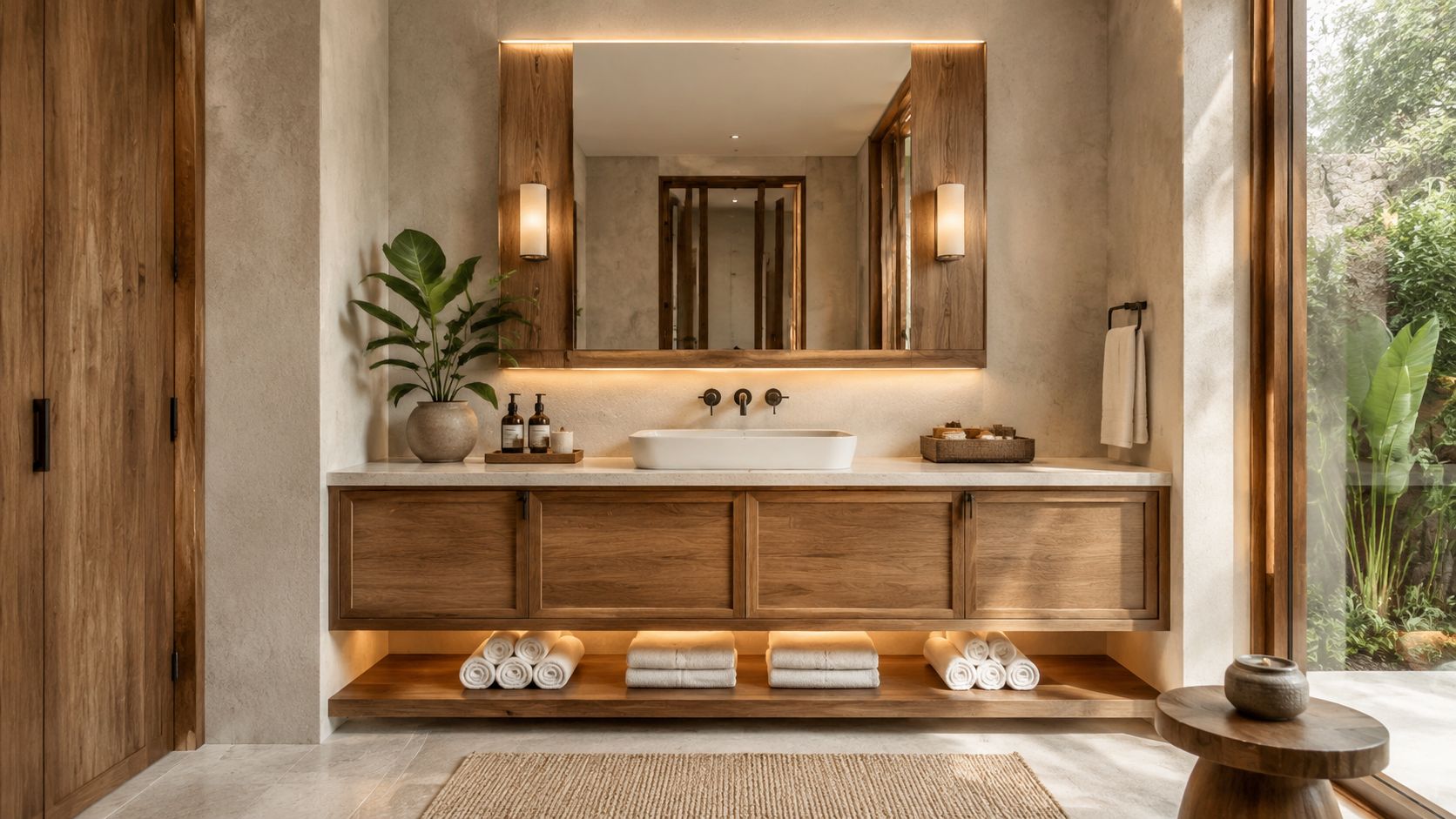
    A modern luxury bathroom featuring wooden cabinetry, a white vessel sink, and ambient under-cabinet lighting.

    Designing for calm

    A spa bath needs concealed storage. Bottles on every surface, visible cords, and overfilled drawers work against the point of the room. Quiet-close hardware, integrated outlets, and dedicated zones for skincare, towels, and daily tools make the space feel settled.

    Counter height matters here too. Counter-height vanities at 36 inches are an important ergonomic consideration, especially for adults who use the space every day, as discussed in guidance on vanity height and coordination. A wellness space shouldn't ask you to stoop every morning.

    For a sense of how calm and material richness can come together, the Easton bath project by Jennifer Gilmer Kitchen & Bath shows how cabinetry, lighting, and architectural restraint can support a more restorative room.

    A short visual look at spa-oriented thinking can help:

    The practical side matters as much as the mood.

    • Hide daily clutter: Plan where every bottle, towel, and tool will live before finalizing the cabinet configuration.
    • Favor tactile finishes: Matte wood, honed stone, and softly brushed metals tend to feel calmer than glossy surfaces.
    • Keep operation quiet: Drawers and doors should open smoothly and close softly.

    6. Cottage / Farmhouse

    Cottage and farmhouse cabinetry offers comfort first. Painted finishes, beadboard references, open shelves, and collected hardware can make a bath feel relaxed and personal in a way that more formal styles often don't. The best versions feel edited, not theatrical.

    This style works especially well in older houses, weekend homes, and family baths where a little softness makes the room more inviting. Cream, muted blue, sage, and warm white are common choices because they support the informal character without making the space feel overly themed.
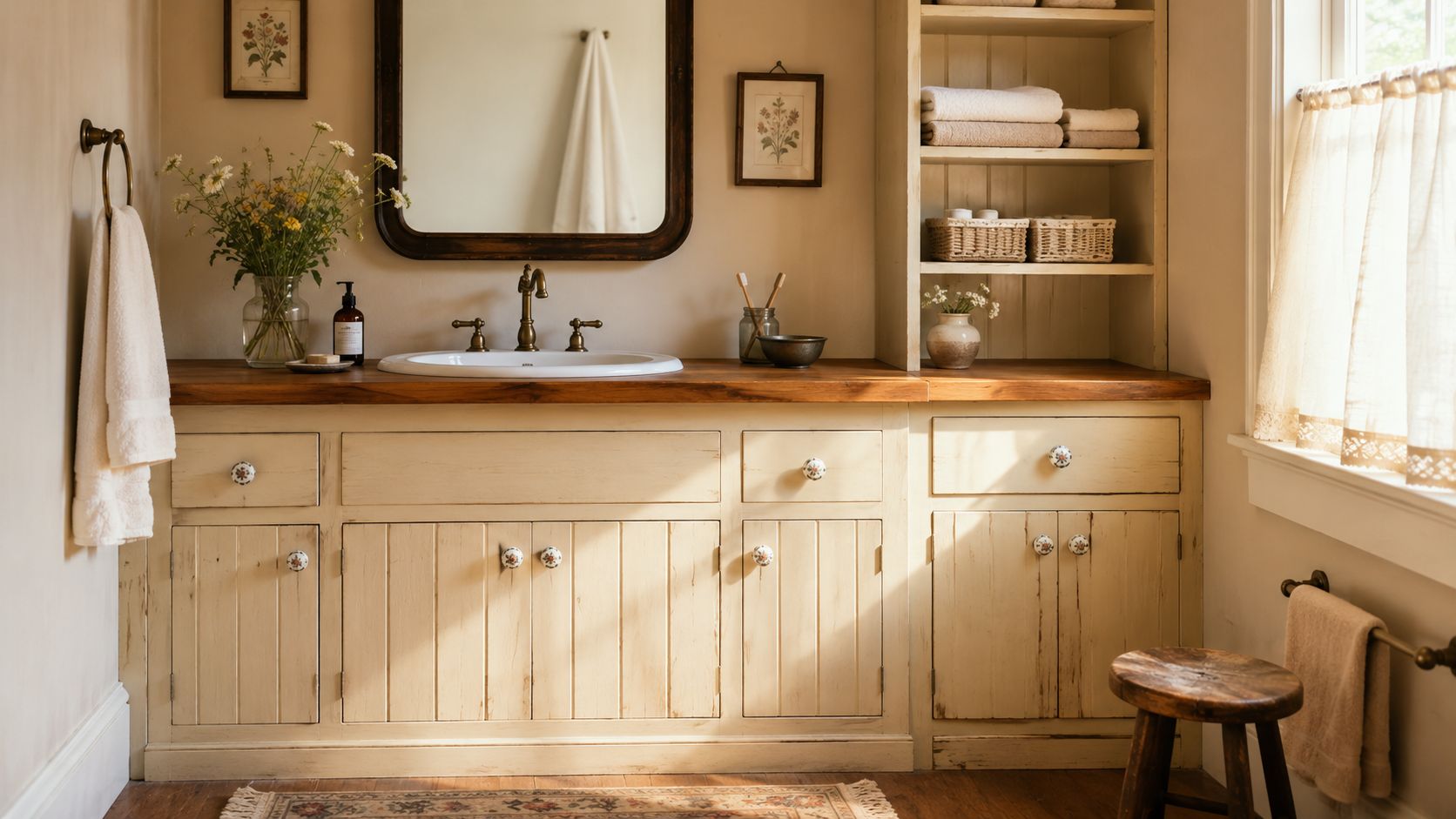
    A rustic cream-colored bathroom vanity cabinet with a wooden countertop in a sunlit vintage-style bathroom interior.

    How to keep it collected, not cluttered

    The challenge with farmhouse baths is restraint. Open shelving can quickly become visible storage overflow. A few folded linens, a ceramic vessel, or a woven basket can be charming. Too much, and the room loses clarity.

    That's why closed storage still matters. A cottage vanity should look easygoing, but it still needs to work hard. Drawers for grooming supplies and concealed storage for extra toiletries keep the charm from becoming maintenance.

    Open shelving should display what you want to see every day, not what you have nowhere else to put.

    This style tends to look strongest when there's some contrast in the room:

    • Pair paint with texture: Soapstone-look surfaces, aged brass, and simple tile add depth.
    • Mix old and new carefully: Vintage mirrors and collected hardware work best when the scale is controlled.
    • Avoid heavy distressing: Gentle wear reads as believable. Aggressive faux aging usually doesn't.

    Nancy McCarren, AIA, LEED AP, often brings this kind of balance to period-sensitive spaces. The room can feel relaxed without giving up good proportion or thoughtful planning.

    7. Contemporary / Flat Panel

    Contemporary flat-panel cabinetry is sharper and more graphic than modern minimalist work. The doors are completely smooth, the geometry is crisp, and the material choices can push further into charcoal, matte black, lacquer, rift oak, or mixed finishes. This is a style for clients who want the bathroom to feel current and architecturally deliberate.

    It's also one of the clearest examples of cabinet style affecting daily function. Existing vanity advice often catalogs forms such as freestanding or floating but doesn't help homeowners connect cabinet interiors to real routines. The gap is especially noticeable when storage pain points involve makeup, backup supplies, wet towels, or hair tools, as outlined in this discussion of common vanity problems.

    The trade-offs to understand

    Flat-panel cabinetry shows fingerprints, alignment issues, and cheap hardware quickly. If the reveals are inconsistent or the finish isn't durable, the room can feel less polished than intended. This style leaves no decorative detail to soften mistakes.

    It does, however, give you enormous freedom with configuration. Long drawers, integrated medicine cabinets, lighting within mirrors, and wall-hung compositions all pair naturally with flat fronts. Mirrored cabinets are also expected to lead the market by type in the years ahead, which reinforces the appeal of integrated storage in contemporary baths, as noted earlier.

    The configuration should reflect use, not just symmetry.

    • Use drawers for categories: Deep lower drawers and shallow upper drawers usually outperform door-only bases.
    • Think about grooming zones: Electrical access and divider inserts matter more in contemporary layouts.
    • Be realistic about finish maintenance: High-gloss lacquer can brighten a room, but it asks for regular wiping.

    The most successful contemporary baths feel intentional from cabinet face to drawer insert. Without that full consideration, the style can look sleek in photographs and frustrating in daily life.

    8. Industrial / Modern Rustic

    Industrial and modern rustic cabinet styles appeal to homeowners who want more material presence. Reclaimed wood, blackened steel, exposed brackets, concrete-look counters, and visible grain create a bathroom that feels grounded and architectural. It can be a compelling direction in lofts, renovated farmhouses, and newer homes that need a little roughness to avoid feeling overfinished.

    This style is strongest when it balances honesty with refinement. A heavy timber vanity under a sleek mirror. A metal frame paired with warm lighting. A concrete surface next to soft towels and quiet plumbing fixtures. That tension keeps the room from becoming overly themed.

    How to keep it refined

    Moisture protection is the first issue. Raw wood and porous surfaces need proper sealing, especially around sinks and splash zones. What looks appealing in a dry showroom vignette may fail quickly in a busy family bath if the details aren't specified carefully.

    Customization also matters here because industrial and rustic forms rarely follow standard storage logic well. The broader vanity market is projected to rise from US$43.15 billion in 2025 to US$85.62 billion by 2035, and within that projection, 60% of homeowners are interested in double-vanity setups while 80% prioritize customizable storage solutions, according to bathroom vanities market projections and homeowner preferences. That combination makes sense. Strong style still has to serve shared routines and practical organization.

    Raw materials belong in a bathroom only when the detailing is disciplined.

    A few principles keep industrial work usable:

    • Seal every vulnerable surface: Wood, concrete, and open metal finishes need bathroom-specific protection.
    • Mix in softness: Mirrors, textiles, and lighting should temper the harder cabinet materials.
    • Keep some storage closed: Industrial rooms need discipline, or they start to look improvised.

    Bathroom Cabinet Styles: 8-Style Comparison

    Style🔄 Implementation Complexity⚡ Resource Requirements⭐ Expected Outcomes📊 Ideal Use Cases💡 Key Advantages
    Modern MinimalistMedium, requires precise installation and integrated hardwareMedium, quality finishes, concealed hardware⭐⭐⭐⭐, Clean, spacious, timelessSmall or contemporary homes, urban condosEasy maintenance; timeless look; pairs with modern fixtures
    TransitionalMedium, balances subtle detailing with modern restraintMedium, quality hardware and finishes without excess⭐⭐⭐⭐, Versatile, balanced, broadly appealingHomes blending period architecture with updated interiorsBroad appeal; adaptable to many rooms; approachable elegance
    Traditional / Raised PanelHigh, detailed joinery, moldings and finish workHigh, premium woods, custom millwork, ornate hardware⭐⭐⭐⭐⭐, Rich, crafted, timelessHistoric homes, formal primary bathsStrong craftsmanship; deep visual texture; enduring value
    ShakerLow–Medium, straightforward construction but finish-sensitiveMedium, good materials and finish quality required⭐⭐⭐⭐, Simple, durable, timelessFarmhouse, transitional, versatile remodelsVersatile across styles; easy to maintain; scalable cost
    Spa / Wellness-InspiredMedium–High, integrated lighting/storage and material coordinationHigh, natural materials, specialty fixtures, spa amenities⭐⭐⭐⭐, Calm, restorative, high-end retreatPrimary baths, luxury renovations, wellness-focused homesPromotes wellbeing; natural aging of materials; luxurious feel
    Cottage / FarmhouseLow–Medium, painted finishes, open shelving, casual detailingLow–Medium, painted cabinetry, vintage or mixed hardware⭐⭐⭐, Warm, lived-in, approachableCountry homes, cozy powder rooms, casual family bathsWarm and forgiving; budget-friendly options; personal character
    Contemporary / Flat PanelHigh, requires precision fabrication and flawless installationMedium–High, specialty laminates/finishes, integrated tech⭐⭐⭐⭐, Bold, sleek, modern statementNew builds, design-forward renovations, modern townhomesStrong visual impact; easy-to-clean surfaces; finish flexibility
    Industrial / Modern RusticHigh, sourcing and integrating raw materials; moisture protectionHigh, reclaimed wood, metalwork, sealing and custom fabrication⭐⭐⭐, Distinctive, material-forward, character-richLofts, converted industrial spaces, bespoke custom projectsUnique, authentic materials; ages well; highlights craftsmanship

    Begin Your Design Journey with a Trusted Partner

    Choosing among bathroom cabinet styles is often the moment a renovation becomes real. Once the cabinet language is clear, other decisions begin to fall into place. Tile has context. Hardware gains direction. Lighting can be configured for the way the vanity will be used. More important, the bathroom starts to reflect the routines and preferences of the people who live there, rather than a generic mood board.

    That's where a thoughtful design process matters. A bathroom cabinet isn't only a finish decision. It shapes storage, ergonomics, circulation, and the room's long-term character. A floating minimalist vanity may give a smaller bath visual ease, but it also changes how cleaning happens and where towels are stored. A raised-panel cabinet may suit a historic home beautifully, but it needs the right scale and enough breathing room. A spa-oriented composition may look serene, but it only stays that way when the drawer interiors and concealed storage are planned with care.

    At Jennifer Gilmer Kitchen & Bath, that kind of planning is part of the work from the beginning. The firm serves homeowners throughout Washington DC, Maryland, and Virginia, and handles projects from concept through installation. That continuity is valuable. It means the cabinetry is considered alongside finishes, lighting, proportions, and how the room will be used every day. Designers such as Jennifer Gilmer, CKD, Nancy McCarren, AIA, LEED AP, and Marie-Josée Parisi understand that a well-designed bath needs both visual coherence and practical ease.

    There's also real value in seeing cabinetry in person. Material tone, door profile, sheen level, and hardware scale are difficult to judge on a screen. Visiting a showroom allows homeowners to compare styles side by side, study craftsmanship closely, and have more productive conversations about what will work in their own homes. Jennifer Gilmer Kitchen & Bath welcomes clients to its showrooms in Chevy Chase, Easton, and Ashburn, where those discussions can begin with real samples and informed guidance.

    If your current bathroom feels unresolved, too cluttered, too formal, too plain, or not aligned with your home, the cabinet style is often the right place to start. Even homeowners exploring adjacent updates such as cabinet refinishing in Toronto usually find that the larger question isn't only finish. It's whether the cabinetry itself expresses the right character and supports daily use.

    A good bathroom should feel composed in the morning rush and quiet for relaxation. The right cabinet style helps make that possible.


    If you're planning a bathroom renovation in Washington DC, Maryland, or Virginia, Jennifer Gilmer Kitchen & Bath offers a full-service design process that carries a project from concept and cabinetry selection through installation. A showroom visit is a practical way to compare bathroom cabinet styles, study materials firsthand, and discuss a layout that fits your home and routine.