.avif)

You're standing in a showroom beside two white tubs that look nearly identical. One feels light when the salesperson nudges it. The other has the unmistakable solidity of a fixture meant to stay put for decades. The difference isn't obvious in a photograph, but you'll notice it every night, on installation day, and the first time a shampoo bottle hits the floor.
That's why the acrylic vs steel bathtub decision deserves more attention than color, silhouette, or a glossy product description. The right tub has to suit the subfloor, the access route, the plumbing plan, the household's habits, and the kind of wear the finish will face. Jennifer Gilmer Kitchen & Bath approaches that choice as part of the room's architecture, not as an isolated fixture selection, for homeowners across Washington, DC, Maryland, and Virginia.
Table of Contents
The Bathtub Decision Most Remodels Get Wrong
A couple came into a showroom with a simple request: a white tub for an upstairs hall bathroom. They had already narrowed the choice to two models with the same general footprint and a similarly clean profile. Their attention went to the drain position, the apron, and the shape of the rim while their designer asked less glamorous questions.
Could the tub reach the second floor without removing a window? Was the existing floor structure sound? Where would a plumber work if the valve needed replacement later? Would the children use the tub every evening, or would it mostly sit unused while the adults preferred the shower?
The couple initially treated those questions as technicalities. They aren't. A bathtub is a loaded fixture, and its material affects delivery, support, sound, comfort, maintenance, and the way a future repair unfolds. Historical context helps explain why this choice still feels so divided. Commercial vitreous enamel was applied to sheet iron and steel in Austria and Germany around 1850, while David Dunbar Buick later developed an enamel-coating process for iron and steel around 1887, establishing the foundation for the steel tub's long residential run through the twentieth century (bathtub history and material background).
A practical planning resource such as planning your bathtub renovation is useful before you compare finishes, because the surrounding work often determines whether a tub choice is sensible.
Four questions belong on the plan set
- What supports the tub? A rigid steel basin and a lightly flexible acrylic shell place different demands on the floor and bedding.
- Who can reach the plumbing? A beautiful apron doesn't help if a future valve repair requires demolition.
- How long must the finish last? Steel resists everyday abrasion, while acrylic offers a more forgiving repair path for shallow scratches.
- How is the bath used? A brief children's bath, an occasional guest soak, and a nightly primary-bath ritual call for different priorities.
The showroom decision becomes much clearer once those answers are written down. Marketing language can describe a finish. It can't tell you whether the room wants a lighter tub, a tougher surface, or better support.
| Decision factor | Acrylic | Enameled steel |
|---|---|---|
| First contact | Warm and less startling | Cool at first touch |
| Handling | Easier to carry and position | More demanding to move |
| Feel underfoot | Comfortable, with slight flexibility if supported | Rigid and solid |
| Finish concern | Scratches from abrasive care | Chips from hard impacts |
| Strongest use case | Upper floors, soaking, flexible layouts | High-traffic baths and hard-wearing alcoves |
How Acrylic and Steel Tubs Are Made
The room's support and access requirements should shape the material choice before showroom styling enters the discussion. Acrylic tubs begin as thermoplastic sheets heated and vacuum-formed over a mold. Manufacturers reinforce the shaped shell with fiberglass plus resin or a wood composite backing. The result is a tub that is lighter, warmer to the touch, and slightly flexible.
That flexibility allows deeper soaking profiles, integrated contours, and freestanding forms, but it still depends on a properly prepared base. Acrylic thickness varies by product tier. Entry-level units may use sheets around 3 mm, while premium cast sheets can approach 5 mm. The specification matters more than the word “acrylic” on the label.
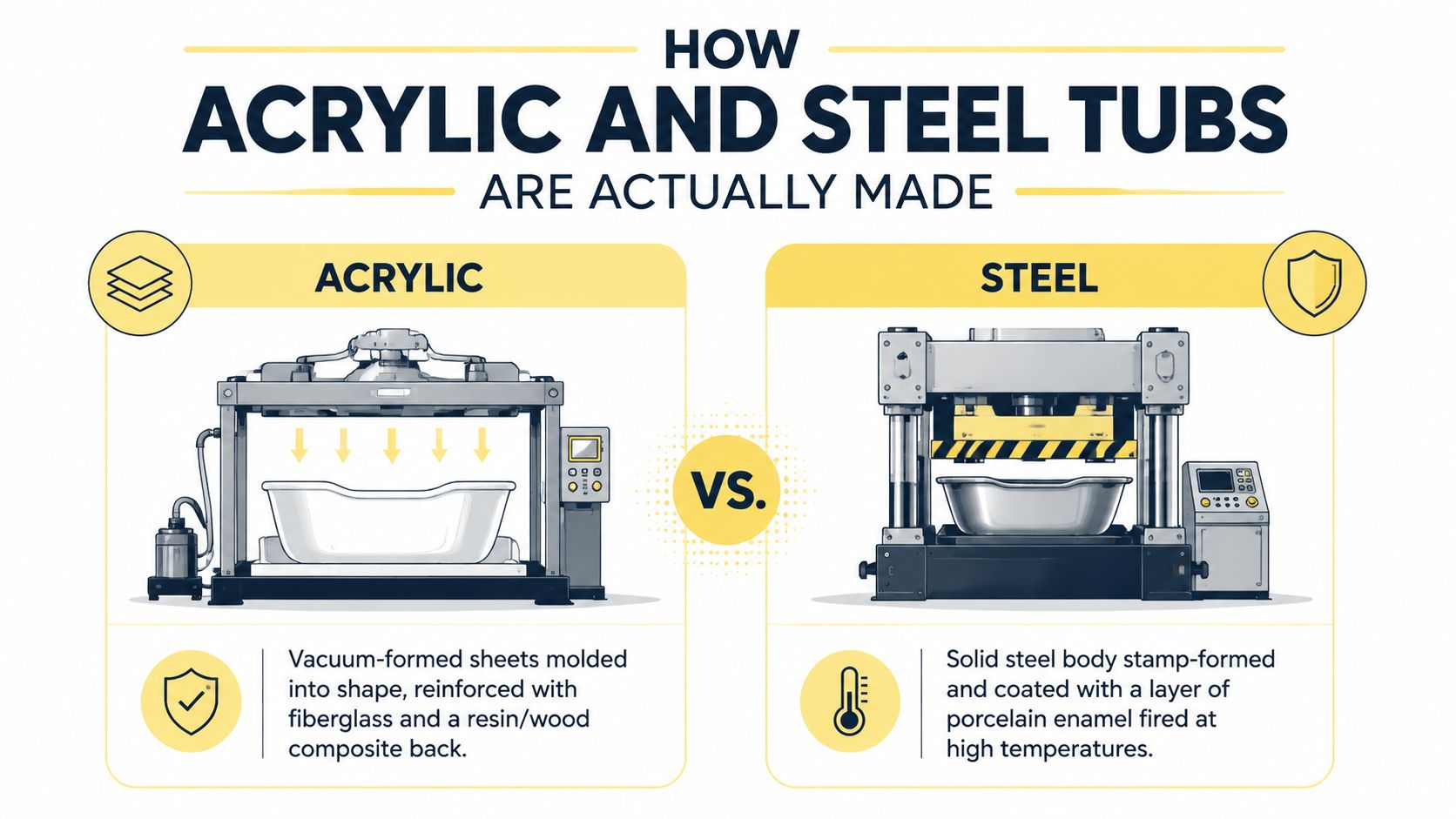
Enameled steel takes the opposite route. A steel sheet is stamped into a basin, then coated with glass-based porcelain enamel fused to the metal at high heat. The finished surface is hard, glossy, and nonporous. The steel body supplies the tub's familiar rigidity and weight, which affects both handling and floor support.
Why the backing and gauge matter
Acrylic buyers should inspect the underside reinforcement and the base preparation. A thin shell with weak backing can feel hollow or flex under load. A reinforced shell with firm support feels substantially more stable in daily use.
Steel buyers should ask about body gauge and support details. Thinner steel can flex more readily, stressing the enamel and raising the risk of chips or cracks. A shaped, reinforced composite shell belongs to a different category than a stamped steel basin with a fused glass surface.
For a broader look at finishes and fixtures, 2026 bathroom renovation materials provides context for comparing specifications before you commit to a tub. Choose acrylic when easier handling, complex shaping, and a forgiving repair route fit the room. Choose enameled steel when rigid support, a hard surface, and long-term wear resistance carry more weight.
What It Feels Like to Use Each Tub
The difference appears before the water reaches your shoulders. Acrylic feels warmer against bare skin because it doesn't conduct heat away as quickly. Steel feels cool at first contact, then gives you a firm, unyielding surface underfoot. Neither experience is better, but one will suit your evening routine more naturally.
The physics is clear. Acrylic has a thermal conductivity of about 0.2 W/(m·K), while steel is around 50 W/(m·K), meaning steel draws heat away far faster and acrylic acts as the stronger insulator (thermal conductivity comparison). One comparison reports that acrylic can maintain water temperature for 20 to 30 minutes, while steel is generally less effective at holding heat during a soak (bath material comparison).
The nightly experience
Acrylic absorbs more of the little noises that make a bathroom feel busy. A bottle placed on the rim, water striking the basin, or a child shifting position tends to sound softer. The surface also warms quickly, which matters in a bathroom with a tall ceiling, a drafty exterior wall, or a household member who dislikes the first cold touch.
Steel has a satisfying solidity. It doesn't give underfoot when the base is properly supported, and its porcelain surface feels smooth and clean. The tradeoff is the characteristic metallic echo when water fills the basin, along with the initial chill that makes the tub feel less inviting before it fills.
Finish behavior separates the materials in a different way. Acrylic can scratch under abrasive powders, rough pads, or grit, but shallow scratches can often be buffed out. Steel enamel resists routine abrasion better, yet a hard impact can chip the surface and expose the dark metal beneath. That repair is more consequential and usually less invisible than polishing a light acrylic scuff.
| Factor | Acrylic Tub | Steel Tub |
|---|---|---|
| Warmth | Warm to the touch | Cool at first contact |
| Heat behavior | Better insulation for soak comfort | Conducts heat away faster |
| Sound | Softer, less resonant | More echo and ringing |
| Underfoot feel | Comfortable, with supported flexibility | Firm and rigid |
| Surface wear | Scratches more readily, shallow marks may buff out | Resists scratches, but chips are serious |
| Daily impression | Relaxed and forgiving | Solid and hard-wearing |
Designer's verdict: If you take a bath because you want comfort, acrylic usually feels better. If you take a bath because the fixture has to withstand constant abuse, steel earns its place.
Installation and Structural Realities
Installation determines whether the tub suits the room's access route, floor structure, and service plan. Acrylic is easier to carry through narrow halls, stair turns, and finished spaces because it weighs less. Typical comparisons list acrylic tubs at about 60 to 80 pounds and steel-plate tubs at about 90 to 120 pounds (installation weight comparison). Broader comparisons place acrylic around 50 to 100 pounds and steel around 150 to 200 pounds, depending on construction and size (bathtub weight comparison).
That difference affects labor, delivery risk, and the shapes a crew can physically bring into position. A lighter acrylic tub still carries bathwater and an occupant, so the installer must support the base, reinforce the rim where required, and stop the shell from moving.
Support determines the outcome
Acrylic handles minor substrate imperfections better than rigid steel, but it can flex when the base is poorly prepared. Movement creates noise, stresses connections, and raises the long-term risk of cracking. Mortar bedding, a manufacturer-approved support system, ledger bracing, and a level substrate all contribute to a stable installation.
Steel feels substantial because the basin is stiff. The floor still needs proper preparation. An uneven or weakly supported subfloor can transfer stress into the enamel, while the rigid body leaves little room for poor workmanship. Base conditions determine how either tub behaves after the tile is finished, regardless of what showroom weight suggests.
| Variable | Acrylic | Steel |
|---|---|---|
| Carrying through a remodel | Generally easier | Often requires more planning and labor |
| Subfloor preparation | Requires a stable, supported base | Demands level, full support |
| Flex risk | Can flex without proper bedding | Less shell movement, but enamel can stress |
| Plumbing access | Plan panels or service routes early | Plan panels or service routes early |
| Future replacement | Often easier to handle | More difficult if access is restricted |
| Layout flexibility | Broad range of forms | Strongest in standard configurations |
Access is part of the design
An alcove tub, drop-in, and freestanding tub each require a different service strategy. Apron height can conflict with existing tile. A drop-in deck can conceal a valve or drain connection that later needs repair. Freestanding tubs may leave the floor visually open, but the supply, waste location, and surrounding clearance must be resolved before framing.
The trim package affects the layout as well. Kohler, American Standard, and Brizo fixtures can differ in rough-in requirements, handle placement, and visual scale. Select the tub alongside the valve, filler, tile build-up, and access plan, while those decisions remain adjustable. For adjacent shower planning, review this guide to primary bathroom shower dimensions while the walls are still open.
Where Each Tub Belongs in a Real Home
The best material depends on the house as much as the household. In the Washington, DC, Maryland, and Virginia homes Jennifer Gilmer Kitchen & Bath designs, an upstairs rowhouse bath presents different constraints from a slab-on-grade new build. A Maryland colonial may have generous framing but a difficult stair route. A Virginia new build may offer more planning freedom, yet the client's nightly habits still determine whether a rigid family tub or a warm soaking tub makes sense.
Steel for the rooms that take punishment
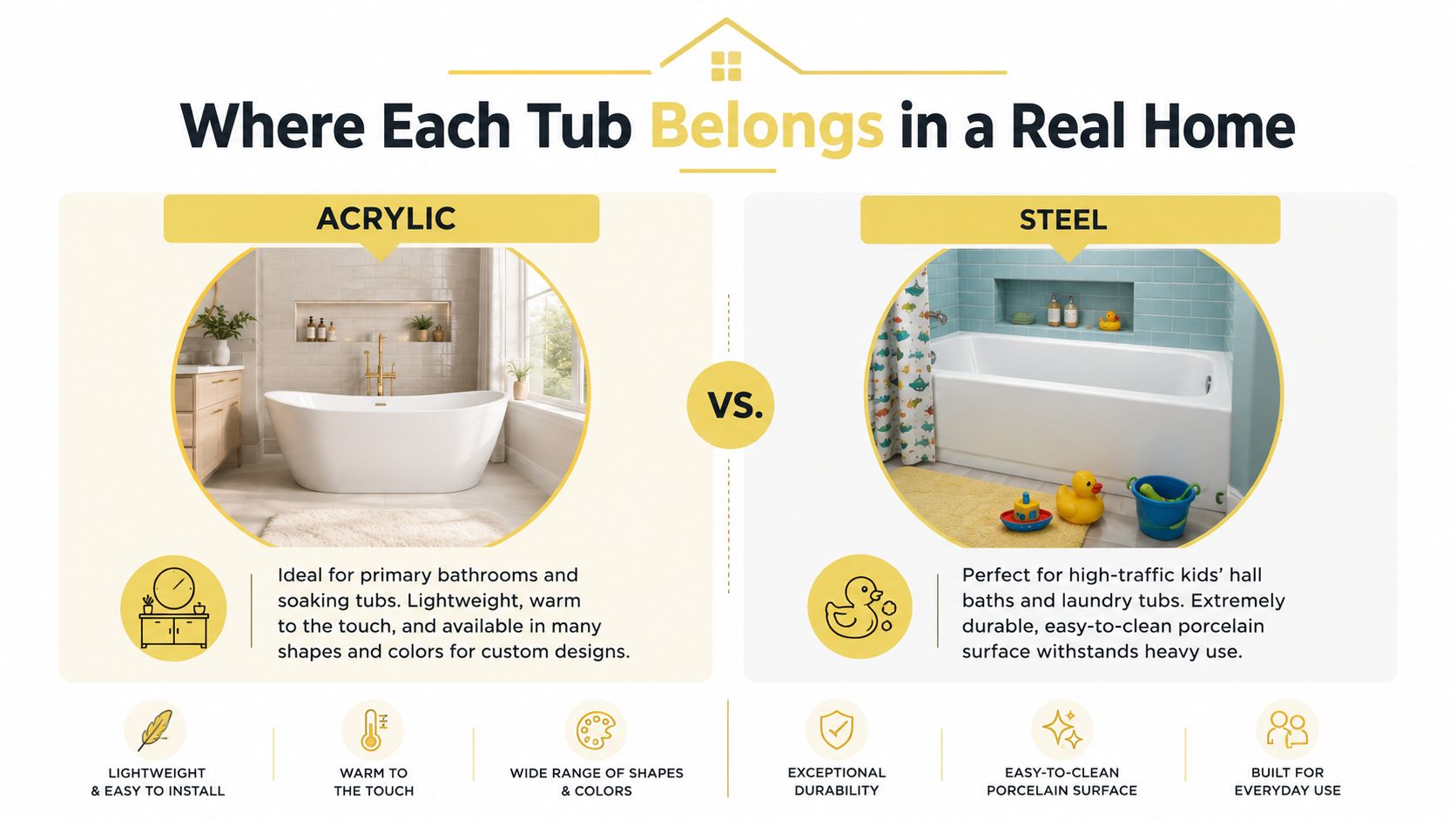
Steel earns its place in a children's hall bath. The porcelain surface handles routine cleaning and everyday abrasion well, and the rigid basin feels reassuring when children climb in and out. It's also a practical choice for a compact bath where a standard alcove footprint makes more sense than a sculptural freestanding form.
In a powder-room conversion that gains a tub, steel can work when the room's proportions and existing framing favor a straightforward installation. The key is not the material's traditional appearance. It's the combination of traffic, cleaning habits, and a defined footprint that doesn't require a more flexible shell.
Acrylic for comfort and access
Acrylic usually wins in a primary suite soaking niche. It feels warmer, accommodates more varied shapes, and places less strain on a difficult delivery route. That matters in an upper-floor bath over a finished ceiling, where carrying and future replacement deserve attention before the tub disappears behind tile.
It also makes sense in an upstairs guest bath when a leak would threaten a finished room below. The material won't prevent a leak, but its lighter handling can simplify installation and later removal. In a curbless wet room, the warm surface and available forms support a quieter, more comfortable bathing experience.
The room's ceiling height, floor framing, access route, and square footage should narrow the field before the showroom finish does. A Maryland homeowner's guide to timeless bathroom materials is a helpful companion when the tub must sit comfortably within a larger palette of tile, cabinetry, hardware, and lighting.
Rental properties often reverse the recommendation. A steel tub can be the more defensible choice where many occupants, hard cleaning, and replacement durability matter more than first-contact warmth. Aging-in-place planning can reverse it again if the lighter installation, warmer surface, and accessible bathing layout support safer daily use. The material follows the use pattern.
Keeping the Finish Looking New
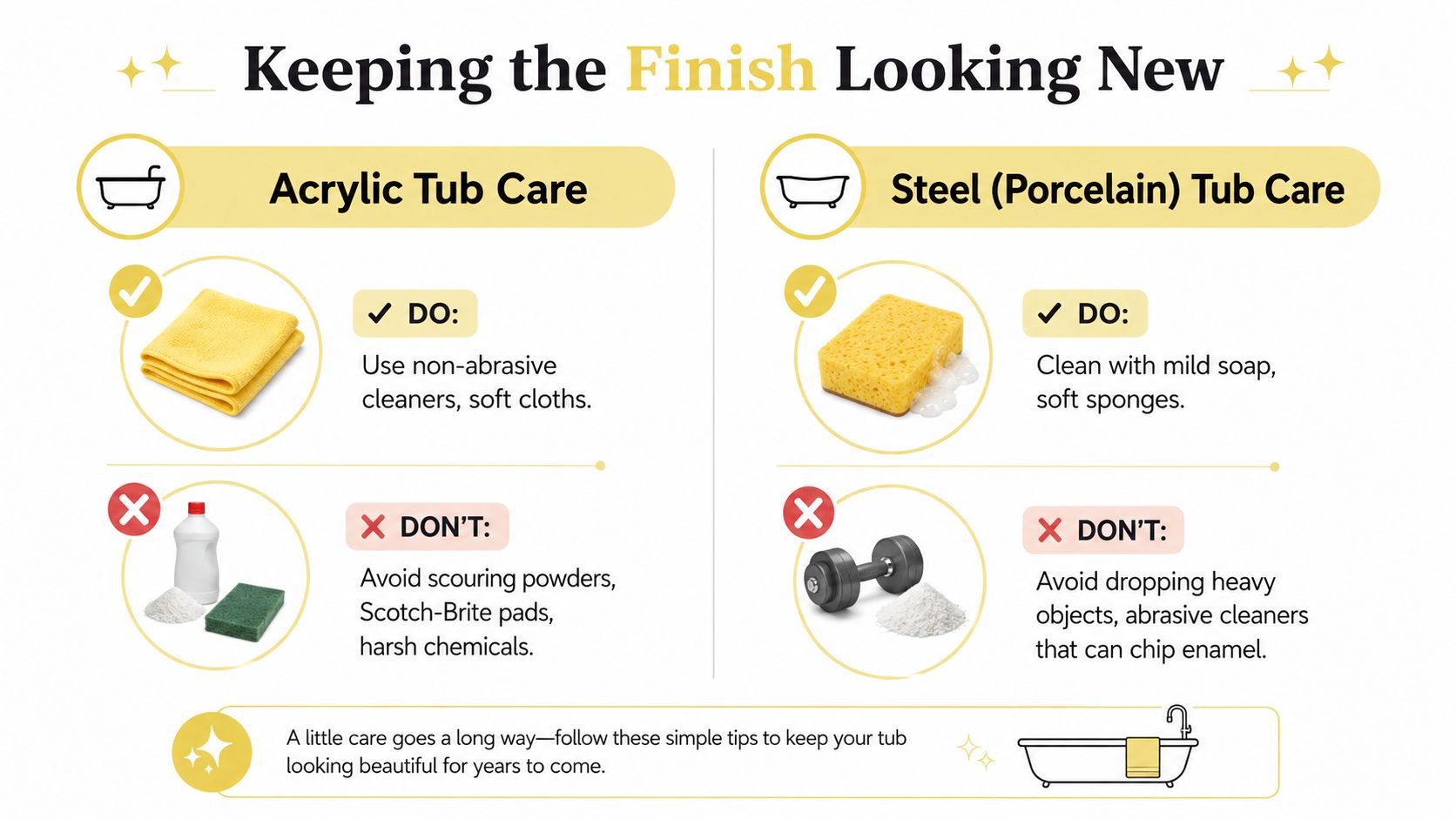
Acrylic rewards a gentle hand. Use a soft microfiber cloth and mild dish soap, then rinse thoroughly. Abrasive powders, Scotch-Brite pads, and harsh chemicals can dull or scratch the surface, turning routine cleaning into a long-term finish problem.
Shallow scuffs don't automatically mean replacement. A careful buff-out can restore the surface, and a melamine foam sponge may help with a light mark when used sparingly and without aggressive pressure. Test any product in an inconspicuous area first, because even a material that can be polished has a limit.
Steel needs different caution
Porcelain enamel is more resistant to household chemicals and abrasion, but it's less forgiving when something hard lands on it. A dropped bottle can chip the glass-like coating and reveal the metal beneath. Repair the chip promptly with the correct porcelain or enamel touch-up kit, rather than assuming the mark is cosmetic.
Avoid suction-cup bath mats on steel enamel. Their repeated grip can hold moisture against the surface and create unnecessary wear. Choose a mat designed for the finish, keep it clean, and lift it regularly so the tub can dry.
Hard water changes the routine for every tub in the region. If mineral deposits appear quickly, weekly wipe-downs become necessary regardless of whether the basin is acrylic or steel. The most protective habit is also the simplest: rinse the walls and basin after each use, then remove standing water from the rim.
| Care concern | Acrylic | Steel enamel |
|---|---|---|
| Everyday cleaner | Mild soap and a soft cloth | Mild soap and a soft sponge |
| Avoid | Scouring powder, abrasive pads, harsh chemicals | Abrasive cleaners and hard impacts |
| Common damage | Scratches and dulling | Chips that can expose metal |
| Repair approach | Careful polishing or buffing | Finish-specific enamel touch-up |
| Best habit | Rinse and dry after use | Rinse and dry after use |
Choosing with Confidence
For most remodels, I recommend quality acrylic. It handles the practical realities of renovation better, especially when the bathroom sits upstairs, access is tight, the tub needs to feel warm, or the client wants a deeper and more individual form. Its weaknesses are manageable when the installer provides proper support and the owner uses the right cleaning products.
The recommendation changes on a slab-on-grade alcove where children, dogs, bath toys, and dropped bottles are daily realities. There, enameled steel is the more sensible workhorse. Its rigid feel and abrasion-resistant surface suit a high-traffic bath, particularly when the layout already favors a standard alcove and the household values a classic glossy finish over warmth.
Three checkpoints settle the shortlist
Start with the substrate. Know whether the tub will sit over a framed floor, a slab, or a finished room that can't easily be opened later. A second-floor bath over a framed subfloor generally favors acrylic because lighter handling simplifies the remodel, but the base still needs real support.
Then judge household traffic. A primary bath used for long, quiet soaks has different requirements from a children's bath that sees constant activity. Choose steel when impact and abrasion dominate. Choose acrylic when touch, warmth, shape, and installation flexibility matter more.
Finally, decide how long you expect to keep the room. If you're planning for a long service life, think about how each finish ages and how a future repair crew will reach the plumbing. A scratchable surface that can be refreshed may be preferable to a hard surface that becomes difficult to repair after a chip.
Neither material is the answer for every project. Cast iron deserves consideration when mass, traditional solidity, and heat retention outweigh delivery difficulty. Solid surface is another legitimate upgrade when a sculptural profile, substantial feel, and premium finish justify the added material and installation demands.
The useful conversation isn't “Which tub is better?” It's “What does this room ask the tub to do?” A thoughtful bathroom remodel planning guide can help organize those decisions before you choose a model. Bring the substrate, traffic pattern, and replacement timeline to the showroom, and you'll leave with a shortlist instead of another afternoon of browsing.
Jennifer Gilmer Kitchen & Bath helps homeowners in Washington, DC, Maryland, and Virginia plan bathroom remodels from concept through installation, including tub selection, space planning, finish coordination, and construction details. Visit Jennifer Gilmer Kitchen & Bath to explore the firm's showrooms, design services, and consultation options for a bath built around how you live.