.avif)

You've chosen the tile. The samples are spread across the vanity, the grout colors are lined up, and one glossy blue ceramic has won everyone over. Then the installer asks about the waterproofing membrane, the drain, the shower floor format, and the substrate. Suddenly, the beautiful surface in front of you feels like only one piece of a much larger decision.
That's exactly right. Ceramic tile for a shower is not a finish-only choice. It's part of a water-management, safety, and maintenance system. The tile has to suit the moisture level, the floor has to support secure footing, and the installation behind the surface has to direct water where it belongs. A well-designed shower should feel composed, but it also has to be built with discipline.
Table of Contents
- Ceramic earns its place through flexibility
- Porcelain favors demanding conditions
- Stone brings authenticity, but asks for care
What You're Really Choosing When You Pick Shower Tile
A homeowner once came into a showroom with a photograph of a quiet, pale shower wrapped in handmade-looking tile. She knew the mood she wanted, down to the soft variation in each piece. What she hadn't yet considered was whether that tile belonged on the floor, how its irregular edges would meet the niche, or how the pattern would work around the drain.
The sample was attractive. The shower still needed a plan.
Behind every finished tile surface are several coordinated layers:
- Substrate: The stable backing that receives the waterproofing and tile.
- Waterproofing membrane: The layer that controls moisture before it reaches the framing or wall assembly.
- Drain and slope: The geometry that moves water out rather than leaving it to collect.
- Mortar and grout: Materials that secure and finish the tile, but don't replace waterproofing.
- Movement accommodation: Flexible details at changes of plane and around penetrations.
- Tile format and finish: The visible layer that affects appearance, traction, cleaning, and installation difficulty.
The most expensive tile in the showroom can't compensate for a weak assembly. A beautifully installed wall can still fail if the niche, valve openings, bench, or drain connection weren't integrated into the waterproofing strategy. That's why I want clients to select the tile and discuss the construction details at the same time.
Practical rule: Choose the tile for its design contribution, then approve it only after its technical data and intended application have been confirmed.
The distinction matters in the DC metro area, where older homes often bring uneven walls, complicated transitions, and tight room dimensions. A tile that looks effortless in a photograph may require careful layout, more precise substrate preparation, or a different format to work gracefully in an actual renovation.
The right question isn't “Do I love this tile?” Ask instead, “Can this tile, in this format and finish, perform as part of the shower I'm building?”
Water Absorption and What Makes Ceramic Tile Suitable
Water absorption measures how porous the tile body is. It's one of the first technical specifications I check for any shower material because a constantly wet enclosure places different demands on tile than a powder room wall.
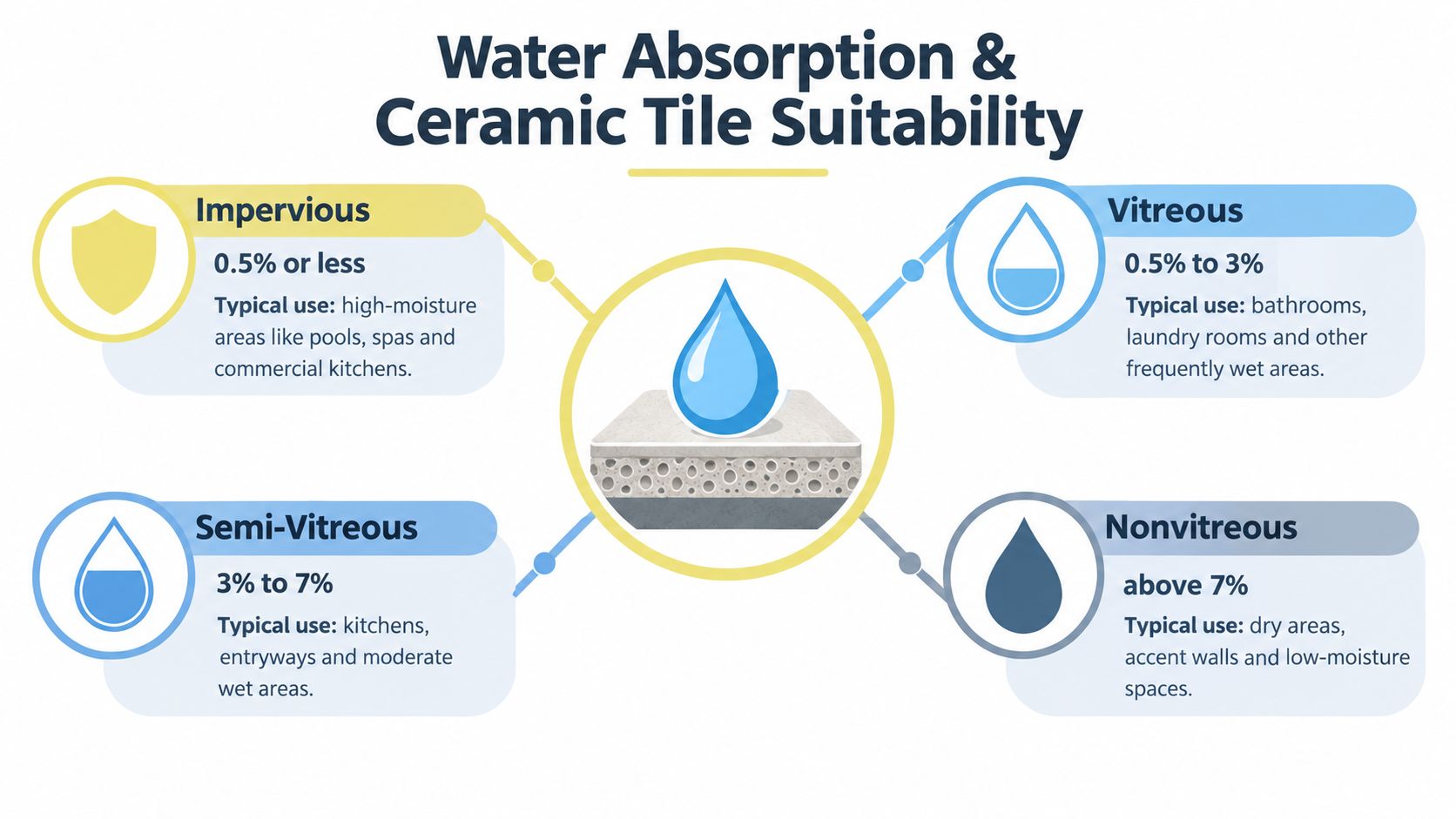
Industry classifications divide ceramic tile into four absorption categories:
| Tile category | Water absorption by weight | Practical reading |
|---|---|---|
| Impervious | 0.5% or less | The densest category |
| Vitreous | More than 0.5% and no more than 3% | Often appropriate for wet applications when properly specified |
| Semivitreous | More than 3% and no more than 7% | Requires closer review for continuous moisture |
| Nonvitreous | More than 7% | Generally unsuitable as a default for a continuously wet shower |
A major U.S. tile-buying guide identifies less than 3% absorption as the general threshold for areas that remain constantly wet, including showers. That gives homeowners a useful screening rule: don't approve a product for a shower until its technical data confirms that it belongs in a suitable absorption category. You can also compare this with broader bathroom flooring options when coordinating the shower with the rest of the room.
What the absorption test actually tells you
Porcelain sits in the densest category. The Porcelain Tile Certification Agency recognizes tile as porcelain only when it absorbs 0.5% or less under ASTM C373 testing, as described in the technical tile-buying guide. The test is straightforward in principle. A dry tile is weighed, saturated with water, weighed again, and evaluated by the percentage increase in weight.
That result tells you about the tile body, not the shower assembly. A low-absorption tile resists water penetration through itself, but it doesn't make the walls, floor, niches, or drain waterproof. The substrate and membrane still have to be specified and installed correctly.
For a conventional shower, I generally favor a product with technical data suited to continuous moisture exposure. Porcelain is an easy choice when the project calls for very low absorption, heavy use, or a floor and wall material that should feel consistent. Ceramic remains an excellent wall material when its specification suits the application, especially when the design depends on color, shape, glaze, or artisanal variation.
The decision should end with two confirmations:
- The tile's absorption and intended-use data are appropriate for the location.
- The waterproofing, substrate, grout, drain, and movement details are designed separately and correctly.
The first protects the material. The second protects the room.
Slip Resistance and How Tile Format Affects Safety
A shower floor needs more than a tile that looks matte in a showroom. Bare feet, water, soap residue, slope, grout, and maintenance all influence traction. That's why I treat the floor as a different design problem from the walls.
Dynamic coefficient of friction, or DCOF, measures friction while a surface is moving. For level interior areas expected to be walked on when wet, ANSI A137.1 establishes a wet DCOF benchmark of at least 0.42. More demanding wet environments, including public showers, are commonly associated with a 0.60 wet value in available technical guidance. These values help compare products, but neither guarantees that a person cannot slip. The testing conditions don't reproduce every barefoot movement, soap film, drainage problem, or maintenance habit.
The DCOF guidance from Daltile makes the important distinction between static friction, which relates to starting movement, and dynamic friction, which relates to maintaining movement. In practice, the number belongs in a larger conversation about format and installation.
Why small mosaics often make sense
Small mosaics, commonly tiles under 4 inches, create more grout joints across the shower floor. Those joints can contribute to underfoot grip, and the smaller pieces conform more easily to the sloped plane leading to the drain. That makes a mosaic a practical choice for many shower floors, even when a large-format tile looks calmer and more current on the walls.
A large tile may have an acceptable wet DCOF and still be a poor floor choice if it doesn't coordinate with the slope. Fewer joints can mean fewer opportunities for the surface to follow the drainage geometry, especially around a centered or linear drain. A wall tile can therefore be perfectly appropriate vertically while remaining unsuitable underfoot.
For homeowners researching finishes, a practical overview such as non slip flooring from DME Superstore can help clarify why surface texture alone isn't enough. I'd still ask the manufacturer for the wet DCOF result for the exact finish and format, then confirm that the product is rated for shower-floor use.
The safest floor is not necessarily the tile with the most aggressive texture. It's the tile, grout layout, slope, drainage, and cleaning plan working together.
A primary bath also deserves a long view. If the room should remain comfortable for aging in place, the designer must consider barefoot traction, visual contrast, grout maintenance, and whether the floor feels secure without becoming difficult to clean. That judgment happens at the scale of the complete floor, not on a single sample.
Waterproofing, Substrate, and Movement Joints
The tile is the visible finish. The waterproofing is the protection. Grout joints aren't waterproof, and grout sealer isn't a substitute for a properly designed shower membrane.
The Tile Council of North America explains that the backer board, bonded waterproofing membrane, drain connection, and transitions must control water before tile and grout are installed. A surface-applied membrane has a particular advantage because it limits moisture entry into the mortar bed and wall substrate, reducing the potential for prolonged dampness and deterioration. Homeowners who want a plain-language overview can also review this waterproofing guide for homeowners.
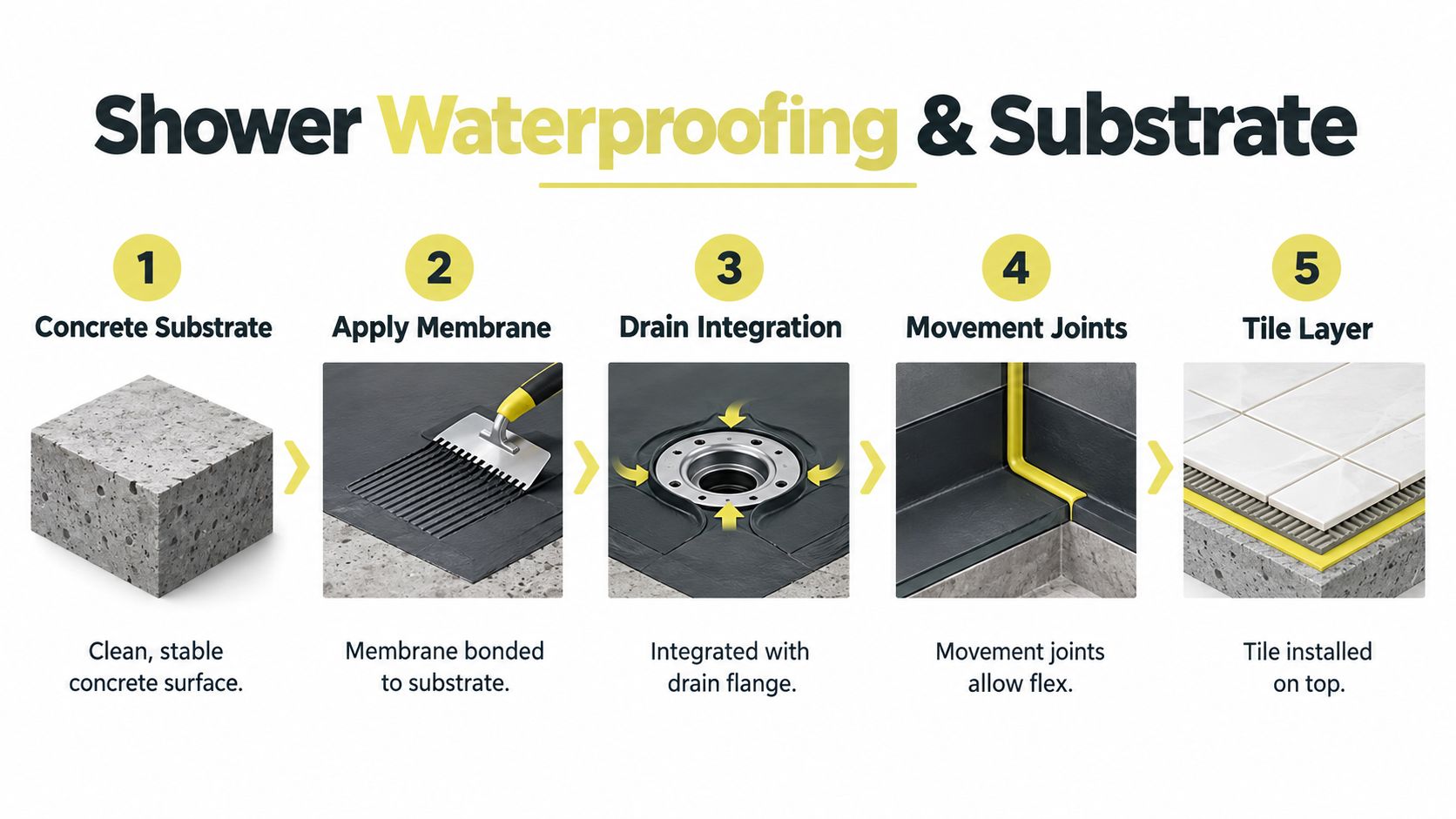
A reliable shower assembly is coordinated in layers:
- Prepare the substrate. The backing must be stable and suitable for the selected membrane system.
- Bond the waterproofing membrane. The membrane should cover the intended wet areas continuously.
- Integrate the drain. The membrane and drain connection must work together, not meet as separate afterthoughts.
- Detail niches and penetrations. Valves, shower arms, benches, and niches need careful treatment.
- Install movement joints. Changes of plane, penetrations, and areas near drains need flexible accommodation.
- Set tile and grout. These finish the assembly after the water-management details are complete.
Steam requires another level of control
A steam shower must manage vapor as well as liquid water. TCNA steam-shower methods SR613 and SR614 call for a bonded waterproof membrane on the floor, walls, and ceiling. The guidance identifies 0.5 perms or less as the vapor-permeance limit for the membrane between tile and substrate. If the selected membrane has a higher permeability rating, a secondary vapor barrier is required behind the wall and ceiling backing.
The same guidance distinguishes between reinforced mortar beds approximately 3/4 inch to 1-1/2 inches thick and an approved cement backerboard option in one method. Tile should meet ANSI A137.1 and be identified by its manufacturer as suitable for steam-room or shower use, while the setting mortar should meet ANSI A118.15, according to published steam-shower guidance.
Movement joints are small details with large consequences. Without them, movement between tile and substrate can produce cracked grout or debonded tile. I want those joints planned as part of the elevation, not improvised after the tile has already been ordered.
Ceramic vs Porcelain and Natural Stone in a Shower
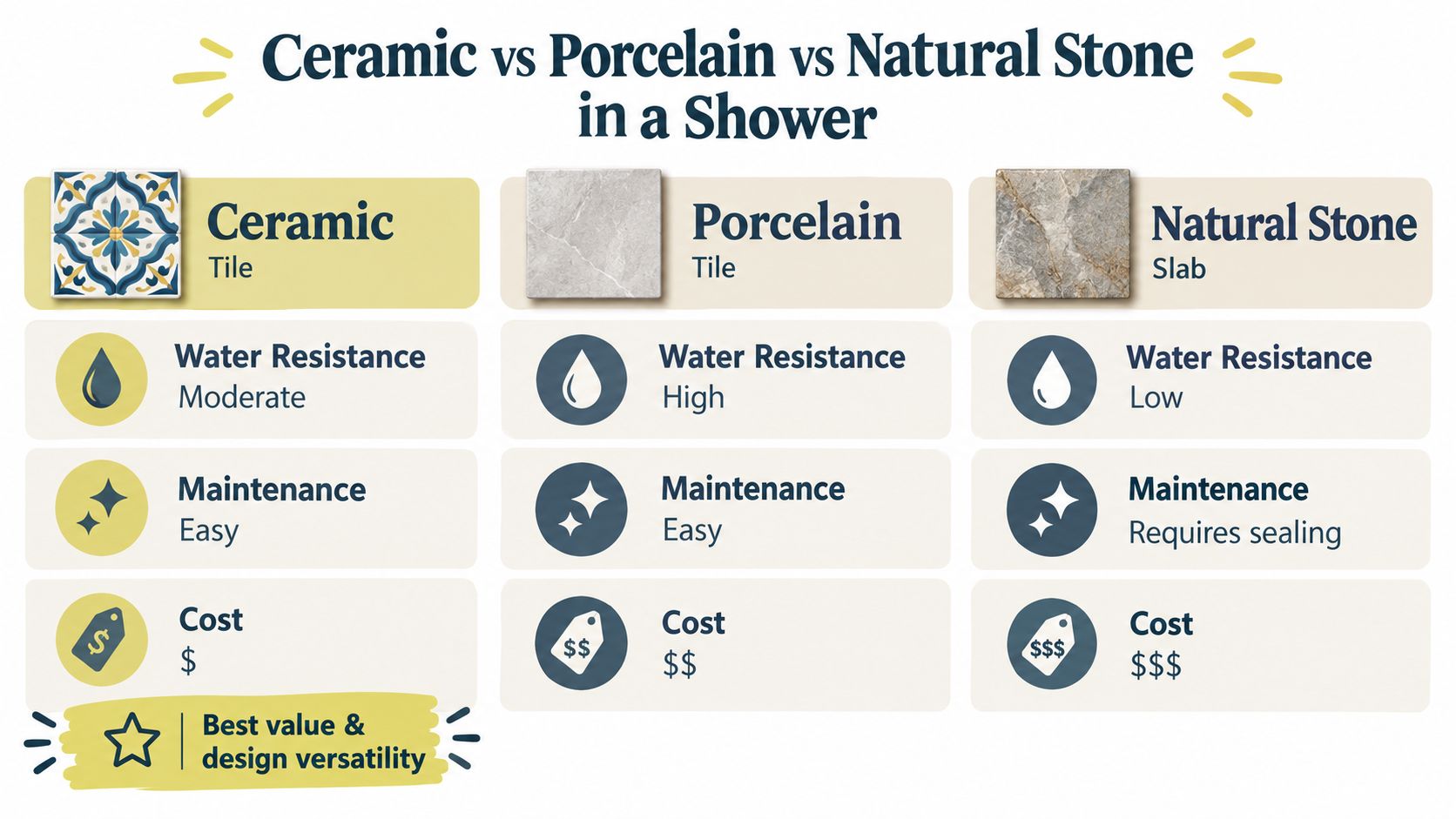
Ceramic, porcelain, and natural stone can all produce a beautiful shower, but they earn their place in different ways. My practical comparison is simple: ceramic offers the broadest design vocabulary, porcelain offers the densest body, and natural stone offers the most individual character with the most upkeep.
Ceramic earns its place through flexibility
Ceramic is my first recommendation for a design-led shower wall when the product's absorption and intended-use data are appropriate. Glazes make room for rich color, patterned surfaces, handmade variation, relief, and unusual shapes. Ceramic is also generally easier to cut and shape, which matters around niches, valves, corners, and detailed borders.
Its limitation is not aesthetic. It's the need to verify the specific product rather than assume every ceramic tile performs the same way in a continuously wet environment. The body, glaze, format, and manufacturer's rating all matter.
Porcelain favors demanding conditions
Porcelain is recognized as porcelain at 0.5% or less absorption under ASTM C373 testing, making it the dense choice for heavy moisture exposure. It works particularly well when a client wants one material to move from the shower floor to the walls, or when a marble, limestone, concrete, or wood appearance needs a lower-maintenance manufactured surface.
For a deeper look at the material, see this guide to porcelain tile for shower. The trade-off is that dense porcelain can demand more capable cutting, handling, and installation. A harder tile isn't automatically a better choice if the crew lacks the equipment or experience to install it cleanly.
Stone brings authenticity, but asks for care
Natural stone has a quality manufactured tile can't fully reproduce. Veining, mineral variation, and subtle shifts in tone give a shower a sense of place. Marble can feel refined and luminous, slate can feel grounded, and limestone can introduce a quieter, softer texture.
Stone also asks more from the owner. Porous varieties may require sealing and more attentive maintenance, and the surface can respond more visibly to water, minerals, cleaners, and wear. I recommend it when the client values natural variation enough to accept the care, not because stone automatically signals quality.
| Material | Best fit | Main trade-off |
|---|---|---|
| Ceramic | Color, pattern, handmade character, design flexibility | Verify wet-area suitability |
| Porcelain | Dense, consistent, lower-absorption performance | More demanding fabrication |
| Natural stone | Individual character and material depth | Sealing and maintenance |
My candid verdict: use ceramic when design expression leads, porcelain when performance and continuity lead, and stone when the homeowner wants the material's living variation and accepts its maintenance profile.
Large-Format Tile and the Trade-offs Most Articles Skip
Large-format tile can make a shower feel quiet and architectural. It can also expose every weakness in the room.
A 12-by-24-inch format is common, while 24-by-48-inch tile is an emerging aspirational size, according to current industry reporting from Floor Focus. Fewer grout joints may reduce discoloration and erosion concerns, but they don't make the shower waterproof. The membrane remains responsible for water management.
The larger the piece, the more consequential the substrate becomes. Walls need to be flat, corners need to be controlled, and the installer has to coordinate cuts around niches, valves, benches, and shelves without creating awkward slivers. Transport and handling also become more difficult, and breakage is more expensive to absorb when a replacement has to be ordered.
The format has to answer the room
Large tile works best when the wall dimensions allow intentional cuts. A design that produces a narrow strip beside the valve wall or an interrupted pattern around the niche may look less resolved than a smaller format with more forgiving proportions.
There's also a practical repair question. A large replacement piece may be harder to source, move, cut, and install without disturbing adjacent surfaces. If a movement joint must remain visible in the field, the designer should decide whether its location supports the composition instead of pretending the joint won't exist.
Fewer joints simplify cleaning only when the installation itself remains controlled.
For shower floors, large format introduces another issue: slope. A floor tile must coordinate with the drainage plane, and smaller mosaics usually follow that geometry more gracefully. I prefer large formats on walls when the room, installer, lighting, and maintenance goals support them. I don't specify them because a magazine photograph made the room look serene.
Format is a collaboration between designer and installer. The right choice considers wall tolerances, room proportions, accessibility, replacement risk, and the visual importance of grout. Cleaning convenience is only one part of the lifecycle.
Grout, Ventilation, and Long-Term Maintenance
The shower's daily life is shaped by details that rarely appear in the inspiration photograph. Grout color, joint layout, surface texture, ventilation, and cleaning rhythm all belong in the original specification.
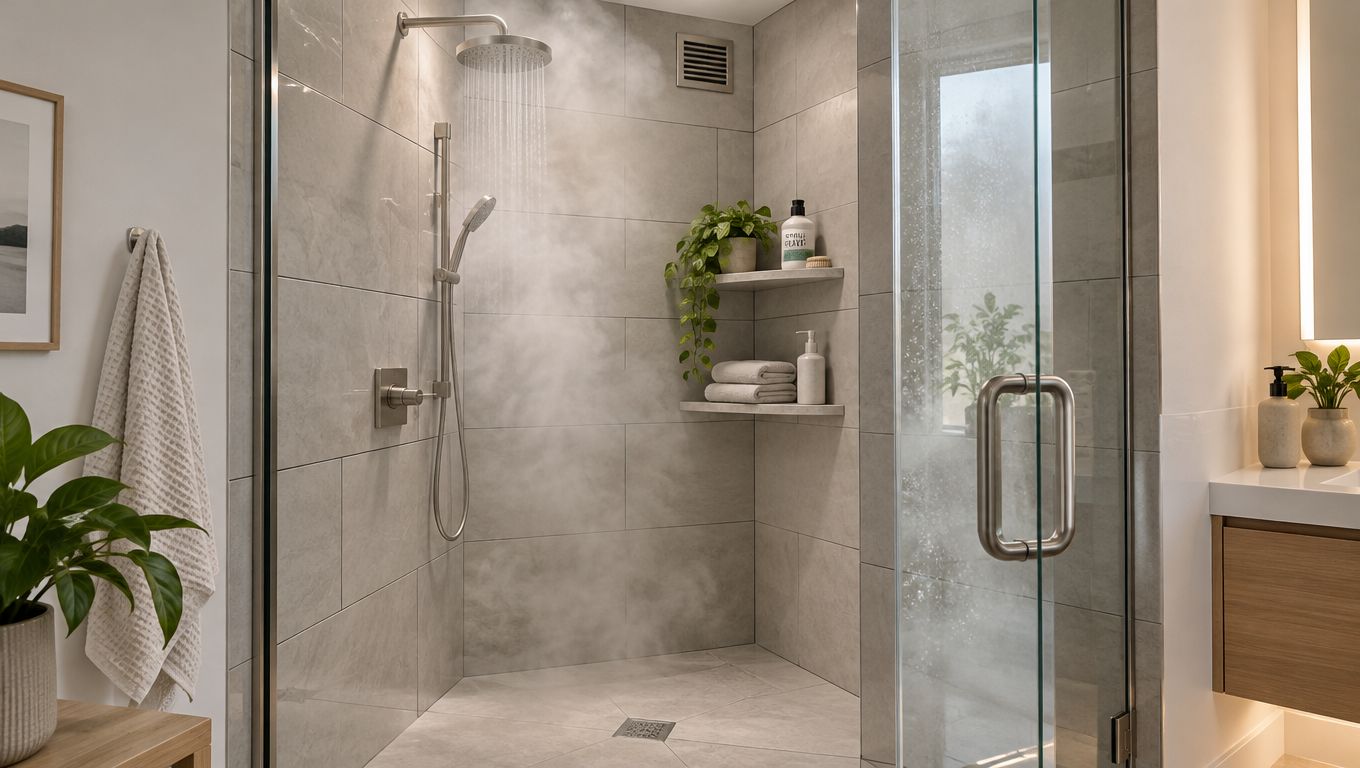
Light grout creates a crisp, precise pattern, but it can show residue more readily. Dark grout may conceal some daily marks while changing the visual weight of the installation. A heavily textured tile can add depth and character, yet it gives soap film more places to settle. I want clients to choose the maintenance profile as deliberately as they choose the palette.
The U.S. Environmental Protection Agency advises that when mold repeatedly appears in a shower or bathroom, increasing ventilation by running the exhaust fan or opening a window, along with cleaning more frequently, will usually prevent recurrence or keep it to a minimum. That advice appears in the EPA's guide to mold, moisture, and your home.
A good plan considers how quickly the room dries, where the exhaust fan is located, how the enclosure holds moisture, and whether the door configuration allows air to move. It also accounts for the homeowner's willingness to wipe down textured surfaces or maintain natural stone.
The guide to cleaning a ceramic tile shower should be part of the handoff conversation, not something discovered after the first discoloration appears.
Here's a useful rhythm to establish before construction:
- After use: Remove standing water and allow the enclosure to dry.
- Regularly: Clean soap residue before it builds into a film.
- As needed: Address grout discoloration, sealant deterioration, or failed soft joints promptly.
- Seasonally: Review ventilation performance and inspect corners, penetrations, and drain transitions.
A well-designed shower isn't maintenance-free. It is designed so the maintenance is understandable, accessible, and proportionate to the materials selected.
The room should dry before its surfaces are asked to perform again.
Designing a Shower That Looks Considered on Day One
The strongest shower designs don't announce their technical decisions. They let the proportions feel calm, the grout alignments feel intentional, and the materials support the way the room is used.
That result comes from treating the visible tile and hidden assembly as one conversation. A ceramic wall tile may set the mood, but the floor format, drain position, waterproofing transitions, grout, movement joints, lighting, and ventilation determine whether that mood survives daily life.
For homeowners in Washington, DC, Maryland, Virginia, and Delaware, Jennifer Gilmer Kitchen & Bath brings material selection, space planning, and installation coordination into the same design process. The firm works with clients from concept through installation, including the tile, grout, layout, and construction details that make a shower function as a complete room rather than a collection of finishes.
If you're planning a shower renovation, Jennifer Gilmer Kitchen & Bath can help evaluate ceramic, porcelain, stone, format, grout, waterproofing, and layout as one coordinated design. Visit the firm's website to begin a conversation about a bathroom that looks composed on opening day and remains practical to live with.