.avif)
You're probably in one of two places right now. Your bathroom still works, but it no longer feels aligned with the way you live. Or you're planning a renovation and finding that most coverage of bathroom design trends 2025 leans either too fleeting or too generic to be useful.
Designing for Daily Ritual: A Look Toward 2025
As we look toward 2025, the conversation around bathroom design has evolved. No longer a purely utilitarian space, the modern bathroom is a sanctuary, a place for quiet ritual and personal restoration. At Jennifer Gilmer Kitchen & Bath, we believe thoughtful design is the foundation of a life well-lived, starting with the spaces we inhabit daily. Our approach, honed over years of serving clients in the Washington DC, Maryland, and Virginia areas, is to craft environments that are both beautiful and personal. This curated guide, drawing on insights from our team, including founder Jennifer Gilmer, CKD, explores the trends that will define the most thoughtful bathrooms of the coming year.
Table of Contents
1. Warm Minimalism and Layered Neutrals
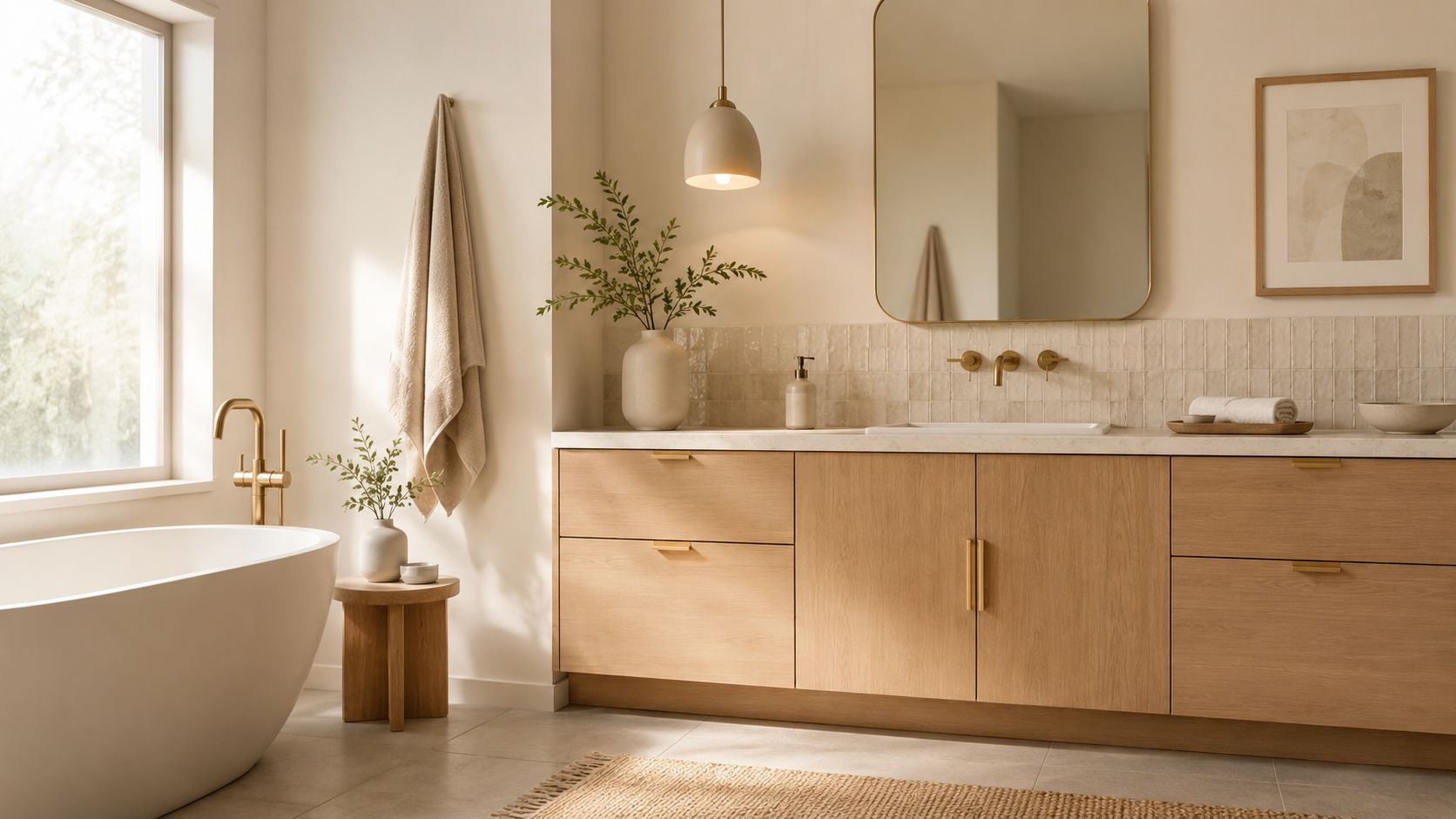
The all-white bathroom is losing ground to something more livable. Warm minimalism keeps the clean lines people still want, but it replaces stark contrast with creamy ivories, soft taupes, warm grays, pale clay tones, and natural wood.
That shift makes sense for homes across Washington DC, Maryland, and Virginia, where many primary baths need to feel calm without reading cold. Jennifer Gilmer Kitchen & Bath often approaches this look through material layering rather than visual excess. A white oak vanity, limestone-look porcelain, brushed brass hardware, and a paint color with a soft undertone will always age better than a room built around one sharp trend.
Soft color, stronger architecture
This palette works best when the room has discipline. Keep cabinetry profiles simple. Let the stone, tile, and lighting carry the nuance.
- Layer matte and sheen: Pair matte painted cabinetry with glazed ceramic tile or a soft reflective wall finish.
- Choose warmth in metal: Brushed brass, satin bronze, and muted nickel sit comfortably with layered neutrals.
- Use one tactile focal point: A fluted sconce, hand-finished zellige-style tile, or ribbed glass pendant adds depth without clutter.
A practical example. In a compact Bethesda bath, a warm white vanity paired with pale taupe wall tile and a cream countertop will feel larger than a high-contrast black-and-white scheme. In a McLean primary suite, the same approach can become more architectural with slab surfaces, integrated lighting, and a restrained plaster-like wall color.
Warm minimalism isn't about less personality. It's about removing visual noise so materials can do the talking.
2. Integrated Wellness and Spa Features
Bathrooms are being designed for recovery, not just routine. That doesn't mean a room has to become theatrical. It means every feature should support comfort, ease, and a sense of retreat.
The strongest evidence sits with wellness itself. According to the NKBA 2025 Bath Trends Report, 73% of industry experts identify spa-like design as the top bathroom trend for 2025. The same report notes growing demand for motion-controlled lighting at 67%, smart showers at 59%, smart toilets at 57%, and heated flooring at 57%. Those features aren't indulgent add-ons anymore. They're becoming part of how homeowners shape a restorative daily ritual.
For clients planning a primary suite, Jennifer Gilmer Kitchen & Bath often begins with the essentials. Floor warming near the vanity. A shower with reliable temperature control. Ventilation that clears humidity quickly. Lighting that shifts from bright morning function to a softer evening setting. If you're thinking through a larger retreat, our perspective on a master suite sanctuary in your DMV home offers a useful starting point.
Wellness that works every day
Lead with performance. A steam enclosure without proper air movement and moisture planning will disappoint quickly.
- Prioritize ventilation first: Steam, radiant heat, and warm finishes demand excellent moisture control.
- Select intuitive fixtures: Controls should be simple enough to use half awake on a weekday.
- Zone your comfort features: Heated flooring is often most effective near the vanity, shower entry, and tub.
- Coordinate heat thoughtfully: Practical inspiration can come from contemporary heating solutions for bathrooms, especially when balancing comfort with wall space.
A well-designed wellness bath feels quiet. You notice it in warm floors on a winter morning, in a mirror that doesn't fog, in lighting that flatters rather than glares.
Before the next point, here's a visual look at spa-focused planning in motion.
3. Sustainable Materials and Water-Conscious Design
Sustainability in the bath has matured. Clients aren't asking for materials that merely sound responsible. They want surfaces and fixtures that wear well, clean easily, and make sense in a wet environment.
That's where careful specification matters. Wood vanities, natural stone, recycled surfaces, and water-saving fixtures can all belong in a well-appointed room, but they need to be selected with the room's humidity, sunlight, and maintenance habits in mind. Across DC, Maryland, and Virginia, older homes often need added moisture management before any beautiful material can perform properly.
Choose materials with a maintenance plan
Some trend coverage celebrates natural finishes without addressing the upkeep they require. A more grounded approach is to compare the romance of a material with the reality of daily use. The Hansgrohe bathroom trends overview points to strong interest in large-format flooring while also emphasizing smaller or no grout lines for durability. That aligns with what Jennifer Gilmer Kitchen & Bath sees in practice. Fewer joints usually mean easier maintenance and a calmer visual field.
If you're weighing classic stone against engineered surfaces, or trying to decide whether reclaimed wood belongs near a shower zone, our guide to timeless bathroom materials for Maryland homeowners is worth reading.
Practical rule: In wet zones, choose the material you can maintain consistently, not the one you admire only in photographs.
A real-world example. A family in Arlington may love the look of a walnut vanity and honed marble top. That can work beautifully if the room has strong ventilation, thoughtful sealing, and habits that match the material. If not, porcelain, quartz, and expertly finished cabinetry often deliver the same warmth with less strain.
4. Moody and Dark Bathroom Palettes
Dark bathrooms have moved well beyond powder room novelty. In 2025, charcoal, ink, olive, aubergine, and warm black are being used with more confidence, especially where homeowners want intimacy and character.
This is one of the most elegant bathroom design trends 2025 has encouraged, but it only succeeds when the supporting elements are equally considered. Good lighting, reflective accents, and tonal variation matter more in a dark room than in a pale one. Without them, the palette can flatten.
A navy vanity against a limestone-look floor. Deep olive walls paired with unlacquered brass. Warm black paneling with a honed marble counter. These combinations feel composed because each one balances shadow with light.
Dark color needs disciplined lighting
Don't rely on a single ceiling fixture. You need layered illumination at the mirror, ambient light that softens the corners, and a bit of accent lighting to reveal texture.
- Use contrast deliberately: Pale stone, off-white plaster, and light oak keep dark walls from feeling heavy.
- Specify bathroom-rated finishes: Moisture-resistant paint and proper trim detailing protect the investment.
- Sample every color in place: Morning light, evening light, and artificial light can produce three different rooms.
The best local applications are often in rooms with a clear architectural envelope. A Georgetown powder room can carry a dramatic lacquered tone. A larger primary bath in Potomac may call for a quieter, matte, cocooning shade with integrated sconces and restrained metalwork.
5. Maximalist Storage and Open Shelving Integration
Storage has become one of the clearest dividing lines between a pretty bathroom and a successful one. Homeowners still admire airy vanities and open shelving, but they also want a place for skin care, electrical tools, spare towels, medicine, and the clutter that daily life produces.
That practical demand is measurable. The NKBA bath trends coverage from CTA Design + Build reports that 83% of surveyed homeowners seek vanities with customizable storage modules, and 79% agree that integrated power outlets within vanities or medicine cabinets are shifting from luxury to standard expectation. That's exactly the kind of functional refinement Jennifer Gilmer Kitchen & Bath prioritizes from the start.
Storage first, styling second
Open shelving can be lovely, but it should never carry the burden of the whole room. Closed storage is what makes open display possible.
- Build in categories: Dedicate zones for daily grooming, backups, linens, and cleaning supplies.
- Add power where it belongs: Interior outlets in a vanity drawer or medicine cabinet reduce countertop clutter.
- Use open shelving sparingly: Reserve it for rolled towels, ceramic containers, or a few handsome bottles.
For clients refining vanity interiors, our article on bathroom vanity organization ideas offers practical direction.
A useful scenario. In a row house bath on Capitol Hill, a customized vanity with drawer dividers, pull-outs, and integrated charging will outperform a floating cabinet with nowhere to hide essentials. Open shelves can still appear, but they should read as decoration supported by serious storage behind the scenes.
6. Curved and Organic Geometry
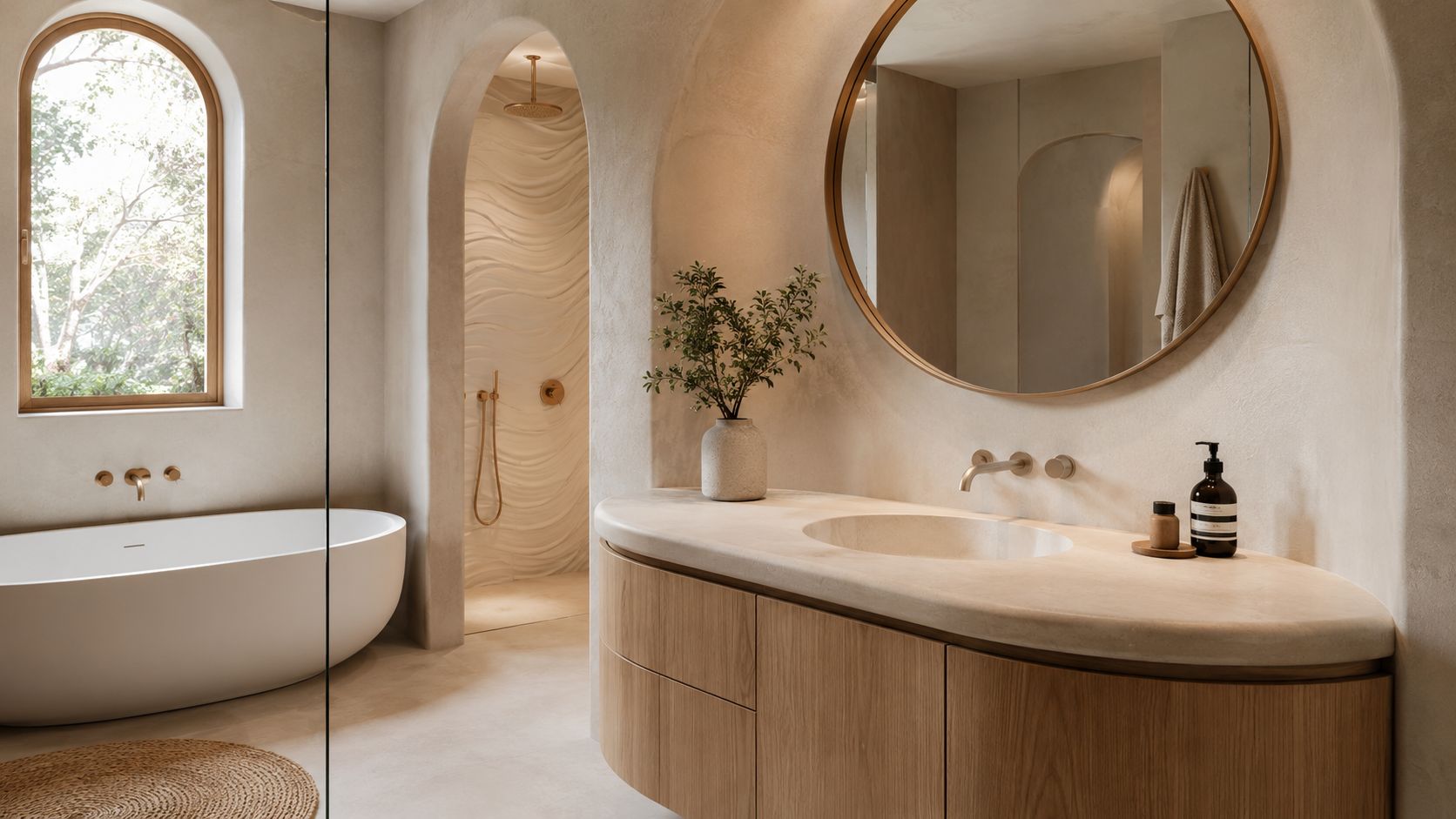
Bathrooms have spent years dominated by straight edges and rigid profiles. Now the room is softening. Curved vanity corners, arched mirrors, rounded plumbing silhouettes, and gentle transitions in tile are making the bath feel more humane.
This isn't about novelty. Curves change how a room moves. They can ease circulation in a tight plan, soften a bank of cabinetry, and make a compact bath feel less abrupt. Jennifer Gilmer Kitchen & Bath often uses this language in measured ways, especially where a room needs grace without sacrificing utility.
Where curves belong
A curved detail works best when it solves something. It might soften a vanity edge near a doorway. It might appear in an arched medicine cabinet that echoes a window shape. It might turn up in a shower niche, where the room benefits from a more sculpted gesture.
Use curves where the body encounters the room. Vanity corners, mirror edges, faucet profiles, and passage points matter more than decorative flourishes that never earn their keep.
Try balancing the softness with structure. Pair a rounded vanity front with a rectilinear floor tile. Use an arched mirror above a disciplined stone counter. In a Chevy Chase primary bath, that mix can feel customized rather than thematic.
7. Personalized, Non-Prescriptive Color
The safest bathroom isn't always the most valuable one. More homeowners are choosing color that reflects their own sensibility rather than a resale cliché. That shift is visible in subtle sage, clay, muted plum, mineral blue, and richer, room-like tones that once stayed outside the bath.
Color is even returning to fixtures. The Woman & Home trend report notes the return of colored sanitaryware, including avocado green, reintroduced as a modern take on a retro palette. Used carefully, that kind of reference can feel witty and current rather than nostalgic in the wrong way.
Color with conviction
A personalized palette doesn't require a fully saturated room. It may be a painted vanity, a colored basin, or a wallpapered powder room that carries the idea.
- Test undertones carefully: A green can read mossy, gray, or yellow depending on your lighting.
- Keep one large surface calm: If walls are expressive, let the tile or countertop rest the eye.
- Use powder rooms boldly: Smaller spaces invite more character and less hesitation.
A practical example. In a Northern Virginia powder room, terracotta walls with a stone sink and brass mirror can feel intimate and polished. In a larger family bath, color may be better introduced through cabinetry or wallcovering rather than floor-to-ceiling tile.
8. Mixed Material Finishes and Textural Contrast
Bathrooms feel richer when every surface doesn't match. The best rooms now pair smooth with tactile, matte with polished, and warm with cool. That contrast gives the eye somewhere to land.
One finish worth noting is marble itself. The Veranda design report points to honed marble as the preferred finish for 2025, and designer Rayman Boozer says, “we don't need everything glossy anymore.” That idea applies far beyond marble. Restraint and texture often feel more enduring than shine alone.
Build a restrained material palette
Mixing materials requires editing. Too many surfaces compete. Too few, and the room feels flat.
- Choose hero materials first: Perhaps a honed marble, white oak, and aged brass.
- Let supporting materials stay quiet: Porcelain wall tile or painted millwork can provide relief.
- Think about touch as much as sight: A ribbed drawer front, leathered stone, or matte ceramic adds presence.
If you're investing in custom cabinetry, the question isn't only style. It's fit, finish, and how the vanity works every day. That's why pieces on why choose a custom bathroom vanity continue to resonate with homeowners who want furniture-level quality in a hard-working room.
9. Smart Technology Integration and Invisible Systems
The smartest bathroom doesn't look technological. It feels effortless. Lighting adjusts naturally. Mirrors stay clear. The shower starts at the right temperature. Outlets are placed where you need them and hidden where you don't.
Projected 2026 preference data reinforces that shift toward practicality. In a Forbes summary of the 2026 AIA survey, stall showers without tubs rise to 49.3%, universal or adaptable design reaches 39.4%, and 55% of renovating homeowners choose fully custom or semi-custom solutions. Those figures suggest a bathroom that serves the way people live, with technology folded into comfort and accessibility rather than displayed as spectacle.
Technology should disappear into the room
Good integration starts before fixture selection. Electrical planning, wall depth, ventilation pathways, and control locations all need to be solved early.
A few examples from current practice help. A medicine cabinet with interior power keeps toothbrushes and razors off the counter. A humidity-sensing fan clears moisture automatically. A heated mirror prevents fogging without adding visible clutter. A smart toilet belongs only if the room has the right power, clearances, and user comfort with the interface.
The right smart feature removes friction. If it adds complication, it doesn't belong in the room.
10. Biophilic Elements and Natural Light Maximization
Natural light remains one of the most persuasive luxuries in bathroom design. It changes every material for the better. Stone gains depth. Paint reveals undertones. Brass softens. Even simple ceramic tile feels more considered.
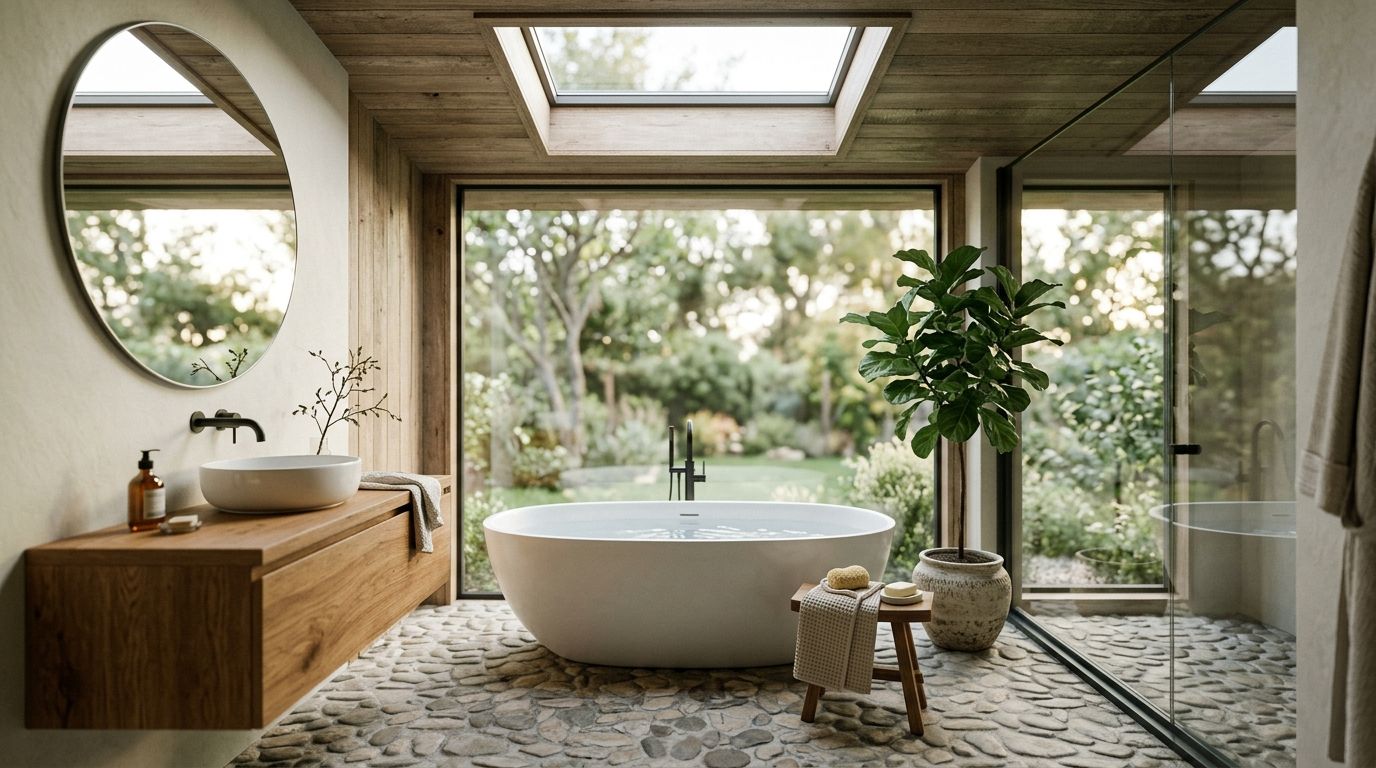
This trend isn't only about a plant on a windowsill. It's about planning the room around daylight, privacy, and a visual connection to the outdoors. In the Washington region, where mature landscaping often surrounds established homes, a carefully placed window can frame greenery and shift the entire mood of a bath.
Design around daylight
One of the most immersive directions here is surface continuity. A design discussion on stone drenching describes the growing use of the same stone across walls, floors, and shower interiors to create a continuous envelope. In a light-filled room, that approach can feel serene and architectural.
Pair daylight with materials that respond well to it. Honed stone, limewashed tones, natural oak, and even statement wallcoverings can all become more expressive in natural light. The House Beautiful roundup on statement wallcoverings also points to wallpaper as a leading way to personalize powder rooms and primary baths, especially where tile alone would feel too neutral.
A practical note for local homes. Privacy glass, clerestory windows, and well-placed skylights often offer the best compromise. You get daylight without overexposing the room, and the bathroom still feels protected.
Bathroom Design Trends 2025, 10-Point Comparison
| Trend | Implementation Complexity 🔄 | Resources & Cost ⚡ | Expected Outcomes 📊 | Ideal Use Cases | Key Advantages ⭐ | Quick Tip 💡 |
|---|---|---|---|---|---|---|
| Warm Minimalism and Layered Neutrals | Low–Medium, straightforward finishes, careful material selection | Moderate, quality materials (wood, warm metals) preferred | ⭐⭐⭐⭐, calm, timeless, spa-like warmth; adaptable | Primary & small bathrooms seeking warmth without clutter | Timeless aesthetic, flexible updates, perceived spaciousness | Layer matte and soft‑gloss finishes; use warm metal hardware |
| Integrated Wellness and Spa Features | High, plumbing/electrical upgrades, steam/heat integration | High, radiant heat, steam, specialty fixtures, ventilation | ⭐⭐⭐⭐⭐, strong comfort, health benefits, high market appeal | Luxury primary suites, regional homes prioritizing year‑round comfort | Multi‑sensory relaxation, increased resale value | Prioritize high‑capacity ventilation and separate circuits |
| Sustainable Materials and Water‑Conscious Design | Medium, sourcing and specification work; possible retrofit needs | Moderate–High, certified materials can cost more upfront but save long term | ⭐⭐⭐⭐, lower utility use, environmental impact, potential rebates | Eco‑minded homeowners, incentive‑eligible projects | Reduced operating costs, market appeal to conscious buyers | Specify WaterSense/EPA‑certified fixtures and local reclaimed sources |
| Moody and Dark Bathroom Palettes | Medium, color/lighting coordination essential | Moderate, paint and quality finishes; lighting upgrades recommended | ⭐⭐⭐⭐, dramatic, intimate, luxurious statement | Powder rooms, primary baths for bold, personal expression | Strong visual impact; highlights fixtures and hides wear | Layer ambient, task, and accent lighting; test colors in situ |
| Maximalist Storage and Open Shelving Integration | Low–Medium, shelving layout and styling discipline required | Low–Moderate, shelving, baskets, attractive containers | ⭐⭐⭐⭐, personalized, highly functional, visually rich | Family baths, styling‑focused homeowners, guest baths | Increased accessible storage; displays personality | Limit palette of displayed items; curate regularly to avoid clutter |
| Curved and Organic Geometry | High, custom or semi‑custom millwork and nuanced installation | High, custom cabinetry/fixtures and specialized labor | ⭐⭐⭐⭐, softer, human‑scaled spaces with distinctive identity | High‑end remodels, statement powder rooms, boutique homes | Welcoming aesthetic; safety (no sharp corners); memorable design | Balance curves with some linear elements to maintain clarity |
| Personalized, Non‑Prescriptive Color | Low, paint and finish choices; coordination needed | Low, cost mainly paint/finishes; cabinetry color may increase cost | ⭐⭐⭐, highly personal, immediate visual impact; risk of dating | Powder rooms, master baths, homeowners wanting bold statements | Distinctive, emotional connection at modest cost | Test colors at different times of day and check undertones |
| Mixed Material Finishes and Textural Contrast | Medium–High, careful coordination and skilled installation | Moderate–High, multiple material sources and trades | ⭐⭐⭐⭐⭐, rich, curated-looking spaces with depth and longevity | Projects emphasizing craft, materiality, or layered aesthetics | Visual complexity; allows performance materials in functional zones | Pick 2–3 hero materials and use others as supporting accents |
| Smart Technology Integration and Invisible Systems | High, wiring, Wi‑Fi, and coordinated controls required | High, smart fixtures, sensors, and infrastructure investment | ⭐⭐⭐⭐, convenience, efficiency, hygiene; potential maintenance overhead | Smart homes, accessible bathrooms, tech‑forward renovations | Water/energy savings, automation, perceived luxury | Choose reliable platforms, include manual overrides, ensure strong Wi‑Fi |
| Biophilic Elements and Natural Light Maximization | Medium, glazing/skylight decisions and plant integration | Moderate, windows/skylights, plant care, durable natural materials | ⭐⭐⭐⭐, improved mood, daylighting, reduced artificial light use | Homes with good exposure, wellness‑focused designs, garden‑adjacent baths | Psychological wellbeing, perceived spaciousness, energy savings | Position windows to balance light without glare; ensure ventilation for plants |
From Inspiration to Installation Bringing Your Vision to Life
A successful bathroom renovation is more than a collection of trends. It's a carefully orchestrated process that balances inspiration with craftsmanship. The most memorable rooms don't chase every new idea. They edit wisely, choose materials with discipline, and solve the daily rituals that matter most.
That's where a full-service design relationship becomes so valuable. Jennifer Gilmer Kitchen & Bath handles projects from concept through installation, which means the early decisions about layout, plumbing placement, lighting, storage, cabinetry, and finishes stay connected all the way through execution. For homeowners in Washington DC, Maryland, and Virginia, that continuity protects both the design intent and the finished result.
Just as important, the best trend decisions are always personal. Warm minimalism may feel right in one home, while a moody palette, expressive wallpaper, or curved vanity profile may better suit another. Jennifer Gilmer, CKD, has long approached bath design with that level of specificity. The room has to reflect the architecture of the house, the pace of the household, and the people using it every day.
At Jennifer Gilmer Kitchen & Bath, that work is shaped by a team with deep experience in design and execution. Designers including Nancy McCarren, AIA, LEED AP, and Marie-Josée Parisi guide clients through layout refinement, material selection, storage planning, and the thousands of quiet decisions that determine whether a bathroom looks current or lives well. The process is collaborative, but it's also decisive. Clients don't need more inspiration boards. They need a clear path.
That path often begins in one of the firm's showrooms, where materials can be seen in person and combinations can be tested with confidence. Visiting Chevy Chase, Easton, or Ashburn gives you a better understanding of finish, scale, and craftsmanship than any mood board can provide. It also gives the design conversation a practical foundation, which is where good work starts.
If you're weighing a bathroom renovation, use these bathroom design trends 2025 as a filter, not a script. Keep the ideas that improve how the room feels and functions. Let go of the ones that won't hold up to your habits, your home, or your standards. Even an unexpected source of remodeling perspective can reinforce the value of thoughtful planning, including broader homeowner guidance like Advice for Big Bear vacation rentals, which reflects how much better renovations go when utility and experience are considered together.
The right bathroom doesn't announce itself as trendy. It feels composed, personal, and resolved from the first sketch to the final installation.
If you're ready to create a bathroom that feels designed specifically for your home and the way you live, start the conversation with Jennifer Gilmer Kitchen & Bath. Visit a showroom in Chevy Chase, Easton, or Ashburn, or schedule a consultation to explore a renovation shaped by thoughtful design, craftsmanship, and a clear point of view.