.avif)

You're standing in a showroom with one hand on a painted semi-custom door and the other on a custom inset sample. Your contractor is waiting for a deposit, your phone holds a growing spreadsheet, and the closing date or move-in date is uncomfortably close. The question isn't just which finish you prefer. It's whether your cabinet order will arrive in time, whether the installation crew can execute the details, and whether the final specification leaves enough room for the rest of the renovation.
That's why the decision between custom vs semi-custom cabinets deserves more attention than a quick comparison of door styles. Cabinetry determines appliance fit, circulation, storage, trim, lighting coordination, and the order in which other trades work. In the Washington, DC, Maryland, and Virginia market, where project schedules are tightly sequenced and skilled labor can be difficult to secure, the cabinet category also establishes the project's exposure to delay.
Table of Contents
- Start with fit, then choose the finish
- Work backward from the date that matters
- Price the service you'll use
- Ask about origin and labor without apology
Setting the Scene in the Showroom
The showroom smells faintly of wood, lacquer, and coffee. On one wall, a semi-custom display shows a disciplined run of cabinets, clean proportions, and a finish palette broad enough to support most design directions. Across the aisle, a fully custom kitchen has the quiet precision of furniture. The doors sit flush, the island fits the room without apology, and every drawer appears to have been considered around a particular task.
You're not choosing between attractive and unattractive. You're choosing how much control you need over the room and how much uncertainty you're willing to carry.
A semi-custom order starts with a manufacturer's system. The factory offers established cabinet sizes, construction methods, door profiles, and finishes, then allows selected modifications. Custom cabinetry begins with the room itself. The designer and cabinetmaker determine the dimensions, construction, materials, and interior details around the architecture and the way you live.
The cabinet decision sets the renovation's rhythm
Cabinets form the structural spine of a kitchen. Their dimensions influence where an appliance can sit, how a countertop is supported, whether a pantry door clears an island, and how trim meets a ceiling or adjacent room. A cabinet decision made too casually can create downstream changes to plumbing, electrical work, flooring, tile, and installation.
High-end residential cabinetry also involves more than manufacturing. The process can include field measurements, shop drawings, approvals, production, shipping, and installation, so the full sequence can extend beyond the cabinet lead time itself, as described in this overview of custom and semi-custom cabinetry planning.
In the DC metro area, that sequence matters. A cabinet delivery that slips can leave an installer, countertop fabricator, electrician, or painter waiting for access. A custom shop may offer the exact solution your room needs, but its schedule depends on available craftspeople and the shop's production queue. Semi-custom cabinetry may be easier to coordinate, but only if the selected line can solve the room's actual dimensional problems.
The practical question: Which cabinet category gives this particular room the right fit without creating schedule risk you can't afford?
Jennifer Gilmer Kitchen & Bath works with homeowners across Washington, DC, Maryland, and Virginia on projects that move from concept through installation. In that setting, the cabinet choice is part of a larger design decision, not an isolated product purchase.
What Defines Custom and Semi-Custom Cabinetry
The labels matter less than the manufacturing process behind them. A homeowner should be able to ask how a cabinet is sized, what can be modified, and which construction details are fixed before comparing finishes.
Semi-custom starts with a manufacturer's framework
Semi-custom cabinets are typically manufactured from preset modules that can be adjusted within defined limits. You choose from a catalog of cabinet widths, heights, depths, door styles, finishes, and accessories. Some manufacturers permit dimensional changes, while others keep modifications narrow. Ask to see the actual modification guide rather than relying on the phrase “semi-custom.”
At the showroom, inspect the cabinet with your hands. Look at the edge banding on exposed panels, the thickness and material of the drawer box, the way the back panel is fitted, and whether the hardware feels deliberate or merely functional. Open a drawer fully and check whether the slide remains smooth under load. Examine the back of the door, where an uneven finish or rough transition can reveal how carefully the line is produced.
A semi-custom line can offer strong construction, but the factory controls the underlying system. Its box dimensions, joinery, door profiles, and finish chemistry generally come from a defined program. That consistency can be valuable, especially when the room is conventional and the selected options work without excessive modification.
For homeowners considering a future refresh rather than a full replacement, Global Construction Team LLC cabinet refinishing offers useful background on how existing cabinetry can be renewed. Refinishing doesn't turn stock or semi-custom boxes into custom cabinetry, but it can be a sensible path when the layout and construction already serve the household.
Custom begins with the room
Custom cabinets are built for a specific kitchen rather than selected from a limited factory grid. The designer can specify face-frame or frameless construction, tailor drawer heights to the items stored inside, coordinate appliance panels, and select materials according to the project rather than a brand catalog.
Look for details that support that claim. Custom work may include dovetail drawer joinery, carefully controlled reveals, bespoke interior accessories, and material selection driven by the specifier. Ask whether the cabinetmaker can adjust an internal shelf, change a drawer configuration, or alter a cabinet depth without forcing the entire design into a preset module.
Construction still matters more than the word “custom.” Federal architectural standards commonly reference 3/4-inch industrial-grade particleboard at approximately 640 to 800 kg/m3, while plywood framing panels are specified as veneer-core hardwood plywood, according to the federal architectural cabinet standard. Those specifications don't determine whether a cabinet is custom or semi-custom, but they show why the box material deserves a direct question.
For a focused explanation of the middle category, see this guide to semi-custom cabinets. Bring the vocabulary into the showroom, then ask for samples that let you compare construction rather than marketing language.
Comparing the Two Side by Side
At the showroom table, the right choice depends less on the label than on the project's exposure to delay, labor demands, and sourcing changes. Semi-custom is usually the better fit when the room works within a manufacturer's program and factory production protects the schedule. Custom earns its premium when exact dimensions, unusual geometry, or tighter material control solve a real problem.
| Criterion | Custom Cabinets | Semi-Custom Cabinets |
|---|---|---|
| Design flexibility | Built to project-specific dimensions for unusual heights, angled corners, curves, integrated appliance panels, and tailored storage. | Uses preset modules with selected modifications. Strong for conventional layouts, curated door styles, and defined finish programs. |
| Construction control | The designer and cabinetmaker can specify box construction, face-frame or frameless approach, drawer proportions, joinery, and materials. | Construction is standardized by the manufacturer and varies by line. Review box material, drawer joinery, finish, hinges, and slides. |
| Typical lead time | Often 8 to 16+ weeks, with measuring, drawings, approvals, shipping, and installation potentially extending the process. | Usually about 4 to 8 weeks for manufactured-to-order cabinetry, subject to the selected line, finish, and order requirements. |
| Market position | Premium, made-to-measure cabinetry. | Dominant middle tier, balancing personalization with manufacturing efficiency. |
| Pricing reference | Around USD 700 per linear foot in the cited industry coverage. Semi-custom and custom cabinet pricing guide | Around USD 350 per linear foot, compared with approximately USD 150 per linear foot for RTA in the cited market analysis. Cabinet market pricing analysis |
| Finish selection | Material, color, sheen, and finish details can be developed around the specification and shop capabilities. | Selected from the manufacturer's curated palette, with options varying by brand. |
| Warranty and longevity | Warranty depends on the cabinetmaker and purchase terms. Longevity depends on materials, joinery, finish, hardware, and installation. | Warranty depends on the manufacturer and line. Factory consistency can help, but specifications still need review. |
| Installation considerations | Requires careful field measuring, shop drawings, and an installer comfortable with site-specific fitting and fine trim work. | Often simpler to coordinate, though walls, floors, and ceilings still need accurate measuring and thoughtful scribing. |
| Best reason to choose it | The room requires exact dimensions, unusual details, or material control unavailable through a catalog. | The room is relatively conventional and you want design choice, dependable production, and a shorter path to installation. |
The following table compares the two categories across the criteria that matter for a remodel decision. The pricing references also show why a tier name cannot establish value. A heavily modified semi-custom order can approach custom pricing, while a well-specified semi-custom line can provide strong construction without charging for dimensions the room does not need.
Semi-custom also matters because it occupies a broad middle position in the market. In 2025, it represented 37.85% of the kitchen cabinet construction-type segment, while a broader cabinet market report placed semi-custom at 46.39% of cabinet types. Another 2024 industry study placed semi-custom at 40%, with stock at 56% and custom at 5%. Kitchen cabinet market data These figures point to a practical conclusion: custom remains a narrower premium segment, while semi-custom serves many remodeling projects that need more choice than stock cabinetry offers.
Showroom rule: Compare the cabinet you'll receive, not the tier name printed on the quote.
Schedule risk makes that rule more important. Custom cabinetry can require more approvals and more skilled installation work. Semi-custom reduces some coordination, but it does not remove measuring, site conditions, or the possibility of damaged or delayed components. In the DC metro area, a cabinet choice that looks economical on paper can become expensive if it forces other trades to wait.
The same distinction appears during difficult remodeling cycles. In September 2023, custom cabinet sales were down 0.6% year over year, semi-custom sales fell 10.3%, and stock sales dropped 28.7%. For the 2023 year-to-date period, custom sales were up 9.9%, semi-custom sales were up 4.1%, and stock sales were down 22.8%, according to U.S. cabinet industry sales data. The pattern supports continued attention to fit, flexibility, and finish quality, even when standard remodeling demand weakens.
A related finish and entry detail, such as Texas entry door solutions (https://breakingglassco.com/entry-doors/), belongs in the broader project specification rather than being treated as an isolated purchase. In cabinetry, the same principle applies: judge the complete scope, including design time, installation skill, schedule exposure, and replacement support.
The Hidden Variables That Shape the Decision
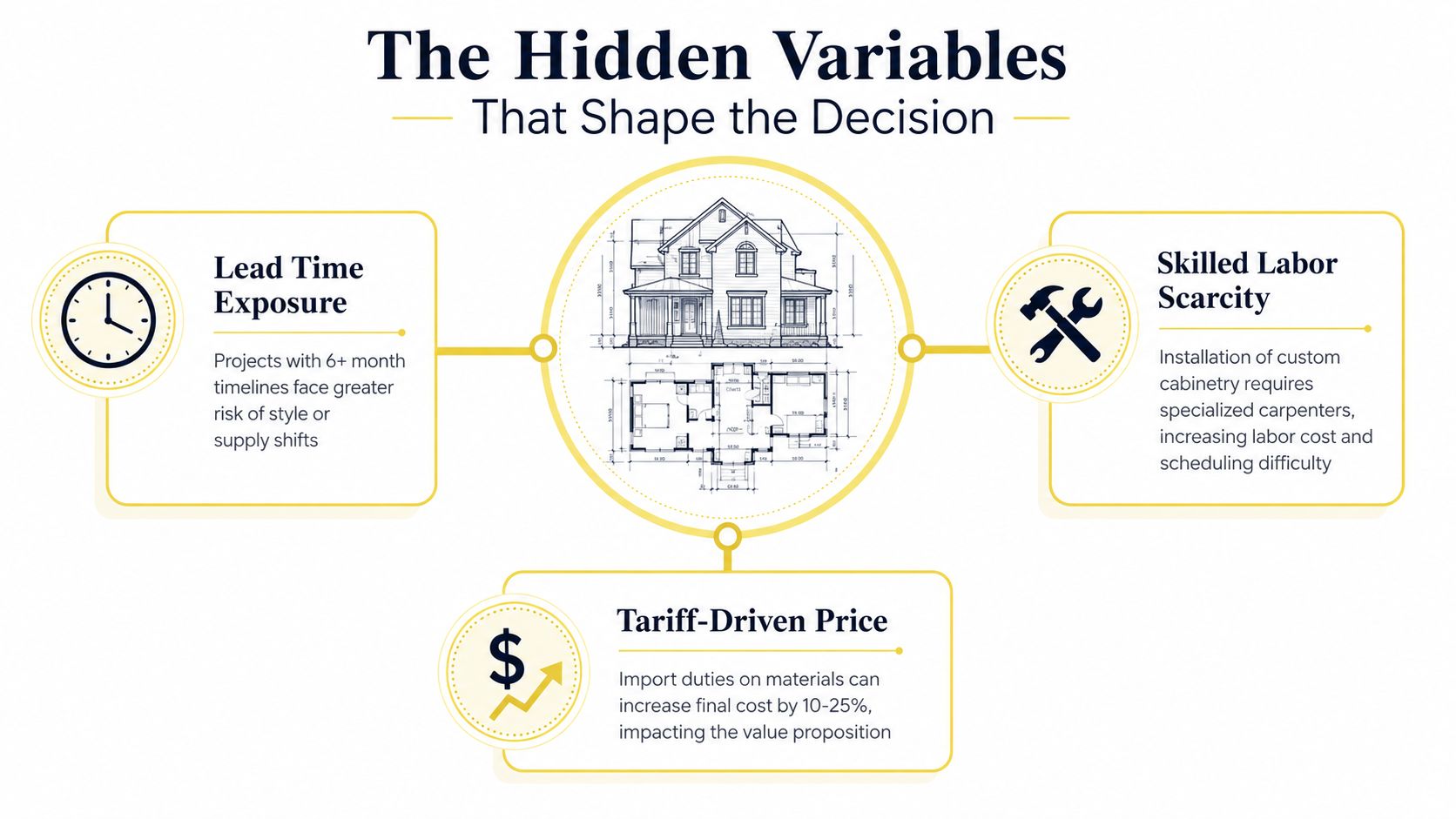
The cabinet category can look settled after the layout and finish are approved. Then the hidden variables enter the room. Lead time exposure, skilled labor availability, and tariff-driven sourcing risk can change the value of a cabinet choice after the design is already fixed.
A published industry comparison places semi-custom production at about 4 to 8 weeks and custom cabinetry at 8 to 16+ weeks. Cabinet production timing That distinction matters because the cabinet clock doesn't operate alone. A custom sequence can include field measurement, shop drawings, approvals, manufacturing, delivery, and installation. If one approval arrives late or a replacement part is needed, every trade scheduled afterward may move.
Labor changes the meaning of “installed cost”
Cabinet pricing tells only part of the story. A custom installation may require a finish carpenter who can manage precise reveals, inset doors, scribing, integrated panels, and irregular walls. A frameless European system can also demand an installer who understands the system's tolerances and sequencing.
In the DC, Maryland, Virginia, and Delaware region, the availability of experienced installation labor can shape the schedule as much as the cabinet manufacturer's promise. A less expensive cabinet line doesn't create value if the project needs repeated site adjustments or if the appropriate installer isn't available when the shipment arrives.
Origin belongs on the specification sheet
Policy can also affect the cabinet decision. Recent U.S. trade actions imposed a 25% duty on imported kitchen cabinets and vanities, and the coverage indicates that the duty applies to completed cabinets as well as parts. Presidential trade action
That doesn't make domestic custom cabinetry automatically safer, or imported semi-custom cabinetry automatically risky. Domestic shops may have shorter, more traceable supply chains, but they can face skilled labor shortages and longer production queues. Imported semi-custom lines may offer manufacturing efficiency while remaining more exposed to duties, shipping disruption, and component sourcing changes.
The right questions are direct: Where are the boxes, doors, hardware, and panels made? Which components are imported? Can the manufacturer hold the quoted price through production? What happens if a part is delayed or arrives damaged?
For a project with a firm completion date, semi-custom often wins because it limits production exposure. For a room whose architecture cannot be resolved through factory modules, custom may still be the responsible choice. The decision depends on which risk you're better equipped to manage.
How a Design Firm Guides the Cabinetry Choice
A professional design conversation should begin with the room, not a stack of finish chips. At Jennifer Gilmer Kitchen & Bath, the initial discussion can map existing conditions, appliance specifications, storage habits, entertaining patterns, and schedule priorities against the capabilities of custom and semi-custom cabinetry.
A senior designer studies the wall conditions and ceiling height before recommending a cabinet category. Plumbing rough-ins, window locations, door swings, sightlines from adjacent rooms, and the relationship between the kitchen and surrounding architecture all influence whether a preset cabinet system will feel intentional or compromised.
The showroom makes construction visible
The second meeting should move beyond catalog images. Put a semi-custom drawer beside a custom drawer and operate both. Compare the slide action, the drawer-box material, the dovetail joints, the hinge adjustment, the finish on the door's reverse, and the way a panel meets an exposed side.
A useful designer won't let the conversation stay at “this one feels nicer.” The discussion should identify which construction details matter for your use, where the manufacturer's options end, and whether the proposed specification solves a real design requirement.
Homeowners who want a deeper understanding of the consultation process can review this guide to working with a kitchen designer. The value of professional guidance lies in translating preferences into dimensions, specifications, and decisions that can survive installation.
Schedule language belongs in the order
A design firm should state the expected lead time, approval milestones, measure-check requirements, and installation responsibilities before the order is released. Purchase orders should identify the approved finish, construction details, hardware, panels, accessories, and any performance expectations that matter to the project.
The measure-check deserves particular attention. Walls are rarely perfect, especially in older DC-area homes. A final verification can catch a dimension that looked acceptable on paper but would create a difficult filler, appliance conflict, or trim condition on site.
Installation crews vetted by the design firm then manage the tolerances that determine how the finished kitchen reads. Premium cabinetry can look ordinary when reveals wander or panels don't align. Careful installation is not the final administrative step. It's part of the design.
Which Option Fits Your Project
My recommendation is straightforward. Choose semi-custom when the room is conventional and the schedule matters. Choose custom when the architecture or the design requires dimensions and details a catalog can't provide. Don't pay for bespoke cabinetry just because the word sounds more substantial.
Semi-custom is often the right fit for row-house kitchens in Dupont Circle and Capitol Hill, where a disciplined plan can make a narrow footprint work beautifully. It also suits rooms with standard 8- or 9-foot ceilings, conventional wall runs, and appliances that can be integrated through the manufacturer's available panels and fillers. If the project can't absorb more than 10 weeks of cabinet lead time, a semi-custom program deserves serious consideration.
Custom earns its place when the room asks for more. Ceilings at 10 feet, inset doors with true flush fronts, curves, angled soffits, irregular plaster walls, unusually deep work surfaces, or non-standard appliance integration can justify the additional design and production coordination. Custom is also appropriate when domestic joinery, material traceability, and a specific relationship to existing millwork are central to the project.
| Homeowner Scenario | Best Cabinet Type | Why It Fits |
|---|---|---|
| Row-house kitchen in Dupont Circle or Capitol Hill with a conventional footprint | Semi-custom | Preset modules and selected modifications can keep the design orderly without adding the full exposure of a shop-built schedule. |
| Kitchen with standard 8- or 9-foot ceilings and standard appliance dimensions | Semi-custom | The room doesn't require bespoke heights or unusual integrations, so factory efficiency can be used where it helps. |
| Kitchen with 10-foot ceilings and a full-height architectural composition | Custom, or a hybrid | Custom cabinetry can establish the exact vertical proportions, while a hybrid may reserve custom work for the areas that need it most. |
| Historic room with curves, angled soffits, or walls that aren't square | Custom | The cabinetry must respond to the room rather than forcing the room into a module. |
| Homeowner wants a custom island but a straightforward perimeter | Hybrid | A custom island can carry the furniture character and specialized storage while semi-custom cabinets manage the repeatable perimeter work. |
| Project with a fixed installation window and limited schedule tolerance | Semi-custom | A shorter, more controlled manufacturing path can reduce exposure, provided the line satisfies the design. |
| Homeowner prioritizes domestic joinery and traceable material sourcing | Custom | The specification can be developed directly with the shop and tied to the project's material priorities. |
The hybrid path is underused by homeowners and used constantly by experienced designers. A semi-custom perimeter with custom uppers can resolve a tall ceiling or unusual sightline without placing every cabinet in a custom production queue. A custom island paired with semi-custom perimeter cabinetry can create a strong focal point while keeping the repeatable portions efficient.
Before committing to a custom build, review the broader custom home building considerations guide for the kind of early planning that affects any highly customized residential project. The same principle applies here: customization works best when the design, budget, schedule, and construction team are aligned before fabrication begins.
Carrying These Questions Into Your First Conversation
Bring four questions to the showroom. They'll produce better guidance than beginning with a favorite paint color.
Start with fit, then choose the finish
Ask, “What does this room require that a standard cabinet system can't provide?” Look first at ceiling height, wall conditions, appliance placement, corners, and storage dimensions. If the answer is nothing significant, semi-custom may give you the right balance. If the room has a clear dimensional challenge, custom may be the more economical design decision because it solves the problem at the source.
Work backward from the date that matters
Ask, “What must happen before the cabinets can be ordered, and what happens if a part is delayed?” Start with your move-in date, closing date, or the point at which other trades need the kitchen accessible. Include design approvals, field measuring, production, shipping, installation, and correction time. A cabinet lead time is not the same as a completed kitchen timeline.
Price the service you'll use
Ask, “What construction details am I paying for, and which of them will I notice every day?” Compare the box material, drawer joinery, hardware, finish, interior accessories, and installation. A shorter price quote isn't useful if it removes the storage feature or durability detail that matters most to your household.
Ask about origin and labor without apology
Ask, “Where are the cabinet components made, and who will install them?” Tariff exposure and labor sourcing can influence the final cost and schedule, so they belong in the first conversation. A designer expects these questions. They help establish a realistic specification instead of creating surprises after the order is placed.
Bring measurements, inspiration images, appliance information, and a realistic budget range to your appointment. Jennifer Gilmer Kitchen & Bath offers showroom consultations in Chevy Chase, Maryland, along with appointment-based design guidance for homeowners throughout Washington, DC, Maryland, Virginia, and Delaware. The first meeting should feel like a working session, with clear next steps and a cabinet strategy suited to your room.
Jennifer Gilmer Kitchen & Bath helps homeowners compare custom and semi-custom cabinetry, plan efficient layouts, coordinate materials, and carry residential kitchen and bath projects from concept through installation across the Washington, DC, Maryland, Virginia, and Delaware area. Visit Jennifer Gilmer Kitchen & Bath to arrange a showroom or appointment-based consultation and bring your cabinet questions to the design table.