.avif)

You've measured the kitchen, saved a folder of door styles, and started comparing cabinet quotes. Then one showroom calls its offering “custom,” another recommends “semi-custom,” and a third points you toward “stock.” The labels sound familiar, but the products behind them can differ in sizing, construction, finish choices, ordering process, and price.
Understanding what semi-custom cabinets are gives you a practical way to read those choices. The right question isn't which category sounds most luxurious. It's which cabinet system gives your home the fit, finish, storage, schedule, and budget you need. In a Washington, DC, Maryland, or Virginia remodel, that answer often depends on how much your architecture asks you to adjust and how much compromise you're willing to accept.
Table of Contents
A Remodeler Walks Into Three Cabinet Showrooms
A homeowner fresh from measuring a narrow galley kitchen can feel as though they've walked into three different industries. In the first showroom, rotating displays of oak doors and laminated boxes suggest a warehouse solution, with cabinets ready to collect or ship. In the second, a designer opens a drawer, discusses modified depths, and lays out finish samples across a large worktable. In the third, a quiet studio presents a kitchen where every cabinet appears to have been built around the room, including its irregular corners and architectural details.
Each salesperson uses the words stock, semi-custom, and custom as though the differences are obvious. You nod politely while mentally comparing three price sheets that may not include the same accessories, modifications, delivery terms, or installation responsibilities.
The useful comparison is not “Which cabinet category is best?” It's “Which category solves the problems in this room without paying for flexibility you won't use?”
Start by separating the decision into three questions:
- How closely must the cabinets fit the room? Fixed-width boxes may work in a straightforward new kitchen, while an older home may need adjustments around plaster walls, uneven corners, or appliances.
- How much visual choice matters? Door profiles, wood species, paint, glaze, interior storage, and finished ends can change the character of the room.
- How much schedule and budget flexibility do you have? A made-to-order product requires more planning than a warehouse cabinet, while fully bespoke work usually demands more design development and coordination.
By the end of this guide, you should be able to enter any showroom and understand what each label delivers. You'll also have a clearer way to weigh the tension that runs through nearly every cabinet decision: price, fit, and finish rarely move together without tradeoffs.
What Semi Custom Cabinets Actually Are
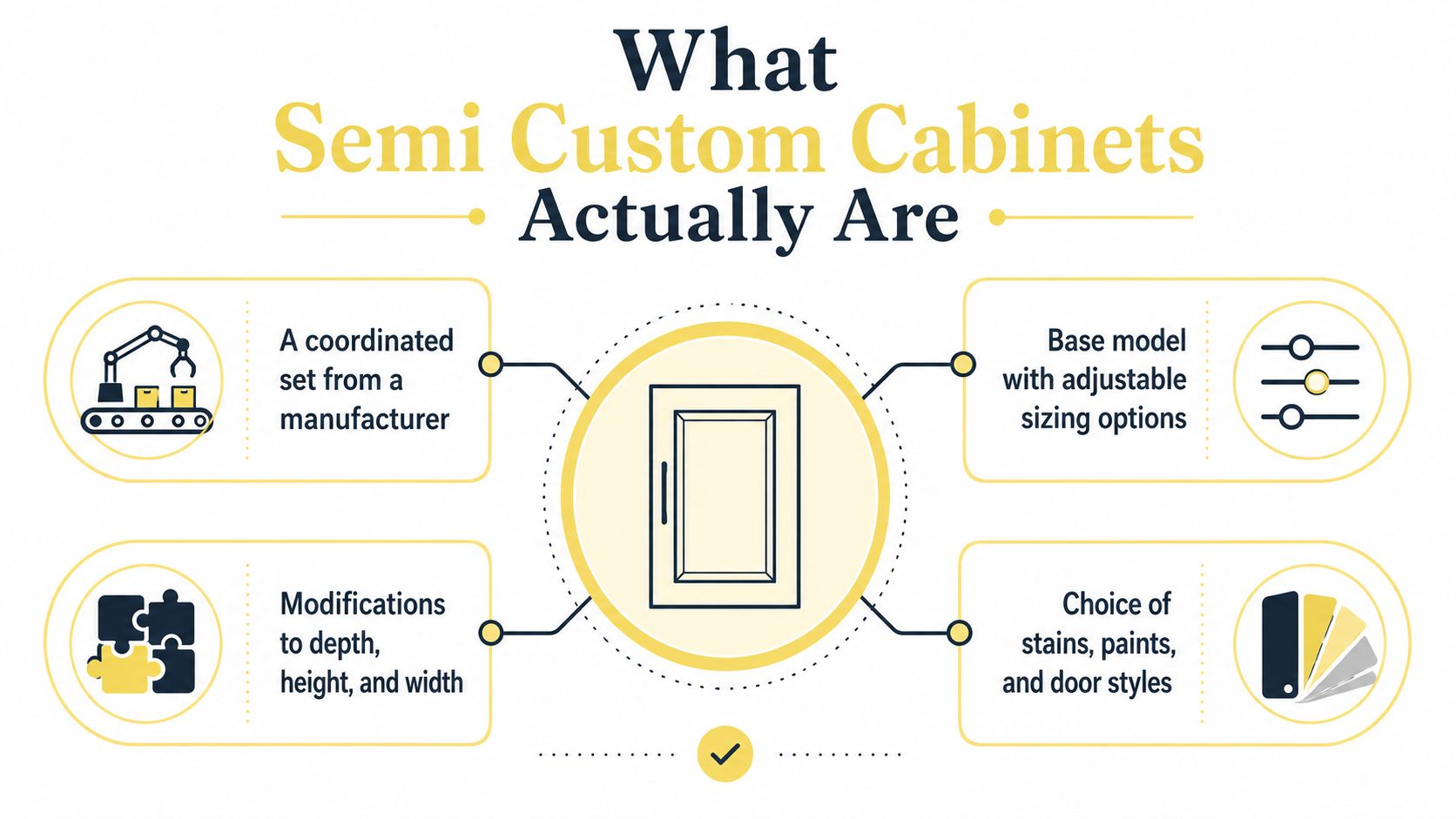
A cabinet line is a coordinated collection made by a manufacturer. It includes a set of cabinet sizes, door styles, finishes, construction details, and accessories designed to work together. The manufacturer produces those components in volume, rather than building every cabinet from a blank sheet of material for one particular home.
Semi-custom cabinetry uses that manufacturing backbone but adds a defined menu of factory modifications. A line may offer standard widths while allowing selected changes to depth and height. Depending on the manufacturer, you may also specify finished ends, taller wall cabinets, altered interior configurations, and other options that help the cabinet sit more naturally in your plan.
The important distinction is that the cabinet remains part of an established system. A designer isn't asking a cabinetmaker to invent a new box for every opening. The manufacturer is adapting a proven product within its construction parameters. The Kitchen Cabinet Manufacturers Association definition quoted by Fine Homebuilding describes semi-custom cabinets as “built to order but within a defined set of construction parameters.” In plain language, the factory makes the cabinet for your order, but only from the options that its line has been engineered to support.
The assembly-line analogy
Think of stock cabinetry as choosing a finished garment from a rack. You select the available size and color, and the speed comes from the fact that the product already exists. Fully custom cabinetry is closer to commissioning a custom suit. The maker takes your measurements, drafts the pattern, selects the materials, and constructs the piece specifically for you.
Semi-custom cabinetry sits between those experiences. The manufacturer has already developed the pattern, but you can request approved changes so the result fits your room more thoughtfully. You're not ordering an off-the-shelf box, and you're not commissioning a one-off kitchen from raw materials.
The category can be confusing because terminology varies by market. The industry source excerpted by Wiley notes that what's called semi-custom in the United States may sometimes be called custom in international markets, so a showroom's label deserves a closer look. Ask what the manufacturer allows, not just what the sales brochure calls the product.
For homeowners who want to understand the broader logic of built-in storage, a guide to what to look for in dressers can also be useful. The same questions apply: examine construction, drawer operation, proportion, finish, and how the piece will serve daily use.
How Semi Custom Compares to Stock and Custom
The stock-to-custom spectrum is easiest to understand when you compare the same decision points. Stock cabinets favor availability and simplicity. Fully custom cabinetry prioritizes exact dimensions and one-off detailing. Semi-custom lines occupy the middle, using factory production while allowing a bounded set of changes.
| Attribute | Stock | Semi Custom | Custom |
|---|---|---|---|
| Construction method | Pre-manufactured in standard sizes | Factory-built to order within defined parameters | Built specifically from shop drawings |
| Lead time | Fastest turnaround when available | Longer than stock because modifications are made to order | Longest, with extensive design and production coordination |
| Fit and sizing flexibility | Fixed dimensions and limited filler solutions | Standard widths with selected depth and height modifications | Dimensions shaped around the architecture |
| Finish and door style options | Limited palette | Broader selection of finishes, door styles, and accessories | Highly individualized materials, profiles, and finishes |
| Price position | Lowest | Middle | Highest |
A stock cabinet is the warehouse pick-up aisle of the cabinetry world. The manufacturer has already decided the available dimensions and finishes, so the designer works with those boundaries. Fillers, panels, and careful layout planning can make stock cabinets successful, especially in a relatively regular room, but the design may require more compromises at walls and appliances.
Semi-custom adds flexibility where it affects the plan most. The category typically offers standard widths plus limited depth and height modifications, along with a broader palette of styles and finishes than stock cabinetry, as described in the industry reference excerpt from Wiley. Those adjustments can improve alignment and reduce the need to disguise awkward gaps.
Full custom is closer to one-of-a-kind furniture by Groen's Fine Furniture. The shop builds to the architectural drawing, which can be the right solution when a room has unusual angles, very specific proportions, or details that no catalog line can accommodate. That flexibility comes with a more involved process and a higher price position.
The phrase “price per linear foot” can sound precise, but it isn't a reliable comparison unless every quote includes the same cabinet construction, modifications, interiors, panels, accessories, hardware, delivery, and installation. A semi-custom line may cost more than stock because it's pre-ordered and includes more customization, as explained in this comparison of custom and semi-custom cabinets. For a more focused discussion of budget planning, review semi-custom kitchen cabinet costs, then ask your designer to compare complete specifications rather than cabinet labels alone.
The Customization Options That Matter Most
The best semi-custom choices are the ones you notice every day. A small dimensional change can improve an appliance enclosure. A carefully selected interior accessory can make a crowded drawer easier to use. A factory finish can create continuity across doors, panels, and trim.
Dimensions that solve real planning problems
Cabinet specification sheets commonly show a base cabinet at 24 inches deep and 34.5 inches high, while some semi-custom systems permit depth changes in increments as fine as 1/16 inch, according to a published semi-custom cabinet specification book. Those figures describe typical published parameters, not a promise that every manufacturer offers the same options.
In practice, a designer may use a depth adjustment to bring a cabinet into better alignment with a wall or appliance. A height change can help a wall cabinet relate to a ceiling, crown molding, or a tall refrigerator enclosure. These decisions need careful field measurement, because a modification is useful only when it solves a defined problem.
The visual language of the room
Semi-custom lines commonly offer more door styles, wood species, factory stains, painted finishes, and glazed options than stock collections. You might move from a simple Shaker profile to a more detailed inset-bead door, or choose a finish that coordinates with flooring, trim, stone, or an adjacent room.
Construction style affects more than appearance. Face-frame cabinetry gives the front of the cabinet a distinct architectural border, while frameless construction emphasizes interior clearance and a cleaner contemporary plane. Overlay choices also change how much of the frame shows. For a clear explanation of full overlay versus half overlay, study the relationship between door coverage, visual proportion, and access.
| Option | What You Can Customize | Practical Impact |
|---|---|---|
| Dimensions | Selected width, depth, and height changes | Better appliance fit, fewer awkward fillers, cleaner transitions |
| Door style | Profiles, overlay, and selected construction details | Establishes the room's visual character and affects clearance |
| Wood and finish | Species, stain, paint, glaze, and finished ends | Coordinates cabinetry with lighting, trim, flooring, and adjacent spaces |
| Interior storage | Pull-outs, dividers, peg systems, and spice storage | Makes everyday tools easier to reach and return |
| Accessories | Hardware and manufacturer-approved specialty components | Supports the household's habits within a coordinated cabinet system |
Storage accessories deserve the same attention as the door sample. Pull-out shelves can bring heavy cookware forward. Drawer peg systems can organize plates without forcing you to stack them precariously. Integrated spice racks can place frequently used ingredients near a preparation zone, although the location must be planned around door clearances and cabinet dimensions. A thoughtful cabinet storage solutions guide can help you identify which improvements deserve space in the specification.
Honest Pros and Cons of Choosing Semi Custom
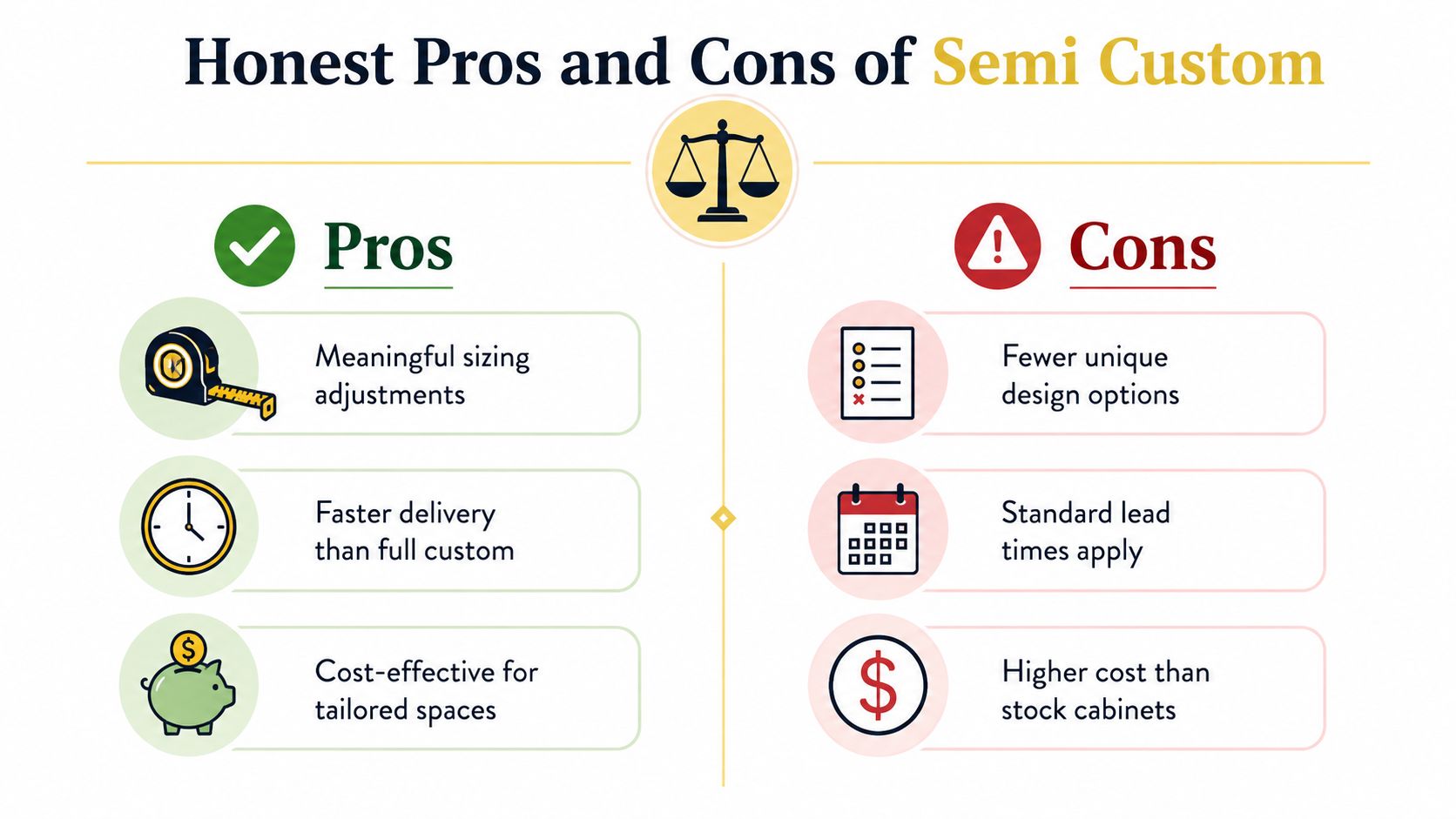
Semi-custom cabinetry earns its place by solving a practical middle problem. Many homeowners need more than fixed stock dimensions, but they don't need every cabinet built as a separate architectural object. A semi-custom line can provide meaningful adjustments, a wider selection of finishes and door styles, and factory-coordinated construction without requiring a fully bespoke process.
Some lines also offer details such as plywood box construction and soft-close hardware, but those features aren't automatic. The manufacturer, product line, and dealer specification matter as much as the category name. Ask to see the actual construction sample and read the order documents before assuming a feature is included.
Where the category helps
- Meaningful fit: Selected depth and height adjustments can address walls, ceilings, and appliance relationships more elegantly than fixed boxes.
- Design choice: Semi-custom lines generally provide a broader finish, door-style, and accessory palette than stock products.
- Factory consistency: Repeated components come from an established production system, which can make the overall order more predictable than a collection of unrelated pieces.
- Budget control: You can direct money toward the modifications and storage details that affect your daily routine instead of paying for one-off construction everywhere.
Where it asks you to compromise
The cabinets still have limits. You can't assume that a semi-custom line will accommodate every angle, radius, unusual depth, or architectural detail. If the room requires a cabinet shape outside the manufacturer's parameters, the designer may need to introduce fillers, trim, alternate cabinetry, or a custom component.
Lead time also runs longer than stock because the cabinets are made to order. Popular finishes can create additional volatility during busy remodeling periods. Recent industry reporting illustrates why a homeowner shouldn't treat cabinet demand or production conditions as perfectly stable. Mordor Intelligence's cabinet market reporting cites a 7.5% year-over-year decline in semi-custom sales in June 2026 and a 2.5% decline in February 2024, while other market views still place semi-custom among the largest cabinet segments. The lesson is operational, not alarming: confirm the current lead time before finalizing a renovation schedule.
Semi-custom also won't automatically create a higher resale value than every other option. Buyers usually respond to a cohesive, well-planned kitchen, durable materials, and useful storage. Quality varies widely, so the line and installation partner deserve close attention.
When Semi Custom Is the Right Call for Your Home
Consider a DC-area Colonial with original plaster walls, corners that aren't perfectly square, and a ceiling height that doesn't correspond neatly to today's standard cabinet planning. The homeowner wants a composed, refined kitchen, but the room doesn't require every box to be invented from scratch. Semi-custom can address selected height and depth conditions while keeping the design within a controlled product system.
A suburban new-construction home presents a different logic. If the builder already offers a semi-custom upgrade package, the category may provide an efficient path to better door styles, finishes, interiors, and storage without creating a separate custom fabrication process. The key is to review what the package includes, since “upgrade” can mean very different things from one builder to another.
A young family may make another strong case. Their priorities may be a durable factory finish, drawers sized for daily tools, a pull-out shelf for small appliances, and storage that children can reach safely. They may care less about rare wood species or a one-off carved detail. Semi-custom lets the design concentrate on function and longevity, rather than paying for craftsmanship that doesn't improve their routine.
The wrong call might be a narrow historic rowhouse kitchen with unusual angles at nearly every turn. If each run must follow an irregular wall and the appliances need highly specific integration, a semi-custom catalog could force too many compromises. A custom cabinetmaker may be better suited to build directly from the architectural conditions.
The right category depends on the home's geometry, the household's priorities, and the compromises the homeowner can accept without regret.
How Jennifer Gilmer Kitchen & Bath Approaches Semi Custom Projects
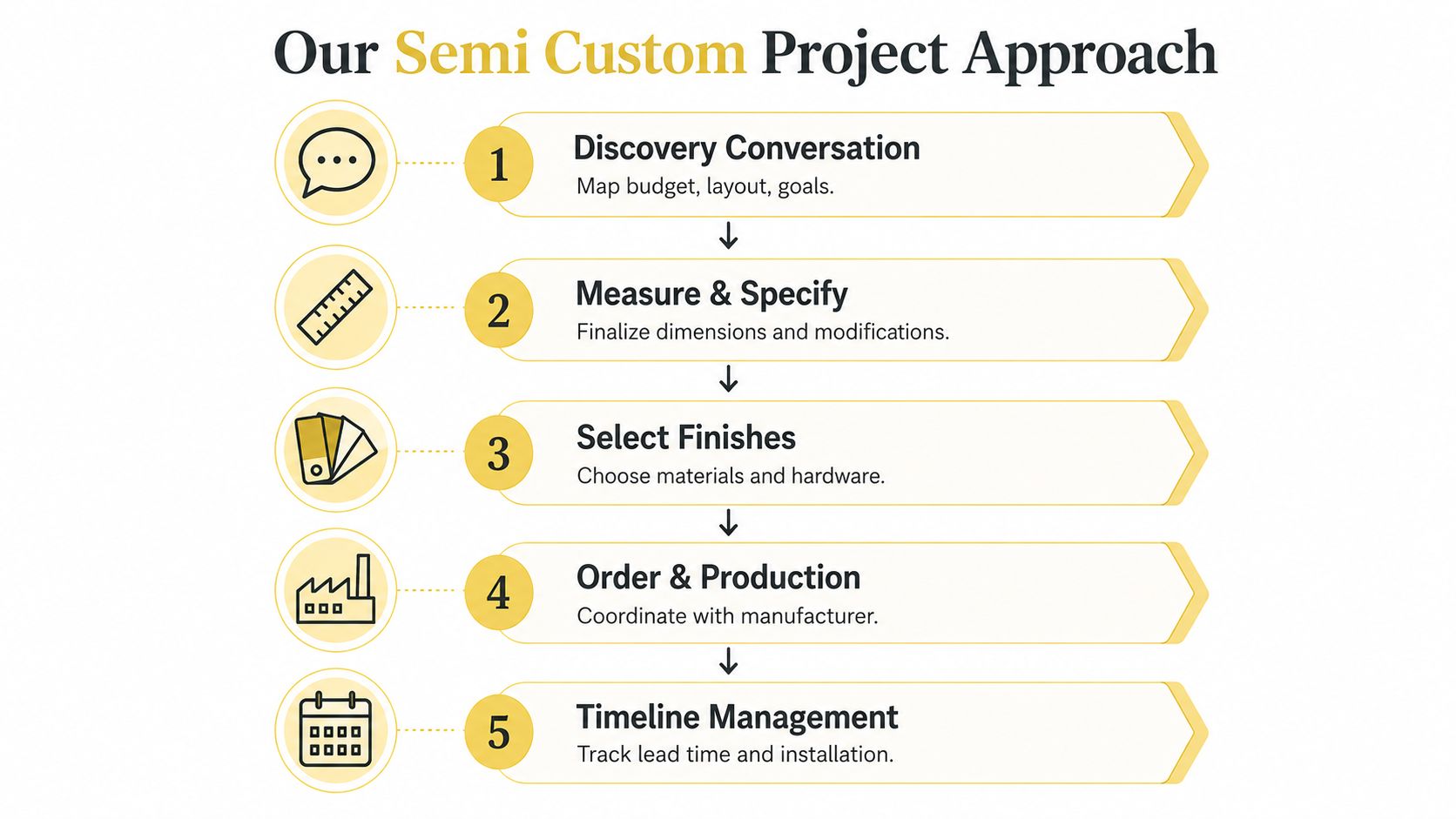
A semi-custom project should begin with a conversation, not a door style. Jennifer Gilmer Kitchen & Bath uses the discovery stage to understand the budget, layout constraints, appliance plan, storage needs, and aesthetic direction before assigning a cabinet line to the room.
Designers can draw from lines such as Koch, Decora, and Quality, comparing the modifications and construction details each manufacturer makes available. That comparison matters because two semi-custom lines may offer different approaches to sizing, interiors, finishes, and lead times. The label alone doesn't tell you whether a product will solve the particular problem in your home.
From sample to specification
A showroom visit gives homeowners a chance to compare door profiles, painted and stained finishes, hardware, and storage accessories side by side. Seeing samples in person is especially useful because color and sheen shift with daylight, artificial lighting, nearby flooring, and countertop materials.
The team then translates the selections into detailed specifications. Measurements and field verification confirm the conditions that drawings can't fully reveal, including wall irregularities, appliance dimensions, plumbing locations, and trim relationships. Delivery and installation coordination complete the process, turning a cabinet order into a room that has been checked from concept through installation.
Homeowners can review examples of the firm's work through the Jennifer Gilmer Kitchen & Bath portfolio. The broader value of a guided process is that it keeps the cabinet system connected to the household, the architecture, and the practical sequence of construction.
Jennifer Gilmer Kitchen & Bath serves homeowners throughout Washington, DC, Maryland, Virginia, and Delaware, with showrooms in Chevy Chase, Easton, and Ashburn. For a homeowner who doesn't need full bespoke work, the firm's role is to balance fit, lead time, and craftsmanship rather than treating semi-custom as a generic product order.
Questions to Ask Before You Commit
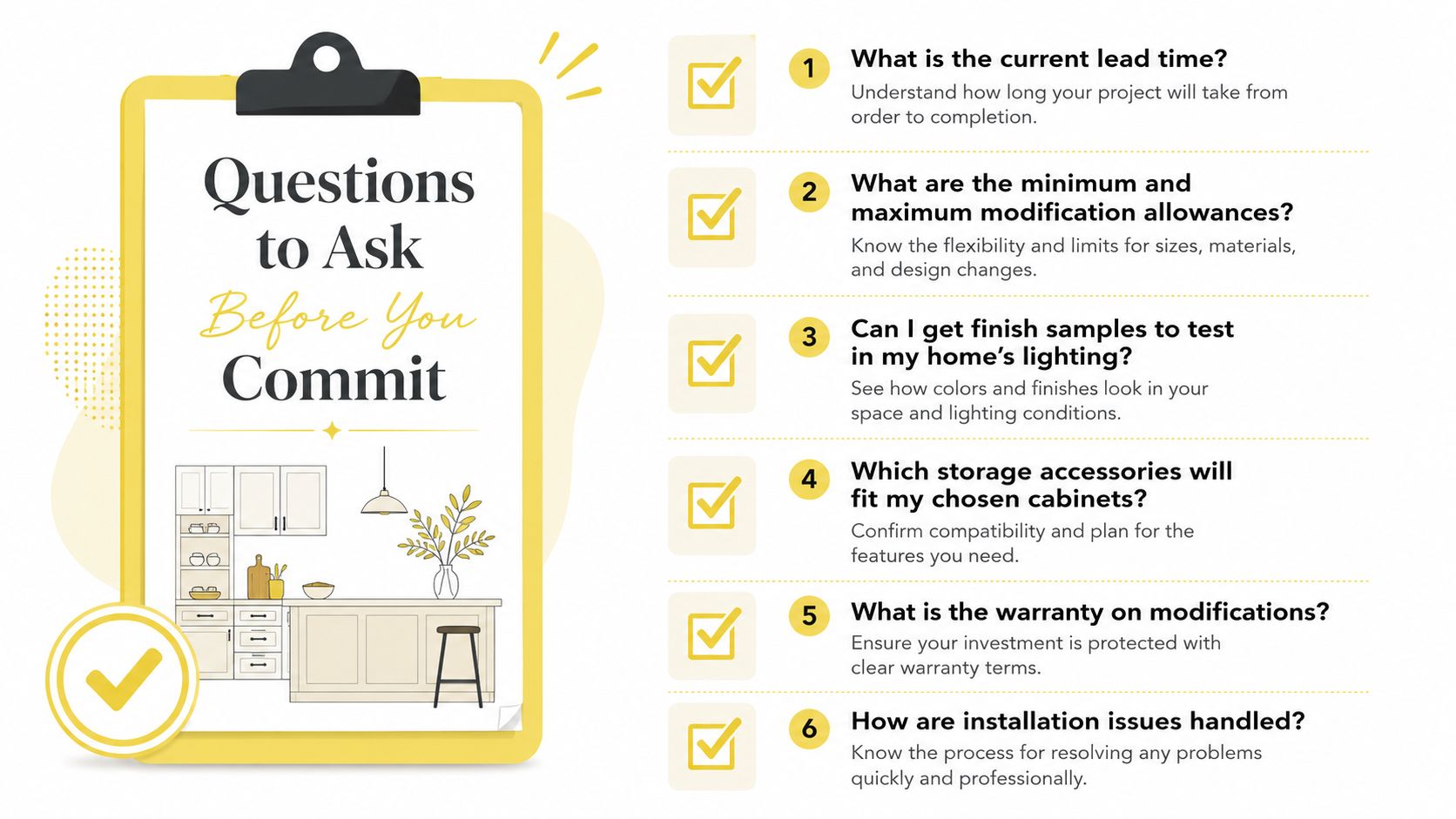
A semi-custom cabinet decision becomes clearer when the showroom answers specific questions in writing. Bring the floor plan, appliance specifications, and your must-haves to the conversation.
- What is the current lead time? Ask when production begins and what could delay delivery.
- What modifications are available? Confirm the minimum and maximum changes for width, depth, and height.
- Can I test the finish? Take physical samples into the home and view them in morning, afternoon, and evening light.
- Which accessories fit the chosen boxes? Verify that pull-outs, dividers, peg systems, and spice storage work with the selected cabinet dimensions.
- What does the warranty cover? Ask specifically about doors, finishes, modified cabinets, and hardware.
- Who handles installation issues? Clarify delivery inspection, damaged components, field adjustments, and follow-up service.
Your decision should reflect the room's architecture, your renovation timeline, and the features you'll notice every day. Semi-custom works particularly well when you know which details matter most, such as a panel-ready appliance, a specific drawer height, or a cleaner wall transition, and you're comfortable letting the cabinet line handle the rest.
Jennifer Gilmer Kitchen & Bath helps homeowners in Washington, DC, Maryland, Virginia, and Delaware evaluate semi-custom cabinetry for fit, finish, storage, and schedule, from early concept through installation coordination. Visit Jennifer Gilmer Kitchen & Bath to explore the firm's portfolio and arrange a consultation for your kitchen or bath project.