.avif)

The homeowner usually walks into this conversation with two things in hand, a budget that feels too small and a stack of kitchen photos that all seem to assume money is no object. The floor in the room is tired, the cabinets are staying for now, and the instinct is to chase the cheapest square-foot price that can be found. That's the wrong first question.
The better question is simple. What is the least expensive kitchen floor you'll still be glad you chose five years from now? In a working kitchen, that answer has more to do with spills, chair drag, pet claws, and installer skill than with a pretty sample board. If you're also trying to keep the rest of the house clean while the remodel is underway, a Kitchener commercial cleaning service can be a useful reference point for how much daily grime a busy surface can accumulate, which is exactly why kitchen flooring needs to be chosen for real life, not just the showroom.
Table of Contents
The Real Question Behind an Inexpensive Kitchen Floor
A homeowner once stood in a gutted kitchen in the Washington DC area, tape measure in one hand, phone in the other, scrolling through a dozen saved pins that all looked more expensive than the rest of the room combined. The cabinets were staying, the appliances were staying, and the floor had become the big decision because everything else was already spoken for. That's the moment when the price question gets sharpened.
Practical rule: In a kitchen, the floor isn't a backdrop. It's a working surface that gets hit by water, grit, and movement all day long.
That's why the cheapest floor on paper can become the priciest one in practice. A kitchen punishes flooring in ways a bedroom never will. Water drips out of the sink area, chairs pivot at the island, a pan gets dropped, the dog runs through with wet paws, and nobody walks carefully forever. In a real kitchen, the floor needs to tolerate abuse without looking worn out after a short run.
Jennifer Gilmer Kitchen & Bath sees this as a design problem, not just a material problem. In homes across Washington DC, Maryland, and Virginia, the most successful budget floors are the ones chosen with the room's daily pattern in mind, then planned from concept through installation so the finish fits the way the kitchen works. That's the standard I'd hold onto.
The right question is not, “What is the cheapest thing I can buy?” It's, “What is the cheapest thing I can buy and still live with comfortably after cooking, cleaning, and normal family traffic start to wear on it?” That shift matters because the most inexpensive flooring for kitchen projects is really a balance between upfront price, daily durability, and how soon you'll have to think about replacing it.
What Inexpensive Really Means for a Kitchen Floor
Start with installed cost, not the sticker on the sample. The product price leaves out labor, underlayment, trim, subfloor prep, and transitions, so the number on the box is rarely the number you pay. A realistic kitchen budget has to cover the finished floor, not just the material.
Sheet vinyl is still the low-cost benchmark because Angi's cheap kitchen floor ideas guide puts materials around $1 to $2 per square foot, with installed vinyl often cited around $4 to $5.50 per square foot. For a 170-square-foot kitchen, that can land around $680 at the low end, while a full kitchen replacement can average $9 to $23 per square foot overall depending on material and labor. That spread tells you where the budget-floor conversation really sits.
A clean way to sort the field is this.
The budget bands
- Entry tier: sheet vinyl, basic laminate, and some lower-cost LVP. These are the products most homeowners can reach when they need a finished kitchen floor without blowing up the budget.
- Middle tier: better laminate and mid-grade LVP. Value improves here because you're getting more convincing visuals and better wear characteristics.
- Upper budget tier: porcelain tile and premium waterproof planks. These still count as cost-conscious compared with stone or hardwood, but the finished price rises because labor and prep do more of the work.
A remodeling guide from Jennifer Gilmer Kitchen & Bath's cost overview is a good reminder that flooring belongs inside the full project budget, not isolated from it. The floor is one line item, but it is also the one that has to survive daily use from the first week the kitchen is back in service.
A floor that feels cheap on installation day can feel expensive after the first year if it shows every scuff, swells near water, or forces a second install sooner than you planned.
That is why “inexpensive” should mean good value over time, not just the lowest invoice. If the room gets hard use, a slightly higher installed cost can still be the smarter buy. And if you are comparing tile options, the tile care tips from J G Carpet are worth reading before you assume the hardest surface is the easiest one to live with.
The Five Materials Worth Comparing
A budget kitchen floor should be judged the way I judge a floor at Jennifer Gilmer Kitchen & Bath, by how it lives under spills, chair legs, dropped pans, and daily cleanup. The lowest sticker price is rarely the best buy if the surface looks tired early or needs replacement sooner than it should.
| Material | Typical Installed Cost per sq. ft. | Water Resistance | Best Kitchen Use |
|---|---|---|---|
| Sheet vinyl | Lower entry tier, often among the least expensive durable surfaces | Good for spills and quick cleanup | Tight budgets, rentals, fast turnarounds |
| Luxury vinyl plank | About $3 to $18 per square foot installed, according to ConstructionFlux, with basic versions around $3 to $7 in some kitchen guides, according to Angi's budget flooring ideas | Strong, especially in rigid-core versions | Family kitchens, open-plan remodels, busy households |
| Laminate | About $3 to $13 per square foot installed, according to Angi's budget flooring ideas | Limited compared with vinyl, unless specifically water-resistant | Dry-to-moderate kitchens where warmth underfoot matters |
| Linoleum | Usually a design-forward budget choice rather than the cheapest line item | Moderate, but still needs care around water | Homeowners who want a softer, quieter surface |
| Porcelain tile | Material may start low, but installed cost climbs with prep and labor | Excellent | High-moisture kitchens, serious cooks, long-term ownership |
Sheet vinyl still earns a place because it gives you a finished floor at the bottom of the budget without making the whole project feel underdone. It works for homeowners who need a clean surface fast, especially in a kitchen that has to go back into service right away. The weakness is visual depth. Lower-end versions can look flat, and a dated kitchen does not hide that well.
Luxury vinyl plank, or LVP, is the standard I see most often in cost-conscious kitchen work. It gives you a wood look without asking you to live with wood's sensitivity to moisture, and that is why it comes up so often in remodel discussions. A kitchen flooring guide from ConstructionFlux points to rigid-core LVP and waterproof construction as the practical direction for kitchens, especially near sinks and dishwashers. Quality still varies a great deal, so a cheap plank usually looks and wears like a cheap plank.
Laminate still has a place if you want warmth and a restrained budget. It is often more affordable than homeowners expect, and Angi's budget flooring ideas shows how it can sit in an approachable installed-cost range. Its weakness is simple. It gives you less forgiveness around standing water than vinyl.
Linoleum is quieter and more design-conscious than many shoppers realize. It is not flashy, and that is part of its appeal for the right client. The tradeoff is that it asks for more care than vinyl, so it belongs with homeowners who will maintain it instead of assuming it can be ignored.
Porcelain tile gives the strongest answer to moisture and stains. It is also where tile care tips from J G Carpet matter, because tile only performs well when the maintenance routine is as disciplined as the installation. The drawback is installation complexity, so the floor should never be judged by material price alone.
Some homeowners ask about engineered wood-look alternatives, and I treat those as a design choice rather than the default kitchen answer. They can work in the right room, but they do not change the basic value equation as cleanly as vinyl, laminate, or tile. For a wider look at where a floor can make sense in another room, see Jennifer Gilmer Kitchen & Bath's bathroom flooring options.
Durability and Maintenance in a Working Kitchen
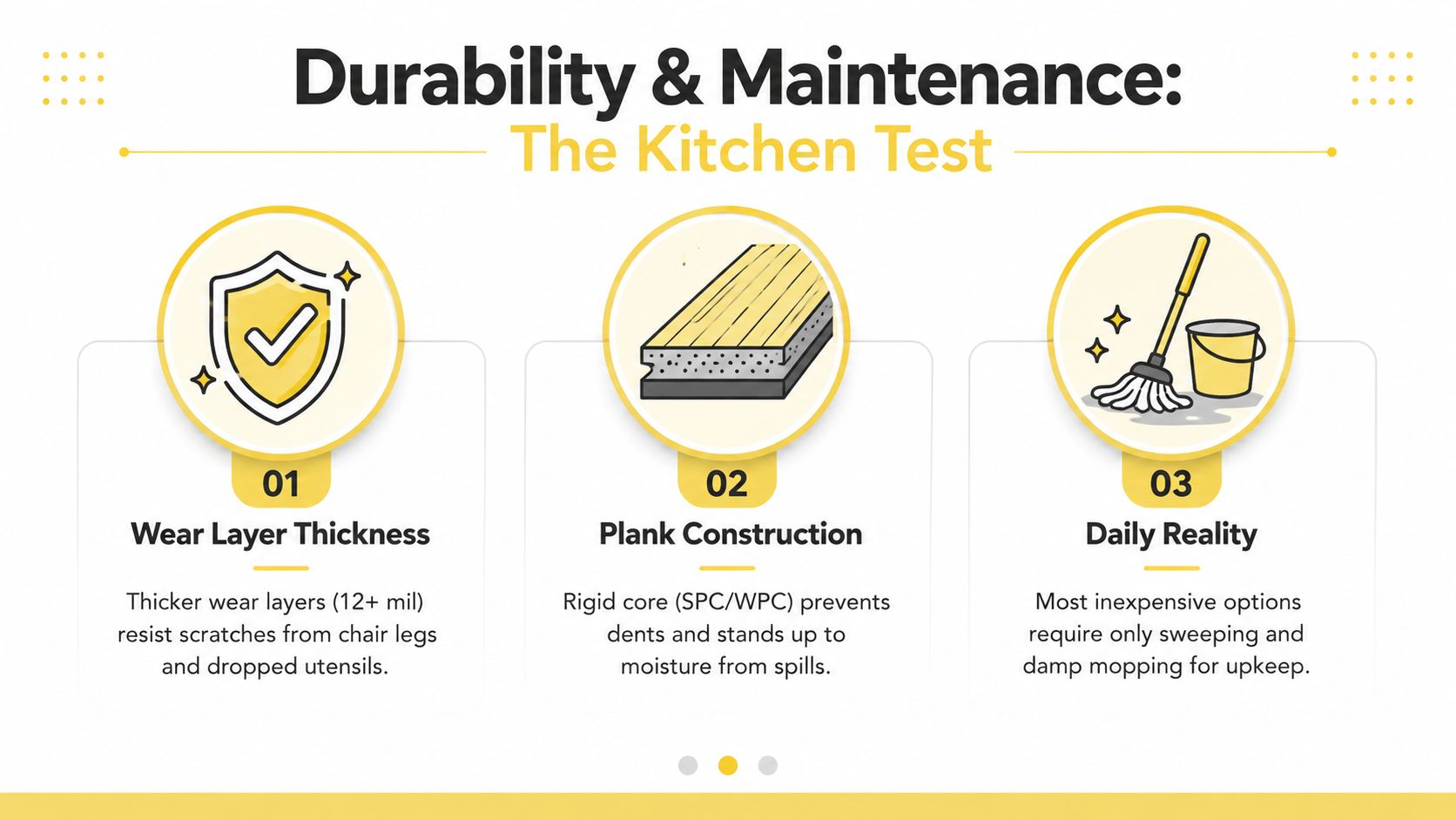
Kitchen floors fail in the same places over and over. The sink zone gets wet, the dishwasher area sees heat and moisture swings, and the island or peninsula becomes the main wear path because people keep turning in the same spots. If a floor is going to hold up, it has to be specified for those stress points, not just for its finish color.
What the wear layer really tells you
For vinyl and LVP, the wear layer is not a decorative detail. It tells you how much abuse the floor can take before surface scuffs become obvious, and kitchen guidance consistently points to 12 to 20 mil as the practical range, with 20 mil preferred for heavy traffic. Another materials guide notes that 0.25 mm to 0.3 mm wear layers suit busy family homes, especially kitchens and halls, and that overall vinyl thickness of 2.6 mm to 4.3 mm is common for quality domestic products, according to Easipay Carpets.
Rigid-core LVP deserves special attention because it changes the way budget flooring behaves. A product with an SPC or WPC core is built for dimensional stability, and industry guidance points to a 100% waterproof core in many rigid-core products, which matters beside sinks, refrigerators, and dishwashers. That makes it a different animal from older click-lock floors that looked similar but didn't handle moisture and temperature swings as well.
Most inexpensive floors are easy to clean when they're new. The question is whether they stay easy once everyday cooking starts to mark them up.
Porcelain tile sits in another category. It's not soft, and it isn't trying to be. Its strength is that it handles water and stains extremely well, which is why it earns a place in busy kitchens even when the installation is fussier than vinyl. The maintenance catch is grout, because grout lines need real attention if you want the floor to keep looking clean.
A working kitchen also exposes weak points you won't notice in a display board. If a refrigerator water line starts to leak, the floor has to cope with that kind of hidden problem quickly, which is why it's worth knowing the signs of a failing water line before the floor has to pay the price. A floor that looks low-maintenance in a showroom can become high-maintenance the first time an appliance leaks under it.
The floor you can sweep and damp mop without worrying every time is the one that earns its keep. That's why vinyl and rigid-core LVP are so often the right budget answer. They don't promise luxury, they promise fewer headaches.
Daily care at a glance
- Vinyl and rigid-core LVP: sweep, then damp mop as needed.
- Laminate: keep moisture controlled and clean spills promptly.
- Tile: mop easily, but don't ignore grout care.
- Linoleum: maintain gently and avoid sloppy wet cleaning.
Matching the Floor to the Way You Actually Cook
The right kitchen floor depends less on taste than on behavior. A couple who reheats takeout, drinks coffee at the island, and entertains occasionally has a different need than a family that cooks nightly and treats the kitchen like the center of the house. The floor has to match that rhythm.
Busy households need forgiving surfaces
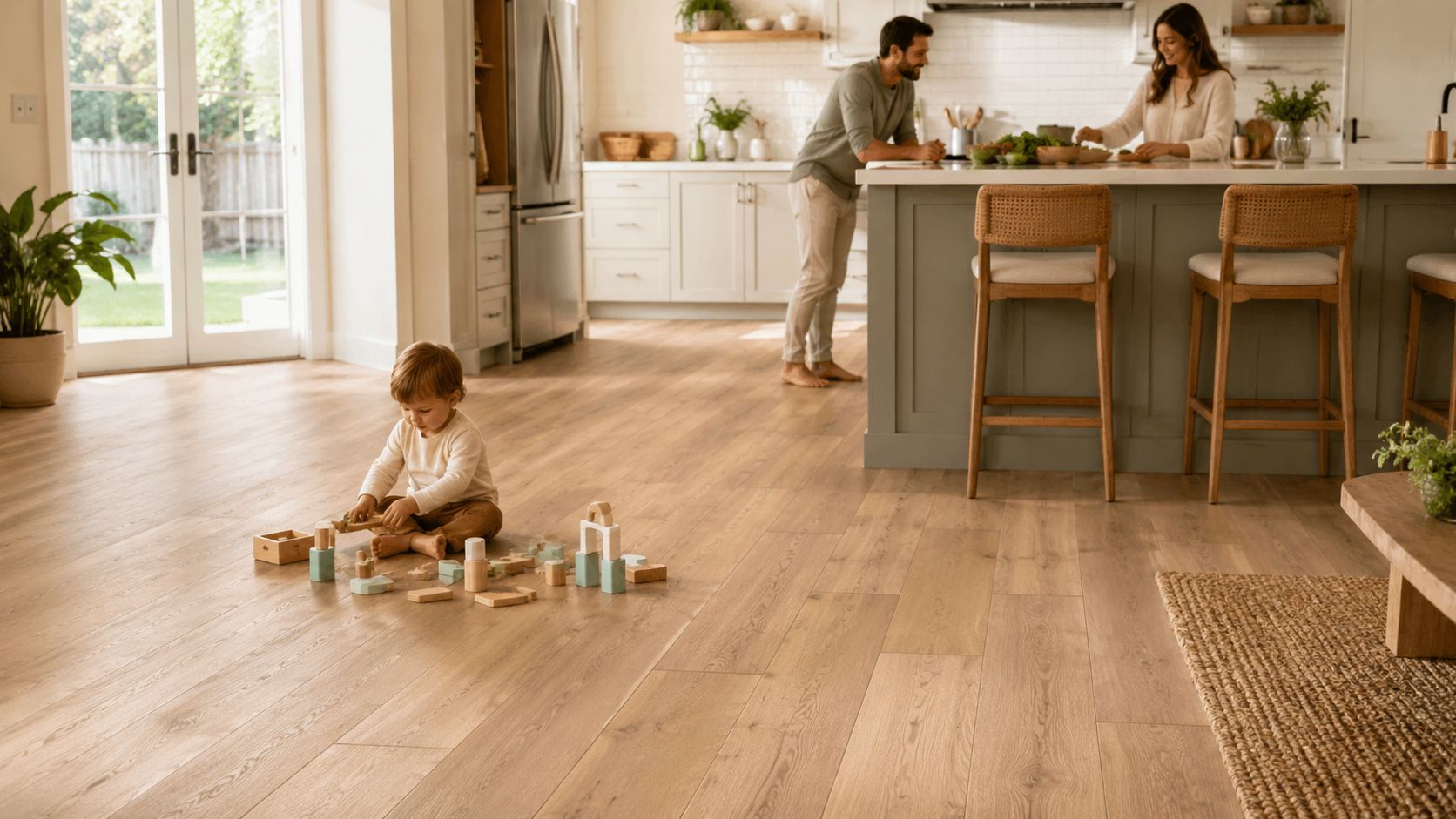
If your kitchen sees a toddler, a dog, and a lot of movement between cooking and cleanup, I'd steer you toward rigid-core LVP first and porcelain tile second. Those floors handle the daily bumps and small water events that come with real use, and they're easier to live with when the room never really gets a break. A floor that looks fine only when no one is using it is not a kitchen solution.
Laminate can still work, but only when the household is disciplined about moisture. If you like the warmer look and feel, choose it with clear eyes. You're trading some water tolerance for a different visual mood, and that trade only makes sense if the room stays dry most of the time.
Design-led homes have different priorities
Clients who care about softness underfoot and a quieter visual field often land on linoleum or a quality laminate. Those choices make sense in homes where the kitchen is used carefully, and where a floor that feels less hard and less loud matters every day. They also work well when the rest of the house is visually busy and the kitchen needs to recede a little.
Designer's note: If you entertain often, think about what guests see first and what they don't notice. Floors should support the room, not call attention to every seam.
Resale matters too. A kitchen floor is one of the first things buyers notice because it sits in their line of sight the second they walk in. In a resale-minded renovation, the safest inexpensive flooring for kitchen projects is usually the one that looks clean, modern, and easy to maintain without forcing the next owner into a fast replacement.
Jennifer Gilmer, CKD, and the design team at Jennifer Gilmer Kitchen & Bath talk through this kind of choice with clients every day in the Washington DC, Maryland, and Virginia area. That's where good selection work happens, by aligning the surface with the household, not just with the sample board.
Installation Quality and Subfloor Prep
A bargain floor can become an expensive mistake if the prep work is weak. That's not dramatic, it's just how flooring behaves. If the substrate moves, dips, or holds moisture, even a good product can telegraph problems that no pretty finish can hide.
What has to be right before the floor goes down
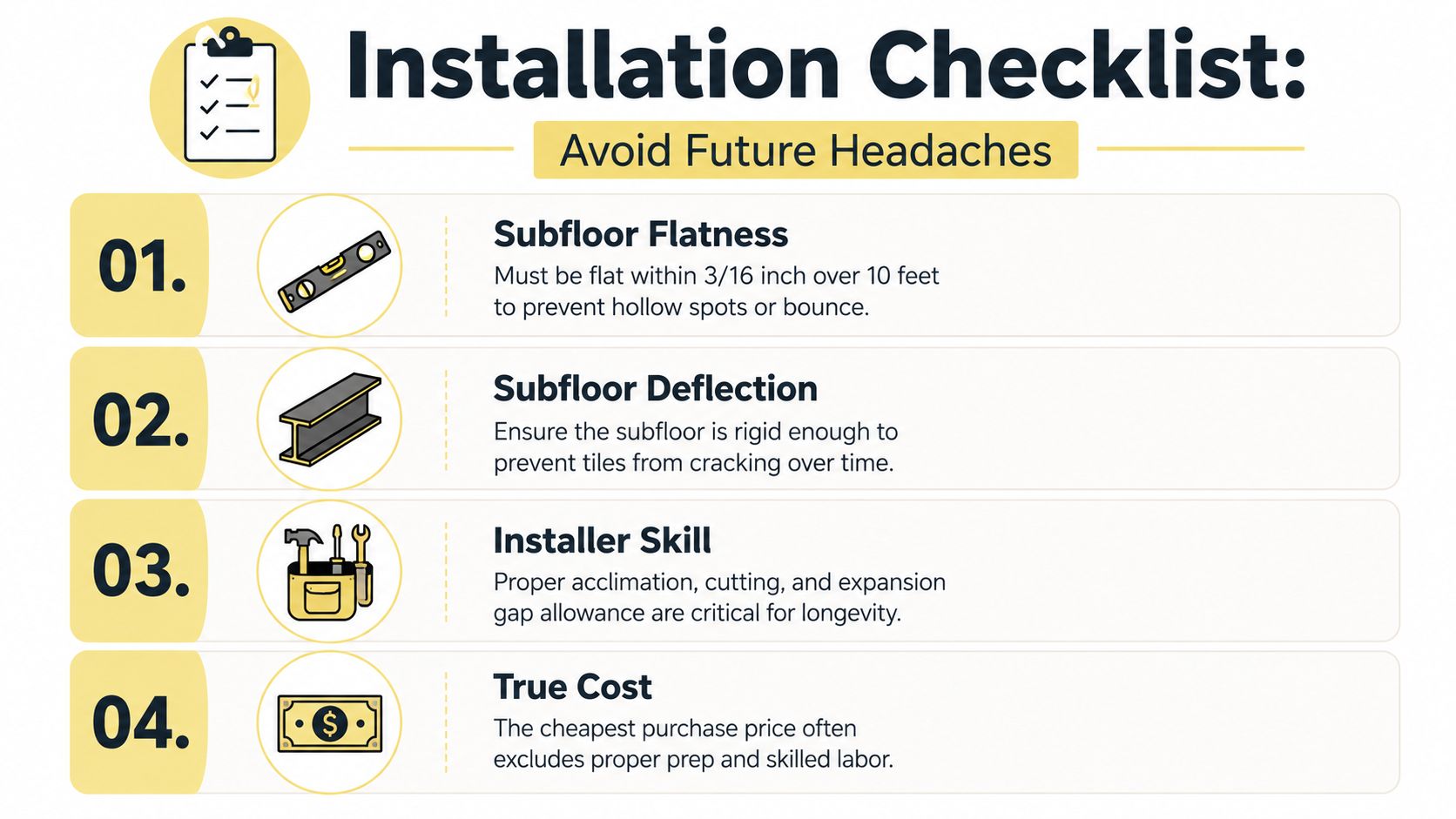
Large-format porcelain tile is particularly unforgiving. Kitchen-floor guidance tied to tile installation points to subfloor flatness of about 1/8 inch in 10 feet and deflection around L/360 to reduce cracking and lippage, while wet-area safety is often linked to DCOF ≥ 0.42 under ANSI A137.1, according to BuildMat Insight. That's why tile is a craft decision as much as a material decision.
Click-lock vinyl has its own issue. If the floor below it isn't even, the plank can echo every ridge and low spot. That might not show up on day one, but it will show up under foot traffic, sunlight, and time. Cheap flooring doesn't stay cheap when the subfloor forces it to fail early.
Here's the short checklist I'd hand a homeowner before they sign anything:
- Ask who handles prep: Don't assume the installer will level the floor unless it's written down.
- Ask about moisture testing: Especially near dishwashers, sinks, and exterior walls.
- Ask about underlayment: It changes comfort, sound, and how well the product performs.
- Ask how transitions will be finished: A good floor still needs clean movement into adjoining rooms.
- Ask what happens if the subfloor needs repair: Surprises are common, and the contract should address them.
A four-point installation checklist infographic can be a useful reminder of the same principles: flatness, deflection, skill, and true cost all matter more than the lowest quote. The quote that seems cheapest often leaves out the work that keeps the floor stable.
If you're comparing finishes for a kitchen and a bath at the same time, Jennifer Gilmer Kitchen & Bath's bathroom flooring guide is a sensible companion read because the same moisture logic applies across both rooms, even if the design goals differ.
Choosing Well and When to Bring in a Designer
The simplest way to decide is to answer three questions. How does the household use the kitchen, how long does the floor need to last, and what is the installed budget after labor and prep are included? If those answers don't line up, the floor choice will feel wrong before the remodel is even finished.
At Jennifer Gilmer Kitchen & Bath, that's the kind of conversation the design team brings into the showroom. Nancy McCarren, AIA, LEED AP, Marie-Josée Parisi, and the rest of the team work through cabinetry, surfaces, lighting, and layout as one project, not as separate shopping trips. The firm serves Washington DC, Maryland, and Virginia, with showrooms in Chevy Chase, Easton, and Ashburn, which matters because full-size materials look different next to actual cabinet finishes and lighting than they do on a screen.
A showroom visit is the point where the choice becomes real. You can see how a plank or tile reads against the cabinet color, how reflective a surface really is, and whether a floor feels too busy once it's placed in the context of the room. For homeowners who want a more guided process, working with a kitchen designer makes sense because the decisions get organized in the right order.
A few final questions always come up:
- Will an inexpensive floor hurt resale? Not if it looks current, well installed, and appropriate to the house.
- Can I phase the remodel? Yes, but flooring should be planned with the rest of the work so transitions and cabinetry lines still make sense.
- When should I splurge? Spend more on the floor when the kitchen is heavily used, or when the room's layout leaves no room for repair later.

Jennifer Gilmer Kitchen & Bath helps homeowners choose flooring as part of a complete kitchen remodel, from concept through installation, so the surface fits the cabinetry, the lighting, and the way the room is used. If you're weighing vinyl, laminate, or tile and want a floor that makes sense beyond the first quote, visit Jennifer Gilmer Kitchen & Bath and talk through the project with a designer who sees the whole kitchen, not just the floor.