.avif)
You're probably starting where most homeowners do. You notice the vanity first, then the shower tile, then the paint color. Meanwhile, the floor under your feet is making the bigger decision. In many DC-area bathrooms, that decision has already gone wrong. Warped vinyl at the tub edge, cracked grout near the toilet, slippery polished tile in a narrow row-house bath, or wood-look flooring that looked refined in the showroom and never should've gone near a steam-heavy primary bath.
Bathroom flooring has to do more than look good in a sample board. It has to handle humidity, wet feet, cleaning products, toilet overflows, and the everyday traffic that comes with family life. In Washington, Maryland, and Virginia homes, that challenge gets sharper because many projects involve older subfloors, uneven framing, and bathrooms that were never detailed for modern moisture control.
The best bathroom flooring options solve both design and performance. They also depend on details most homeowners aren't told early enough, including what happens under the toilet base, whether the subfloor is flat enough for large-format tile, and whether your heating plan works with the material you love.
Table of Contents
Why Your Bathroom Flooring Choice Matters
A bathroom floor isn't background. It sets the rules for the whole room.
Take a common Washington scenario. A homeowner buys a classic brick row house, updates the faucet and lighting, and leaves the floor decision until late in the process. The old flooring comes up and reveals an uneven subfloor, staining around the toilet flange, and a transition height that now affects the vanity, door swing, and shower curb. What looked like a finish choice turns into a planning issue.
That's why experienced designers treat flooring as a first-round decision, not a decorative one. Floor thickness affects cabinetry clearances. Surface texture affects safety. Material movement affects where seams belong and whether a bathroom feels calm or fussy once all the fixtures are in place.
Practical rule: Pick your floor before you lock in plumbing trim, vanity details, and threshold conditions. Those pieces don't live separately once construction starts.
The market reflects how much homeowners care about this category. The global bathroom flooring market is projected to reach $510.13 billion in 2024, driven by demand for durable, water-resistant materials such as ceramic tile and vinyl sheet, according to bathroom flooring market projections. That scale isn't just industry trivia. It shows how central flooring has become to renovation spending.
In real homes across DC, Maryland, and Virginia, the right floor also protects resale value because buyers notice wear immediately. A bathroom can have beautiful millwork and excellent lighting, but if the floor looks tired, slippery, or poorly detailed around fixtures, the room reads as compromised.
A good bathroom floor does four jobs at once:
- Handles moisture: It has to tolerate splashes, steam, and cleaning.
- Feels safe: Wet floors need grip, not gloss for its own sake.
- Supports the design: It should ground the room, not fight the tile, paint, or cabinetry.
- Lasts with dignity: Wear should look gradual, not catastrophic.
That's why flooring deserves more attention than it usually gets.
Understanding Key Bathroom Flooring Materials
Some bathroom flooring options are popular because they're beautiful. The best ones stay popular because they survive real life.
What the market tells us
The market still favors practical performers. Ceramic tile and vinyl sheet hold major share because water resistance and durability remain the first requirements in a wet room. At the same time, newer categories such as engineered wood and laminate are attracting homeowners who want a softer, more residential look without giving up all moisture protection.
That's the broad picture. The room itself decides the winner.
The main material families
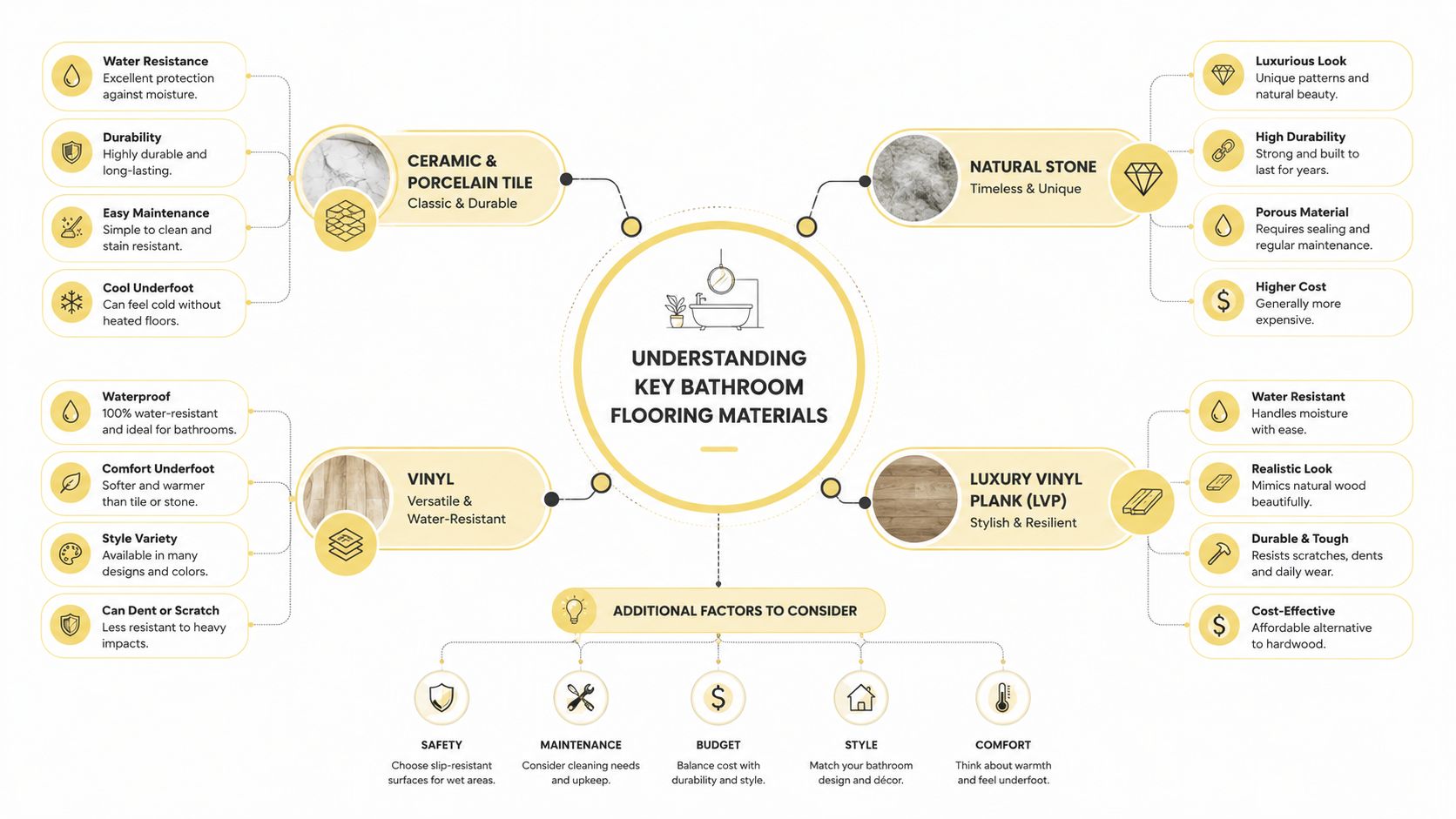
Ceramic tile is the familiar workhorse. It comes in a huge range of formats, colors, and finishes, and it suits many bathrooms well. It's a solid choice for secondary baths and powder rooms where you want flexibility and classic appeal.
Porcelain tile is the material I recommend most often when performance matters most. It's denser than standard ceramic, handles water exceptionally well, and now comes in finishes that mimic limestone, marble, concrete, and wood without the upkeep those surfaces usually demand.
Natural stone includes marble, limestone, slate, and travertine. It brings depth and variation that manufactured materials often can't replicate. It also asks more of the homeowner. Stone needs a thoughtful sealing and maintenance plan, and some finishes become slippery in the wrong application.
Luxury vinyl, especially plank or tile formats, appeals to homeowners who want warmth underfoot and a faster installation path. This category needs precision when you shop. “Vinyl” is too broad to be useful. Core construction matters, wear layer matters, and seam detailing matters.
Engineered wood can work in select bathrooms where the goal is a furniture-like, refined appearance rather than an overtly wet-room feel. It's better suited to lower-risk spaces and disciplined households than to busy family baths with constant splashing.
Solid hardwood doesn't belong in most bathrooms. It absorbs moisture, moves too much, and creates problems that are expensive to reverse.
Some materials fail slowly and elegantly. Others fail all at once. In bathrooms, that difference matters.
Laminate has improved, but it still belongs in the caution category for bathrooms. It can be useful in powder rooms or lightly used spaces, but it's not my first choice for a primary bath or a children's bath where water sits longer than it should.
Cork feels warm and soft, which some homeowners love, but it demands careful product selection and disciplined maintenance. I'd only consider it for a very specific design goal and a low-splash room.
Concrete gives a spare, architectural look that works well in contemporary homes. It can be elegant, especially with radiant heat, but the substrate and finish have to be handled carefully.
Epoxy resin creates a monolithic finish and resists moisture well when properly installed. It's more niche in residential bathrooms, but it can work beautifully in modern projects where a continuous floor plane is part of the design language.
If you're narrowing materials by style first, timeless bathroom material guidance for Maryland homeowners is a helpful companion read. It's a good way to sort out which finishes will still feel right years from now.
Comparing Durability Water Resistance Maintenance and Cost
Useful opinions are particularly valuable now. Plenty of materials can work in a bathroom. Fewer deserve a strong recommendation once durability, moisture, upkeep, and budget are all on the table.
Where each material earns its place
If you want the clearest long-term answer, porcelain tile is the benchmark. It offers a water absorption rate below 0.5% and commonly lasts 30 to 75+ years with proper maintenance, according to porcelain tile bathroom flooring performance data. For a primary bath, family bath, or any room where you don't want to revisit the floor for decades, porcelain is the conservative, smart choice.
Luxury vinyl plank earns its place for a different reason. It's easier underfoot, often easier to install, and generally easier to live with in homes where comfort matters as much as formality. It won't deliver the same generational lifespan as porcelain, but it can be the right answer for a basement bath, a fast refresh, or a busy household that wants fewer cold surfaces.
Natural stone sits in the high-character category. It can be beautiful, but beauty comes with obligations. You'll need to accept periodic sealing, a more watchful cleaning routine, and the possibility that some etching or patina is part of the material's story.
Laminate, engineered wood, cork, concrete, and epoxy all have valid uses, but they're more conditional choices. The right room, the right detailing, and the right expectations matter more with these materials than with porcelain or high-quality luxury vinyl.
A quick practical note. Bathroom floor performance isn't only about what lands on the floor. Plumbing issues shape wear too. If you're dealing with slow drainage, backup risk, or recurring standing water near the shower, this guide on how to Learn to clear your blocked shower gives homeowners useful context before floor damage spreads.
Comparison of Bathroom Flooring Materials
| Material | Durability | Water Resistance | Maintenance | Cost Range |
|---|---|---|---|---|
| Porcelain tile | Excellent | Excellent | Moderate, mostly grout care | Mid to high |
| Ceramic tile | Good to excellent | Good | Moderate, mostly grout care | Budget to mid |
| Natural stone | Good to excellent | Good when sealed | High | High to luxury |
| SPC or WPC luxury vinyl plank | Good | Excellent | Low | Budget to mid |
| Engineered wood | Moderate | Moderate | Moderate | Mid to high |
| Laminate | Moderate | Fair to good depending on product | Low to moderate | Budget to mid |
| Cork | Moderate | Moderate with proper finishing | Moderate | Mid |
| Concrete | Excellent | Good with proper sealing | Moderate | Mid to high |
| Epoxy resin | Good to excellent | Excellent | Low to moderate | Mid to high |
| Solid hardwood | Poor for bathrooms | Poor | High | High |
Choose the floor that matches your tolerance for maintenance, not just your taste in finishes.
If your budget is tight, don't cut corners on moisture performance just to get a more expensive look. In bathrooms, failure usually starts where water sits unnoticed.
Installation Subfloor and Fixture Considerations
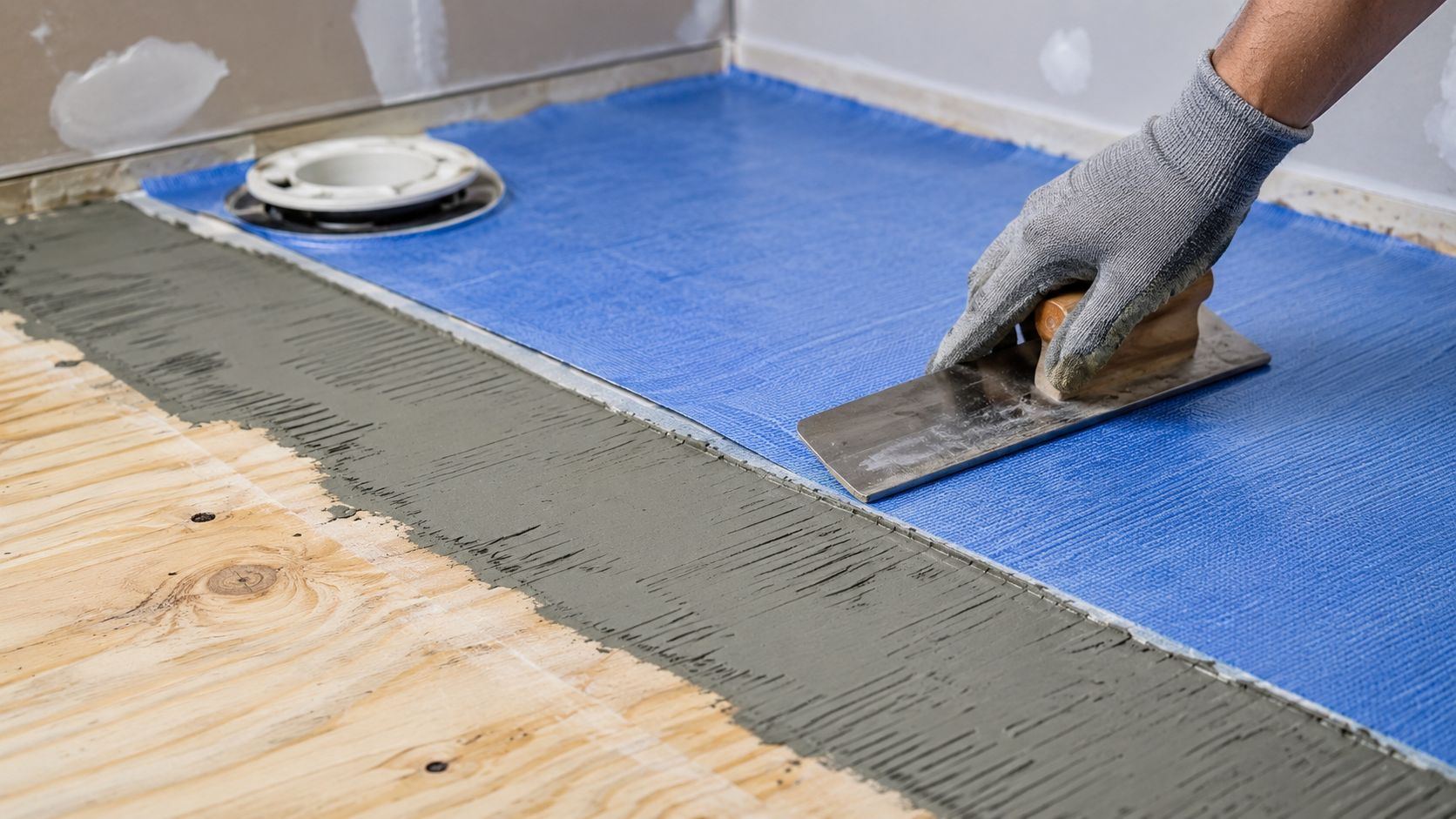
A well-chosen material can still fail if the installation is casual. Most flooring problems I see start below the finish layer.
Start with the subfloor, not the finish
Tile needs stiffness and flatness. If the subfloor flexes, grout cracks and tiles eventually follow. Vinyl needs smoothness. Telegraphing from dips, ridges, or patchwork seams can ruin the final appearance. Wood-based products need moisture discipline from the start, not after the room is closed up.
Before any finish flooring goes down, check these points:
- Structural soundness: Old homes in DC and Maryland often hide soft areas near tubs and toilets.
- Flatness: Large-format tile and floating floors are unforgiving.
- Moisture history: Stains, odor, and darkened subfloor areas usually mean there's more to investigate.
- Transition heights: Floor build-up affects door clearance, thresholds, and fixture alignment.
If the renovation includes plumbing upgrades behind walls or under the floor, a homeowner can benefit from understanding how repiping work intersects with finish decisions. Stultz Plumbing offers a useful example of how plumbing scope can expand once existing systems are exposed.
For homeowners planning a remodel with multiple trades involved, project managing a renovation is worth reading before you finalize the construction sequence. Bathroom floors don't fail in isolation. They usually fail because timing, prep, and coordination were loose.
The toilet detail most guides miss
One installation detail deserves blunt advice. Bathroom flooring should extend under the toilet base, not stop around it. Many consumer guides skip this, but it matters because gaps around the base can collect water and create conditions for mold or leakage, as noted in this bathroom flooring guidance on toilet installation coverage.
That point is especially relevant in humid bathrooms across DC and Maryland, where trapped moisture lingers longer.
Set the toilet on top of the finished floor. Don't cut around it and hope caulk will compensate for a bad decision.
The same mindset applies to vanities, tub skirts, and shower curbs. Clean geometry is usually better geometry. A bathroom floor should feel intentional, continuous, and easy to maintain once the room is in use.
Design Styling and Underfloor Heating Pairings
A bathroom floor has to perform, but it also sets the emotional temperature of the room. Some floors make a bathroom feel bright and composed. Others make it feel chopped up, dim, or colder than it needs to be.
How designers create visual calm
In smaller bathrooms, lighter flooring usually wins. Light-colored tile, vinyl, laminate, or concrete can make a room feel brighter and more open, and that matters in many DC-area homes where bathrooms have limited natural light. Pale limestone-look porcelain, soft greige ceramic, and quiet concrete tones all help a compact room breathe.
Slip-resistance matters just as much as color. Slip-resistance is a mandatory safety criterion, and both textured porcelain tile and SPC luxury vinyl plank can offer rated surfaces that help prevent slipping while still looking refined, according to bathroom flooring safety guidance from Tarkett.
A few styling pairings work consistently well:
- Light porcelain with painted cabinetry: Clean, refined, and timeless.
- Wood-look SPC plank with warm brass or bronze: Softer and more relaxed than stone-heavy schemes.
- Large-format tile with minimal grout contrast: Best for bathrooms where you want visual quiet.
- Textured stone-look surfaces: Useful when you want character without the maintenance profile of true stone.
For more visual direction, these bathroom tile design ideas are a strong starting point if you're balancing floor tile with shower walls and vanity finishes.
What works with heated floors
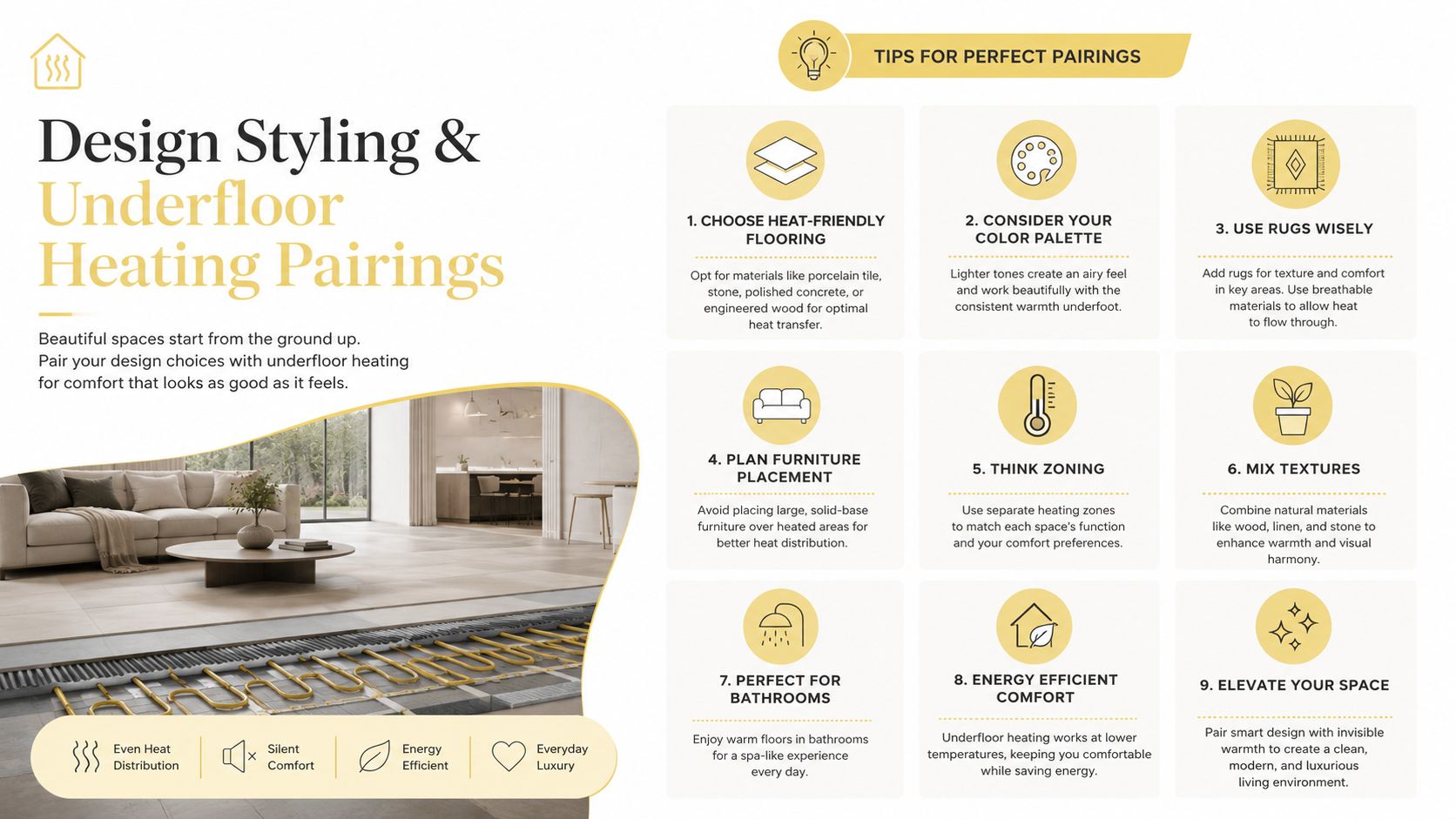
Underfloor heating changes the comfort equation. It can make tile far more appealing to homeowners who dislike a cool floor in winter, and it often turns a good bathroom into one that feels considered.
Porcelain and ceramic tile are excellent partners for radiant heat because they conduct warmth well and hold it consistently. Natural stone can also work beautifully over heating systems, particularly in bathrooms where a more substantial material palette fits the architecture.
SPC luxury vinyl plank can pair well with some heating systems, but this requires discipline. You need to follow the flooring manufacturer's temperature limits, approved underlayment guidance, and adhesive or locking-system requirements. This isn't a category for improvisation.
Engineered wood is the most delicate of the group. It can work over radiant systems in some cases, but the product spec, the heating method, and the bathroom's moisture conditions all need to align. If you want a relaxed wood look without that level of caution, SPC is usually the easier answer.
Warmth underfoot should feel invisible. If the heating plan forces awkward transitions or risky material choices, the design is off course.
Sustainability and Budget Friendly Flooring Choices
Budget and sustainability often get treated as separate conversations. They aren't. Homeowners usually want materials that last, avoid unnecessary waste, and don't create expensive maintenance problems two years later.
Budget choices that hold up
If you need a cost-conscious floor for a bathroom, start by separating cheap from economical. They're not the same.
Ceramic tile can be economical because it has broad price flexibility and a long visual life. SPC luxury vinyl plank can also be economical because installation is often simpler and the surface is easier on feet and schedules. Laminate may look appealing on price, but in a true bathroom environment it's a more conditional choice.
The key distinction in vinyl is important. Only luxury vinyl plank with an SPC or WPC core offers near-zero water absorption and true waterproof performance, while generic sheet vinyl can degrade in wet areas over time, according to this breakdown of bathroom flooring performance and vinyl core differences.
That means shoppers shouldn't stop at the word “vinyl.” Ask what core the product uses. If the answer is vague, keep looking.
A practical view of greener selections
Sustainability in bathroom flooring is less about trend language and more about lifecycle thinking.
Consider these angles:
- Longevity first: A floor that lasts well and avoids replacement is often the smarter environmental choice.
- Low-maintenance finishes: Materials that don't require aggressive cleaners or frequent replacement parts reduce long-term burden.
- Responsible look-alikes: Porcelain that mimics marble or reclaimed wood can deliver the visual effect without the same sourcing or maintenance complications.
- Selective natural materials: Reclaimed wood-look tile or recycled-content surfaces can make sense when the product is also suitable for wet-room use.
If your priority is a balanced decision, porcelain and high-quality SPC often come out ahead. They're practical, widely available, and easier to specify responsibly than many homeowners expect.
How to Choose and Next Steps
The best bathroom flooring options become clear once you stop asking one question and start asking five.
Ask yourself this instead:
- How wet does this room get, really?
- How much maintenance will I keep up with?
- Do I want a floor that feels warm and soft, or one that will outlast nearly everything else in the room?
- Will this bathroom have radiant heat?
- Am I choosing a surface, or am I choosing a full installation system with subfloor prep, transitions, and fixture detailing?
If you want the shortest version of my advice, here it is.
Choose porcelain tile for the strongest long-term performance, the most design flexibility, and the least regret in a heavily used bathroom. Choose SPC luxury vinyl plank when comfort, budget discipline, and simpler installation matter more, but only if the product is specified correctly. Use natural stone when you love authentic material variation enough to accept the upkeep. Treat laminate, engineered wood, cork, concrete, and epoxy as situational choices, not automatic ones.
When you review samples in a showroom, don't just compare color. Put the samples through practical questions. Is the surface slippery? Will the grout color age well? Does the scale work in your actual room? Will the floor still make sense once the toilet, vanity, and shower glass are in place?
Homeowners in the Washington DC, Maryland, and Virginia area benefit from seeing these materials in person, especially when comparing light reflectance, texture, and edge detail. That's where a sample stops being a pretty square and becomes a real decision.
If you're planning a bathroom renovation in Washington, DC, Maryland, or Virginia, Jennifer Gilmer Kitchen & Bath offers thoughtful guidance from concept through installation. Visit the showrooms in Chevy Chase, Easton, or Ashburn to compare materials in person, review layout options, and discuss the details that make a bathroom floor perform as well as it looks.