
You don't have to choose between painting every knotty pine cabinet white and embracing an all-over cabin look. The more useful approach is to decide where the wood deserves attention. A pine pantry beside quiet painted cabinetry can feel collected and architectural, while the same knot pattern repeated across every door can overwhelm a room. For a modern Mid-Atlantic kitchen, controlled contrast is often the better starting point.
Table of Contents
- A main kitchen with a furniture-like center
- An older house with something worth keeping
- A pantry that welcomes a lived-in surface
Where Knotty Pine Cabinets Belong
Knotty pine is lumber selected for its visible branch scars, and its strongest role is often an accent rather than an uninterrupted cabinet run. Before choosing a stain or door profile, decide which part of the room should carry that character.
Where knotty pine belongs in a kitchen
| Cabinet role | Use knotty pine | Why |
|---|---|---|
| Full run of doors and drawers | Selective | Softwood marks show first in busy work zones |
| Island, pantry wall, or furniture-like piece | Yes | Knots read as an accent against quieter surfaces |
| Painted upper cabinets | Only with knot sealing | Resin can bleed through light paint |
| Drawer fronts at sink or range | Prefer a harder wood | Pulls, water, and cookware concentrate wear |
| Breakfast area or secondary kitchen | Often yes | A lived-in surface suits lower daily impact |
The distinction isn't rustic versus contemporary. It's about visual concentration: how much grain, color variation, and irregular pattern you want to see from the doorway, and how those surfaces will be used once dinner preparation begins.
An island can be a good candidate, but its placement matters. A furniture-like island used for serving has a different life from one crowded with stools, a dishwasher, and the household's main sink. The recommendation should follow the activity, not just the cabinet's name.
A return to wood isn't a mandate for pine
The 2026 Houzz U.S. Kitchen Trends Report shows wood narrowly ahead of white among cabinet colors, 29 percent to 28 percent, with medium wood tones at 15 percent and light wood tones at 11 percent. That's useful context for renewed interest in visible grain, but it doesn't establish knotty pine as the default species.
A homeowner drawn to warm wood may want the evenness of maple or the long, orderly grain of rift white oak. Someone choosing knotty pine should want the branch marks themselves, not a brown cabinet.
Placement rule: Give knotty pine a clearly defined role, then let the surrounding cabinetry support it.
Let the house set the scale
For homeowners working with Jennifer Gilmer Kitchen & Bath in Washington, DC, Maryland, and Virginia, the architectural setting matters. A colonial house, an early twentieth-century city home, and a transitional suburban plan needn't borrow the same rustic vocabulary.
In a narrow kitchen, a pine pantry at the end of the room can provide a warm focal point without filling the upper sightline with knots. In a larger room, a freestanding-looking piece can introduce the familiarity of furniture while leaving the working perimeter more restrained.
Placement is only the beginning of a sound decision. The knot pattern, finish, construction, neighboring materials, and choice between custom and semi-custom cabinetry all need to suit that role. A beautiful sample becomes a successful kitchen only when those choices work together.
Reading the Knots and Choosing a Finish
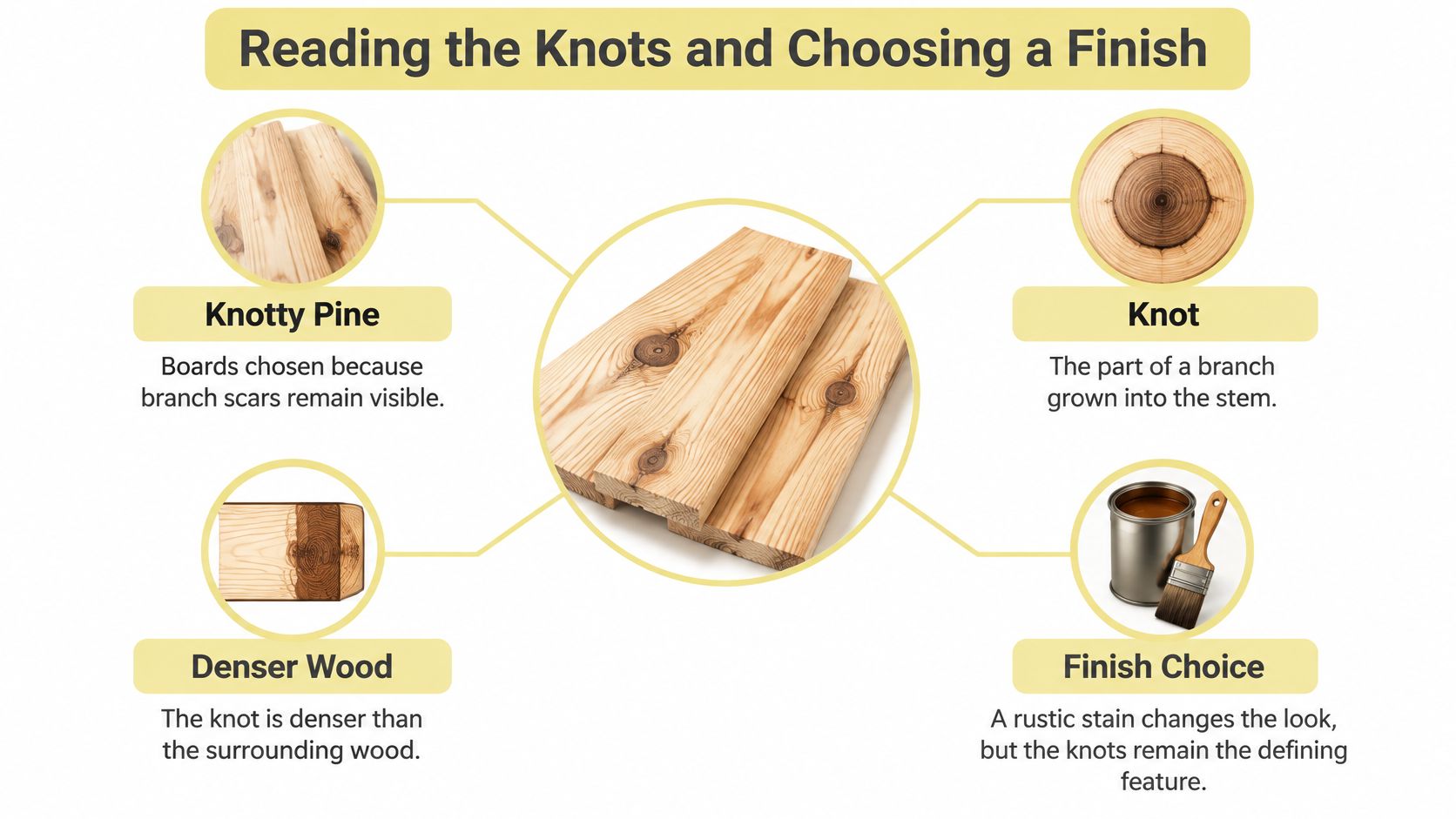
Knotty pine isn't ordinary pine made rustic with stain. Its defining marks are already in the board. The U.S. Forest Service's finishing guidance describes a knot as the portion of a branch incorporated into the stem and explains how dense knots and resin affect finish adhesion and discoloration.
Think of a knot as a letter and a cabinet door as a printed page. The irregular marks are the point, but their size and spacing determine whether the composition feels balanced. A door crowded with large knots can make delicate hardware and patterned stone look incidental.
The diagram below separates the wood's defining features from the finish applied over them.
Read a whole door, not a finish chip
A finish chip can establish color, but it can't show how a knot interrupts a rail or how contrasting grain crosses a broad panel. Hold a full door upright and examine it from the distance at which you'll normally see the cabinetry.
- Knot size and spacing: Look for a distribution you enjoy across the entire door, not just an appealing corner.
- Tight and loose knots: Ask the cabinetmaker to identify sound knots and explain how any loose material, cracks, or openings will be addressed.
- Pitch pockets: Check resinous areas rather than assuming the topcoat will conceal them.
- Grain bands and direction: Notice pale earlywood, darker latewood, and whether the panel's grain sits comfortably within its frame.
Move the sample beside the countertop and under the proposed lighting. A color that looks softly neutral on a horizontal sample may appear much warmer on an upright door.
Choose between visible grain and painted form
A clear or lightly tinted finish preserves the grain and branch marks without deliberately recreating the heavy amber-orange appearance associated with many older kitchens. Forest Service guidance generally favors clear, water-repellent, or semitransparent treatments over paint for knotty grades, although an interior cabinet still needs a finish system appropriate to kitchen use.
Paint makes sense when you value an existing door's shape more than its grain. Every knot needs an appropriate barrier, such as shellac or a compatible stain-blocking primer, tested on representative boards before the full job proceeds. Light paint is especially unforgiving of resin discoloration.
Stained pine also deserves a test panel because uneven absorption can produce conspicuous bands. Our guide to kitchen cabinet finishes offers context for weighing appearance alongside everyday care.
The USDA Forest Products Laboratory's Wood Handbook treats drying, moisture control, dimensional change, and finishing as related but distinct considerations, and notes that coatings slow moisture exchange rather than stop it. Doors and panels should be properly dried and acclimated before fabrication, with exposed faces and edges finished.
Approve the knot pattern and color on a full sample door before the layout is locked, not after the cabinets have been ordered.
Record the agreed finish in writing: surface preparation, primer where needed, topcoats, sheen, cure time, and cleaning method. That record makes expectations clear and gives future maintenance a practical starting point.
Softwood Wear and Seasonal Movement
How knotty pine compares in hardness
The approximate Janka values reported by Captivating Cabinets are 380 lbf for eastern white pine, 1,290 lbf for red oak, and 1,450 lbf for hard maple.
| Wood | Approximate Janka hardness | What it means at the cabinet |
|---|---|---|
| Eastern white pine | 380 lbf | Dents and edge bruises from cookware and pulls |
| Red oak | 1,290 lbf | Roughly three times pine's Janka value, indicating greater dent resistance |
| Hard maple | 1,450 lbf | A common harder face for busy drawer fronts |
Knotty pine is a softwood, and eastern white pine records daily impacts more readily than these harder cabinet woods. Janka measures the force required to embed a standardized steel ball into wood. It's a useful dent benchmark, not a promise about how a finished kitchen will look after daily use.
Species, density, growth conditions, moisture, and board orientation all affect performance, as the Glamorwood cabinet-material guide explains. Handle the actual sample door and feel its edges; don't try to judge durability from a photograph or a finish name.
Allow the door to move
Seasonal movement is a separate issue from surface softness. Swedish Wood gives a rule of thumb for pine and spruce of about 0.26 percent movement radially and tangentially per percentage-point change in wood moisture content; applied across a 20-inch door, a 5-percentage-point change represents roughly 0.26 inch of movement.
That's an illustration, not a prediction for every cabinet door. The actual response depends on species, cut, construction, and joinery, but it explains why a broad solid panel shouldn't be restrained as though it were dimensionally fixed.
A cabinetmaker can accommodate that behavior with frame-and-panel doors, floating panels, and appropriate clearances at the case. Finishing all exposed surfaces helps moderate moisture exchange, while detailing around dishwashers and sinks should keep water from lingering against the wood.
Put protection where people touch
Eased edges are less vulnerable than sharp corners, and hardware backplates can protect the area around frequently used pulls. A durable topcoat helps with surface wear, but it can't turn soft pine into maple.
Use harder-wearing materials where cookware, shoes, and repeated handling concentrate contact. That may mean a harder drawer front beside the range, a resilient plinth at the floor, or a work surface chosen independently of the decorative cabinetry. Our guide to the best kitchen cabinet materials can help frame those choices around use rather than appearance alone.
Daily-use test: If a small dent would bother you every time you reached for a pan, don't put pine on that drawer front.
Patina can suit a relaxed breakfast area or pantry. Beside a meticulously maintained stone counter in a heavily used cooking zone, the same marks may feel out of place. Decide where visible change belongs before installation, rather than asking the finish to prevent every trace of use.
Pairing Knotty Pine with Quiet Materials
An original pine kitchen may represent a deliberate design choice, not an unfinished builder solution. A House Digest historical overview places knotty pine's strongest popularity in the 1940s through the 1960s, when its availability, affordability, and natural appearance suited postwar interiors.
The familiar rustic composition below shows how strongly warm wood can establish a room's character.
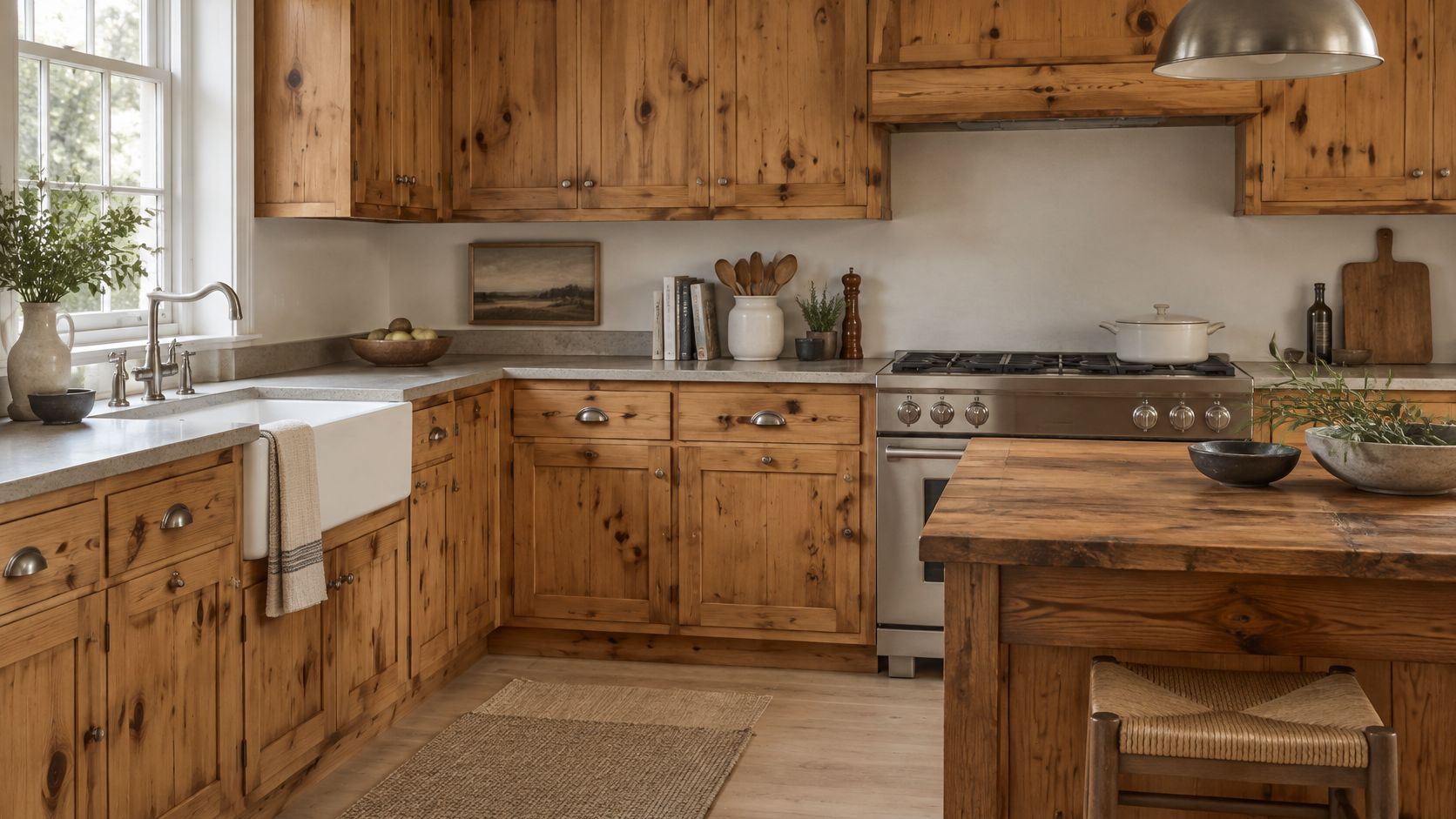
What makes an older scheme feel dated is often the combination: heavy amber shellac, dark trim, and period hardware used together. You don't necessarily need to remove the pine. You need to decide which neighboring elements still belong.
Give the grain quiet neighbors
Start with the largest adjacent surface. Honed stone or calm quartz in a warm gray can provide a steady background without introducing another emphatic pattern. Compare actual slabs or generous samples with the door, because a small stone chip can hide the movement that becomes obvious across a countertop.
If white perimeter cabinetry is part of the composition, Varun Marbles' guide to granite countertop finishes for white kitchens is a useful companion for considering the counter's surface treatment. The relevant question is how the finish and pattern sit beside both painted cabinetry and knotty wood.
Brushed metal or unlacquered hardware can add a tactile detail without making every pull a focal point. A quieter second wood, such as rift white oak, walnut, or maple, can frame the pine, provided the undertones look intentional together.
For another visual reference, consider the cabinetry, surrounding surfaces, and proportions in this kitchen video.
Keep the architecture in charge
In a Washington, DC, Maryland, or Virginia home, molding should respond to the house rather than to a generalized rustic theme. An Arts and Crafts interior may welcome a different cabinet frame from a colonial kitchen or a later transitional plan. Overscaled lodge-style trim can feel misplaced in a compact city room.
Lighting deserves the same restraint. Test the sample under ambient and task lighting so the grain remains legible without every knot becoming a deep shadow. Pine should be one instrument in the room, not the whole orchestra.
Try a final pairing test: if the pine doors were painted a quiet color tomorrow, would the layout, stone, and hardware still feel resolved? If so, the room has a sound composition beyond its wood choice.
Accent Uses That Keep the Kitchen Calm
Knotty pine earns its place in a modern Mid-Atlantic kitchen when one piece carries the warmth and the rest of the room stays quiet. In a main kitchen, painted perimeter cabinets can handle the daily work while a pine island stands slightly apart from the working run, facing the room like a piece of furniture. A plain stone top gives serving dishes and everyday clutter a calm landing place.
A designer at Jennifer Gilmer Kitchen & Bath might sketch exactly this composition during a showroom consultation. Each material has a job: quiet cabinetry organizes the working wall, and the island gives the gathering area a warmer expression.
A main kitchen with a furniture-like center
The island might have eased corners where people pass and hardware with backplates on its storage side. Its seating face can show the most expressive boards, while the drawer beside the range remains a harder wood within the perimeter cabinetry.
The result doesn't require a rustic floor, exposed beams, or a farmhouse sink. A measured amount of pine sits comfortably beside straightforward wall cabinets and a restrained backsplash. Scale does the calming: one furniture-like piece reads as an accent, while a full run of knotty doors would read as a theme.
An older house with something worth keeping
In an early twentieth-century house with a later pine kitchen, a few sound doors might deserve a place in the renovation. After cleaning and a finish assessment, they could form a shallow pantry or breakfast-room cupboard within a newly organized layout.
The bruised sink cabinets needn't remain merely to preserve a matching set. Replacing those cases can free the designer to improve cleanup space and appliance access while retaining the doors that have the most pleasing proportions.
Keep the pieces that contribute character, not the arrangement that makes cooking difficult.
A lighter clear finish may be possible where the existing coating and wood condition allow it. The retained cabinetry can then read as part of the home's history without requiring the entire kitchen to function as it once did.
A pantry that welcomes a lived-in surface
A breakfast room or butler's pantry offers another possibility: a complete pine run used for cups, linens, and occasional serving. Here, a little wear may sit comfortably beside pottery and a simple stone counter. Because the space sees gentler traffic than the main kitchen, a few marks over the years can read as patina rather than damage.
The supporting choices can remain modest:
- A restrained counter: Choose a surface that doesn't compete with the cupboard doors.
- Comfortable hardware: Select pulls that feel secure when carrying a tray or opening a loaded drawer.
- Useful storage: Fit the interior to the items kept there, rather than preserving empty display space.
Household routines are the useful starting point, not a lodge photograph. Which room matches your traffic? If every meal happens around the same sink and working drawers, the accent composition is the honest choice.
Choose Custom or Semi-Custom Cabinetry
Choose the construction path based on the wood's behavior and the project's demands, not from the prestige of a label. Custom cabinetry offers a way to specify board selection, movement allowances, and finish testing. Semi-custom cabinetry works from an established range of door styles, dimensions, and factory finishes, so its suitability depends on what the particular maker offers.
Custom and semi-custom knotty pine compared
| Decision | Custom | Semi-custom |
|---|---|---|
| Knot size and placement | Boards selected for the doors you will see | Limited to the maker's grade and mix |
| Movement detailing | Floating panels and clearances specified | Standard case and door construction |
| Finish and resin control | Written primer, coats, sheen, and cure | Factory finish menu |
| Best fit | Wide panels, paint, or partial reuse of old pine | A small accent with an approved sample |
A factory finish menu isn't necessarily inadequate, and custom work isn't automatically well detailed. The meaningful distinction is whether the maker can document and deliver the construction and appearance you've approved.
Spend on the decisions that need control
Custom work is the stronger candidate when pine covers wide panels, when existing doors must be integrated into new cabinetry, or when a painted finish needs testing against resin. Those conditions call for more than selecting a door from a display.
A small pantry accent may be well suited to semi-custom construction if the available pine door and clear finish match an approved physical sample. Confirm availability early rather than assuming every cabinet line offers knotty pine.
Board selection, individual detailing, and finish development add labor to custom work. A sensible budget can concentrate that attention on the visible feature while using standard cabinetry elsewhere. Our comparison of custom versus semi-custom cabinets explains the broader decision without reducing it to a simple good-and-better hierarchy.
Bring the material into the plan review
Jennifer Gilmer Kitchen & Bath serves Washington, DC, Maryland, and Virginia, with a process that carries projects from concept through installation. During plan review, we help clients select cabinet door styles and finishes together, so the material decision stays connected to the room's proportions and daily use.
We also show clients what the finished project will look like on a screen before work begins. That view helps establish the balance of pine and quieter surfaces, although it doesn't replace the physical sample needed to judge grain, color, and texture.
Once plans and materials are finalized, we prepare the cabinet contract along with the other selected materials. We can also help clients find a contractor to implement the design.
Bring a photograph of an existing door, or an image that captures your finish goal, to a showroom appointment. In the resource room, place hardware and countertop options beside the cabinet sample so the decision rests on a complete composition, not an isolated wood preference.
Jennifer Gilmer Kitchen & Bath offers thoughtful layout planning, cabinetry selection, and installation coordination to help knotty pine feel intentional in a working kitchen. Visit Jennifer Gilmer Kitchen & Bath to arrange a showroom consultation, and bring a door photograph or finish inspiration to explore where this character-rich wood belongs in your home.