.avif)
You're standing between two full slabs at a stone showroom, phone in hand, comparing a saved Pinterest kitchen with the surfaces in front of you. One quartz slab has convincing movement and soft veining. The granite beside it has a quieter, honed finish that looks nothing like the glossy stone in older kitchens. Both could work, and that's exactly why the decision feels difficult.
The familiar quartz vs granite countertops debate has changed. Quartz now offers controlled patterns that can closely echo natural stone, while granite comes in polished, honed, and leathered finishes that affect how it looks and wears. The right choice depends less on a universal winner and more on appearance, heat, upkeep, fabrication, sustainability, resale expectations, and the way your household uses the kitchen.
| Attribute | Quartz | Granite |
|---|---|---|
| Material | Engineered stone made with ground quartz, resins, pigments, and other components | Natural igneous stone quarried and cut into slabs |
| Visual character | Consistent color and repeatable pattern | Unique movement and variation from slab to slab |
| Hardness | Commonly around 7 on the Mohs scale | Commonly around 6 to 7 |
| Sealing | Generally doesn't require sealing | Usually requires periodic penetrating sealer |
| Heat approach | Use trivets and heat protection | More tolerant of hot cookware, but still treat the surface carefully |
| Best fit | Low-maintenance living and controlled design | Natural variation, dramatic movement, and heat-heavy cooking |
Table of Contents
Why This Countertop Decision Feels Harder Than It Should
A homeowner we'll call Elena arrived at a showroom with a clear preference for “white quartz.” Her inspiration images showed a clean island, pale cabinetry, and subtle marble-like veining. Then she saw a real granite slab with warm gray movement, a leathered finish, and enough depth to make the room feel collected rather than coordinated. Her phone still favored quartz. The slab in front of her favored granite.
That conflict is common because photographs flatten the details that matter in a working kitchen. A small sample can make veining appear delicate, while a full slab may carry bold movement across the island. Glossy surfaces reflect light differently from honed or leathered ones. A color that looks calm under showroom lighting can feel stark beside your cabinet door, backsplash sample, or flooring.
Practical rule: Choose the surface in the context of the room, not as an isolated square on a screen.
The market has also moved beyond the old glossy-quartz-versus-polished-granite comparison. Quartz remains the more standardized engineered surface, typically made from about 93% ground quartz and commonly rated around 7 on the Mohs hardness scale. Granite usually falls in the 6 to 7 range, and its performance can vary because each slab is a natural mix of minerals rather than a controlled manufactured blend. Slabwise's comparison of quartz and granite durability explains why installers often assess individual granite slabs before fabrication.
Today's granite may be matte, honed, or leathered, not only glossy. Today's quartz can imitate marble, limestone, and granite with far more convincing veining than earlier generations. The useful question is no longer which material wins in the abstract. It's which surface gives your kitchen the visual language, maintenance routine, and performance margin your household can live with.
What Quartz and Granite Actually Are
Start with the material itself. Quartz countertops are engineered slabs, not solid natural quartz. Independent descriptions place their composition roughly in the 90% to 94% ground quartz range, combined with polymer resins and pigments. Construction Flux's explanation of quartz and granite composition provides the basic distinction: quartz is manufactured for consistency, while granite is quarried as a natural stone.
Granite begins as an igneous rock formed when magma cools. It commonly contains quartz, feldspar, and mica, but the balance varies. That mineral composition creates the movement, speckling, depth, and color shifts that make one slab different from the next. A fabricator may need to study the full slab to understand where a vein will land in relation to a sink, cooktop, or island edge.
A shared vocabulary for slab selection
- Aggregate: The ground mineral material used in an engineered slab.
- Resin binder: The polymer material that holds quartz aggregate and pigments together.
- Veining: Linear or branching movement that runs through a slab. In quartz, it's designed and reproduced. In granite, it forms naturally.
- Honed: A smooth, low-sheen finish with less reflection than polish.
- Leathered: A textured finish that emphasizes the stone's natural surface and can soften visual glare.
- Bookmatched: Two adjacent slabs placed as mirror images so their pattern creates a continuous, symmetrical composition.
Quartz's controlled manufacturing makes repeatability its defining design advantage. If you need a long run of counter material to read consistently, or you want a restrained pattern across several work zones, quartz simplifies specification. Granite offers the opposite experience. Its uniqueness can be the central design feature, particularly on a large island where the slab's natural movement remains visible.
| Attribute | Quartz | Granite |
|---|---|---|
| Source | Manufactured slab | Quarried natural stone |
| Pattern control | Repeatable from slab to slab within a product line | Each slab has individual variation |
| Main visual strength | Consistency and controlled veining | Geological character and one-of-a-kind movement |
| Finish options | Commonly polished or matte, depending on collection | Polished, honed, and leathered finishes |
| Design planning | Easier to coordinate across multiple surfaces | Requires full-slab review and careful layout |
The material distinction matters because it predicts the design experience. Quartz gives you more control before installation. Granite asks you to respond to what the earth produced.
How They Look, Wear, and Hold Up Side by Side
Both materials are durable enough for everyday kitchen work, but they don't fail in the same places. Quartz generally has a modest advantage in scratch resistance because it's commonly rated around 7 on the Mohs hardness scale, while granite is generally described in the 6 to 7 range. Elle Decor's quartz and granite comparison makes the practical point clearly: neither surface is scratch-proof, so a cutting board still belongs between your knife and the counter.
Heat is the sharper dividing line. Granite is the safer choice for households that regularly move cookware from oven or cooktop to counter, although a trivet remains sensible. Quartz contains resins, so sudden, concentrated heat can damage the surface or create discoloration. An induction cooktop doesn't eliminate the risk. A pan removed from the cooking zone can still be hot enough to demand protection.
What everyday scenarios reveal
A knife slips near the prep area. Quartz and granite can both withstand ordinary use, but either may chip at an exposed edge or suffer damage from forceful impact. A glass of red wine sits overnight. Quartz's nonporous surface is usually more forgiving, while granite's result depends heavily on the slab and its sealer. A hot pan lands beside the range. Granite has the stronger margin; quartz asks for a trivet.
Finish changes the visual equation. A polished surface reflects more light and can emphasize fingerprints, streaks, and seams. Honed granite often disguises etching and everyday marks better than polished granite, but it may show oils more readily. Dark quartz can look sleek in a sample and reveal fingerprints across a broad island in daylight. Marketing photographs rarely show that lived-in detail.
| Factor | Quartz | Granite | Best in Real Kitchens |
|---|---|---|---|
| Scratches | Strong resistance, but not scratch-proof | Strong resistance, varying by slab | Both, with cutting boards |
| Heat | Needs protection from hot cookware | More tolerant of direct heat | Granite for high-heat cooking |
| Stains | Nonporous and generally highly stain-resistant | Protection depends on stone density and sealing | Quartz for spill-prone households |
| Chips | Edges can chip under impact and repairs may be visible | Chips can often receive color-matched filler | Depends on edge design and fabricator |
| Finish | Controlled appearance, with finish options by collection | Polish, hone, and leather can change perceived wear | Choose based on lighting and use |
| Sealing | Not generally required | Usually required | Quartz for minimal upkeep |
For a broader look at how countertop materials fit different kitchen plans, review this guide to the best types of kitchen countertops. My design verdict is situational: choose quartz when stain control and consistency matter most. Choose granite when natural movement and heat tolerance deserve priority.
The Real Maintenance Tradeoff Over Time
Maintenance is where the decision usually becomes practical. Quartz generally needs little beyond prompt cleanup with mild soap and water. Granite usually needs a penetrating sealer because its porosity varies by slab. Resealing is commonly discussed at intervals of one to three years, depending on the stone and use, according to Moreno Granite's guidance on heat, scratches, and stains.
That interval isn't a universal appointment on the calendar. A dense granite used lightly may need attention less often than a more absorbent slab in a busy kitchen. Test the surface according to the fabricator's instructions, and ask which sealer was applied at installation. Sealing reduces absorption. It doesn't make granite impervious to every spill or eliminate the need to wipe up coffee, wine, and oils.
Routine care versus future service
Quartz wins the daily-care contest. You don't need to remember a sealing schedule, and ordinary spills tend to stay on the surface rather than soak in. You do need to use trivets, avoid harsh cleaners, and pay attention to prolonged sunlight, especially near a bright south-facing window.
Granite asks for a little more participation but offers strong serviceability. A small chip can often receive color-matched filler from an experienced repair professional. Quartz chips may also be repairable, but the technician has to match a manufactured pattern that runs through the slab, so a professional repair is usually the sensible route.
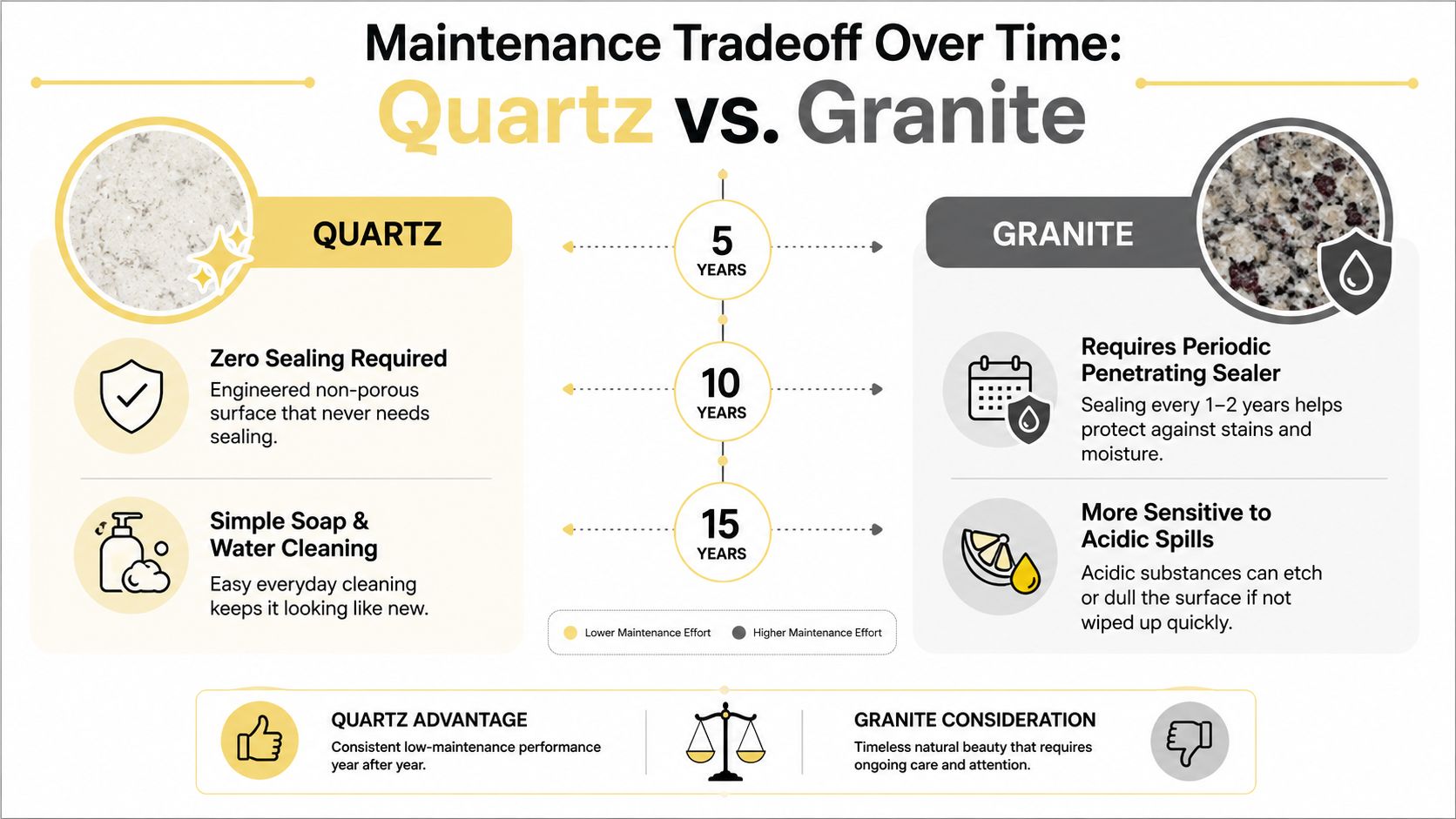
Daily-use test: If you resent sealing, choose quartz. If you resent heat restrictions more, choose granite and accept the care that protects it.
Your household's habits should decide the tradeoff. A family that leaves lunch containers, coffee cups, and art supplies across the island may value quartz's easy cleanup. An enthusiastic cook who uses cast iron and moves roasting pans constantly may prefer granite's heat tolerance. Neither surface is maintenance-free in the broad sense. Quartz minimizes routine care. Granite offers a more forgiving relationship with heat, provided you maintain its protection.
Cost, Fabrication, and What Each Material Demands
The countertop price is only one line in a remodeling plan. The final cost also reflects slab selection, templating, edge details, sink and cooktop cutouts, seam placement, delivery, installation, and any cabinet reinforcement. Because those variables change from kitchen to kitchen, I won't attach invented price ranges to a surface without a verified project scope.
Material pricing for quartz and granite often overlaps in the middle of the market. Granite can move sharply upward when the slab is rare or unusually dramatic, while premium quartz collections can also command more than standard lines. The right comparison is between specific slabs with comparable fabrication requirements, not between the material names alone.
Fabrication changes the budget
Quartz has a consistent density and pattern, which generally makes cutting and seaming more predictable. Granite requires closer inspection because fissures, mineral shifts, and natural movement influence where the fabricator can safely place seams and cutouts. A dramatic vein may look beautiful on the island and awkward when interrupted by a sink opening.
Ask these questions before approving the slab:
- Where will the seams land? Request a drawing showing seams in relation to the sink, dishwasher, cooktop, and island sightlines.
- How will the edge be finished? A simple eased edge, a more layered profile, and a waterfall return require different labor and visual planning.
- What reinforcement is needed? Large stone surfaces, especially around wide overhangs, may require structural support from the cabinetry.
- How will the slab be laid out? Ask to see the proposed template on the actual slab when the pattern is important.
- Who handles repair or adjustment? Clarify whether the installer or fabricator owns the work after installation.
Farmhouse sink cutouts, appliance openings, and full-height backsplashes deserve early attention. So does lead time, particularly when you're considering an exotic granite that must be sourced, inspected, and coordinated with the installation schedule.
For the broader financial planning that surrounds cabinetry, labor, appliances, and finish selections, use this realistic guide to kitchen remodeling costs in 2026. A well-designed countertop decision protects the schedule as much as it protects the budget.
Sustainability, Health, and Resale Considerations
Natural doesn't automatically mean greener. Granite requires quarrying, processing, and transportation. Quartz uses a large mineral component but also relies on polymer resins and pigments. Manufacturing location, shipping distance, recycled content, quarry practices, and the documentation available for the exact product all affect the environmental picture.
That's why sustainability claims should stay specific. Independent environmental product declarations for quartz surfaces show that manufacturers are publishing lifecycle information, making it possible to evaluate products beyond a simple natural-versus-engineered label. Accio's coverage of countertop trends and sustainability considerations also identifies recycled content, low-VOC resins, and eco-conscious product options as increasingly relevant to material selection.
Ask for documentation, not assumptions
Indoor air quality deserves the same care. Quartz products may carry certifications related to low VOC emissions, and properly sealed granite can perform well in occupied interiors. Ask the supplier for current product documentation, resin and emissions information where applicable, and installation guidance. “Natural” and “engineered” describe origin, not a complete health profile.
Resale is equally local. Granite can signal natural luxury to buyers who value geological variation. Quartz can appeal to buyers who want predictable color, straightforward maintenance, and a contemporary look. Market preference has shifted significantly: Slabwise's quartz market data reports granite at about 35% of the countertop market in 2016 and quartz near 22%, while its 2026 figures place quartz around 36% and granite around 24%. The same source cites a separate forecast placing granite at 28.0% market share in 2025 and projects engineered quartz growth at an 8.2% CAGR from 2026 through 2033.
Those figures describe broad market movement, not a guarantee for your neighborhood. For a resale-focused renovation, choose a material that suits the home's architecture and local buyer expectations. For an environmentally conscious project, request verified information for the precise slab line and supplier rather than relying on the stone category alone.
Matching the Surface to the Household
The most useful recommendation starts with the people who'll use the kitchen. A surface that suits an avid baker may frustrate a household that treats the island as a homework station, breakfast bar, and package drop zone.
Busy families
Choose quartz for a family kitchen where spills are routine and cleanup needs to stay simple. Its nonporous character and controlled pattern make it a practical choice for an island that sees coffee, school projects, snacks, and frequent wiping. A consistent slab also makes seams and transitions easier to plan visually across a large work area.
Avid home cooks
Granite deserves serious consideration if the cooktop and oven are in constant use. Its natural stone composition gives it a stronger heat profile, and a carefully selected slab can add visual depth that improves with the room's cabinetry and lighting. You'll need to accept sealing and still use reasonable care around edges and impact points.
Designer's recommendation: Decide whether your household's bigger irritation is routine maintenance or heat protection. That answer often settles the material choice quickly.
Resale-minded renovators
For resale, I prefer a quiet quartz pattern in a well-resolved kitchen when the surrounding design is contemporary and the local market favors low-maintenance finishes. Granite remains appropriate when the home's character, architecture, or buyer base responds to natural stone and individual slab variation. Don't select a countertop in isolation. The backsplash, cabinet color, hardware, and lighting determine whether the surface reads intentional.
Design purists and secondary scenarios
Choose granite when the geology is the point. Dramatic movement, bookmatched layout, and a leathered finish can give an island an identity no repeatable pattern can fully reproduce. For rental properties, quartz often simplifies turnover and replacement planning. For aging-in-place kitchens, its reduced routine maintenance may lower long-term friction.
Countertop selection cascades into every other finish. Before finalizing cabinet paint, backsplash tile, plumbing fixtures, and hardware, settle the household fit and the slab's visual direction. If you're considering a lower-cost update rather than a full replacement, this guide to laminate resurfacing countertops can help clarify whether your project needs new stone at all.
Choosing Well in the Showroom
A small sample can help you establish color, but it can't tell you how a full slab will behave across an island. View the material vertically and horizontally. Stand several feet away, then move close enough to inspect the finish. Look at it under bright showroom light and in a quieter corner, because reflection can hide texture and make veining appear more uniform than it is.
For an island, ask how the pattern will travel from the main field to the edge. If you want bookmatching, confirm that adjacent slabs are available and that the fabricator can preserve the intended movement. With quartz, ask about batch consistency, resin content, warranty exclusions, heat guidance, and whether future additions could match the original product. With granite, ask where the slab came from, whether a visible line is a natural fissure or a crack, and where the fabricator recommends placing seams.
Bring your cabinet door, backsplash sample, flooring sample, and hardware finish to the appointment. A warm white quartz may look gray beside a cool white cabinet. A green-gray granite may become the bridge between stained wood, painted cabinetry, and aged brass. These relationships are easier to judge in person than on a screen.
Jennifer Gilmer Kitchen & Bath supports clients through material selection in its Washington, DC, Maryland, and Virginia service area, including guided showroom appointments and stone-yard coordination. The firm's process can connect the slab decision to cabinetry, layout, finish specifications, and installation planning from concept through completion, rather than treating the countertop as a late-stage purchase.
Visit Jennifer Gilmer Kitchen & Bath to discuss quartz and granite options with a design team serving Washington, DC, Maryland, and Virginia. Bring your cabinet and backsplash ideas, and let the firm help you evaluate full slabs, fabrication details, and a countertop plan that fits how your kitchen will be used.