.avif)

What makes a countertop the right choice for your kitchen, the way it looks in a showroom, or the way it supports your actual life? Cooking habits, cleaning tolerance, design direction, budget, and the role each zone plays all matter. A surface that works beautifully for a careful baker may frustrate a busy family, while a low-maintenance material used everywhere can leave an otherwise personal kitchen feeling flat.
The best types of kitchen countertops balance durability, maintenance, cost, fabrication, and aesthetic character. The material also needs to work with the layout, cabinetry, lighting, storage, and installation details around it. A mixed-material plan can be more successful than forcing one surface across every work zone.
Jennifer Gilmer Kitchen & Bath serves homeowners throughout Washington DC, Maryland, and Virginia, helping clients coordinate those decisions from concept through installation. The firm's designers consider how an island, perimeter run, baking station, beverage area, and cleanup zone will be used before recommending a material. Here are ten countertop options, with the practical trade-offs that shape a successful remodel.
Table of Contents
1. Granite
Granite remains a strong choice for homeowners who want natural-stone durability and visual depth. Quarried in large slabs, it offers substantial variation in color, mineral movement, and pattern. No two slabs are identical, which gives a kitchen more individual character than a manufactured surface designed for uniformity.
Its crystalline structure makes granite resistant to everyday scratching and heat. Consumer Reports found that heat, cuts, and scratches didn't damage granite in its testing, while materials guidance notes that sealed granite resists most stains more effectively than unsealed stone. Crowley's Granite explains the durability and sealing considerations for granite.
Where granite works best
Granite suits a kitchen where the countertop should provide a grounded, architectural element. A quiet gray slab can support painted cabinetry, while a more active stone may become the visual focus of an island. Because the pattern can be significant, it's wise to select the slab before finalizing backsplash and hardware decisions.
View samples, and preferably the full slab, under several lighting conditions. Showroom lighting can make a stone look cooler, brighter, or more uniform than it will appear at home. Porosity varies, so ask the installer for a specific sealing recommendation rather than assuming every granite surface requires the same routine.
Practical rule: Decide on the edge profile early. A beveled, bullnose, or ogee edge changes how the stone reads and affects fabrication planning.
Honed granite can be useful in a busy household because its matte finish is less likely to emphasize fingerprints and water spots. If you're weighing the total remodel investment, Jennifer Gilmer Kitchen & Bath's guide to the average kitchen remodel cost can help place countertop decisions within the broader project.
2. Quartz Engineered Stone
Quartz is the practical middle ground between a highly controlled aesthetic and the presence of stone. Manufacturers combine ground natural quartz with resin binders and pigments, creating slabs with predictable color and repeatable pattern. That consistency helps when a homeowner wants a calm surface across a long perimeter or needs several slabs to coordinate closely.
Quartz is nonporous, so liquids don't soak into the surface and routine sealing isn't required. Zeeland Lumber's overview of durable kitchen countertops identifies nonporosity as a major maintenance advantage. Consumer Reports evaluates countertops for stains, abrasions, cutting, heat, and impacts, and its 2025 summary rated quartz highly in stain resistance, cutting, abrasion, and heat exposure at 400°F. Read Consumer Reports' countertop buying guide.
Daily use still matters
Quartz works especially well for families who want an easy-care surface that can handle cooking, school lunches, and entertaining without a sealing schedule. It's also useful when the cabinetry, tile, or lighting already provides visual complexity and the countertop needs to remain composed.
Ask to see a large-format sample in the kitchen's natural light. A small showroom chip won't show how veining travels across an island or how a warm white shifts beside cabinet paint. Matte finishes can soften the manufactured quality of the material, while a polished surface may better suit a formal kitchen.
Use trivets and hot pads for very hot cookware, even though quartz performs well in many heat tests. Extensive south-facing windows also deserve attention, so confirm the manufacturer's guidance when the countertop will receive strong direct sunlight.
3. Marble
Marble is less about carefree performance than light, movement, and graceful aging. As a metamorphic limestone, it has a luminous quality that can make an island feel like a piece of architecture. Each slab has its own veining, from fine linear marks to broad, cloudlike movement, so the selection process is part of the design rather than a final finish decision.
Marble can etch when it meets acidic foods, and it can develop scratches, stains, and tonal changes with use. Those marks aren't defects in the conventional sense. They're evidence of contact with the kitchen, and they become part of the surface's patina.
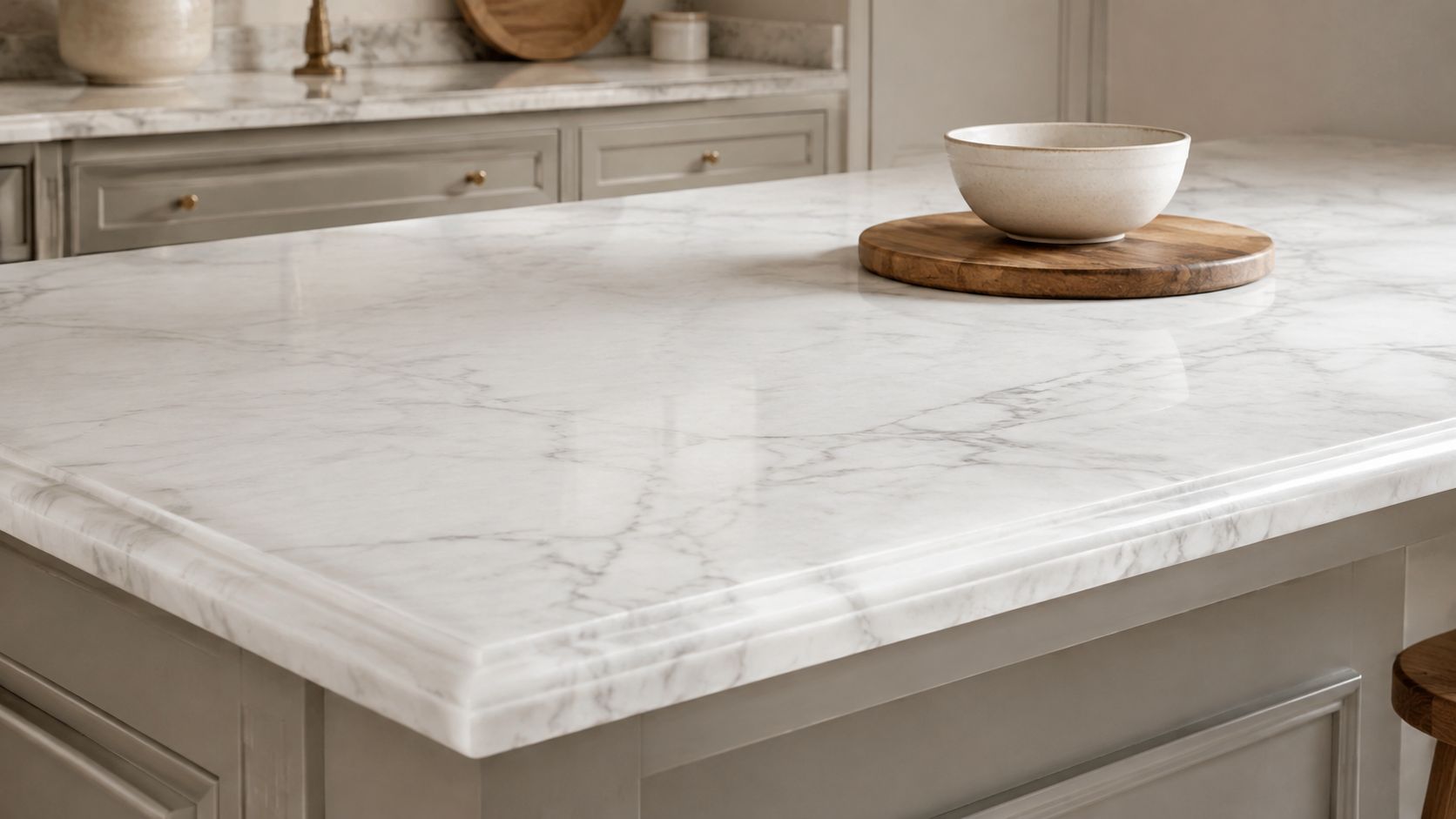
Give marble the right assignment
A baking station or island can be an excellent place for marble, particularly when the homeowner appreciates a surface that changes subtly over time. Pairing it with quartz or granite on the primary cooking and cleanup runs reduces maintenance pressure without losing marble's presence where it matters most.
Honed marble has a quieter, softer finish than polished stone and tends to reduce glare. It won't prevent etching, but it can make small marks less visually prominent. Photograph or view the slab under different lighting before approving it, because veining and reflectivity can shift considerably between a showroom and a home.
Marble makes sense when the homeowner chooses its character deliberately, not when the homeowner expects it to behave like quartz.
Discuss etching during the design consultation. That conversation should happen before fabrication, especially if the kitchen will be used by children, frequent entertainers, or anyone who prefers a pristine appearance. A well-chosen marble surface can be rewarding, but only when care expectations are shared from the start.
4. Butcher Block and Wood
Wood countertops bring warmth that stone can't quite replicate. Maple, walnut, and oak create a tactile surface with visible grain, softer acoustics, and a connection to the traditions of cooking. Butcher block is particularly effective on an island, where the material can make a large volume feel more welcoming.
Wood also moves with changes in moisture and temperature. It can dent, scratch, stain, and show wear, which means it asks for more participation than a nonporous surface. That isn't necessarily a weakness. For the right homeowner, patina is part of the appeal.
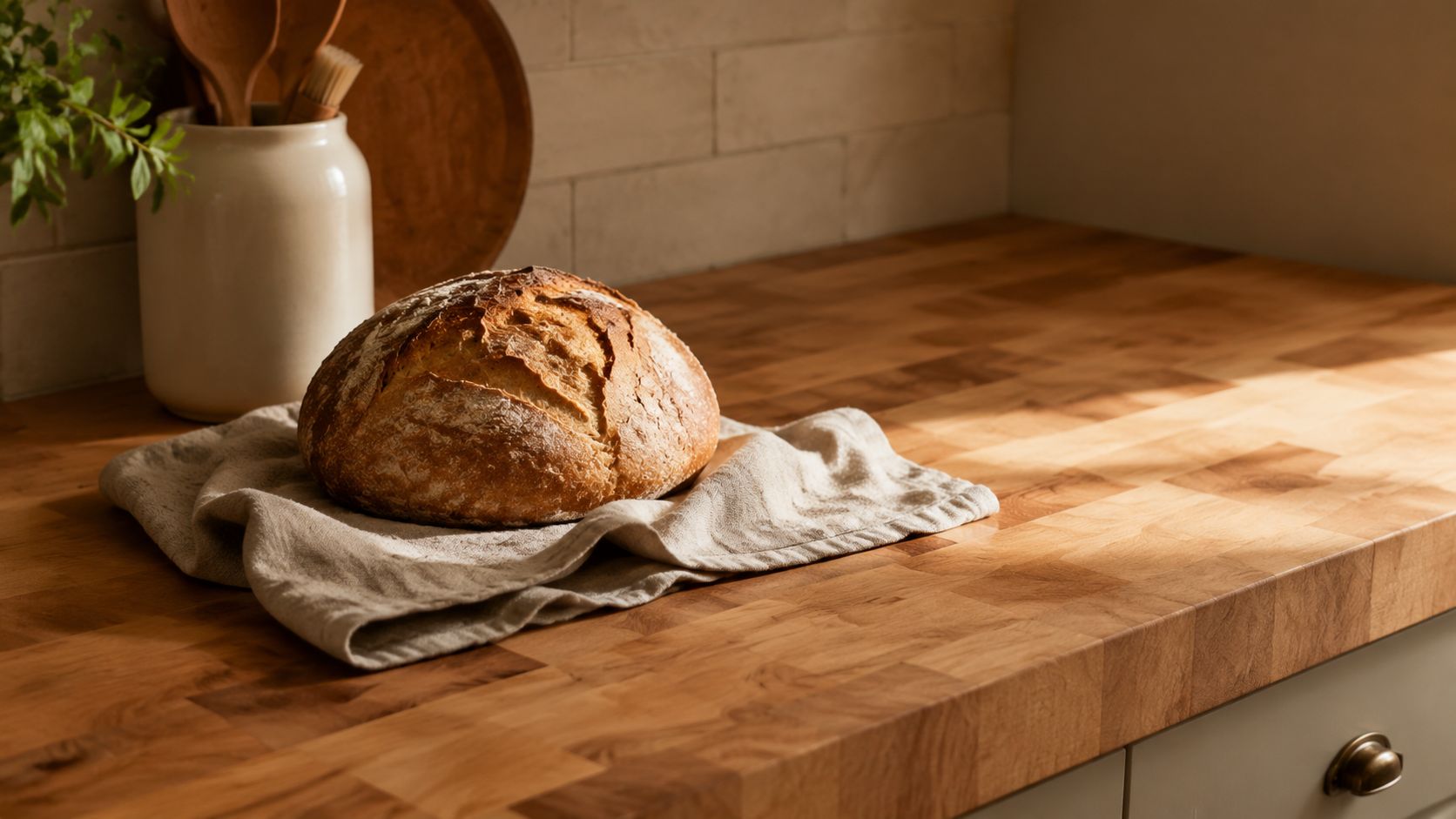
Use wood where touch matters
A homeowner who enjoys baking, serving, or gathering around the island may prefer wood's warmth to the cooler feel of stone. End-grain butcher block is a natural fit for a dedicated prep surface, while walnut can add contrast to light cabinetry without introducing a busy pattern.
Harder woods, including maple and walnut, can help reduce denting, but no wood surface should be treated as indestructible. Keep high-moisture areas, such as the sink perimeter, in stone or quartz when possible. A mixed plan protects the wood and gives each material a clear role.
- Discuss patina early: Make sure everyone understands that use will alter the surface.
- Choose the fabrication carefully: Grain direction, seam placement, and finishing affect the final appearance.
- Match the finish to the routine: A food-preparation surface needs a finish and maintenance plan suited to regular contact.
For additional perspective on the material's character and care, this butcher block guide from Simply Hospitality offers useful background. Wood works best when the homeowner wants a surface that records daily life rather than conceals it.
5. Concrete
Concrete gives designers unusual freedom. A fabricator can shape sculptural edges, integrated drainboards, custom inlays, and distinctive transitions that would be difficult to achieve with standard slab materials. Polished, stained, or textured finishes can make the countertop feel like a crafted object rather than a conventional worktop.
That flexibility comes with responsibility. Concrete can vary in tone, show pores and hairline changes, and require ongoing attention to its sealer. The finished result depends heavily on the fabricator's sample work and communication, especially when the design includes integrated details.
Treat fabrication as part of the design
Ask for physical samples and photographs of completed installations. A concrete sample can reveal the color family and aggregate direction, but it won't fully communicate how a long island will read beside cabinetry. Review the sealer options early. Penetrating and topical sealers produce different levels of sheen and have different upkeep implications.
Integrated features must be planned before the countertop reaches the job site. A drainboard, raised ledge, or custom sink detail isn't something to add casually after fabrication begins. Matte sealers over polished concrete can reduce the emphasis on dust and fingerprints while preserving the material's depth.
A kitchen with concrete benefits from restraint elsewhere. Simple cabinetry, carefully placed lighting, and a quiet backsplash give the surface room to speak. It's particularly effective when the homeowner values craftsmanship and accepts that a handmade material may include variation.
The following video offers visual context for concrete countertop fabrication and finish development.
6. Laminate
Laminate is a sensible answer when cost control, speed, or temporary use matters more than natural material authenticity. Modern patterns can convincingly suggest stone, wood, or solid color, and improved construction makes the material more useful than its dated reputation suggests.
It works well in a starter home, rental property, modest renovation, or secondary kitchen where the surface needs to perform without absorbing a large share of the budget. It can also help preserve funds for layout improvements, better storage, or lighting, changes that often affect the kitchen more than an expensive countertop alone.
Make an economical surface look intentional
Quality matters. Choose a reputable laminate brand with a clear warranty, and coordinate the edge banding with the surface rather than treating the edge as an afterthought. A well-resolved edge and clean installation can make the countertop feel deliberate.
Laminate is less suitable for a kitchen where the homeowner expects the surface to accept high heat, heavy chopping, or decades of refinishing. It also won't provide the deep variation of a natural slab. Those limits are easier to accept when the material is assigned to moderate-use areas or paired with an authentic accent.
- Use it strategically: A laminate perimeter can work with a stone or concrete island.
- Plan for the project horizon: It's practical when future replacement is likely.
- Protect vulnerable areas: Use cutting boards and heat protection as part of the routine.
If existing countertops are serviceable but visually tired, Jennifer Gilmer Kitchen & Bath's information on laminate resurfacing countertops may help you consider whether replacement is necessary. The best choice isn't always the most expensive material. It's the one that supports the project's actual priorities.
7. Solid Surface Acrylic and Polyester Blends
Solid surface materials, including Corian, occupy a useful space between laminate and natural stone. Made from resin and mineral fillers, they're homogeneous throughout, nonporous, and capable of being shaped with heat. That allows fabricators to create integrated sinks, curved transitions, and nearly invisible seams.
For a contemporary kitchen, the quality can be more important than a stone-like pattern. A long uninterrupted run in a soft neutral can make cabinetry and architectural details feel more prominent. Integrated sinks are especially appealing in cleanup zones because the transition between basin and counter is visually quiet.
Consider repairability and seam placement
Solid surface can be repaired more readily than many slab materials, but the homeowner should still understand how the specific product responds to scratching, heat, and impact. Ask how the surface is maintained and where seams will fall. A material that looks smooth in a showroom still needs careful fabrication on site.
Large samples are useful for evaluating sheen and color. A small piece won't reveal how a matte solid surface interacts with undercabinet lighting or whether a pale tone feels warm enough beside the selected cabinet finish. Designers can also use seam placement to align with cabinet divisions or keep transitions away from the busiest work areas.
Solid surface suits a homeowner who values clean geometry, integrated details, and understated maintenance. It may not provide the mineral depth of granite or marble, but it can deliver a calm, refined result when the kitchen's strength lies in proportion and flow rather than dramatic veining.
8. Recycled Glass and Composite Materials
Recycled glass countertops combine glass fragments with resin or concrete binders, creating surfaces with a distinctive mix of color, light, and texture. Depending on the composition, the material can feel jewel-like, terrazzo-inspired, or granular. It's a compelling option for clients who want reclaimed content and a countertop that doesn't resemble every other stone surface.
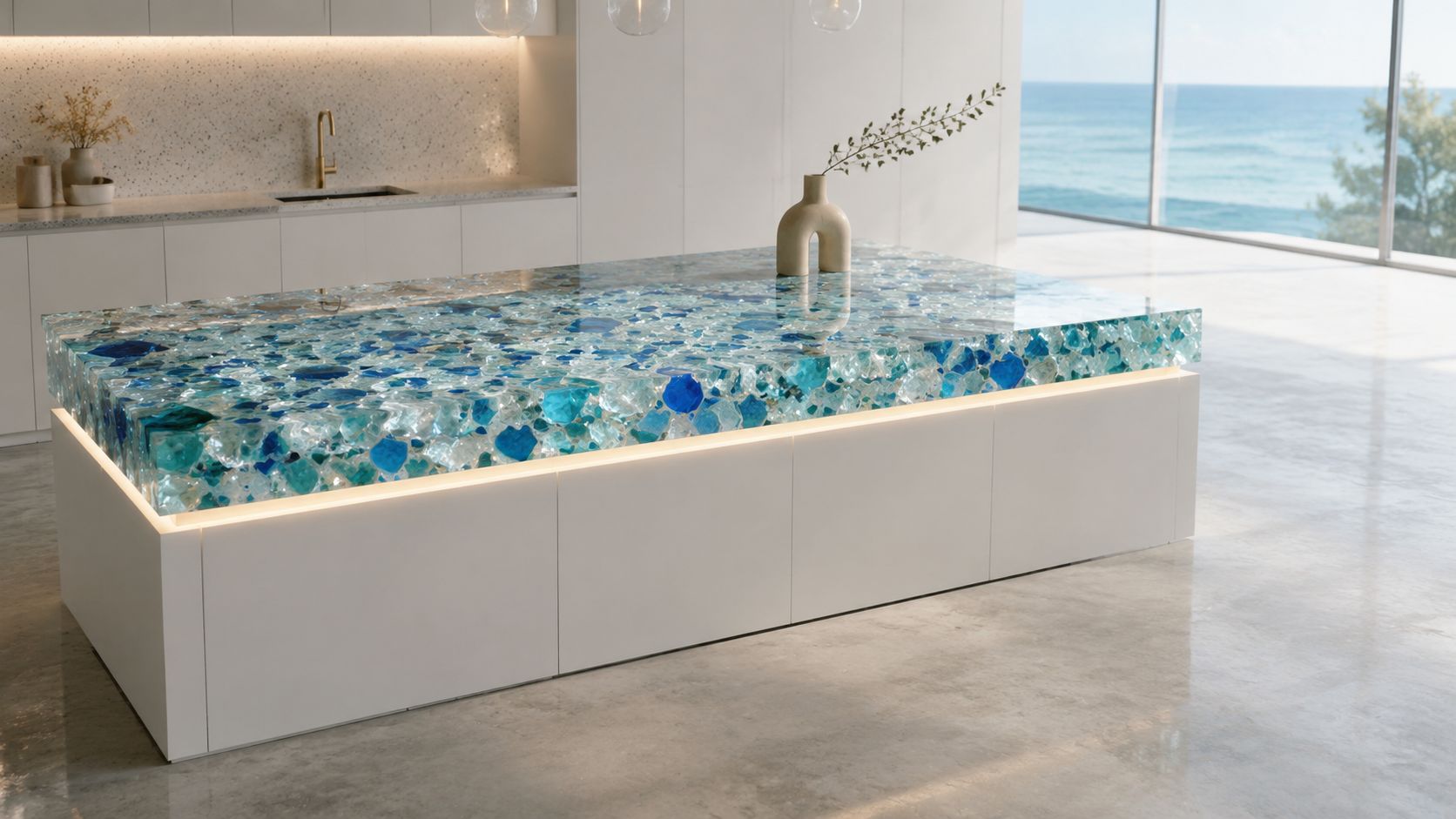
The visual effect depends on the glass selection, binder, lighting, and slab scale. A sample may look restrained until sunlight or undercabinet illumination activates the fragments. Conversely, a highly active mix can overwhelm a small kitchen if the cabinetry, backsplash, and flooring also compete for attention.
Reserve it for a meaningful zone
An island is often the right location for recycled glass. It allows the homeowner to enjoy the material's individuality without committing the entire kitchen to a strong pattern. A perimeter in quartz, solid surface, or another quiet material can keep cleanup and cooking areas visually controlled.
Work closely with the designer and fabricator when selecting colors and fragment sizes. Slight variation and small imperfections should be understood as features of the material, not installation failures. A lighting designer can help determine whether undercabinet or backlighting will clarify the surface or create unwanted reflection.
Recycled glass is a strong choice for an environmentally conscious client who also wants a personal design statement. It's not the default answer for every kitchen, but it can make a carefully planned focal zone feel connected to the home's broader material story.
9. Stainless Steel
Stainless steel brings the working character of a professional kitchen into a residential setting. It pairs naturally with serious cooking, contemporary cabinetry, and industrial details, while integrated sinks and welded seams can create a remarkably continuous surface.
Polished steel reflects more light and can make a compact kitchen feel active and bright. Brushed or satin finishes are usually more forgiving around fingerprints and everyday scratches. Textured finishes can add depth while reducing the visual intensity of a broad uninterrupted run.
Plan for the way steel ages
Stainless steel is heat resistant and hygienic, but it won't remain visually untouched. Cleaning patterns, fine scratches, and areas of repeated contact will develop over time. Some homeowners appreciate that professional wear pattern. Others prefer a finish that conceals daily evidence more effectively.
Discuss integrated sinks, backsplash returns, and welded seams during the design phase. These details can make the material feel custom rather than applied. They also need experienced fabrication because the quality of the joints and transitions determines whether the result looks refined.
- Control reflection: Use brushed or satin steel when polished surfaces would create too much glare.
- Protect the finish: Avoid abrasive tools and select products formulated for stainless steel.
- Accept the patina: Decide whether developing wear will add character or create frustration.
Stainless steel works particularly well at a dedicated prep or cooking zone, where its professional associations feel natural. A wood island or painted cabinetry can soften the composition, giving the kitchen warmth without losing the practical identity of the metal.
10. Choosing Countertops With Designer Guidance
The best types of kitchen countertops become easier to compare when the decision starts with zones rather than a single finish. A family with young children may value quartz's low-maintenance routine on the perimeter, while a serious baker may prefer marble at a dedicated baking station. A homeowner who enjoys the feel of natural materials may place wood on the island and use a more resilient surface near the sink.
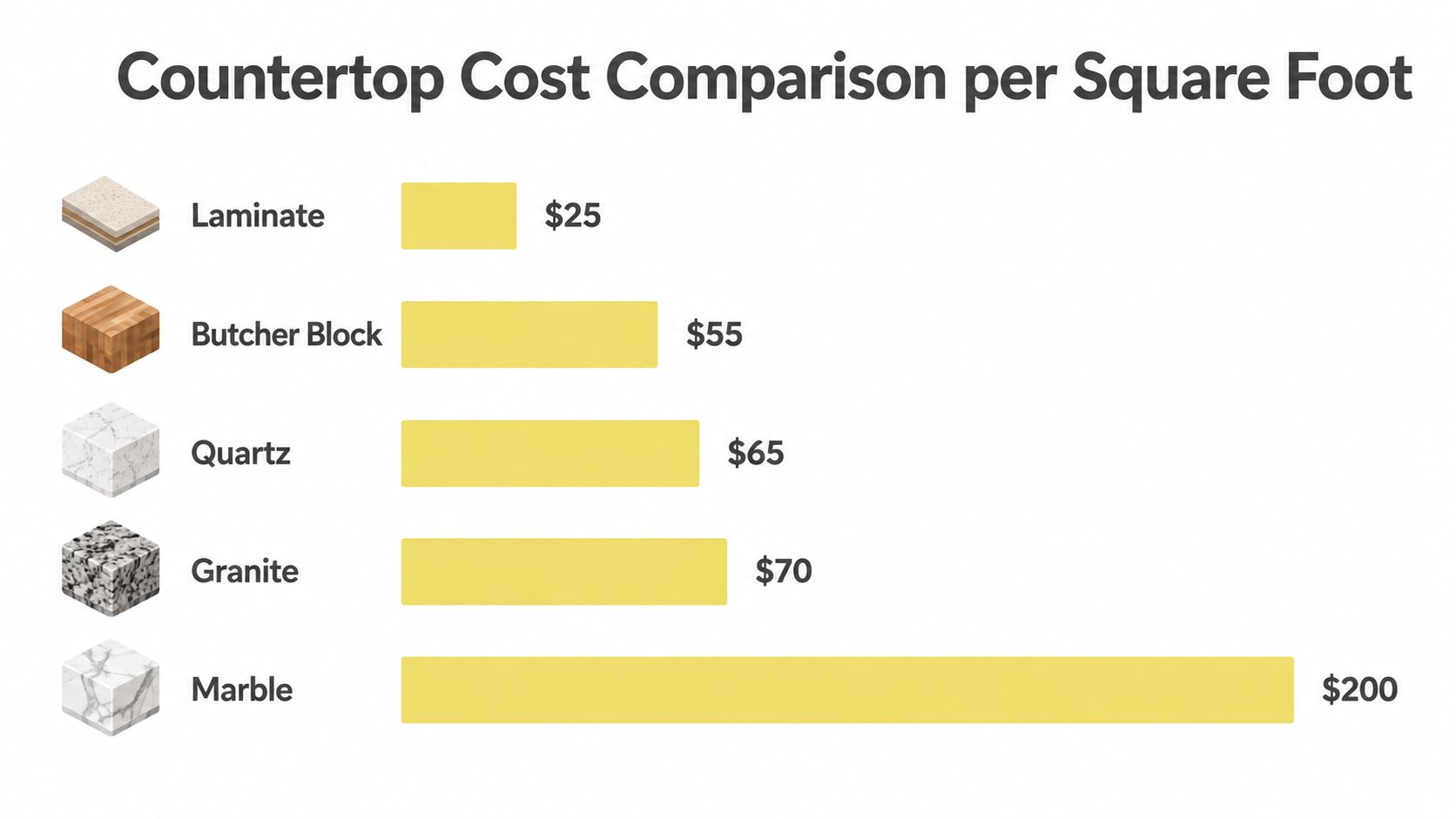
Cost and fabrication timing also shape the decision. The planning ranges below are the figures supplied for this comparison, and actual proposals vary with material selection, slab availability, edge work, layout, installation conditions, and regional labor.
- Laminate: $10-$40 per square foot, with a typical lead time of 1-2 weeks.
- Wood: $35-$80 per square foot.
- Granite: $40-$100 per square foot.
- Quartz: $50-$80 per square foot, with a typical lead time of 2-4 weeks for quartz, granite, and solid surface.
- Concrete: $65-$150+ per square foot.
- Marble: $100-$300+ per square foot, with a typical lead time of 3-6 weeks.
- Recycled glass: $150-$300+ per square foot, with a typical lead time of 4-12 weeks for concrete and recycled glass.
- Stainless steel: $150-$250 per square foot, with a typical lead time of 3-6 weeks.
Build the surface plan around use
Large samples should be viewed in the home's lighting before color and finish decisions are final. Confirm seam locations, edge profiles, sink details, drainboards, and any integrated features during design, not after slabs have been ordered. Complex materials require fabricators with relevant experience, and a beautiful material can disappoint when the fabrication approach doesn't suit its pattern or structure.
The global countertops market was estimated at USD 157.74 billion in 2025 and is projected to reach USD 267.38 billion by 2033, implying a 6.8% CAGR from 2026 to 2033. Granite held a 28.0% share in 2025, while kitchen applications accounted for 62.8% of demand, according to Grand View Research's countertops market report. The scale of kitchen use helps explain why homeowners often gravitate toward materials that balance durability, visual appeal, and availability.
In the United States, quartz is the dominant countertop category, with one industry estimate placing it at 51% share, compared with about 24% for granite. That source lists installed quartz pricing at roughly $55-$120 per square foot, positioning it as a mainstream premium option. SlabWise provides the U.S. countertop industry estimates. For a broader design process that coordinates layout, cabinetry, lighting, and materials, Jennifer Gilmer Kitchen & Bath offers guidance on working with a kitchen designer.
A coordinated countertop plan can transform your cooking space without making every surface identical. Let the busiest zones carry the easiest-care material, and reserve expressive materials for places where their character will be appreciated.
Top 10 Kitchen Countertops Comparison
| Material | Implementation complexity 🔄 | Resource requirements 📊 | Expected outcomes ⭐ | Ideal use cases ⚡ | Key advantages 💡 |
|---|---|---|---|---|---|
| Granite | High, heavy slabs, professional templating & installation (🔄) | High, skilled fabricator, solid cabinetry, sealing; $40–100/ft² (📊) | Durable, heat/scratch-resistant, long lifespan; unique slab appearance (⭐) | Resale-focused kitchens, heavy-use cooking zones, classic/contemporary styles (⚡) | Timeless aesthetic, one-of-a-kind veining, increases home value (💡) |
| Quartz (Engineered) | Moderate, precise fabrication and seam placement (🔄) | Mid, fabricator required, no sealing; $50–80/ft² (📊) | Non-porous, stain-resistant, consistent color/pattern (⭐) | Busy families, resale-minded projects, predictable color schemes (⚡) | Low maintenance, wide color options, predictable slabs (💡) |
| Marble | High, specialized handling, frequent sealing and careful install (🔄) | High, expert fabricator, regular sealing; $100–300+/ft² (📊) | Elegant, develops patina, softer and acid/etch-prone (⭐) | Design-forward zones, baking stations, low-use luxury kitchens (⚡) | Unmatched luminosity and veining, design prestige (💡) |
| Butcher Block / Wood | Moderate, acclimation, expansion gaps, periodic refinishing (🔄) | Mid, hardwood material, ongoing oiling/finish; $35–80/ft² (📊) | Warm, repairable, develops patina; requires routine maintenance (⭐) | Prep surfaces, rustic/traditional kitchens, tactile cooking spaces (⚡) | Warmth, knife-friendly, refinishable, sustainable sourcing options (💡) |
| Concrete | High, poured or prefab expertise, potential site disruption (🔄) | Mid–High, formwork, sealers, artisan labor; $65–150+/ft² (📊) | Highly customizable, dramatic look, requires sealing and may patina/crack (⭐) | Custom contemporary designs, integrated drainboards, statement islands (⚡) | Unlimited customization, integrated features, decorative aggregates (💡) |
| Laminate | Low, fast fabrication, simple installation (🔄) | Low, lightweight substrate, lowest cost; $10–40/ft² (📊) | Affordable, practical, resists staining but not heat/impact (⭐) | Budget remodels, rentals, starter homes, temporary solutions (⚡) | Most budget-friendly, wide design variety, quick install, no sealing (💡) |
| Solid Surface (Acrylic/Polyester) | Moderate, thermoforming and invisible seams by specialists (🔄) | Mid, resin-based slabs, experienced fabricators; $40–100/ft² (📊) | Seamless appearance, repairable for minor damage, heat-sensitive (⭐) | Seamless contemporary kitchens, integrated sinks, curved designs (⚡) | Hygienic, seamless joins, thermoformable, buffable scratches (💡) |
| Recycled Glass & Composites | High, artisan fabrication, custom templating, long lead times (🔄) | High, reclaimed glass + binders, premium cost; $150–300+/ft² (📊) | Visually dramatic, sustainable, variable durability depending on binder (⭐) | Accent islands, design-forward homes, clients prioritizing sustainability (⚡) | Distinctive aesthetics, eco-friendly, can be backlit for effect (💡) |
| Stainless Steel | Moderate–High, precision metalworking, welded seams, expert install (🔄) | High, food-grade steel and skilled fabricator; $150–250+/ft² (📊) | Professional, hygienic, heat/impact-resistant; shows fingerprints/scuffs (⭐) | Professional kitchens, contemporary/industrial designs, serious cooks (⚡) | Hygienic, heat-proof, durable, integrates sinks for seamless workflow (💡) |
Make the Countertop Part of the Whole Design
A countertop shouldn't be selected as an isolated material purchase. It sets the visual rhythm of the kitchen, affects how the island meets the room, and determines how comfortably the homeowner can work, clean, serve, and gather. The right choice depends on the relationship between the surface and everything around it, including cabinet proportions, appliance placement, backsplash height, lighting temperature, hardware, flooring, and storage.
Start with full-size samples whenever possible. View them in morning and evening light, beside the cabinet door, and near the backsplash material. A warm white quartz may feel soft beside natural wood but stark beside a cool painted finish. Honed granite or marble may look understated in a sample room yet reveal beautiful depth under carefully positioned task lighting.
Maintenance deserves equal attention. Quartz offers a low-care routine because it's nonporous and doesn't require routine sealing. Granite can be highly durable, but its porosity and sealing needs should be discussed with the installer. Marble, wood, concrete, and stainless steel each ask the homeowner to accept a particular kind of change, whether that means etching, seasonal movement, sealer care, or visible wear patterns.
Fabrication planning is just as important as material selection. Edge profiles, seam placement, integrated sinks, drainboards, backsplashes, and appliance clearances should be resolved before the slab is fabricated. Materials with strong veining need thoughtful layout, while concrete, recycled glass, and stainless steel benefit from fabricators who understand their specialized requirements.
Mixed materials often provide the most satisfying answer. Quartz or granite can support the primary cooking and cleanup zones, while marble gives a baking area more specific function and character. Wood can warm an island, and recycled glass can create a distinctive accent without dominating the entire room. A successful combination doesn't look accidental. The materials need a shared color relationship, a clear hierarchy, and a reason for each transition.
The U.S. countertops market was estimated at USD 33.77 billion in 2025 and is forecast to reach USD 52.48 billion by 2033, with a 5.7% CAGR from 2026 to 2033. Kitchen applications led that market with a 60.6% share in 2025, according to Grand View Research's U.S. countertops market report. Those figures reinforce the central design point: kitchen surfaces are long-term remodeling decisions, not minor decorative substitutions.
Jennifer Gilmer Kitchen & Bath serves Washington DC, Maryland, and Virginia, with showrooms in Chevy Chase, Easton, and Ashburn. Homeowners can compare materials in person, discuss work zones and maintenance expectations, and coordinate countertops with cabinetry, lighting, storage, and installation from concept through completion. In-home lighting, fabrication lead times, and the way your household cooks should guide the final decision.
Visit a Jennifer Gilmer Kitchen & Bath showroom in Chevy Chase, Easton, or Ashburn, or schedule an in-showroom or by-appointment consultation to review countertop samples and layout possibilities. The firm can help you select a surface plan that fits your kitchen zones, design direction, and expectations for care.
Jennifer Gilmer Kitchen & Bath provides full-service kitchen remodeling, cabinetry, layout planning, material selection, lighting coordination, and installation support for homeowners in Washington DC, Maryland, Virginia, and Delaware. Visit Jennifer Gilmer Kitchen & Bath to explore the showrooms, review design resources, and arrange a consultation for your countertop and kitchen project.