.avif)

You're standing in a kitchen that still functions, but the countertops tell a different story. The laminate is tired, maybe a little dated, and you're weighing whether a refresh will buy you time or just delay the inevitable. That's the right question to ask before you spend a dollar, because laminate resurfacing countertops can be a smart design move in one kitchen and a waste of money in another.
The appeal is obvious. HomeGuide places laminate countertop resurfacing at $5 to $10 per square foot, while new laminate countertops run $20 to $80 per square foot installed HomeGuide cost guide. HomeAdvisor gives a similar benchmark, estimating refinishing, re-laminating, or repair at $214 to $548 on average, with laminate resurfacing itself around $3 to $7 per square foot HomeGuide cost guide. In a DC, Maryland, or Virginia kitchen where the cabinet boxes are still sound, that gap is often the difference between a sensible update and a full-scale remodel.
Table of Contents
Understanding Laminate Resurfacing Countertops
A homeowner usually gets to this point after living with the same countertop for years. The color feels flat, the pattern dates the room, and the surface may still be structurally fine. In that case, resurfacing is not a cosmetic gimmick, it's a practical way to extend the life of what you already own.
What resurfacing actually means
In real terms, laminate resurfacing usually means one of two things. The first is re-laminating, which puts a fresh laminate sheet over the existing top. The second is a refinishing or coating approach that uses a countertop-specific product rather than a general-purpose paint.
That distinction matters. HGTV describes resurfacing as either removing and replacing laminate or covering it with a fresh layer of laminate, while This Old House notes that DIY projects often rely on laminate sheets and contact cement rather than a simple paint kit HGTV resurfacing overview. If a surface is only being painted, that's not the same trade-off as applying new laminate over a solid base.
Practical rule: if the substrate is good and the layout still works, resurfacing can be a disciplined upgrade. If the surface is failing underneath, it's just a prettier patch.
Who should consider it
This works best for homeowners who want to keep the current kitchen footprint and avoid ripping out serviceable cabinets. It's also a sensible move when the room needs visual restraint, not a dramatic rebuild. A good designer will look at the countertop in the context of the whole room, not as an isolated object.
There's also a service-life reality here. House Digest says most laminate countertops need resurfacing every 10 to 15 years, depending on use and wear House Digest laminate resurfacing guidance. That makes resurfacing a cyclical maintenance decision, not a permanent material upgrade.
The Resurfacing Process Explained
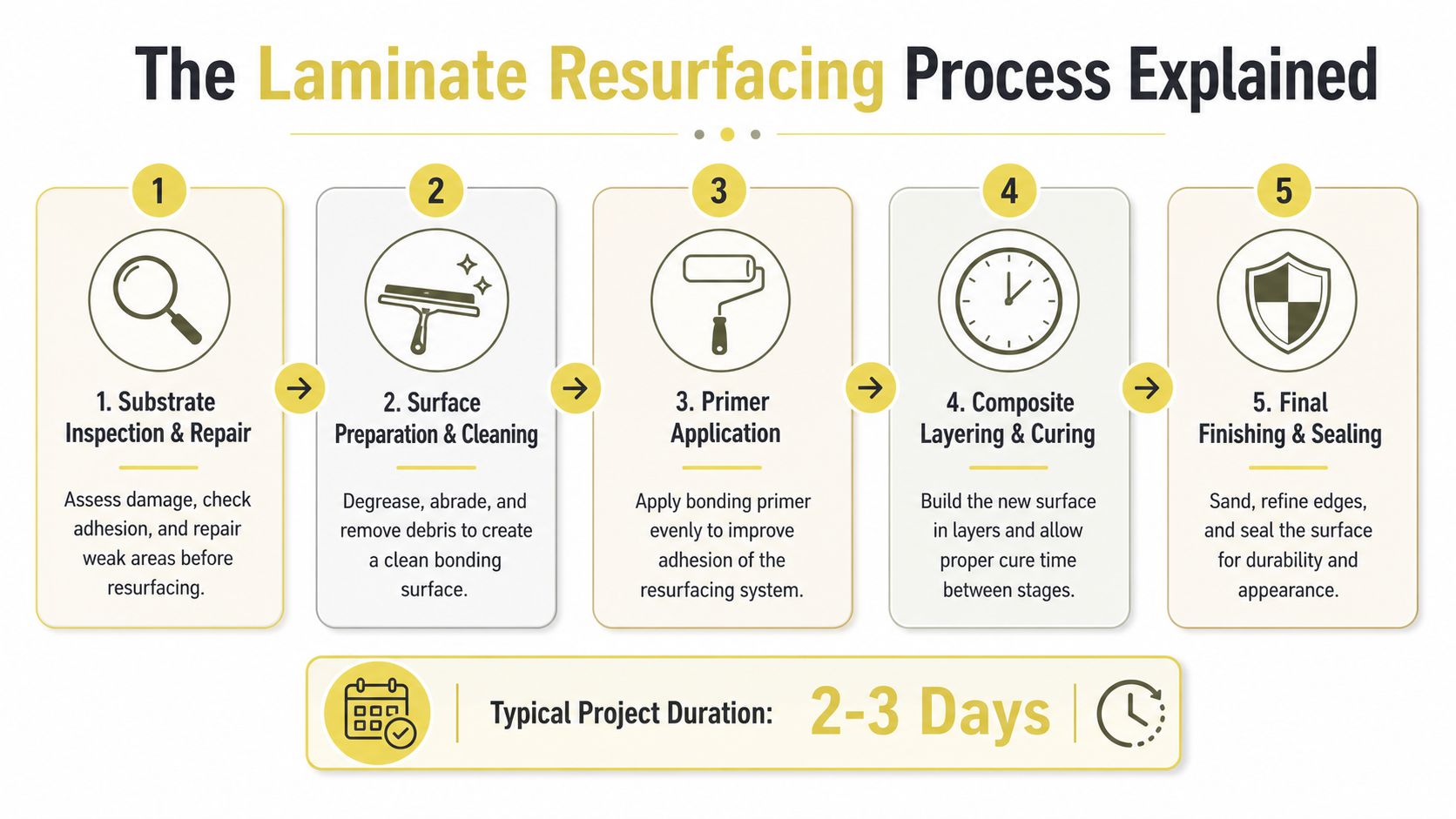
A proper job starts with the substrate, not the finish. If the existing top is loose, swollen, or contaminated, no amount of new material will make it trustworthy. That's why the first step is inspection, not shopping.
What a professional checks first
Formica's installation brief is blunt about this. The existing top should be examined for loose or poorly bonded laminate, and the new sheet should go only over a clean substrate or well-bonded laminate Formica resurfacing brief. It also warns against applying over deep-texture laminates, paint, vinyl, or paper because those surfaces compromise adhesion and can telegraph through the finish.
That's where many cheap bids go wrong. A contractor who skips inspection is gambling with bond failure.
Re-laminating versus coating
Re-laminating is the more substantial option. It means bonding a new laminate sheet to the top, usually with contact cement, after careful prep and repair. Coating methods are lighter by comparison, and they depend on the existing surface being stable and properly prepared.
The sequence matters either way. Clean the top thoroughly. Address small defects. Sand where the system calls for it. Then apply the resurfacing material with discipline, not improvisation.
If you're comparing kitchen and cabinet projects, the process behind refinish your laminate cabinets gives a useful parallel, because the same rule applies, prep determines whether the finish lasts.
Why the best installers are cautious
A good installer doesn't rush to sell you a finish before checking the base. That's not hesitation, it's craftsmanship. In a kitchen, the hidden layer is usually where the problem lives.
Clean substrate, stable bond, then finish. Reverse that order and you're paying for trouble.
Cost Comparison and Budget Considerations
A 30-square-foot DC kitchen often shows the value of resurfacing fast. If the cabinets stay, the layout stays, and the substrate is sound, resurfacing usually saves about $1,000 to $1,500 against full replacement. That is the kind of gap that matters when the goal is a sharper kitchen, not a total rebuild.
How the numbers line up
HomeGuide puts laminate resurfacing at $5 to $10 per square foot, while new laminate countertops run $20 to $80 per square foot installed HomeGuide cost guide. Angi also places resurfaced countertops in a lower-cost band than replacement and notes that resurfaced laminate can last 5 to 10 years or more when the surface is stable and the work is done properly Angi resurfacing guide. HomeGuide further says countertop resurfacing or refinishing overall typically falls between $5 and $20 per square foot or $150 to $800 total, depending on the method and material HomeGuide cost guide.
That spread is why resurfacing is a renovation move, not a replacement move. You spend less now, keep the kitchen functional, and get a cleaner visual result without paying for materials you do not need.
| Option | Cost per Square Foot | Typical Total Cost | Expected Lifespan |
|---|---|---|---|
| Laminate resurfacing | $5 to $10 | $150 to $800 total, or $214 to $548 average for refinishing, re-laminating, or repair | 5 to 10 years or more for resurfaced laminate Angi resurfacing guide |
| New laminate countertops | $20 to $80 installed | Higher than resurfacing, varies by kitchen size | Replacement cycle depends on material and use |
| Full countertop replacement | Not quoted in the verified data | Not quoted in the verified data | Long-term solution, but not always the smart spend for a kitchen that only needs a surface update |
What affects the final bill
The surface price is only part of the bill. If the substrate needs repair, if seams need more attention than expected, or if sink areas require extra care, the cost climbs quickly. That is why a kitchen designer should inspect the top in person before anyone gives a confident budget number.
For homeowners planning a broader remodel, this realistic guide to kitchen remodeling costs in 2026 helps put countertop work in context, because surface decisions rarely exist on their own.
When Resurfacing Is Not the Right Choice
Some kitchens should not be resurfaced. That sounds blunt, but it's the honest advice a homeowner needs before spending money on a surface that can't recover from underlying damage. If the base has failed, the finish is irrelevant.
Red flags that change the decision
Moisture damage is the big one. Seams around sinks and dishwashers are vulnerable, and standing water can break down caulk or adhesive over time. Once that happens, the laminate may peel, bubble, or separate in ways resurfacing can't correct.
Edge wear is another warning sign. If the laminate is lifting or the substrate has started to swell, the problem isn't cosmetic anymore. It's structural.
What resurfacing can't fix
It can't restore a top that has already delaminated in multiple places. It can't disguise bubbling that keeps returning because water is still getting in. And it can't salvage a counter that has lost integrity around cutouts, seams, or unsupported edges.
If the sink area is compromised, don't ask a finish to solve a substrate problem. That's the wrong tool for the job.
There's also a planning issue. If the cabinet configuration is about to change, or the kitchen layout is already holding the room back, resurfacing is too small a move. In that case, you're better off directing money toward a more complete redesign.
A lot of how-to content focuses on surface prep and skips the hard question of whether the kitchen has already crossed the line from refreshable to replaceable. For a homeowner, that question matters more than any product tutorial.
Comparing Resurfacing to Refacing and Replacement
The best choice depends on what else in the kitchen needs attention. A countertop doesn't live by itself. It has to work with the cabinets, the lighting, the backsplash, and the way people move through the room.
Three different levels of intervention
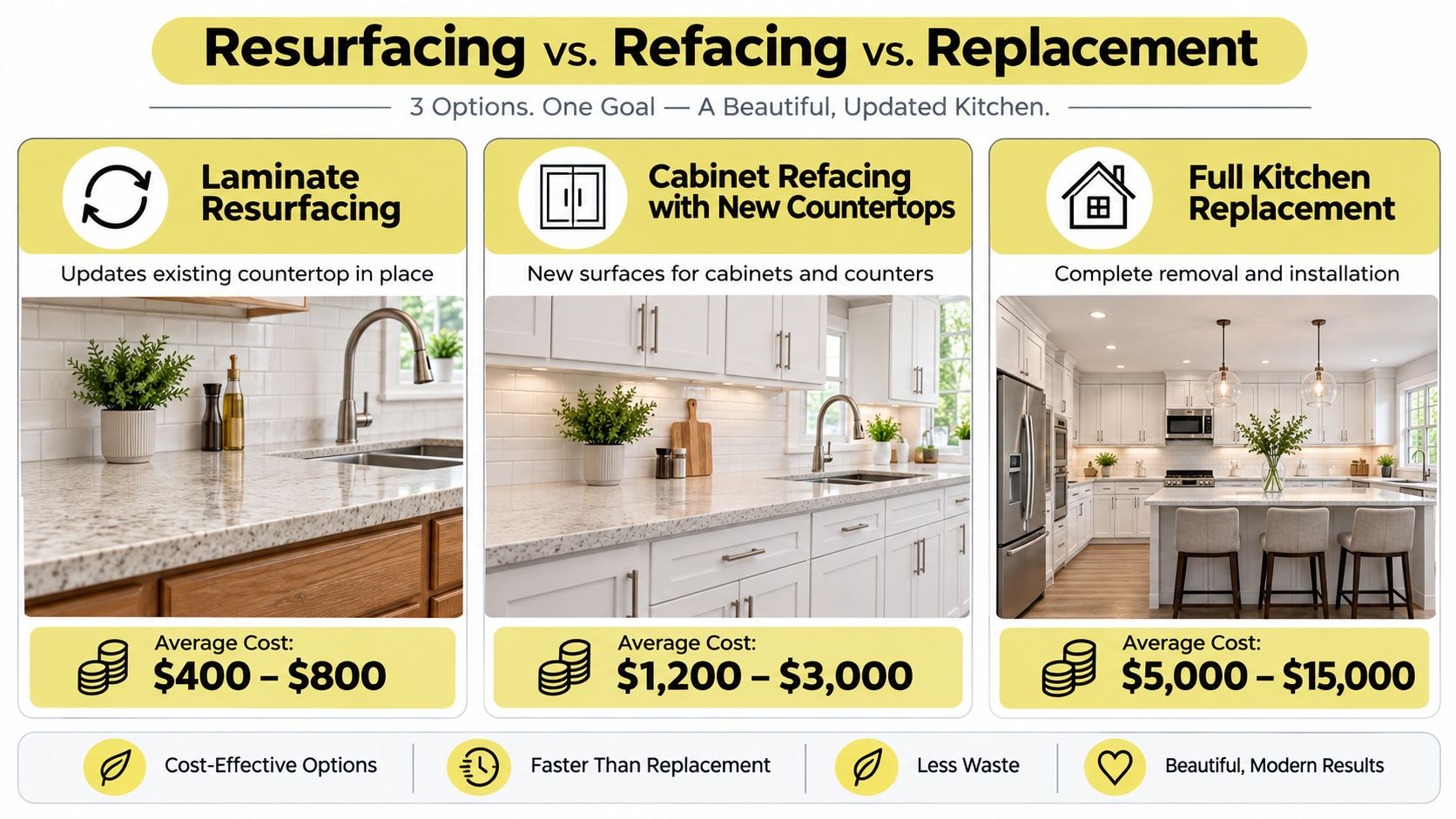
Laminate resurfacing is the lightest touch. It updates an existing countertop in place, so the kitchen stays usable with less disruption. Cabinet refacing with new countertops goes further, because it updates the cabinet faces and the surfaces together. Full kitchen replacement is the broadest move, and it gives the most design freedom.
How to think about the trade-offs
If the room is fine and the goal is to modernize it cleanly, resurfacing is the efficient answer. If the cabinets feel tired too, refacing often makes more sense because it gives the counters a better visual partner. If the layout is wrong, or the storage is inadequate, replacement is the only option that really fixes the problem.
That's where timeline comes in. Resurfacing is usually the least disruptive path, while replacement asks more of the household in both planning and patience. For families trying to keep life moving, that difference matters as much as the budget.
For broader scheduling context, this guide to how long a kitchen remodel takes helps homeowners see where resurfacing sits inside a larger project plan.
Maintenance and Longevity Expectations
A resurfaced countertop is a practical finish, not a carefree one. It can serve well, but it asks for more attention than many homeowners expect. That's the trade-off for choosing a lower-cost refresh over a full replacement.
What daily care really looks like
Use hot pads near cooktops. Don't cut directly on the surface. Wipe spills promptly, especially around seams and sink cutouts, because water is the enemy of a bonded edge. These are small habits, but they protect the finish from the kinds of damage that shorten its life.
Angi says resurfaced laminate can last 5 to 10 years or more Angi resurfacing guide. That's a useful range, not a promise. Busy kitchens, especially those with heavy cooking and frequent cleaning, will wear the finish faster than a lightly used one.
Heat and maintenance realities
Heat deserves its own warning. One guide notes that gas cooktop edges need heat-resistant materials within about 2 inches of the burner, and that plain paint can scorch while epoxy can yellow DG Floors laminate resurfacing guidance. That's exactly why the finish choice should match how the kitchen is used.
If you want a longer-view perspective on materials and upkeep, this designing a kitchen that lasts a lifetime piece is worth reading before you commit to a surface that needs regular attention.
The right finish should suit the cook, not just the countertop photo.
Making the Right Decision for Your Kitchen
The best decision isn't “resurface or replace” in the abstract. It's whether the existing kitchen can support the finish you want, the life you live, and the plan you have for the home. That's why a showroom consultation matters more than an online quote.
What a designer looks at first
A skilled kitchen designer checks the cabinet condition, the layout, the lighting, and the surface relationship between the countertop and everything around it. If the room already feels balanced, resurfacing may be enough. If the room is visually split, functionally awkward, or headed toward a bigger renovation, a wider scope protects the investment better.
Jennifer Gilmer Kitchen & Bath works that way in the Washington DC, Maryland, and Virginia area. The conversation starts with how you use the kitchen, then moves into materials, space planning, and installation coordination, so the final answer fits the room instead of forcing the room to fit the answer.
When resurfacing makes sense
Choose resurfacing if the substrate is sound, the layout still works, and you want a clean update without tearing apart a serviceable kitchen. Choose replacement if moisture has already compromised the top, if the cabinetry is part of the problem, or if the overall design needs more than a surface-level fix.
That's the difference between spending money and investing it. One buys a short-term facelift. The other supports the kitchen you want to live with.
If you're deciding whether laminate resurfacing countertops are the right move for your home, Jennifer Gilmer Kitchen & Bath can help you sort out the surface, the layout, and the long-term design plan in one conversation. Visit Jennifer Gilmer Kitchen & Bath to schedule a consultation in Chevy Chase, Easton, or Ashburn, and get clear guidance from designers who know how to align craftsmanship with real-life kitchens.