
Which countertop is more durable: the one that tolerates a hurriedly parked hot pan, or the one that doesn't need a sealing calendar? That question matters more than which stone wins a showroom comparison. The right choice depends on what happens between unpacking groceries and clearing the dinner plates.
Table of Contents
- What the advantages actually buy you
- Hard doesn't mean indestructible
- Verify the stone before you approve it
- Give hot cookware a permanent home
- Separate stains from etching
- Protect edges as carefully as the surface
- Let your habits deliver the verdict
- Include fabrication in the decision
- See the room and the slab before committing
Why Quartz and Quartzite Get Confused
Say you're choosing a pale countertop for oak cabinetry. A quartz sample has a soft cream background and sweeping veins; the quartzite slab beside it looks remarkably similar. Their names suggest close relatives, but their appearance tells you very little about how they'll behave in your kitchen.
Engineered quartz is manufactured from crushed quartz, polymer resin, and pigments. The manufacturing process allows controlled colors and patterns, along with a nonporous face. Quartzite is quarried metamorphic stone, formed when quartz-rich sandstone recrystallizes under geological heat and pressure. Its grain, veining, and absorption characteristics belong to the particular slab.
A small sample can help you choose a color family, but it can't settle the material decision.

Choose the kind of resilience you need
Quartzite is generally harder and more heat-tolerant. Quartz is usually easier to own because routine sealing isn't part of its care.
Low maintenance is not a synonym for most durable.
A cook who regularly moves heavy pans off the burner needs something different from a household that wants predictable cleanup and a quiet, repeating pattern. Neither preference is more discerning. The mistake is paying for a virtue you won't use while overlooking a limitation you'll encounter daily.
At Jennifer Gilmer Kitchen & Bath, we begin with those habits on projects across Washington DC, Maryland, and Virginia, then carry the material choice from concept through installation. Understanding quartz vs quartzite pros and cons starts with your household, not the prettiest sample.
Quartz and Quartzite Side by Side
Quartz and quartzite at a glance
| Criterion | Engineered quartz | Natural quartzite |
|---|---|---|
| Composition | About 90–95% crushed quartz with resin and pigments, according to Slabwise | Metamorphic rock from quartz-rich sandstone |
| Hardness | Quartz mineral about 7 Mohs; resin is softer | Typically about 7–8 Mohs, according to Pioneer Granite and Quartz |
| Sealing | Nonporous; routine sealing usually unnecessary | May absorb liquid; reseal about every 1–3 years, as described by The Santa Barbara Independent |
| Heat | Resin is vulnerable to high heat; use trivets | Better tolerance for hot cookware |
| Stains and acid | Resists many common stains | Acids can etch some finishes; sealer helps resist stains |
| Appearance | Consistent color and pattern | Veining and color vary by slab |
| Installed planning range | Lower starting range, with premium products overlapping natural stone | Higher starting range; slab and fabrication determine the quote |
| Best household fit | Uniform look and lighter daily care | Natural movement and higher heat tolerance |
Choose quartz for control and lighter care. Choose verified quartzite for natural character and greater heat tolerance.
What the advantages actually buy you
Quartz's strongest advantage isn't just that it's manufactured. It's that manufacturing makes the result more predictable. You can coordinate an island, perimeter counters, and an adjoining serving area without depending on the quarry to produce matching movement.
That doesn't mean every seam disappears or every manufactured vein lands perfectly. The fabricator still needs a layout, and you should review where patterns stop, repeat, or meet. But you begin with a more controlled palette.
Quartzite offers something different: irregularity that can make a room feel collected rather than specified. A vein may soften, divide, or change direction across the slab. That variation can be beautiful on a broad island, but it also demands decisions about which portion becomes the focal face and which gets cut away.
The practical drawbacks follow the same division. Quartz asks you to protect its resin from hot cookware. Quartzite asks you to accept slab-specific care, possible absorption, and more deliberate selection.
Hard doesn't mean indestructible
For perspective, UCL's geology glossary places quartz at approximately 7 on the Mohs scale and true quartzite at about 7–8, depending on composition and structure. Those are mineral-hardness measures, not a promise that a finished counter can't be marked, chipped, or damaged.
Steel can leave metal marks without cutting into the mineral. A heavy object can also chip an exposed edge even when the broad surface resists abrasion. Don't confuse scratch resistance with permission to chop directly on the counter.
Verify the stone before you approve it
A quartzite label isn't proof of composition. Stones sold under the same commercial category don't necessarily share the same performance, and a pale, marble-like appearance doesn't establish that you're buying true quartzite.
Ask the supplier to confirm the material identification and have the fabricator evaluate a representative offcut for absorption, scratching, and acid response. Testing should happen with permission, not on the finished face of a slab you've casually inspected at the yard. Unexpected etching deserves investigation rather than a reassuring sales description.
Approve the actual slab, including its fissures, repairs, and proposed cutout locations. A sample chip can't reveal whether a strong vein will run attractively through the island or disappear into a sink opening. If you're still considering other surfaces, our guide to the best types of kitchen countertops can help broaden the decision before you commit.
Heat Stains Scratches and Daily Care
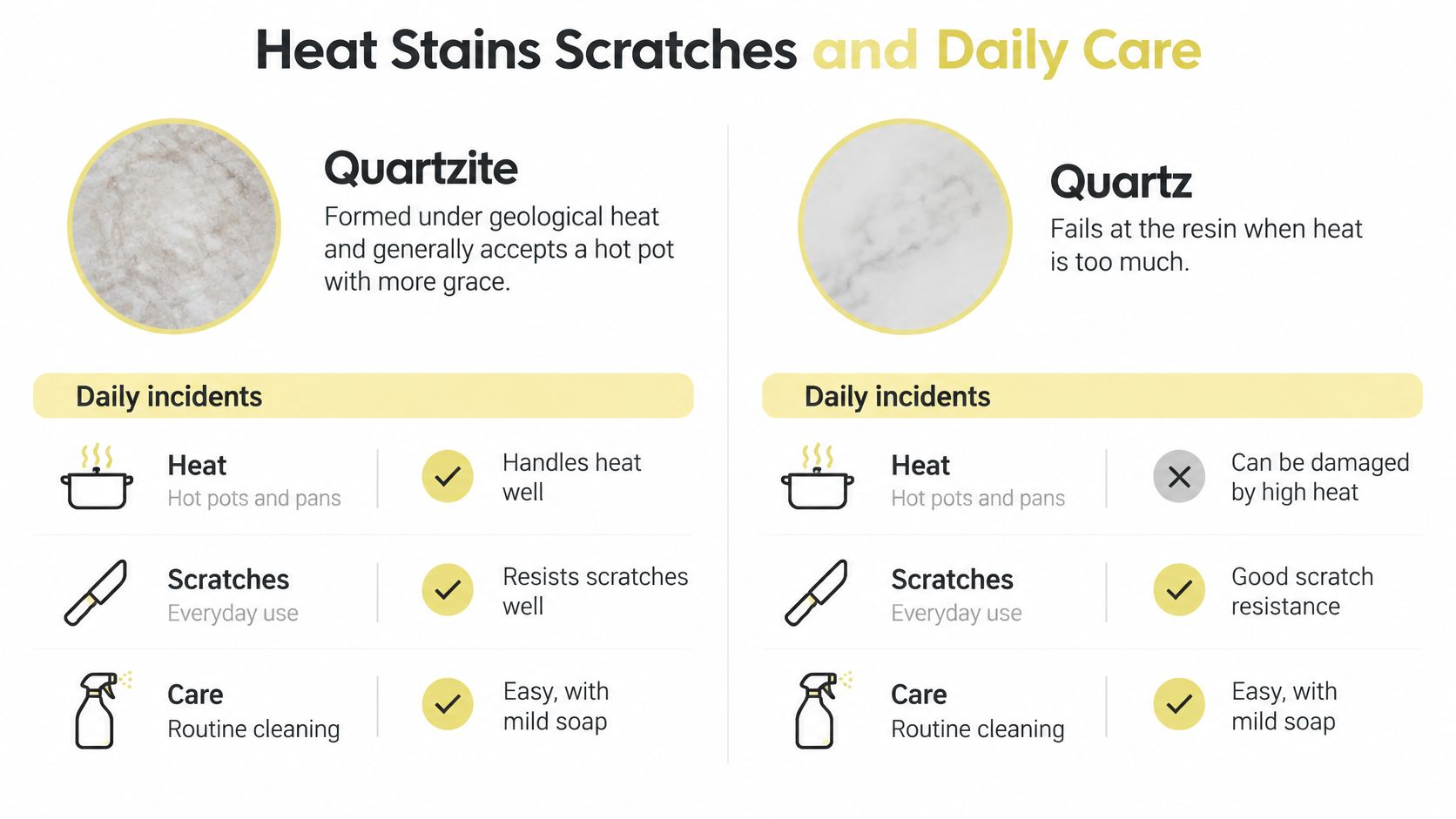
A roasting pan comes out of the oven while someone is draining pasta at the sink. The closest clear counter becomes the landing spot. That's the moment when a material specification either supports your habits or asks you to change them.
The everyday differences are easiest to understand through those small incidents.
Give hot cookware a permanent home
The Spruce places the risk of melting, scorching, discoloration, or cracking in engineered quartz at approximately 300°F. That's not a guaranteed safe-use threshold: the product, exposure duration, and concentrated heat all matter.
With quartz, keep a substantial trivet beside the range and another where you unload the oven. Choose heat-resistant pads large enough to support the pan's base, and leave room to use them without moving a utensil crock or appliance.
Quartzite gives you more latitude, but a trivet remains sensible. Plan the landing area first so protecting the counter doesn't depend on remembering where someone put the hot pad.
Practical rule: Quartz asks for heat discipline. Quartzite asks for sealing discipline.
Separate stains from etching
A stain changes the stone's color because a substance has entered or affected it. An etch changes the surface finish through a chemical reaction. Sealer can reduce absorption; it doesn't make an acid-sensitive finish immune to lemon juice.
For quartzite, wipe up wine, oil, and acidic spills promptly. Use a pH-neutral stone cleaner and a soft cloth rather than vinegar, abrasive powder, or a general bathroom cleaner. If a water drop darkens the stone instead of remaining beaded, arrange a sealing assessment.
For quartz, a soft cloth with mild dish soap and water is a useful daily starting point. Remove residue with a clean damp cloth and dry the surface, especially on dark finishes where streaks are conspicuous. Use the manufacturer's approved cleaner for stubborn marks rather than escalating to abrasive pads.
Keep the comparison grounded in daily use as you review the materials.
Protect edges as carefully as the surface
Use a cutting board for both materials. Set it near the prep sink or primary work area so it's easier to reach than the bare counter.
Pay attention to where heavy cookware meets an edge, particularly around sink cutouts. Lower a cast-iron skillet into the sink rather than dragging or knocking it across the rim. Those habits protect the craftsmanship of the finished installation without turning the kitchen into a room you're afraid to use.
What Changes the Installed Price
Stonify's comparison places installed quartz at approximately $50–$150 per square foot, compared with roughly $70–$200 or more per square foot for quartzite. Treat those as planning bands, not a bid for your kitchen.
The overlap matters. A premium engineered surface can cost more than a relatively accessible natural slab, and an elaborate fabrication can outweigh savings on the material itself.
Start with the slab, then price the craftsmanship
A quiet quartz color is generally easier to specify repeatedly. With quartzite, a particular background color, dramatic vein, or book-matched arrangement can narrow the available selection and increase the material allowance.
Fabrication comes next. A simple eased edge requires less work than a built-up mitered edge, while a waterfall end requires careful cutting and alignment so the movement reads convincingly as it turns toward the floor. Apparent thickness is therefore a design decision as well as a budget decision.
Sink and cooktop cutouts add work, and overhangs may need support coordinated with the cabinets. Vein placement also affects yield: the fabricator may need to leave usable stone aside to keep a prominent line out of a seam or preserve the best portion for the island.
- Compare equivalent scopes. A material-only quote isn't comparable to one that includes templating, fabrication, delivery, and installation.
- Identify the extras. Ask whether the edge, backsplash, cutouts, supports, and disposal are included.
- Review the layout before cutting. A less expensive slab isn't a saving if the approved design requires additional material.
Budget for getting the stone into the room
Installation access matters in older Washington DC, Maryland, and Virginia houses. Stairs, tight turns, narrow doors, and a long island slab can change how the installation is planned and staffed.
At Jennifer Gilmer Kitchen & Bath, we consider the countertop alongside cabinetry and appliances rather than treating it as an isolated purchase. We also provide realistic timelines from design to completion, so material selection and fabrication fit the wider project.
Our realistic guide to kitchen remodeling costs helps place that surface allowance within the whole renovation. Before accepting a countertop quote, ask the fabricator: what's included in the installed square-foot price, and what's extra for the edge, splash, and cutouts?
Counters Islands and Backsplashes
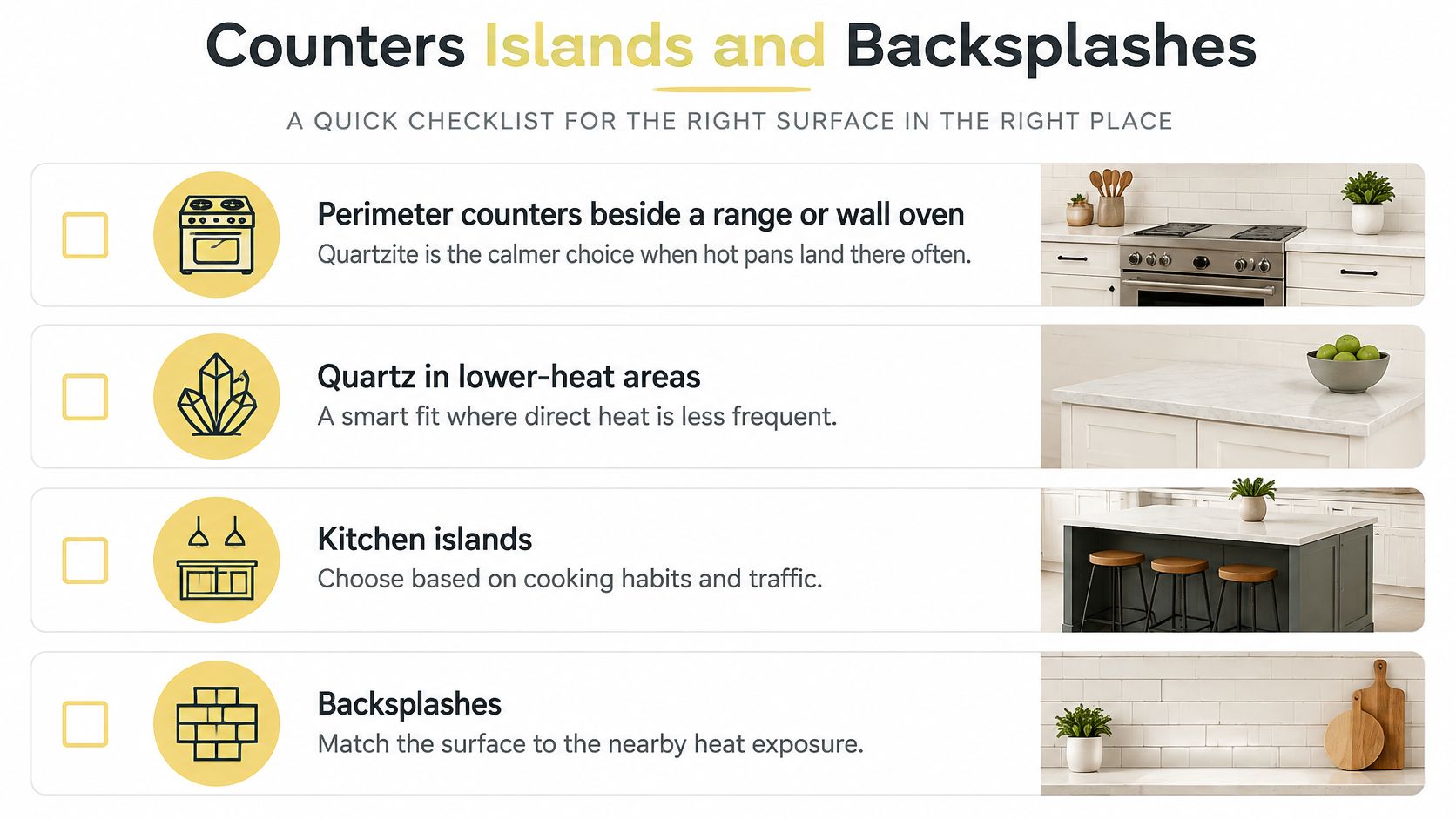
The counter beside the range deserves a different conversation from the island where children eat breakfast. Choose by location, not by insisting that the entire kitchen must express the same material preference.
For frequent hot-pan landings, lean toward verified quartzite. For a family cleanup zone, quartz is often the more comfortable everyday choice. Southern Living's comparison makes the useful distinction that durability includes heat, staining, maintenance, and the conditions in which the surface will be used.
Where quartz or quartzite fits
| Location | Lean toward | Why |
|---|---|---|
| Perimeter by the range | Quartzite if pans land hot; quartz if trivets are certain | Heat is the deciding risk |
| Busy family perimeter | Quartz | Nonporous face and no routine sealing |
| Quiet repeating island | Quartz | Color can be matched and repeated |
| Focal or waterfall island | Quartzite | Natural movement is the point of the piece |
| Cooktop backsplash | Quartz, where the appliance clearance and product specification permit it | Splatter cleanup without sealing |
| Full-height stone backsplash | Quartzite when it continues the counter slab | Vein becomes part of the architecture |
| Sunny or hot pass-through | Quartzite, or quartz with real shade and a suitable product specification | Resin dislikes sustained heat |
Let the island have a clear role
If the island should settle the room, use a restrained quartz pattern and let cabinetry, lighting, or a view supply the interest. A forceful countertop isn't necessary in every well-designed kitchen.
If the island is the focal point, select quartzite for the way its movement reads from the doorway and adjacent seating. Review waterfall faces together with the top, not as leftover pieces assigned after the main slab is cut.
Use this location checklist while considering the room as a whole.
Make the backsplash earn its place
Behind a cooktop, easy cleaning is valuable, but heat clearances come first. Don't assume quartz is suitable because it's practical on an adjacent counter; confirm the appliance requirements and the surface manufacturer's restrictions.
A full-height quartzite backsplash makes sense when the continuation of the vein is central to the room. Consider outlets, shelf brackets, and hood placement before approving the cuts. Our guide to backsplash materials for kitchens offers other options when a slab backsplash isn't the right fit.
Choose the backsplash for the wall it occupies, not merely because it matches the counter.
Jennifer Gilmer, CKD, first identifies what's clunky, disjointed, or not working aesthetically and functionally in an existing kitchen or bath. That eye for the whole room matters here: place the work zones before falling in love with a slab photograph.
Match the Stone to the Way You Cook
Choose the limitation you're comfortable managing. A beautiful countertop shouldn't require you to become a different kind of cook, cleaner, or host.
Your answers to these questions should lead the decision.
Let your habits deliver the verdict
- Does hot cookware regularly leave the burner for the counter? Choose verified quartzite, or make permanent trivets part of the quartz layout. Don't rely on a promise that everyone will remember.
- Are weeknights messy, with little appetite for a sealing calendar? Choose quartz. Its simpler ownership is a meaningful benefit, not a compromise in taste.
- Does the room need a singular natural surface? Choose quartzite if you're willing to care for it and spend time approving the slab and fabrication layout.
- Should the counters provide a quiet, repeatable background? Choose quartz. Let the rest of the room provide depth through wood grain, hardware, lighting, and proportion.
Don't choose quartzite because it sounds more exclusive, and don't choose quartz because someone calls it maintenance-free. Both deserve thoughtful installation and ordinary care. The best specification is the one whose demands fit naturally into your household.
Include fabrication in the decision
Before fabrication begins, ask who cuts the stone, whether cutting is performed wet, and how dust is captured. Ask about HEPA cleanup and how any necessary on-site modifications will be controlled.
The California Department of Public Health's workplace air-monitoring guide identifies cutting, grinding, drilling, and polishing engineered stone as tasks that can generate respirable crystalline silica capable of causing silicosis. Natural quartzite fabrication can involve silica exposure too, so choosing natural stone isn't a substitute for responsible dust controls.
That occupational hazard isn't the same as ordinary use of an intact installed countertop. The useful homeowner response is to screen fabrication practices, not to fear the finished kitchen.
See the room and the slab before committing
Our design process shows you what the finished project will look like on a screen before work starts. We accompany clients to the stone yard for counter selections and can help find a contractor to implement the design, with support from concept through installation.
Bring your cooking habits, cabinet preferences, and a few layouts you like to the consultation. Then see the material in person and approve the actual slab, not a photograph standing in for it.
Jennifer Gilmer Kitchen & Bath brings countertop selection together with cabinetry, appliances, and space planning for homeowners across Washington DC, Maryland, and Virginia. Visit Jennifer Gilmer Kitchen & Bath to arrange a consultation and choose a surface that suits both the room you want and the way you cook.