.avif)

You're standing in a cabinet showroom with two samples in front of you. One shows the layered edge of a plywood cabinet box. The other is a beautifully smooth MDF door prepared for paint. Both look convincing under showroom lighting, and neither tells you what will happen beside the dishwasher, under the sink, or after years of daily use.
That's why choosing the best kitchen cabinet materials isn't a matter of picking a wood species from a display board. The decision involves the cabinet box, door, drawer components, finish, hardware, moisture exposure, formaldehyde compliance, and the difference between custom and semi-custom construction. A kitchen may combine several materials, each assigned to the job it handles best.
The right questions are practical. Will the cabinet sit in a splash zone? Do you expect to remain in the home for decades? Are you prioritizing a flawless painted finish, natural grain, low maintenance, or indoor air quality? A thoughtful remodel answers those questions before anyone orders doors.
Table of Contents
What a Homeowner Learns Standing in Front of the Cabinets
A homeowner named Claire recently arrived at a showroom with a folder of inspiration images and a very reasonable concern: she wanted painted cabinets, but she didn't want to sacrifice durability. Her designer placed two samples on the worktable. The first was a plywood box with visible veneer layers at the edge. The second was an MDF door with a routed profile and a perfectly even paint surface.
Claire ran her hand across both and asked the question most homeowners eventually ask: “Which one is better?”
The answer depends on the cabinet's job. Plywood and MDF aren't competing versions of the same product. Plywood is primarily a structural material for cabinet boxes, shelves, and high-load components. MDF is often the smarter material for painted doors and decorative panels because its uniform density machines cleanly and accepts finish coatings smoothly. The best kitchen usually uses materials in combination rather than forcing one substrate throughout.
The material is underneath the design
A cabinet's visible finish gets most of the attention, but the substrate determines much of its behavior. Solid hardwood brings natural grain and can be refinished. Plywood provides cross-laminated strength and reliable screw retention. MDF produces crisp profiles and an even painted surface. Particleboard keeps costs controlled, but it has less tolerance for water intrusion and heavy mechanical stress.
Surface treatments add another layer. Thermofoil is a heat-fused vinyl surface applied over an MDF substrate. Laminate and melamine create practical, cleanable faces over engineered cores. Veneer gives you a real-wood appearance without building every component from solid lumber.
A useful showroom question: Don't ask only, “What are the doors made of?” Ask, “What are the box, shelves, drawer parts, and finished edges made of?”
Location changes the specification
The cabinet above a range hood faces heat and grease. The sink base faces leaks, cleaning products, and damp towels. A dishwasher-adjacent panel experiences repeated bursts of warm vapor. An upper cabinet in a dry corner has a much easier assignment.
Your expected stay matters, too. A homeowner planning a long-term kitchen should look beyond first cost and choose materials that preserve structural value over decades. A homeowner furnishing a short-term property may reasonably prioritize a clean appearance, easy maintenance, and controlled expense.
Indoor air quality belongs in the same conversation. The EPA's guidance on formaldehyde and indoor air quality identifies pressed wood products using urea-formaldehyde resins as important indoor formaldehyde sources, with MDF generally emitting more than other pressed wood products because of its higher resin-to-wood ratio. That doesn't make every engineered board unsuitable. It means the cabinet specification should include verified compliance, not just an attractive finish.
The Core Cabinet Materials at a Glance
There isn't one universal winner. Solid hardwood and plywood are the strongest long-term choices for structure, MDF is the specialist for painted doors, and laminate-based surfaces are practical where easy cleaning matters most. Particleboard has a place in budget cabinetry, but it shouldn't be treated as equivalent to plywood.
The lifespan ranges below are editorial planning bands based on the durability ranges in this cabinet lifespan guide. Actual service depends on construction, installation, moisture control, finish quality, and care.
Natural and engineered wood
Solid hardwoods, including maple, oak, cherry, walnut, and birch, sit in the premium tier. Maple has a relatively quiet grain and works well when painted or lightly stained. Oak shows a more pronounced pattern and disguises small marks. Cherry deepens visually over time, while walnut brings a darker, more distinctive grain. Solid hardwood cabinets can last 30 to 50 years with proper care, according to the cited durability guide. They tolerate normal use well, but natural wood expands and contracts with humidity, and matching a repaired section can be difficult.
Plywood belongs in the mid to premium range depending on grade, veneer, and core construction. Baltic birch offers consistent layers and a clean edge, while standard cabinet-grade plywood may use hardwood faces over a different inner core. Cross-laminated veneers resist racking, improve screw pull-out strength, and handle moisture better than particleboard or standard MDF. Quality plywood boxes commonly plan for 20 to 35 years of service, based on the same durability source. The downside is that exposed layers need thoughtful edge banding or veneer treatment.
MDF is a mid or budget-mid material with a dense, uniform fiber structure. It machines cleanly for routed door profiles and offers a smoother painting surface than plywood. Its weakness is water. If an unsealed edge absorbs moisture, MDF can swell and lose structural integrity. A dry, well-sealed application is essential.
Particleboard is the budget choice. It's made from compressed wood particles and resin, often covered with melamine or laminate. It can perform adequately in dry areas, but it doesn't hold screws or resist swelling as well as plywood when water reaches the core. For a focused comparison of engineered boards, which is better engineered wood offers useful background on how engineered wood differs from particleboard.
Surfaces and finish systems
Thermofoil is a heat-fused vinyl wrap applied over MDF. It offers a smooth, easy-clean surface and works well for simple slab doors. It's cost-effective, but heat and steam can cause the wrap to loosen, particularly near kettles, dishwashers, and poorly ventilated cooking areas.
High-pressure laminate, or HPL, uses a decorative layer bonded under pressure to a core. It's a strong choice for busy kitchens that need resistance to stains and routine abrasion. Low-pressure melamine is a resin-coated paper surface fused directly to a board, usually particleboard or MDF. Melamine is affordable and practical, though its edge treatment and core quality matter.
Painted MDF offers the most consistent surface for a smooth painted door. Painted hardwood reveals grain movement and can develop a more tactile, traditional character. Factory conversion varnish usually provides more controlled coverage and durability than site-applied paint, though a well-executed field finish has its own place in carefully managed renovations.
Veneer is a thin layer of real wood applied over plywood or MDF. It creates authentic grain with greater panel stability than broad solid-wood components. Veneer belongs in the mid to premium range, depending on species, matching, and finish quality.
| Material | Typical Lifespan | Relative Cost | Best For |
|---|---|---|---|
| Solid hardwood | 30 to 50 years | Premium | Natural-grain doors and long-term kitchens |
| Plywood | 20 to 35 years | Mid to premium | Cabinet boxes, shelves, and wet zones |
| MDF | 15 to 20 years in dry conditions | Budget-mid | Painted doors and routed profiles |
| Particleboard | 8 to 15 years | Budget | Dry, light-use cabinetry |
| Thermofoil | 8 to 15 years | Budget-mid | Simple doors and easy-clean surfaces |
| High-pressure laminate | 15 to 20 years | Mid | Busy kitchens needing durable surfaces |
| Melamine | Varies by board and use | Budget-mid | Interior components and stock cabinetry |
| Veneer | Comparable to its core and finish | Mid to premium | Real-wood appearance with stable panels |
How Moisture and Daily Wear Shape the Right Choice
The sink base is where cabinet marketing meets reality. A small plumbing leak, a wet sponge left against an edge, or repeated dishwasher vapor can expose the difference between a stable panel and a swollen one.
Plywood is the strongest all-around box substrate for humid kitchens. Its cross-laminated veneer structure resists racking and holds screws more securely than particleboard or MDF. That makes it particularly appropriate for sink bases, dishwasher-adjacent cabinets, and wall units carrying substantial loads. Independent cabinet education sources also identify plywood as more moisture-tolerant than standard MDF, while noting that MDF can swell and lose integrity when it gets wet. The cabinet material comparison from Final Draft Cabinetry provides that practical moisture distinction.
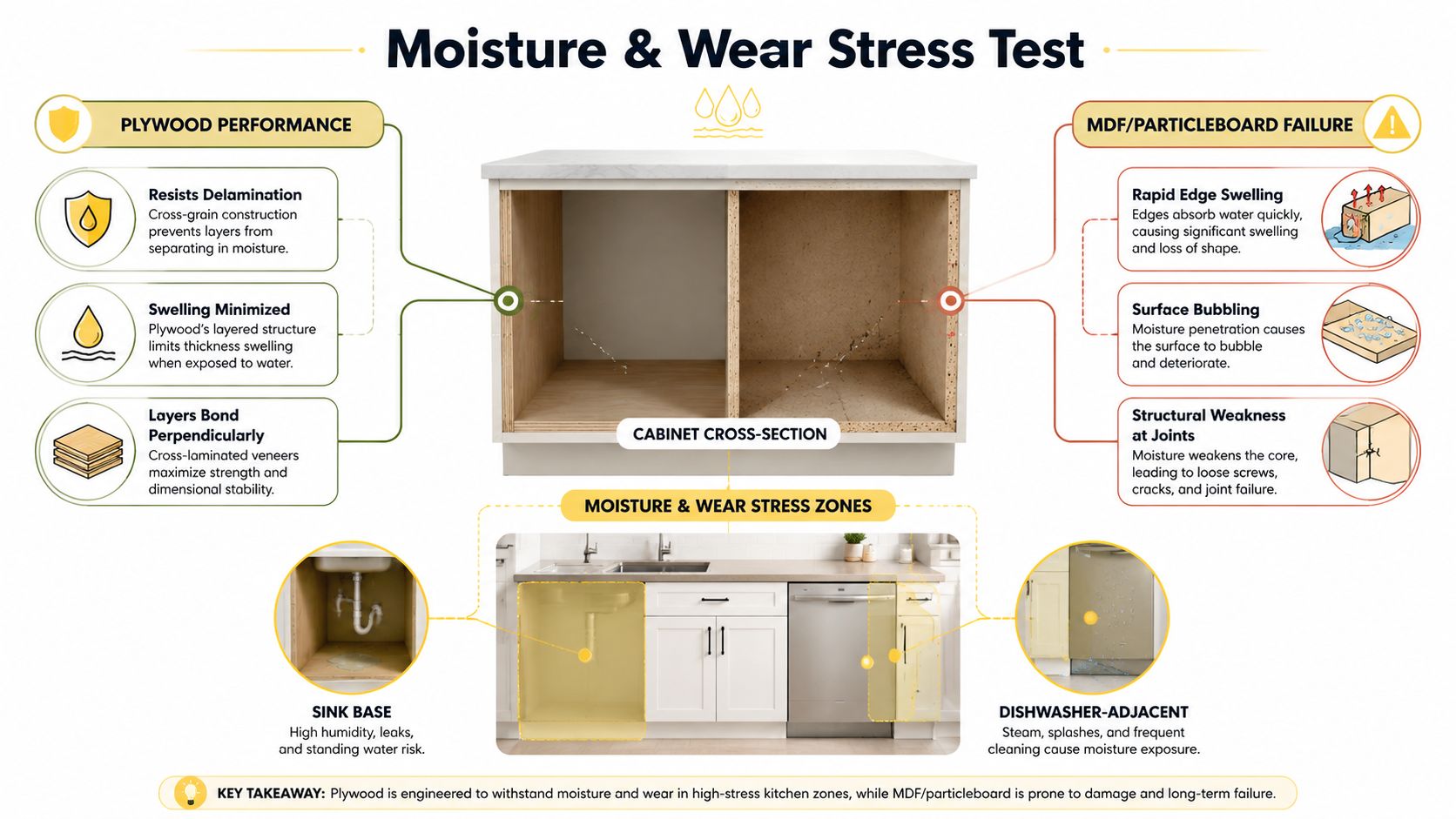
Stress zones deserve different specifications
MDF is excellent for a painted door, but its edges need complete sealing. Steam from a dishwasher can work into a damaged finish film, and repeated exposure may cause edge swelling. Thermofoil has a different failure pattern. The board may remain intact while the vinyl surface peels or separates near concentrated heat.
Particleboard is the least forgiving when water reaches an unprotected edge or toe-kick. It can work in dry upper cabinetry where budget matters, but I wouldn't specify it as the default sink-base material for a long-term remodel. Toe-kicks also deserve attention because they absorb mop splashes, shoe impacts, and occasional standing water.
Hardware adds mechanical stress. Hinges and drawer runners repeatedly load the screw connections, so plywood and solid wood offer a stronger foundation where doors are heavy or drawers are used constantly. Quality concealed hardware matters, too. A hardware guide cites Blum testing to 200,000 open-close cycles for hinges and 100,000 cycles for drawer runners under rated load in its discussion of soft-close systems, as detailed in this soft-close hardware guide.
A working demonstration can make the choice tangible:
Specifier's rule: Match the substrate to the wettest, hottest, and most-abused zone first. Then use the finish and door material to create the visual language.
The Quiet Factor Behind a Healthy Kitchen
The most expensive cabinet isn't automatically the healthiest choice. Indoor air quality depends on the resins, panel certification, and the materials used throughout the cabinet, not merely on whether the door looks like hardwood.
The EPA identifies MDF, particleboard, and hardwood plywood as pressed wood products regulated under TSCA Title VI. The agency's consumer guidance lists formaldehyde limits of 0.05 ppm for hardwood plywood, 0.09 ppm for particleboard, 0.11 ppm for MDF, and 0.13 ppm for thin MDF, with compliance for regulated panels and finished products required beginning June 1, 2018. Those limits appear in the EPA's TSCA Title VI consumer FAQs.
CARB Phase 2 and TSCA Title VI are the compliance benchmarks I'd expect to see on a serious U.S. cabinet specification. The relevant panels and finished products should be supported by third-party certification. A label alone isn't enough if nobody can provide the documentation behind it.
Read the compliance language carefully
The EPA's formaldehyde rule distinguishes between standard composite wood, exterior-grade pressed wood, and lower-emission pathways. Exterior-grade products use phenol resins and emit less formaldehyde than products made with urea-formaldehyde resins. ULEF, or ultra-low-emitting formaldehyde, reduces emissions through approved resin and manufacturing approaches. NAF, or no added formaldehyde, avoids intentionally added formaldehyde, although the availability of complete cabinet systems depends on the fabricator and product line.
Thermofoil and laminate surfaces are sealed by design, but that doesn't mean the entire cabinet is low-emission. The box, door core, drawer bottom, shelves, and back panel may use different boards with different compliance documentation.
| Standard | Particleboard Limit (ppm) | MDF Limit (ppm) | Plywood Limit (ppm) | Typical Cabinet Use |
|---|---|---|---|---|
| TSCA Title VI consumer limits | 0.09 | 0.11 | 0.05 | Boxes, shelves, doors, and finished products |
| EPA final-rule limits effective March 22, 2025 | 0.05 | 0.06 | 0.03 | U.S. sourcing and compliant composite components |
The later limits and certification requirements are described in this industry report on EPA formaldehyde rules and cabinet sourcing. Ask the showroom for the panel certification, the standard named on the quote, and the substrate used in each major component. If the salesperson can discuss sheen but not emissions documentation, keep asking.
Matching Materials to Custom and Semi-Custom Construction
Cabinet construction tier changes what you can specify. Custom cabinetry gives you the most control over materials and details. Semi-custom cabinetry gives you meaningful choices within a manufacturer's system. Stock cabinetry gives you speed and price, but fewer opportunities to change the underlying construction.
Custom cabinetry
Fully custom cabinets are built to a project's dimensions and specifications, often through a dedicated shop. An all-plywood box, solid hardwood doors, furniture-grade veneer, dovetail drawer boxes, unusual depths, integrated reveals, and carefully matched panels become realistic parts of one coordinated package.
Custom work also allows the designer to assign materials by location. A sink base can receive a more moisture-stable box, while a painted island door can use MDF for a smoother profile. A tall pantry can be detailed around a specific appliance rather than adjusted to a fixed catalog opening.
Regional fabrication in the DC area can also affect the conversation. Local coordination may give the design team more flexibility with panel matching, finish sheen, and site-specific detailing, though lead times depend on the fabricator, scope, and installation schedule.
Semi-custom cabinetry
Semi-custom lines modify a vendor's standard catalog. Homeowners may choose sizes, finishes, storage accessories, and selected construction upgrades without commissioning every component from scratch. A common pairing is a furniture-grade plywood box with MDF doors for painted designs, or plywood boxes with veneer doors for a natural-wood kitchen.
The advantage is controlled flexibility. You can often add better drawer construction, adjust storage, and choose a reveal or face-frame treatment while staying within a defined production system. The limitation is that unusual dimensions, specialty finishes, and one-off details may not be available.
For a detailed explanation of how these options differ, review custom versus semi-custom cabinets before comparing quotes.
Stock cabinetry
Stock cabinets use fixed sizes and a limited menu of finishes. Thermally fused laminate or melamine over particleboard is common, particularly where the homeowner prioritizes upfront economy and a clean, consistent surface. This can be sensible for a rental, secondary kitchen, or dry area, but I wouldn't choose it only because the sample looks polished.
| Construction Tier | Box Material | Typical Door Material | Finish Options | Lead Time |
|---|---|---|---|---|
| Custom | Plywood, hardwood, or specified engineered core | Solid hardwood, MDF, or veneer | Broadest range, including custom sheen | Fabricator and project dependent |
| Semi-custom | Furniture-grade plywood or engineered board | MDF, hardwood, veneer, or laminate | Manufacturer catalog with upgrades | Vendor and project dependent |
| Stock | Particleboard or standard engineered board | Melamine, laminate, or thermofoil | Limited catalog finishes | Typically more standardized |
The meaningful comparison isn't “custom is better.” It's whether the extra control solves a real planning problem. A narrow DC row house, an older home with irregular walls, or a kitchen requiring integrated storage may benefit from custom detailing. A straightforward layout may work beautifully with a carefully selected semi-custom line.
Maintenance Routines and Expected Lifespan
Cabinet longevity begins with the material specification, but daily care determines whether that material reaches its potential. The durability ranges in this cabinet lifespan reference place solid hardwood at 30 to 50 years with proper care, plywood-core cabinetry at 20 to 35 years, MDF-core cabinetry at 15 to 20 years in dry climates, and thermofoil or laminate over particleboard at roughly 8 to 15 years.
Those ranges aren't promises. Moisture can shorten lifespan by 20% to 30% in high-moisture areas, including under sinks and near dishwashers, according to the cited durability data. Hardware may also need attention before the cabinet material does. Hinge and drawer-runner replacement can become relevant around 12 to 15 years, regardless of the door material, depending on use and hardware quality.
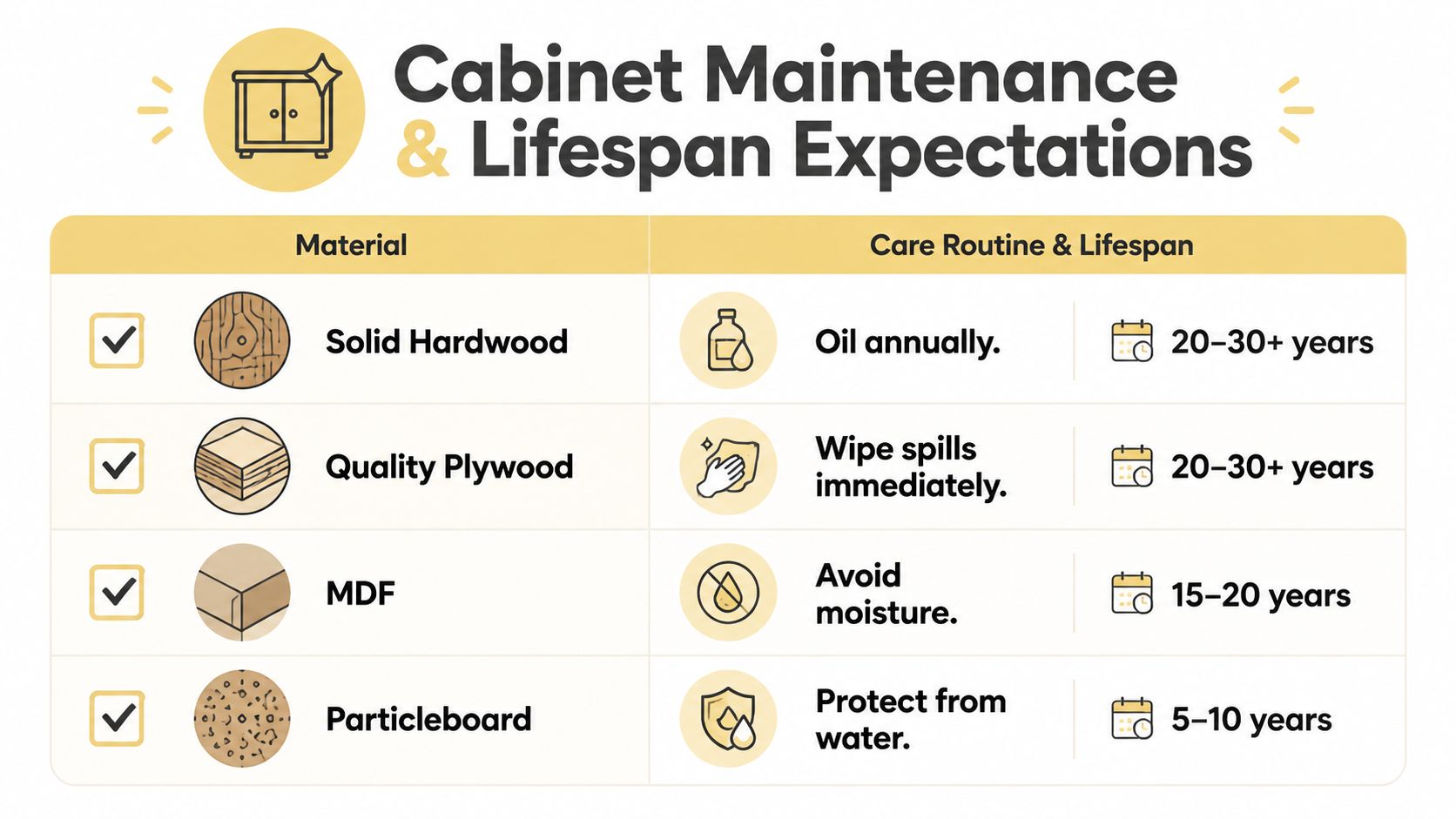
Match care to the surface
Natural wood needs attention to its finish, not a universal oiling routine. Open-grain species such as oak and ash may benefit from periodic conditioning when the finish system calls for it. Sealed hardwood generally needs mild soap or the manufacturer's recommended cleaner rather than aggressive polishing.
Painted MDF requires more discipline around edges. Avoid steam cleaners and harsh chemicals, wipe spills promptly, and keep a touch-up kit available for small chips. MDF's smooth face can remain beautiful, but a damaged edge is an invitation for moisture.
Laminate and thermofoil usually respond well to gentle, non-abrasive cleaning. Don't use scouring powders, and don't direct concentrated steam at seams or wrapped edges. If thermofoil begins to lift near a dishwasher or kettle, document the problem early because the surface repair may be limited once the adhesive bond has failed.
A simple care calendar
- Daily: Wipe water, coffee, oil, and food from doors and exposed edges. Pay special attention to the sink base and dishwasher side panel.
- Weekly: Clean high-touch pulls, the area above the cooktop, and the lower toe-kick with a compatible mild cleaner.
- Seasonally: Inspect sink plumbing, dishwasher seals, exposed seams, and cabinet bottoms for swelling or discoloration.
- Annually: Review finish condition, adjust hinges, and follow the manufacturer's guidance for conditioning natural wood.
- As needed: Use the correct touch-up product for painted doors, veneer, laminate, or hardwood. Don't improvise with household polish.
For a closer look at how coating choices affect maintenance and appearance, Jennifer Gilmer Kitchen & Bath provides guidance on kitchen cabinet finishes.
Putting It Together With a Thoughtful Remodel Plan
The most productive showroom visit begins before you arrive. Bring a floor plan showing plumbing and appliance locations, two or three cabinet door style references, a flooring or countertop sample, and a written priority list. Rank durability, cost, sustainability, maintenance, and style in the order that reflects your household.
Then ask for a complete material schedule, not a door sample alone. The quote should identify the box substrate, door and drawer-front substrate, shelf construction, back panels, finish type, edge sealing, hardware, and joinery. Request the applicable TSCA Title VI or CARB Phase 2 documentation, along with any ULEF or NAF claims.
Test the vulnerable details
A showroom sample can't recreate every kitchen condition, but it can start a more honest conversation. Ask to see how the proposed cabinet handles the sink-base zone, dishwasher side, toe-kick, and above-range area.
Use these questions at the counter:
- Box specification: Is the cabinet box plywood, MDF, particleboard, or a hybrid?
- Door specification: Is the door solid hardwood, MDF, veneer, thermofoil, or laminate?
- Edge protection: How are sink-base edges, toe-kicks, and exposed seams sealed?
- Compliance: Which third-party certification covers each composite wood component?
- Finish: Is the coating factory-applied conversion varnish, lacquer, polyurethane, or site-applied paint?
- Joinery: How are corners, shelves, drawer boxes, and hardware connections constructed?
- Warranty: What does the warranty cover for thermofoil or laminate peeling, swelling, and edge failure?
- Schedule: What are the expected lead times for plywood-box semi-custom cabinetry and all-wood custom work?
You can even request a sample of the proposed material to leave overnight in the sink-base zone of a working kitchen, then inspect it for edge swelling the next morning. It's not a laboratory test, but it exposes whether the fabricator takes moisture behavior seriously.
Leave with two written packages
Ask the designer to compare two complete packages line by line. One might pair a plywood box with painted MDF doors and factory conversion varnish. Another might use plywood boxes with veneer doors and a clear finish. Compare the actual components, compliance documentation, finish, hardware, warranty, and schedule rather than comparing broad labels such as “wood” or “premium.”
The guide to choosing kitchen cabinets can help you organize that evaluation before the appointment. Jennifer Gilmer Kitchen & Bath serves homeowners throughout Washington, DC, Maryland, Virginia, and Delaware, with projects coordinated from concept through installation. The strongest material decision is the one that supports the layout, appliance placement, storage plan, indoor air priorities, and way you use the room every day.
Jennifer Gilmer Kitchen & Bath helps homeowners compare custom and semi-custom cabinetry, cabinet substrates, finishes, hardware, and space-planning details as part of a coordinated remodel. Visit Jennifer Gilmer Kitchen & Bath to arrange a showroom consultation in the Washington, DC, Maryland, or Virginia area and bring your material questions to a design team that can carry the project from concept through installation.