.avif)

Custom kitchen cabinets cost per linear foot usually lands around $500 to $1,200 installed, and premium work can climb past $1,500. If your kitchen feels too small, too awkward, or just not worthy of the way you live, that number is the honest place to start.
A homeowner rarely gets into cabinet pricing because they want a math lesson. They get there because one quote feels possible, another feels excessive, and both seem to describe the same room. Jennifer Gilmer Kitchen & Bath sees that tension all the time in Washington DC, Maryland, and Virginia, where the conversation starts with the room, the storage, and the finish level, not just the headline price.
Table of Contents
A Quote That Looks Simple but Rarely Is
The first thing I tell clients is this, a per-foot number is only useful if you know what kind of cabinet it buys. Custom kitchen cabinets cost per linear foot is usually framed in a $500 to $1,200 installed range, with high-end work going above $1,500 per linear foot when the specification gets more exacting or more ornate. That range appears across major consumer guides and gives you a workable budgeting anchor before design decisions start pushing the number around HomeAdvisor.
A quote at $650 per foot and a quote at $875 per foot can both be reasonable. They just may not describe the same product. One might include a builder-grade box, imported hardware, and a fast finish schedule, while the other is paying for furniture-grade joinery, dovetailed drawers, and a more layered hand-applied finish.
Read the quote as a specification, not a verdict
That's why the linear-foot figure should be treated as a shared language, not a final answer. It helps you compare the scope of one proposal against another, but only if you read what sits behind the number. A lower bid can be perfectly real and still leave out the detail work that makes a kitchen feel finished.
For homeowners comparing custom and semi-custom options, Jennifer Gilmer Kitchen & Bath has a useful primer on custom vs. semi-custom cabinets. The key point is simple, the price gap usually reflects flexibility, craftsmanship, and the degree to which the cabinets are being built for your room instead of adapted to it.
Practical rule: if two cabinet quotes are close in price, compare the finish system, drawer construction, and hardware line by line before you compare the total.
You can also see why compact kitchens need sharper planning. A small room doesn't excuse sloppy cabinet decisions, it just makes every inch more valuable, which is why resources like storage solutions for compact kitchens can help you think more strategically about where storage needs to live.
What a Linear Foot of Cabinetry Actually Measures
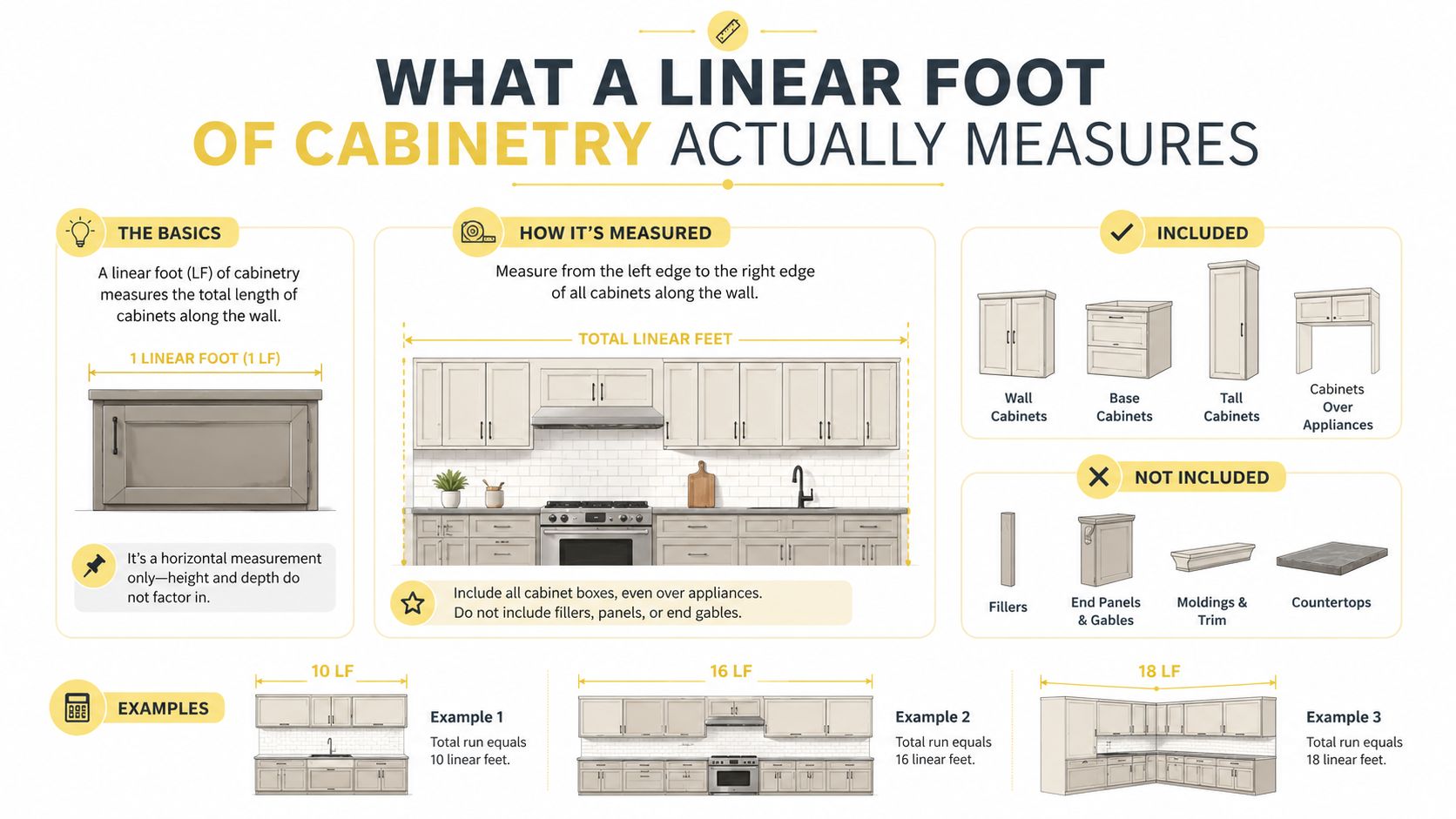
A linear foot is a wall measurement, not a storage volume. It describes the length of cabinetry run along the wall, usually one foot of face length at the cabinet line, regardless of whether that foot contains a shallow drawer stack, a pantry tower, or a sink base Fast Kitchen Design. That distinction matters because a quote can look compact on paper while hiding very different cabinet types inside the same measurement.
Why the same footage can cost very different amounts
A 10-foot run with tall pantry towers and a sink base carries more material, more hardware, and more fabrication time than a 10-foot run of standard bases. Both still read as ten linear feet. That's where homeowners get tripped up, because the headline number only tells you the length of the wall occupied, not the complexity hidden inside it.
Some estimators fold fillers, finished ends, toe kicks, and decorative panels into the linear-foot figure. Others charge them separately. That's one of the quietest reasons two bids can look close at first glance and then diverge once the details are pinned down.
When you're reviewing a proposal from Jennifer Gilmer Kitchen & Bath or any serious designer, ask where the quote ends and where the finish work begins. For a deeper look at how cabinet style and construction choices change the brief, the firm's guide on how to choose kitchen cabinets is a smart place to compare your options before pricing hardens.
A clean quote names what's included, the box, the trim, the finish, the installation scope. Anything less invites confusion later.
The Three Tiers of Cabinet Quality
The market still organizes cabinet pricing into three tiers, and that structure is useful because it tells you what kind of build philosophy you're buying. Stock cabinetry sits at the lowest end, usually around $60 to $200 per linear foot HomeAdvisor. Semi-custom rises into roughly $150 to $700 per linear foot, while custom cabinetry generally starts around $500 and can climb to $1,200 or more per linear foot Seattle Cabinets.
What you're paying for in each tier
Stock cabinets are built in fixed sizes and finishes. They're efficient, predictable, and limited. Semi-custom gives you more sizing flexibility, more door choices, and more interior options, but it still works within a manufacturing grid. Custom is different. It's made to the wall, the ceiling, and the way you cook, which is why exacting space planning matters so much in a design-led process like Jennifer Gilmer Kitchen & Bath.
| Comparing Stock, Semi-Custom, and Custom Cabinetry | ||||
|---|---|---|---|---|
| Tier | Construction | Finish Options | Lead Time | Typical Per-Foot Range |
| Stock | Fixed sizes, mass-produced components | Limited | Short | $60 to $200 |
| Semi-Custom | Modified stock with more sizing options | Broader | Moderate | $150 to $700 |
| Custom | Built to the room and specification | Broadest, most tailored | Longer | $500 to $1,200+ |
A semi-custom kitchen can look refined in a straightforward room, which is why a lot of homeowners choose it. But once you need exact appliance integration, odd corners, or storage that's built for how you move through the kitchen, custom becomes the cleaner solution. Jennifer Gilmer Kitchen & Bath publishes a helpful semi-custom kitchen cabinets cost guide that makes that middle tier easier to compare against a true custom build.
The difference isn't just finish. It's how much of the room the cabinetmaker is solving for.
What Drives the Per-Foot Price Up or Down
Custom pricing moves when the specification changes, not when the salesperson gets creative. The most expensive part of the project is rarely the cabinet shell alone, it's the combination of build method, finish labor, and the precision needed to make everything fit cleanly in the room. Premium work can exceed $1,500 per linear foot when you start layering in higher-end materials, complex layouts, and integrated features Cuisine Idéale.
The decisions that really matter
A few choices change the budget far more than others:
- Box construction: Plywood, finished interiors, and more precise joinery cost more than basic box construction because the shop is spending more time and better material on the structure itself.
- Finish complexity: Painted finishes, custom color matches, and multi-step hand finishes take more labor than a simple stain or standard factory finish.
- Door and drawer-front style: Slab and straightforward Shaker profiles are easier to produce than inset or beaded inset work, which demands tighter tolerances.
- Hardware: Soft-close hinges and full-extension slides are expected in quality work, but premium systems and specialty pull-outs raise the total.
- Storage integrations: Spice inserts, tray dividers, lazy Susans, and drawer organizers add cost because they add parts, labor, and planning time.
If you're comparing refacing against replacement, Home Pro's guide on kitchen cabinet refacing vs replacement is a practical way to see where the line between a cosmetic refresh and a true cabinet investment gets drawn.
| Specification Levers and Their Per-Foot Impact | Common Choices | Approximate $/Linear Foot |
|---|---|---|
| Box construction | Basic build, finished interiors, tighter joinery | Moves the price upward as the structure becomes more refined |
| Finish complexity | Standard stain, painted finish, custom color, hand-applied finish | Moves the price upward as labor increases |
| Door style | Slab, Shaker, inset, beaded inset | Moves the price upward as tolerances tighten |
| Hardware | Standard soft-close, premium slides, specialty systems | Can add a modest amount or a meaningful amount, depending on scope |
| Storage integrations | Roll-outs, dividers, spice inserts, waste pull-outs | Usually adds incremental cost per feature |
Where installed pricing quietly jumps
Installation can inflate the final number faster than homeowners expect. Wall leveling, plumbing relocations, and structural adjustments don't change the cabinet line item itself, but they absolutely change the installed total. That's why a clean quote from Jennifer Gilmer Kitchen & Bath, which handles projects from concept through installation in Washington DC, Maryland, and Virginia, should separate cabinet fabrication from site work instead of blending them together.
Don't let a quote hide the hard parts of the job. The harder the room, the more important it is to know what's structural and what's decorative.
A Worked Example for a 20-Foot Kitchen
A 20-foot run is the cleanest way to test the numbers because it forces the conversation onto real specifications. At a common custom range of $500 to $1,200 per linear foot, that kitchen lands around $10,000 to $24,000 before unusually complex millwork enters the picture. That is the cabinet math before the room starts asking for more.
Three ways the same kitchen can price out
| 20-Foot Kitchen Cost Scenarios by Tier | Cabinet Build | Cabinet Cost (Installed) | Notes |
|---|---|---|---|
| Stock | Standard sizes, basic finish | Roughly $10,000 to $14,000 | Fast and limited, with less flexibility |
| Semi-custom | More sizing options, upgraded finish choices | Roughly $16,000 to $22,000 | Better fit and more design control |
| Fully custom | Built to the room with tailored details | Roughly $20,000 to $30,000+ | Highest flexibility and the most exact fit |
The spread is not about taste alone. It comes from the specification choices that change labor, fit, and finish. In a room with the same footprint, a tighter door style, more refined joinery, or a more labor-heavy finish can move the number more than a homeowner expects.
An inset door package costs more than a simpler face-frame look because the tolerances are tighter. A painted finish usually lands higher than stain because the prep, priming, and finishing sequence takes more labor. Put those two choices together and the price can jump sharply while the plan view stays exactly the same.
What sits outside the cabinet number
The cabinet quote is only one part of the project. Countertops, installation, and structural work sit beside the cabinetry, not inside it.
That matters because a clean linear-foot figure can make a kitchen look cheaper than it really is. Jennifer Gilmer Kitchen & Bath treats the cabinet spec as one piece of a larger design decision, so the budget reflects what the room needs instead of hiding the hard parts in a single lump sum.
Budgeting Moves You Can Make Early
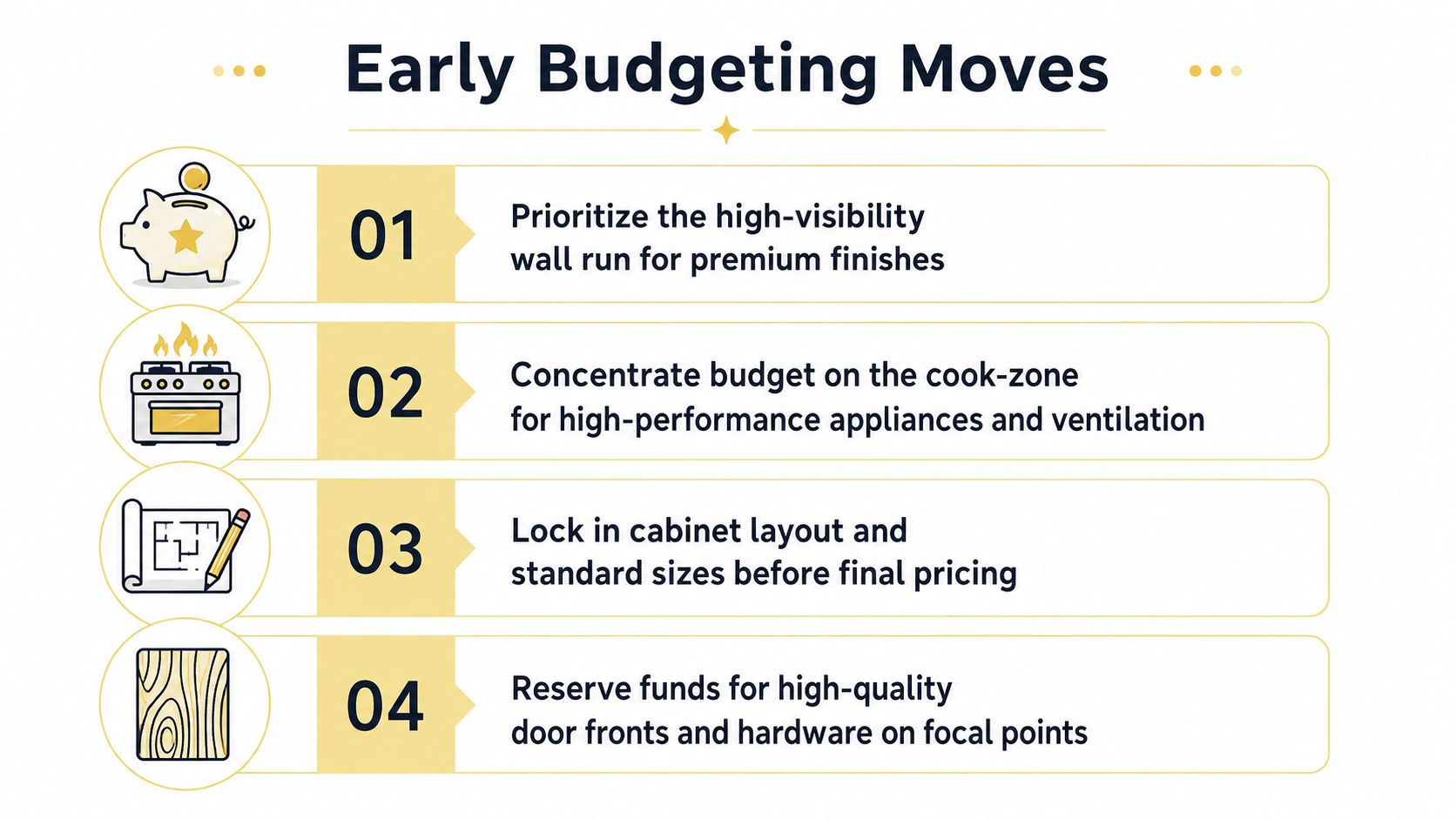
The smartest budget decisions happen before the quote becomes fixed. Once the room is drawn and the cabinet spec is locked, there's less room to steer the price. That's why I push clients to decide where the cabinets need to be beautiful, where they need to be merely efficient, and where the money should stay invisible.
Spend where the eye lands first
Put your strongest finishes on the most visible wall run. Put your best storage planning into the cook zone, where daily use happens. Tall pantry towers and utility cabinets can often be simplified without making the kitchen feel stripped down, because they disappear behind closed doors.
A single statement choice usually works better than scattered upgrades. Pick one, an inset door, a specialty finish, or integrated appliance panels, and let the rest of the kitchen support it. That gives the room a clear point of view instead of a diluted one.
- Protect the structure: Don't cheap out on box quality or install integrity just to save a little on paper.
- Protect the function: Keep the storage that supports how you cook, then trim decorative excess elsewhere.
- Treat hardware carefully: Low-grade hardware is false economy if it starts failing early.
- Use finishes strategically: Spend on focal points, not on every cabinet equally.
The vertical checklist below is a useful way to organize those choices before pricing hardens. For homeowners who want a designer-led process, Jennifer Gilmer Kitchen & Bath can help translate the room into a cabinet plan that balances storage, finish, and installation scope without losing control of the budget.
How Design and Pricing Work Together
A cabinet quote should come from the design, not sit on top of it like a sticker. When the room is measured, the floor plan is built, and the cabinet details are specified, the per-foot price becomes traceable. That's the advantage of a designer-led process, you can see why a number is what it is instead of guessing which part of the project inflated it.
Pricing transparency is part of good design
Jennifer Gilmer Kitchen & Bath works that way because a custom kitchen is not just a purchase, it's a sequence of decisions. The design team considers layout, appliance placement, storage, hardware, and finish selection as connected choices, which keeps the final proposal tied to the room instead of drifting away from it.
That matters when the project gets complicated. If a pantry tower needs to shift, if the finish changes, or if integrated storage gets added late, those changes should read clearly in the price. Hidden scope creates tension. Clear scope creates confidence.
One important reason homeowners choose custom cabinetry is that the room itself often demands it. Washington DC, Maryland, and Virginia homes include tight footprints, older structures, and renovation conditions that don't always cooperate with stock sizes. In those cases, custom isn't a luxury label, it's a practical answer to a real planning problem.
The best cabinet budgets don't try to flatten everything into one number. They show where the money goes, where it's worth spending, and where the design can stay restrained without weakening the room. That's how a homeowner makes a confident decision instead of a hesitant one.
If you're planning a kitchen remodel in Washington DC, Maryland, or Virginia, Jennifer Gilmer Kitchen & Bath can help you turn your cabinet budget into a clear design plan from the first measurement through installation. Visit Jennifer Gilmer Kitchen & Bath to start a conversation about your kitchen, your storage needs, and the cabinet spec that fits your home.