.avif)

A sustainable kitchen rarely announces itself with a particular finish or a conspicuous product label. It reveals itself on an ordinary morning, when someone opens the refrigerator and sees the vegetables that need using, reaches the pantry without moving three containers, fills a kettle without leaving the tap running, and loads the dishwasher after dinner because the machine is easy to use correctly. Kitchen sustainability is shaped by daily decisions, and good design makes those decisions simpler.
For homeowners in Washington, DC, Maryland, and Virginia, a remodel is an opportunity to consider those patterns before selecting cabinetry or countertops. Jennifer Gilmer Kitchen & Bath approaches that conversation from concept through installation, coordinating storage, work zones, appliances, lighting, and finishes so the room supports the way a household lives.
Table of Contents
- A Morning in a Sustainable Kitchen
- Food use comes first
- Operating efficiency follows use
- Materials and longevity belong together
A Morning in a Sustainable Kitchen
On a weekday morning in Chevy Chase, the first useful decision may happen before the coffee is made. The refrigerator door opens, and a clear drawer puts spinach and herbs in view rather than burying them behind tall containers. A leftover container sits at eye level, ready for lunch. Nothing about the scene looks overtly “green.” It prevents the familiar second trip to the market for food that was already at home.
The pantry works in much the same way. Pull-out shelves bring flour, grains, and canned goods forward, while a narrow section near the prep counter holds the ingredients used most often. The resident can see what is available, assemble breakfast without searching, and return items to their places without creating a hidden back row.
At the sink, a calibrated faucet delivers the water needed to rinse fruit or fill the kettle. The dishwasher remains closed until dinnerware and cookware make a full load. Its location matters: when the machine sits beside the sink and near dish storage, unloading doesn't become a chore that gets postponed.
Practical rule: A sustainable feature only works when the household can use it without extra effort.
That quiet sequence is the vocabulary of a well-planned kitchen: visible food, accessible storage, full loads, and sensible flow. It also shows why sustainability can't be reduced to a material palette. A beautiful cabinet that hides ingredients, an efficient dishwasher placed across a busy passage, or a recycling bin tucked behind an awkward door can undermine good intentions.
The most durable remodel is one that performs well through years of ordinary use. Jennifer Gilmer Kitchen & Bath helps clients examine that performance early, so the finished room reflects both personal style and the practical demands of the next stage of daily life.
What Sustainability Means to Set the Foundation
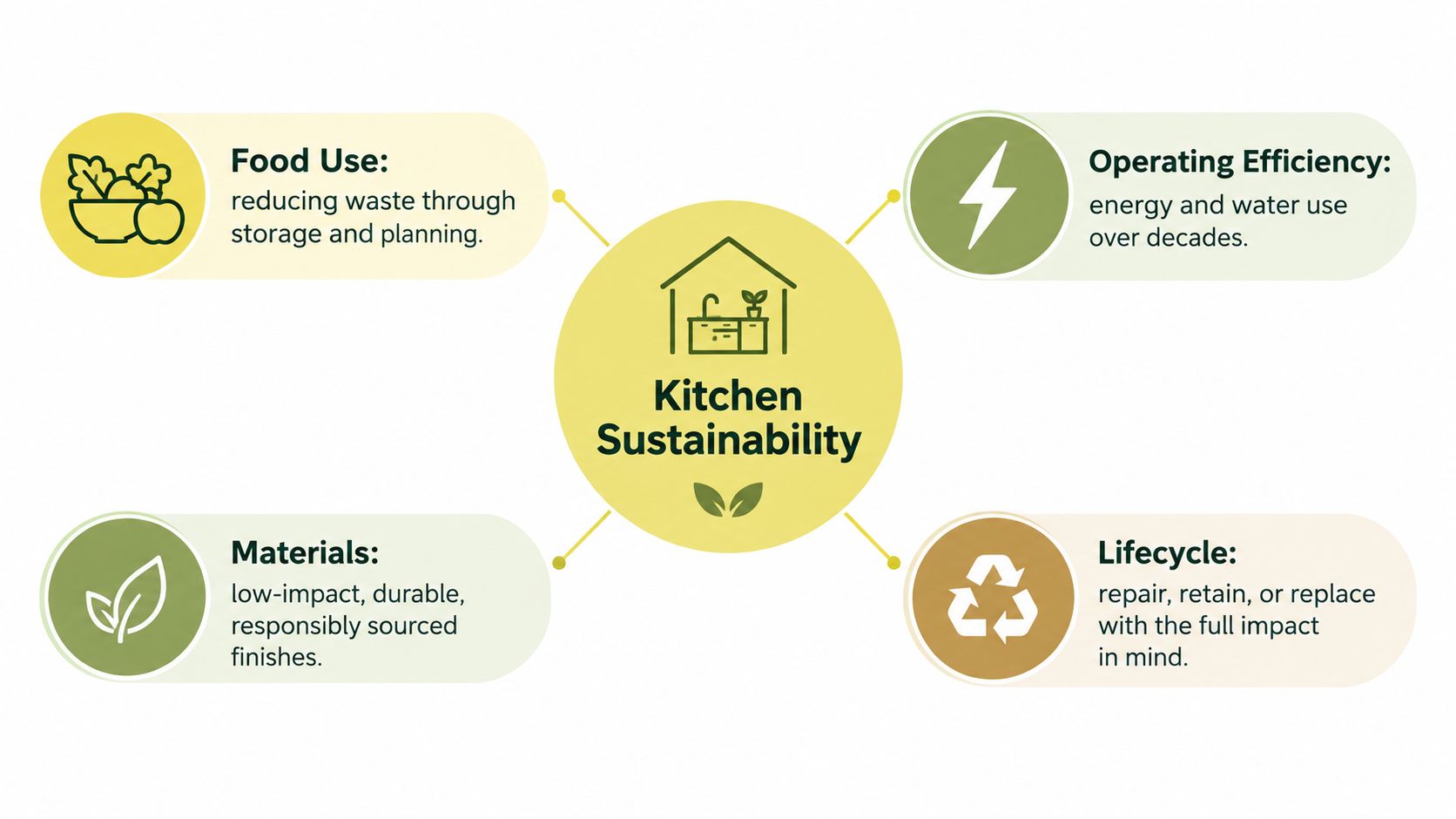
Kitchen sustainability rests on several connected concerns. Treating only one of them as the goal can produce a room that looks responsible but performs poorly.
Food use comes first
Food waste belongs at the center of the conversation because household decisions determine a large share of food's embedded land, water, energy, and emissions impacts. The United Nations Environment Programme Food Waste Index 2024 reports that 1.05 billion tonnes of food were wasted in 2022 at household, food-service, and retail stages. Households accounted for 631 million tonnes, approximately 60% of the total.
A remodel can't solve purchasing habits on its own. It can make ingredients visible, leftovers easy to store, and scraps simple to separate. Those small choices support better planning at the point where much of the waste occurs, the home.
Operating efficiency follows use
Refrigerators, dishwashers, faucets, and lighting operate repeatedly over many years. Their annual energy and water demand deserves comparison alongside appearance, capacity, noise, and installation requirements. An appliance that looks efficient on paper but frustrates the household may not deliver its intended benefit if it is used poorly or replaced prematurely.
For homeowners comparing everyday tools, a resource such as this sustainable kitchenware guide can help broaden the discussion beyond built-in products to the objects that move through the room every day.
Materials and longevity belong together
Material selection involves more than recycled content. Provenance, durability, maintenance, repairability, and the possibility of refinishing all affect the useful life of a kitchen. A finish that can be touched up or a door that can be repainted may avoid an unnecessary replacement later.
The final question is lifecycle. Can a cabinet be repaired? Can an appliance be retained? Can a surface be refinished? Jennifer Gilmer Kitchen & Bath coordinates these questions across cabinetry, layout, lighting, and appliance specifications, because sustainability principles remain aspirational until they appear in drawings, schedules, and installation details.
Designing to Prevent Food Waste at Home
A forgotten container at the back of the refrigerator can turn a well-planned meal into waste. Sustainable kitchen design starts with preventing that everyday miss, using storage that keeps food visible, accessible, and easy to use.
The World Resources Institute analysis of household food waste identifies forgetting or losing track of food, uncertainty about how to use it, over-preparing meals, and lack of time as leading U.S. household food-waste drivers. Each cause points to a practical design response.
A refrigerator with clear drawers and sensible zones can separate produce, prepared food, dairy, and frequently used ingredients while keeping them in view. A pantry with adjustable pull-outs brings smaller packages forward instead of letting them disappear behind tall containers. The guide to organizing a kitchen pantry offers a useful starting point for sorting categories before cabinet dimensions are finalized. Transparent fronts can help in selected locations, but using them everywhere for appearance alone adds visual noise. The best balance keeps monitoring easy without making the room feel exposed or crowded.
ReFED reports that U.S. consumers waste nearly 35 million tons of food annually, with an associated cost of approximately $261 billion. That scale makes storage planning more consequential than a general instruction to “organize better.” Place the pantry beside the prep counter, reserve freezer space for leftovers, and create a landing area where meal components remain visible during preparation.
Visibility versus visual minimalism
Deep, opaque cabinetry can look exceptionally tidy when closed, yet it may conceal duplicate purchases and forgotten ingredients. A slightly more open arrangement, with shallow storage, full-extension hardware, labeled zones, and sufficient clearance, makes the back of each shelf easier to inspect.
A practical pantry plan might include:
- Everyday ingredients: Position staples near the main prep surface rather than at the far end of the room.
- Short-life produce: Use visible refrigerator drawers or an open shelf for food that needs attention soon.
- Leftovers: Reserve a consistent refrigerator or freezer zone so prepared food remains identifiable.
- Scraps: Place a compost or food-scrap container near prep and cleanup, where it is easy to use.
- Date awareness: Allow room for labels or a simple marker so leftovers can be identified without opening every container.
The layout should reflect the household's actual cooking rhythm, including shopping frequency, batch cooking, and foods that regularly go unused. Jennifer Gilmer Kitchen & Bath can connect that information to cabinet dimensions, work-zone planning, and appliance placement. The goal is a calm kitchen where purchased food stays visible, usable, and enjoyable.
Appliance Replacement, Repair, or Retention
A remodel doesn't automatically justify replacing every appliance. The more responsible decision may be to retain a reliable unit, repair it, or replace only the appliance whose operating performance and service history make a new model worthwhile.
The European Commission's 2025 assessment notes that producing each tumble-dryer unit consumes an average of 4.6 gigajoules of energy and generates about 14 kilograms of landfill waste at end of life. Its discussion of repairability scoring and spare-parts availability points toward a broader principle: manufacturing and disposal belong in the appliance decision, not only the energy label.
Recovery also varies by product category. Research on consumer durable goods reports a recovery rate of about 58% for major appliances, compared with 5.6% for small appliances. Those figures, discussed in the European Commission assessment, make local collection and recycling pathways worth checking before demolition.
A practical appliance audit
Before approving replacement, consider:
- Service history: Has the unit required repeated repairs, or has it operated reliably?
- Remaining life: Is the appliance near the end of its useful service, or does it still have years of practical use?
- Energy performance: What does the current label show, and how does that compare with a replacement?
- Refrigerant considerations: Does the refrigerator raise environmental or service concerns that affect retention?
- Repair access: Are parts and qualified service available in the Mid-Atlantic area?
- End-of-life planning: Is there a responsible local recycling, donation, or collection route?
In Washington, DC, Maryland, and Virginia, repair information and convenient collection systems may not be as straightforward as homeowners expect. That uncertainty shouldn't lead automatically to replacement. It should lead to better documentation and a clear comparison of operating impact, embodied impact, warranty, and service support.
Appliance integration also affects longevity. The kitchen appliance integration guidance is useful when evaluating clearances, panels, ventilation, and access for future service. Jennifer Gilmer Kitchen & Bath helps clients consider those details during planning, so a decision to retain or replace an appliance is made alongside the cabinetry rather than after the cabinets have been ordered.
Choosing Cabinetry, Surfaces, and Finishes That Age Well
Materials earn their sustainability value through service. A cabinet, counter, or floor that remains useful and repairable can have a different environmental profile from one that looks responsible at installation but requires early removal.
Cabinet construction deserves plain attention. Face-frame and frameless systems create different visual proportions and storage conditions. Dovetail drawer joinery, appropriate hardware, stable cabinet boxes, and a finish suited to the household's maintenance habits all influence whether the cabinetry can be adjusted, repaired, or refinished later. Engineered wood products can use raw material efficiently and provide dimensional stability, while solid hardwood doors with a quality finish may be repaired or refinished instead of discarded.
A material conversation grounded in use
For countertops, stone can offer durability but may involve extraction and fabrication impacts. Solid surface can often be repaired, while butcher block brings warmth and may be renewed through maintenance. Composite options vary by composition, manufacturing, and end-of-life pathway. No single surface wins in every kitchen because cooking style, cleaning habits, regional availability, and installation requirements change the calculation.
The same applies to flooring. A material that tolerates dropped cookware, muddy shoes, and repeated cleaning may serve a household better than a fashionable option that shows wear quickly. Marie-Josée Parisi's approach to material curation reflects that broader view, pairing visual restraint with choices that can support the room over time.
| Material category | Construction method | Repairability profile | End-of-life option |
|---|---|---|---|
| Cabinet boxes | Engineered wood products selected for stability and efficient material use | Damaged components may be repaired or replaced without removing every cabinet | Reuse, donation, component recovery, or responsible disposal where available |
| Cabinet doors | Solid hardwood or durable finished panels | Hardwood doors can often be refinished; finished panels may be repaired selectively | Reuse, refinishing, donation, or material-specific disposal |
| Countertops | Stone, solid surface, butcher block, or composite fabrication | Depends on the material, damage, edge detail, and local fabricator support | Reuse, salvage, recycling where accepted, or disposal |
| Flooring | Plank, tile, sheet, or resilient installation | Varies from board replacement and refinishing to localized repair | Reuse, salvage, recycling where accepted, or disposal |
The overview of kitchen cabinet materials gives homeowners a starting point for comparing construction choices. The more useful showroom question is not, "Is this material sustainable?" It is, "How will this material behave after years of cooking, cleaning, and changing needs?"
Jennifer Gilmer Kitchen & Bath can coordinate cabinetry, surfaces, hardware, and finish selections so the visual character of the room doesn't depend on short-lived novelty. A calm kitchen often comes from fewer, better-resolved decisions, including details that allow the room to be maintained rather than replaced.
Energy and Water Efficiency in Daily Operation
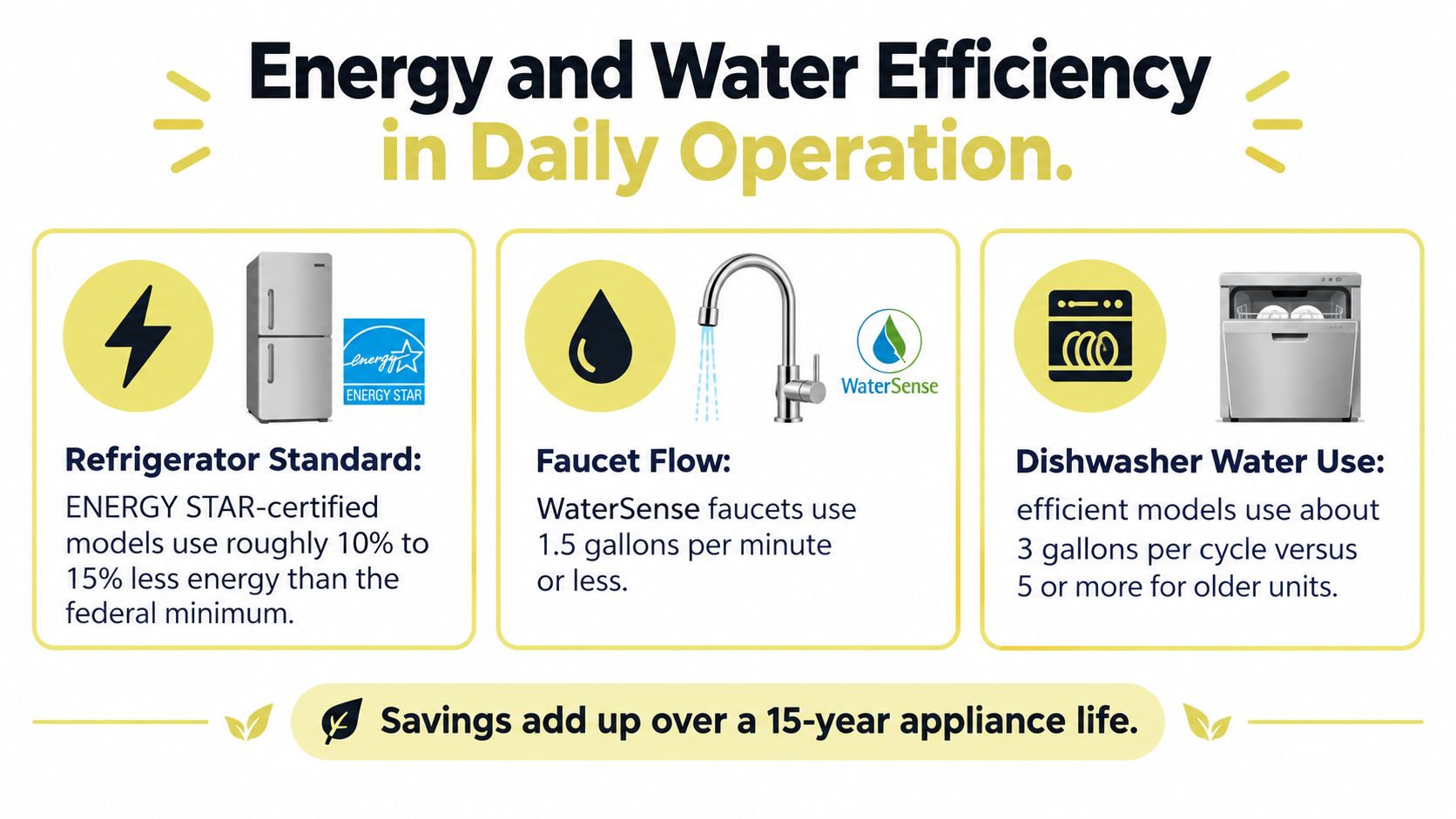
A kitchen can look efficient and still waste energy or water every day. Compare purchase price with annual kilowatt-hours, water use, capacity, service access, and the likelihood that the household will use the appliance correctly.
ENERGY STAR data indicate that certified refrigerators use about 9% less energy than models meeting the federal minimum standard. Certified dishwashers use approximately 12% less energy and 30% less water than standard models. The ENERGY STAR appliance brochure provides a useful basis for comparing operating performance instead of relying only on the label displayed on the appliance.
Small specifications, repeated often
EPA WaterSense guidance states that federal efficiency standards limit kitchen faucets to a maximum flow rate of 2.2 gallons per minute at 60 pounds per square inch of water pressure. The EPA faucet guidance gives designers a practical comparison point. The larger gain comes from pairing the right flow rate with a sink, dishwasher, waste station, and landing areas that reduce unnecessary running time.
The U.S. Department of Energy estimates that an ENERGY STAR dishwasher can save about 3,870 gallons of water over an average 10-year lifetime, with typical certified dishwasher operating cost below $35 annually. DOE guidance also reports that hand washing can cost about $40 more per year in utility costs than running a fully loaded dishwasher. The DOE kitchen appliance guidance supports a straightforward design requirement: size and locate the dishwasher so full cycles are practical, then provide storage close enough to make unloading easy.
Refrigerator replacement calls for a separate check. ENERGY STAR materials report that a 15-year-old refrigerator uses about twice the energy of a new certified model. Confirm cabinet dimensions, ventilation clearances, door swing, and delivery access before ordering. A highly efficient refrigerator still performs poorly in daily use if its doors strike a passage or its interior does not suit the household.
At a prep sink or bar, homeowners may also compare instant and tankless taps before choosing a hot-water system. The finish matters, but standby demand, installation requirements, and actual use should guide the decision.
Jennifer Gilmer Kitchen & Bath coordinates appliance specifications with cabinetry integration, lighting, and circulation, helping clients compare operating data while keeping the room comfortable and workable.
Layout, Lighting, and Waste Collection Working Together
A sustainable kitchen needs a coherent route from storage to preparation to cleanup. The refrigerator, pantry, sink, prep counter, range, dishwasher, and waste collection should support one another instead of forcing ingredients, dishes, and scraps across the room.
Place the pantry where grocery items can be put away without blocking the primary work zone. Keep the refrigerator accessible to someone grabbing a snack without interrupting meal preparation. Locate the dishwasher beside the sink and near dish storage, and give the main prep counter enough uninterrupted space for chopping, assembling, and sorting.
Lighting reinforces those choices. Daylight can make ingredients easier to see, while layered task lighting keeps prep surfaces usable when the afternoon fades. Under-cabinet lighting is especially helpful where upper cabinetry would otherwise cast a shadow. Ventilation should also be planned around the cooking equipment and the household's willingness to use it, because a system that is noisy, poorly located, or difficult to operate may be ignored.
Make source separation the easy route
The U.S. Environmental Protection Agency reports that food represented 24.1% of municipal solid waste sent to landfills in 2019. When food, yard trimmings, wood, and paper or paperboard are combined, organic materials represented 51.4% of municipal solid waste in landfills. The EPA composting guidance identifies municipal solid-waste landfills as the third-largest source of human-related methane emissions in the United States, accounting for approximately 14% of methane emissions in 2022.
EPA also estimates that landfilled food accounts for 58% of fugitive methane emissions from municipal solid-waste landfills. The EPA analysis of methane from landfilled food waste gives waste planning a direct climate connection.
For a household in Washington, DC, suburban Maryland, or Northern Virginia, the right system depends on local collection access. A compact pull-out with separate recycling and compost compartments may suit one home, while another may need a larger, removable food-scrap container and a dedicated place for paper bags or municipal collection materials. A practical waste plan should also allow the bins to be removed easily for cleaning.
Jennifer Gilmer, CKD, and the design staff at Jennifer Gilmer Kitchen & Bath bring these choices into the broader process from concept through installation. Homeowners who need help evaluating collection logistics can also use a compliant waste management partner as part of their local planning. The important design decision is simple: put separation where the work happens, not in a remote corner that turns every sustainable action into an interruption.
Planning a Sustainable Remodel With Confidence
A sustainable remodel is a coordinated set of decisions, not a single purchase. The showroom is where those decisions become tangible. In Chevy Chase, Easton, and Ashburn, homeowners can compare cabinet construction, handle storage hardware, examine finishes, review appliance labels, and discuss faucet specifications in the same conversation.
That kind of comparison helps resolve trade-offs fairly. A durable cabinet may justify its place through repairability and service life. An efficient dishwasher may be a sound choice only when the layout gives it room to open fully and makes complete loads convenient. An existing refrigerator may deserve retention, while an older unit with poor operating performance may justify replacement after its end-of-life route is documented.
Nancy McCarren, AIA, LEED AP, and Marie-Josée Parisi contribute to a design culture that treats planning as both visual and practical. The firm's authored guidance, including The Kitchen Bible: Designing the Perfect Culinary Space, gives homeowners another way to prepare for the questions that arise around layout, storage, materials, and daily use.
For clients in Washington, DC, Maryland, Virginia, and Delaware, the value of an end-to-end process is coordination. Cabinetry, lighting, appliances, work zones, finish selections, and installation details can be reviewed as parts of one room rather than isolated purchases. Kitchen sustainability becomes credible when the room is designed to last, used efficiently, and maintained thoughtfully.
Jennifer Gilmer Kitchen & Bath offers full-service kitchen remodeling, custom and semi-custom cabinetry, storage planning, appliance integration, material selection, and installation coordination for homeowners throughout Washington, DC, Maryland, Virginia, and Delaware. Visit Jennifer Gilmer Kitchen & Bath to explore the firm's showrooms and begin a remodel planned around durable materials, visible storage, and practical daily efficiency.