
<p>You&#39;re standing in the kitchen, looking at cabinet samples on one side, countertop swatches on the other, and the wall between them suddenly feels like the decision that will pull everything together or throw it off. Such is the influence of <strong>kitchen backsplash design</strong>. It sits in the daily line of sight, takes the wear of cooking, and shapes how the whole room reads from the first cup of coffee to the last pan washed at night.</p><p>For homeowners in <strong>Washington DC, Maryland, and Virginia</strong>, Jennifer Gilmer Kitchen &amp; Bath approaches the backsplash as part of a complete kitchen system, not a finishing touch that gets selected at the end. The right choice supports the cabinetry, the countertop, the lighting, and the way the room is used. In a market where <strong>85%</strong> of renovating homeowners named backsplashes, countertops, and cabinets as top priorities in the 2025 U.S. Houzz Kitchen Trends Study, the backsplash clearly belongs in the center of the design conversation, not on its edges (<a href="https://st.hzcdn.com/static/econ/2025_Houzz_US_Kitchen_Trends_Study.pdf">Houzz 2025 Kitchen Trends Study</a>).</p><h2>Table of Contents</h2><ul><li><a href="#the-backsplash-as-the-kitchens-centerpiece">The Backsplash as the Kitchen&#39;s Centerpiece</a></li><li><a href="#classic-tile-and-what-it-gives-you">Classic tile and what it gives you</a></li><li><a href="#slabs-stone-and-cleaner-sight-lines">Slabs, stone, and cleaner sight lines</a></li><li><a href="#texture-handmade-qualities-and-glass">Texture, handmade qualities, and glass</a></li></ul></li><ul><li><a href="#where-it-should-begin-and-end">Where it should begin and end</a></li><li><a href="#whats-current-in-2025-and-beyond">What&#39;s current in 2025 and beyond</a></li></ul></li><ul><li><a href="#let-one-surface-lead">Let one surface lead</a></li><li><a href="#a-useful-way-to-make-the-decision">A useful way to make the decision</a></li></ul></li><ul><li><a href="#what-matters-most-at-installation">What matters most at installation</a></li></ul></li><li><a href="#your-design-journey-with-jennifer-gilmer-kitchen-and-bath">Your Design Journey with Jennifer Gilmer Kitchen &amp; Bath</a></li><li><a href="#a-thoughtful-finish-for-an-enduring-kitchen">A Thoughtful Finish for an Enduring Kitchen</a></li><p><a id="the-backsplash-as-the-kitchens-centerpiece"></a></p><h2>The Backsplash as the Kitchen&#39;s Centerpiece</h2><p><img src="https://cdnimg.co/b78da3ac-486c-4ba2-8b92-e65823313a9e/f7bda99d-bc8d-4f89-be7d-1024f976bd72/kitchen-backsplash-design-kitchen-interior.jpg" alt="A warm, sunlit kitchen featuring a patterned tile backsplash, natural wood cabinetry, and a marble countertop island."></p><p>A backsplash does more than protect drywall. It sets the room&#39;s rhythm, texture, and point of view. In a refined kitchen, the wall surface between the counter and the cabinetry helps determine whether the space feels crisp, warm, polished, or relaxed.</p><p>Jennifer Gilmer Kitchen &amp; Bath treats the backsplash as a visual anchor from the start. The wall surface connects what happens below it, the countertop and base cabinets, with what sits above it, the uppers, hood, shelving, and lighting. If those parts do not speak the same language, the room feels assembled instead of composed.</p><p>That coordination matters because clients are making overlapping decisions, often at the same time. In the 2025 U.S. Houzz Kitchen Trends Study, <strong>85%</strong> of renovating homeowners identified backsplashes, countertops, and cabinets as top priorities. The backsplash is part of the room&#39;s main investment, and it deserves the same level of thought as the cabinetry selection or the countertop fabricator&#39;s finish.</p><blockquote><p><strong>Practical rule:</strong> choose the backsplash while you are still shaping the full palette. It is easier to coordinate color, reflectivity, and pattern early than to correct a room after the major finishes are locked.</p></blockquote><p>For a kitchen that feels personal and enduring, the backsplash should also suit how the space is used day to day. A busy cook in the DC, Maryland, or Virginia area may need a surface that cleans easily and harmonizes with strong cabinetry, while another client may want the backsplash to carry more of the visual character. A curated <a href="https://www.gilmerkitchens.com/portfolio-page">portfolio of completed kitchen work</a> shows how the backsplash can soften strong cabinetry, sharpen a neutral scheme, or hold its own as a focal point without overwhelming the space.</p><p><a id="exploring-materials-from-classic-tile-to-modern-slabs"></a></p><h2>Exploring Materials from Classic Tile to Modern Slabs</h2><p><img src="https://cdnimg.co/b78da3ac-486c-4ba2-8b92-e65823313a9e/f239aab2-209e-469d-b0b2-1fd6cf66ce99/kitchen-backsplash-design-comparison.jpg" alt="A comparison infographic between classic tiled and modern slab kitchen backsplash designs for home renovation."></p><p><strong>Ceramic tile</strong> remains the benchmark for a reason. A Statista-based survey cited for 2024 and 2025 found ceramic tile was selected by <strong>34%</strong> of homeowners who installed or planned a new backsplash, ahead of glass at <strong>7%</strong>, marble at <strong>6%</strong>, granite at <strong>4%</strong>, and zellige at <strong>4%</strong> (<a href="https://www.thecabinetcoach.com/kitchen-backsplash-trends/">kitchen backsplash trends</a>). That spread reflects how many clients still want a surface that balances design range, cost control, and long-term practicality.</p><p><a id="classic-tile-and-what-it-gives-you"></a></p><h3>Classic tile and what it gives you</h3><p>Ceramic works because it can disappear into the background or become the feature, depending on the glaze, shape, and layout. A simple white tile can feel calm and architectural. A handmade-look square can bring texture. A patterned ceramic can introduce just enough movement to make the kitchen feel collected rather than generic.</p><p>The trade-off is that tile always introduces joints. Those grout lines can be part of the beauty, but they also ask for more maintenance than a continuous slab. In a busy kitchen, that matters. If a household cooks often, especially with heavy splatter at the range, a low-porosity ceramic surface usually makes life easier than more porous materials.</p><p><a id="slabs-stone-and-cleaner-sight-lines"></a></p><h3>Slabs, stone, and cleaner sight lines</h3><p>Modern slab backsplashes appeal to clients who want a quieter, more continuous wall. A stone or engineered slab that runs from counter to upper cabinetry creates one broad plane, which can make a kitchen feel more composed. That approach is especially strong in rooms where the countertop has beautiful movement, because the same material can continue upward without breaking the visual field.</p><p>The downside is commitment. Slabs demand more precision in planning, seam placement, and fabrication. They can also narrow the design options if the stone itself is visually loud, since the backsplash and countertop then compete for attention. In those rooms, restraint elsewhere matters more.</p><p><a id="texture-handmade-qualities-and-glass"></a></p><h3>Texture, handmade qualities, and glass</h3><p>Materials such as zellige or glazed artisan tile introduce surface variation that catches light in a softer way than factory-perfect tile. That quality can feel warm and personal, especially in kitchens that need a little depth. Glass, by contrast, reads cleaner and more reflective, but it can feel colder if the rest of the room doesn&#39;t balance it with warmth in wood, fabric, or finish.</p><p>The most useful question isn&#39;t “Which material is best?” It&#39;s “How should this kitchen live?” A formal entertaining kitchen may welcome a richer, more decorative backsplash. A hardworking family kitchen may call for a quieter surface that&#39;s easy to wipe down and won&#39;t dominate the room.</p><p><a id="mastering-layout-scale-and-current-design-directions"></a></p><h2>Mastering Layout Scale and Current Design Directions</h2><p><img src="https://cdnimg.co/b78da3ac-486c-4ba2-8b92-e65823313a9e/10e7a098-58d1-4479-b866-3ffd187a0784/kitchen-backsplash-design-scale-layout.jpg" alt="A design infographic explaining the importance of scale and layout for a professional kitchen backsplash appearance."></p><p>A backsplash only feels resolved when its scale fits the architecture around it and the way the kitchen is used. A <strong>4-inch</strong> rise can work in a restrained prep zone, but many kitchens need a more deliberate decision about how high the wall treatment should go. The visual shift between a short strip and a full-height wall is substantial, even when the material stays the same.</p><p><a id="where-it-should-begin-and-end"></a></p><h3>Where it should begin and end</h3><p>The wall behind the cooktop deserves the strongest protection and the clearest visual treatment. Design guidance often points to extending the backsplash at least to the bottom of the hood or microwave and across the width of the range, because that zone takes the most heat, steam, and splatter (<a href="https://apollotile.com/blogs/our-blogs/backsplash-height-guide-standard-measurements-tips-design-ideas">backsplash height guide</a>). A full-height run or slab often earns its place there because it protects the wall and gives the cooking area a more finished read.</p><p>At other walls, the stop point should follow the room&#39;s geometry. Where an upper cabinet run ends, the backsplash should often end cleanly with it. Around a window, it may continue to the casing or wrap the opening, depending on how the room is detailed. Open shelves change the equation again, because they expose more wall and ask the backsplash to function like an architectural surface rather than a hidden background.</p><blockquote><p>A well-placed stop line makes a backsplash feel custom. A random stop line makes the wall look interrupted.</p></blockquote><p>Lighting changes how scale reads, which is why backsplash decisions should be considered alongside the room&#39;s illumination. A surface that looks quiet in daylight can feel much busier under strong task lighting or under-cabinet fixtures, so it helps to review <a href="https://www.gilmerkitchens.com/blog/kitchen-lighting-fixtures">kitchen lighting fixtures</a> before confirming the final height and finish. In practice, the same tile can read refined, flat, or overly reflective depending on how the light falls across it.</p><p><a id="whats-current-in-2025-and-beyond"></a></p><h3>What&#39;s current in 2025 and beyond</h3><p>A 2025 trend direction is the <strong>full-wall backsplash</strong>, which extends coverage beyond the traditional space between counter and cabinet (<a href="https://mystyletrends.com/kitchen-backsplash-trends/">My Style Trends</a>). The same direction shows up in artisan-inspired square tile, irregular edges, and hand-finished surfaces that create a more integrated, custom feeling. Homes &amp; Gardens also points to texture, glazing variation, and color variation as part of the current mood, with bolder tile murals returning in a more expressive way (<a href="https://www.homesandgardens.com/kitchens/kitchen-backsplash-trends">Homes &amp; Gardens</a>).</p><p>LEICHT Westchester describes continued momentum for larger-format and floor-to-ceiling backsplash applications, along with sculptural options such as three-dimensional and ribbed tile (<a href="https://www.leichtwestchester.com/blog/kitchen-backsplash-trends-the-ultimate-2025-design-guide">LEICHT Westchester</a>). HerdiStone also notes growing interest in taking tile or stone all the way to the ceiling, especially around range hoods and window walls (<a href="https://herdistone.com/blogs/news/kitchen-backsplash-trends-2025-herdistone">HerdiStone</a>).</p><p>These directions do not mean every kitchen should go tall or textured. They do mean the backsplash is being asked to do more than sit between two surfaces. It is becoming part of the room&#39;s architecture, and in homes across DC, Maryland, and Virginia, that usually calls for a designer&#39;s eye to balance proportion, durability, and the way the space will function.</p><p><a id="creating-harmony-with-cabinets-and-countertops"></a></p><h2>Creating Harmony with Cabinets and Countertops</h2><p><img src="https://cdnimg.co/b78da3ac-486c-4ba2-8b92-e65823313a9e/1da80514-fa59-4fdc-9091-d58e562c7721/kitchen-backsplash-design-modern-kitchen.jpg" alt="A modern kitchen with natural wood cabinets, a marble island countertop, and a vertical stone tile backsplash."></p><p>The most successful kitchens don&#39;t match everything. They balance it. A backsplash can either sit back and give the countertop and cabinetry room to breathe, or it can step forward and become the feature that gives the palette its energy. The key is deciding which role it should play before the material order is placed.</p><p><a id="let-one-surface-lead"></a></p><h3>Let one surface lead</h3><p>If the countertop has strong veining or bold movement, the backsplash usually works better when it&#39;s quieter. That keeps the room from feeling busy. A simple tile field, a soft glaze, or a clean slab can give the stone below it room to read properly.</p><p>If the countertop is calm, the backsplash can carry more personality. That&#39;s where artisan tile, a richer color, or a more tactile finish can add depth without fighting the rest of the room. Nancy McCarren, AIA, LEED AP, often approaches the palette by looking at tone, finish, and pattern together so the room feels considered rather than overdesigned.</p><p>The cabinetry matters just as much. Warm wood usually wants a backsplash with some softness, either in color, texture, or reflectivity. Painted cabinetry can go either way, depending on whether the client wants contrast or continuity. A narrow white tile wall against dark cabinets feels crisp. A taupe or cream field can feel gentler and more layered.</p><p><a id="a-useful-way-to-make-the-decision"></a></p><h3>A useful way to make the decision</h3><ul><li><strong>Choose contrast when the room needs definition.</strong> A quieter counter with a patterned backsplash, or a richly veined counter with a plain backsplash, creates clarity.</li><li><strong>Choose continuity when the room already has strong architecture.</strong> Repeating a tone from the cabinet or countertop helps the kitchen feel settled.</li><li><strong>Choose texture when color is already doing enough.</strong> Surface variation can add interest without introducing another dominant hue.</li><li><strong>Choose restraint when appliances and hardware already have a strong presence.</strong> The backsplash should support, not compete.</li></ul><p>The cabinetry conversation often includes storage planning too, because uppers, open shelving, and hood details change how much wall is visible. A thoughtful <a href="https://www.gilmerkitchens.com/blog/cabinet-storage-solutions">cabinet storage solution plan</a> can affect how much backsplash you see and where the eye lands when you walk into the room.</p><blockquote><p><strong>Designer&#39;s note:</strong> the right backsplash doesn&#39;t shout. It makes the cabinetry and countertop feel like they were always meant to live together.</p></blockquote><p>For visual harmony, consider the light as part of the composition. Matte surfaces absorb more of it. Glossy surfaces bounce it around. Under-cabinet lighting can make a color look warmer or cooler than it did in the showroom, which is why sample viewing matters so much.</p><p><a id="the-importance-of-craftsmanship-installation-and-care"></a></p><h2>The Importance of Craftsmanship Installation and Care</h2><p>A beautiful backsplash can fail if the substrate is wrong. The wall has to be <strong>dry, flat, and solid</strong> for proper adhesion, and installers typically add about <strong>10%</strong> extra tile to account for cuts around outlets and corners, which helps protect the finish and avoid lippage or bond failure (<a href="https://tilezz.com/blogs/tilezz_digest/your-complete-guide-to-kitchen-backsplashes">Tilezz installation guide</a>). That extra planning is not waste, it&#39;s insurance for a clean, durable result.</p><p>Preparation is where the work becomes craft. Grease, dust, old paint issues, and uneven patches all affect how tile sits and how grout performs. In a kitchen, those small misses show up later as cracked joints, uneven edges, or tiles that don&#39;t sit flush. A careful installer reads the wall before the tile ever goes up.</p><p><a id="what-matters-most-at-installation"></a></p><h3>What matters most at installation</h3><ul><li><strong>Flatness and clean adhesion.</strong> The surface has to support the tile uniformly, especially around the range and sink.</li><li><strong>Outlet and edge planning.</strong> Small cuts are where a backsplash looks either precise or clumsy.</li><li><strong>Grout selection and sealing.</strong> Grout should be appropriate to the material and sealed when the system calls for it, especially in porous assemblies.</li><li><strong>Transitions.</strong> Where the backsplash meets drywall, shelves, hood details, or window trim, the finish has to resolve cleanly.</li></ul><p>Care depends on the material. Ceramic and porcelain are generally straightforward to maintain, while natural stone and more porous grout systems need more attention. Textured surfaces can be beautiful, but they may catch more cooking residue than a smooth glaze. That&#39;s one reason design and maintenance should be discussed together, not separately.</p><p>Jennifer Gilmer Kitchen &amp; Bath manages these details as part of the overall project process, from selection through installation coordination. That matters because the visual decision and the technical decision are really the same decision in a kitchen that&#39;s meant to last.</p><p><a id="your-design-journey-with-jennifer-gilmer-kitchen-and-bath"></a></p><h2>Your Design Journey with Jennifer Gilmer Kitchen &amp; Bath</h2><p>Choosing a backsplash gets easier when you can see the materials in person, compare them under real light, and talk through the room as a whole. At Jennifer Gilmer Kitchen &amp; Bath, that conversation begins in one of the showrooms in <strong>Chevy Chase, Easton, or Ashburn</strong>, where clients can handle samples and see how tile, stone, cabinetry, and finishes interact. That tactile step often changes the direction of the design in a good way.</p><p>The firm serves <strong>Washington DC, Maryland, and Virginia</strong>, and the process is built to support homeowners who want guidance without losing their own point of view. Jennifer Gilmer, CKD, Nancy McCarren, AIA, LEED AP, and Marie-Josée Parisi all bring a design eye to the practical decisions that shape the finished kitchen. That can mean helping a client decide whether the backsplash should fade back or take the lead, or whether a material that looks lovely in daylight will still feel right under evening lighting.</p><p>A strong backsplash plan also depends on the rest of the room. Appliance placement, cabinet configuration, and lighting all influence how the wall reads once the kitchen is in use. That&#39;s why the firm&#39;s work from concept through installation matters, because the backsplash can&#39;t be separated from the room around it if the goal is a cohesive result.</p><p>Jennifer Gilmer Kitchen &amp; Bath also includes backsplash tiling among its interior offerings, which lets the design team address the wall surface as part of the full kitchen composition rather than as a detached finish choice. For clients, that means fewer loose ends and a more grounded decision-making process. The result is usually calmer, because the choices are being made in context.</p><p><a id="a-thoughtful-finish-for-an-enduring-kitchen"></a></p><h2>A Thoughtful Finish for an Enduring Kitchen</h2><p>A good backsplash doesn&#39;t need to dominate the room to define it. It can be quiet, tactile, expressive, or almost architectural, as long as it belongs to the kitchen as a whole. The best kitchen backsplash design respects the cabinet lines, supports the countertop, suits the way the household cooks, and feels right under the light that fills the room every day.</p><p>That&#39;s where professional design makes a real difference. Material, scale, layout, and craftsmanship all matter, but they matter most when they&#39;re considered together. A backsplash chosen with care won&#39;t feel dated as quickly, because it&#39;s not relying on novelty alone. It&#39;s part of a thoughtful composition built around how you live.</p><p>For homeowners in the DC area, Maryland, and Virginia, the right next step is a conversation, not a guess. Bring your cabinet ideas, countertop samples, and kitchen questions to Jennifer Gilmer Kitchen &amp; Bath, and begin shaping a backsplash that feels personal, practical, and lasting.</p><hr><p>A CTA for <a href="https://gilmerkitchens.com">Jennifer Gilmer Kitchen &amp; Bath</a>.</p>

Explore kitchen backsplash design with Jennifer Gilmer Kitchen & Bath. Our guide covers materials, styles, and layouts for homes in the DC, MD, and VA area.

Kitchen Backsplash Design an Expert Guide for 2026
<p>You&#39;re standing in the kitchen, looking at cabinet samples on one side, countertop swatches on the other, and the wall between them suddenly feels like the decision that will pull everything together or throw it off. Such is the influence of <strong>kitchen backsplash design</strong>. It sits in the daily line of sight, takes the wear of cooking, and shapes how the whole room reads from the first cup of coffee to the last pan washed at night.</p><p>For homeowners in <strong>Washington DC, Maryland, and Virginia</strong>, Jennifer Gilmer Kitchen &amp; Bath approaches the backsplash as part of a complete kitchen system, not a finishing touch that gets selected at the end. The right choice supports the cabinetry, the countertop, the lighting, and the way the room is used. In a market where <strong>85%</strong> of renovating homeowners named backsplashes, countertops, and cabinets as top priorities in the 2025 U.S. Houzz Kitchen Trends Study, the backsplash clearly belongs in the center of the design conversation, not on its edges (<a href="https://st.hzcdn.com/static/econ/2025_Houzz_US_Kitchen_Trends_Study.pdf">Houzz 2025 Kitchen Trends Study</a>).</p><h2>Table of Contents</h2><ul><li><a href="#the-backsplash-as-the-kitchens-centerpiece">The Backsplash as the Kitchen&#39;s Centerpiece</a></li><li><a href="#classic-tile-and-what-it-gives-you">Classic tile and what it gives you</a></li><li><a href="#slabs-stone-and-cleaner-sight-lines">Slabs, stone, and cleaner sight lines</a></li><li><a href="#texture-handmade-qualities-and-glass">Texture, handmade qualities, and glass</a></li></ul></li><ul><li><a href="#where-it-should-begin-and-end">Where it should begin and end</a></li><li><a href="#whats-current-in-2025-and-beyond">What&#39;s current in 2025 and beyond</a></li></ul></li><ul><li><a href="#let-one-surface-lead">Let one surface lead</a></li><li><a href="#a-useful-way-to-make-the-decision">A useful way to make the decision</a></li></ul></li><ul><li><a href="#what-matters-most-at-installation">What matters most at installation</a></li></ul></li><li><a href="#your-design-journey-with-jennifer-gilmer-kitchen-and-bath">Your Design Journey with Jennifer Gilmer Kitchen &amp; Bath</a></li><li><a href="#a-thoughtful-finish-for-an-enduring-kitchen">A Thoughtful Finish for an Enduring Kitchen</a></li><p><a id="the-backsplash-as-the-kitchens-centerpiece"></a></p><h2>The Backsplash as the Kitchen&#39;s Centerpiece</h2><p><img src="https://cdnimg.co/b78da3ac-486c-4ba2-8b92-e65823313a9e/f7bda99d-bc8d-4f89-be7d-1024f976bd72/kitchen-backsplash-design-kitchen-interior.jpg" alt="A warm, sunlit kitchen featuring a patterned tile backsplash, natural wood cabinetry, and a marble countertop island."></p><p>A backsplash does more than protect drywall. It sets the room&#39;s rhythm, texture, and point of view. In a refined kitchen, the wall surface between the counter and the cabinetry helps determine whether the space feels crisp, warm, polished, or relaxed.</p><p>Jennifer Gilmer Kitchen &amp; Bath treats the backsplash as a visual anchor from the start. The wall surface connects what happens below it, the countertop and base cabinets, with what sits above it, the uppers, hood, shelving, and lighting. If those parts do not speak the same language, the room feels assembled instead of composed.</p><p>That coordination matters because clients are making overlapping decisions, often at the same time. In the 2025 U.S. Houzz Kitchen Trends Study, <strong>85%</strong> of renovating homeowners identified backsplashes, countertops, and cabinets as top priorities. The backsplash is part of the room&#39;s main investment, and it deserves the same level of thought as the cabinetry selection or the countertop fabricator&#39;s finish.</p><blockquote><p><strong>Practical rule:</strong> choose the backsplash while you are still shaping the full palette. It is easier to coordinate color, reflectivity, and pattern early than to correct a room after the major finishes are locked.</p></blockquote><p>For a kitchen that feels personal and enduring, the backsplash should also suit how the space is used day to day. A busy cook in the DC, Maryland, or Virginia area may need a surface that cleans easily and harmonizes with strong cabinetry, while another client may want the backsplash to carry more of the visual character. A curated <a href="https://www.gilmerkitchens.com/portfolio-page">portfolio of completed kitchen work</a> shows how the backsplash can soften strong cabinetry, sharpen a neutral scheme, or hold its own as a focal point without overwhelming the space.</p><p><a id="exploring-materials-from-classic-tile-to-modern-slabs"></a></p><h2>Exploring Materials from Classic Tile to Modern Slabs</h2><p><img src="https://cdnimg.co/b78da3ac-486c-4ba2-8b92-e65823313a9e/f239aab2-209e-469d-b0b2-1fd6cf66ce99/kitchen-backsplash-design-comparison.jpg" alt="A comparison infographic between classic tiled and modern slab kitchen backsplash designs for home renovation."></p><p><strong>Ceramic tile</strong> remains the benchmark for a reason. A Statista-based survey cited for 2024 and 2025 found ceramic tile was selected by <strong>34%</strong> of homeowners who installed or planned a new backsplash, ahead of glass at <strong>7%</strong>, marble at <strong>6%</strong>, granite at <strong>4%</strong>, and zellige at <strong>4%</strong> (<a href="https://www.thecabinetcoach.com/kitchen-backsplash-trends/">kitchen backsplash trends</a>). That spread reflects how many clients still want a surface that balances design range, cost control, and long-term practicality.</p><p><a id="classic-tile-and-what-it-gives-you"></a></p><h3>Classic tile and what it gives you</h3><p>Ceramic works because it can disappear into the background or become the feature, depending on the glaze, shape, and layout. A simple white tile can feel calm and architectural. A handmade-look square can bring texture. A patterned ceramic can introduce just enough movement to make the kitchen feel collected rather than generic.</p><p>The trade-off is that tile always introduces joints. Those grout lines can be part of the beauty, but they also ask for more maintenance than a continuous slab. In a busy kitchen, that matters. If a household cooks often, especially with heavy splatter at the range, a low-porosity ceramic surface usually makes life easier than more porous materials.</p><p><a id="slabs-stone-and-cleaner-sight-lines"></a></p><h3>Slabs, stone, and cleaner sight lines</h3><p>Modern slab backsplashes appeal to clients who want a quieter, more continuous wall. A stone or engineered slab that runs from counter to upper cabinetry creates one broad plane, which can make a kitchen feel more composed. That approach is especially strong in rooms where the countertop has beautiful movement, because the same material can continue upward without breaking the visual field.</p><p>The downside is commitment. Slabs demand more precision in planning, seam placement, and fabrication. They can also narrow the design options if the stone itself is visually loud, since the backsplash and countertop then compete for attention. In those rooms, restraint elsewhere matters more.</p><p><a id="texture-handmade-qualities-and-glass"></a></p><h3>Texture, handmade qualities, and glass</h3><p>Materials such as zellige or glazed artisan tile introduce surface variation that catches light in a softer way than factory-perfect tile. That quality can feel warm and personal, especially in kitchens that need a little depth. Glass, by contrast, reads cleaner and more reflective, but it can feel colder if the rest of the room doesn&#39;t balance it with warmth in wood, fabric, or finish.</p><p>The most useful question isn&#39;t “Which material is best?” It&#39;s “How should this kitchen live?” A formal entertaining kitchen may welcome a richer, more decorative backsplash. A hardworking family kitchen may call for a quieter surface that&#39;s easy to wipe down and won&#39;t dominate the room.</p><p><a id="mastering-layout-scale-and-current-design-directions"></a></p><h2>Mastering Layout Scale and Current Design Directions</h2><p><img src="https://cdnimg.co/b78da3ac-486c-4ba2-8b92-e65823313a9e/10e7a098-58d1-4479-b866-3ffd187a0784/kitchen-backsplash-design-scale-layout.jpg" alt="A design infographic explaining the importance of scale and layout for a professional kitchen backsplash appearance."></p><p>A backsplash only feels resolved when its scale fits the architecture around it and the way the kitchen is used. A <strong>4-inch</strong> rise can work in a restrained prep zone, but many kitchens need a more deliberate decision about how high the wall treatment should go. The visual shift between a short strip and a full-height wall is substantial, even when the material stays the same.</p><p><a id="where-it-should-begin-and-end"></a></p><h3>Where it should begin and end</h3><p>The wall behind the cooktop deserves the strongest protection and the clearest visual treatment. Design guidance often points to extending the backsplash at least to the bottom of the hood or microwave and across the width of the range, because that zone takes the most heat, steam, and splatter (<a href="https://apollotile.com/blogs/our-blogs/backsplash-height-guide-standard-measurements-tips-design-ideas">backsplash height guide</a>). A full-height run or slab often earns its place there because it protects the wall and gives the cooking area a more finished read.</p><p>At other walls, the stop point should follow the room&#39;s geometry. Where an upper cabinet run ends, the backsplash should often end cleanly with it. Around a window, it may continue to the casing or wrap the opening, depending on how the room is detailed. Open shelves change the equation again, because they expose more wall and ask the backsplash to function like an architectural surface rather than a hidden background.</p><blockquote><p>A well-placed stop line makes a backsplash feel custom. A random stop line makes the wall look interrupted.</p></blockquote><p>Lighting changes how scale reads, which is why backsplash decisions should be considered alongside the room&#39;s illumination. A surface that looks quiet in daylight can feel much busier under strong task lighting or under-cabinet fixtures, so it helps to review <a href="https://www.gilmerkitchens.com/blog/kitchen-lighting-fixtures">kitchen lighting fixtures</a> before confirming the final height and finish. In practice, the same tile can read refined, flat, or overly reflective depending on how the light falls across it.</p><p><a id="whats-current-in-2025-and-beyond"></a></p><h3>What&#39;s current in 2025 and beyond</h3><p>A 2025 trend direction is the <strong>full-wall backsplash</strong>, which extends coverage beyond the traditional space between counter and cabinet (<a href="https://mystyletrends.com/kitchen-backsplash-trends/">My Style Trends</a>). The same direction shows up in artisan-inspired square tile, irregular edges, and hand-finished surfaces that create a more integrated, custom feeling. Homes &amp; Gardens also points to texture, glazing variation, and color variation as part of the current mood, with bolder tile murals returning in a more expressive way (<a href="https://www.homesandgardens.com/kitchens/kitchen-backsplash-trends">Homes &amp; Gardens</a>).</p><p>LEICHT Westchester describes continued momentum for larger-format and floor-to-ceiling backsplash applications, along with sculptural options such as three-dimensional and ribbed tile (<a href="https://www.leichtwestchester.com/blog/kitchen-backsplash-trends-the-ultimate-2025-design-guide">LEICHT Westchester</a>). HerdiStone also notes growing interest in taking tile or stone all the way to the ceiling, especially around range hoods and window walls (<a href="https://herdistone.com/blogs/news/kitchen-backsplash-trends-2025-herdistone">HerdiStone</a>).</p><p>These directions do not mean every kitchen should go tall or textured. They do mean the backsplash is being asked to do more than sit between two surfaces. It is becoming part of the room&#39;s architecture, and in homes across DC, Maryland, and Virginia, that usually calls for a designer&#39;s eye to balance proportion, durability, and the way the space will function.</p><p><a id="creating-harmony-with-cabinets-and-countertops"></a></p><h2>Creating Harmony with Cabinets and Countertops</h2><p><img src="https://cdnimg.co/b78da3ac-486c-4ba2-8b92-e65823313a9e/1da80514-fa59-4fdc-9091-d58e562c7721/kitchen-backsplash-design-modern-kitchen.jpg" alt="A modern kitchen with natural wood cabinets, a marble island countertop, and a vertical stone tile backsplash."></p><p>The most successful kitchens don&#39;t match everything. They balance it. A backsplash can either sit back and give the countertop and cabinetry room to breathe, or it can step forward and become the feature that gives the palette its energy. The key is deciding which role it should play before the material order is placed.</p><p><a id="let-one-surface-lead"></a></p><h3>Let one surface lead</h3><p>If the countertop has strong veining or bold movement, the backsplash usually works better when it&#39;s quieter. That keeps the room from feeling busy. A simple tile field, a soft glaze, or a clean slab can give the stone below it room to read properly.</p><p>If the countertop is calm, the backsplash can carry more personality. That&#39;s where artisan tile, a richer color, or a more tactile finish can add depth without fighting the rest of the room. Nancy McCarren, AIA, LEED AP, often approaches the palette by looking at tone, finish, and pattern together so the room feels considered rather than overdesigned.</p><p>The cabinetry matters just as much. Warm wood usually wants a backsplash with some softness, either in color, texture, or reflectivity. Painted cabinetry can go either way, depending on whether the client wants contrast or continuity. A narrow white tile wall against dark cabinets feels crisp. A taupe or cream field can feel gentler and more layered.</p><p><a id="a-useful-way-to-make-the-decision"></a></p><h3>A useful way to make the decision</h3><ul><li><strong>Choose contrast when the room needs definition.</strong> A quieter counter with a patterned backsplash, or a richly veined counter with a plain backsplash, creates clarity.</li><li><strong>Choose continuity when the room already has strong architecture.</strong> Repeating a tone from the cabinet or countertop helps the kitchen feel settled.</li><li><strong>Choose texture when color is already doing enough.</strong> Surface variation can add interest without introducing another dominant hue.</li><li><strong>Choose restraint when appliances and hardware already have a strong presence.</strong> The backsplash should support, not compete.</li></ul><p>The cabinetry conversation often includes storage planning too, because uppers, open shelving, and hood details change how much wall is visible. A thoughtful <a href="https://www.gilmerkitchens.com/blog/cabinet-storage-solutions">cabinet storage solution plan</a> can affect how much backsplash you see and where the eye lands when you walk into the room.</p><blockquote><p><strong>Designer&#39;s note:</strong> the right backsplash doesn&#39;t shout. It makes the cabinetry and countertop feel like they were always meant to live together.</p></blockquote><p>For visual harmony, consider the light as part of the composition. Matte surfaces absorb more of it. Glossy surfaces bounce it around. Under-cabinet lighting can make a color look warmer or cooler than it did in the showroom, which is why sample viewing matters so much.</p><p><a id="the-importance-of-craftsmanship-installation-and-care"></a></p><h2>The Importance of Craftsmanship Installation and Care</h2><p>A beautiful backsplash can fail if the substrate is wrong. The wall has to be <strong>dry, flat, and solid</strong> for proper adhesion, and installers typically add about <strong>10%</strong> extra tile to account for cuts around outlets and corners, which helps protect the finish and avoid lippage or bond failure (<a href="https://tilezz.com/blogs/tilezz_digest/your-complete-guide-to-kitchen-backsplashes">Tilezz installation guide</a>). That extra planning is not waste, it&#39;s insurance for a clean, durable result.</p><p>Preparation is where the work becomes craft. Grease, dust, old paint issues, and uneven patches all affect how tile sits and how grout performs. In a kitchen, those small misses show up later as cracked joints, uneven edges, or tiles that don&#39;t sit flush. A careful installer reads the wall before the tile ever goes up.</p><p><a id="what-matters-most-at-installation"></a></p><h3>What matters most at installation</h3><ul><li><strong>Flatness and clean adhesion.</strong> The surface has to support the tile uniformly, especially around the range and sink.</li><li><strong>Outlet and edge planning.</strong> Small cuts are where a backsplash looks either precise or clumsy.</li><li><strong>Grout selection and sealing.</strong> Grout should be appropriate to the material and sealed when the system calls for it, especially in porous assemblies.</li><li><strong>Transitions.</strong> Where the backsplash meets drywall, shelves, hood details, or window trim, the finish has to resolve cleanly.</li></ul><p>Care depends on the material. Ceramic and porcelain are generally straightforward to maintain, while natural stone and more porous grout systems need more attention. Textured surfaces can be beautiful, but they may catch more cooking residue than a smooth glaze. That&#39;s one reason design and maintenance should be discussed together, not separately.</p><p>Jennifer Gilmer Kitchen &amp; Bath manages these details as part of the overall project process, from selection through installation coordination. That matters because the visual decision and the technical decision are really the same decision in a kitchen that&#39;s meant to last.</p><p><a id="your-design-journey-with-jennifer-gilmer-kitchen-and-bath"></a></p><h2>Your Design Journey with Jennifer Gilmer Kitchen &amp; Bath</h2><p>Choosing a backsplash gets easier when you can see the materials in person, compare them under real light, and talk through the room as a whole. At Jennifer Gilmer Kitchen &amp; Bath, that conversation begins in one of the showrooms in <strong>Chevy Chase, Easton, or Ashburn</strong>, where clients can handle samples and see how tile, stone, cabinetry, and finishes interact. That tactile step often changes the direction of the design in a good way.</p><p>The firm serves <strong>Washington DC, Maryland, and Virginia</strong>, and the process is built to support homeowners who want guidance without losing their own point of view. Jennifer Gilmer, CKD, Nancy McCarren, AIA, LEED AP, and Marie-Josée Parisi all bring a design eye to the practical decisions that shape the finished kitchen. That can mean helping a client decide whether the backsplash should fade back or take the lead, or whether a material that looks lovely in daylight will still feel right under evening lighting.</p><p>A strong backsplash plan also depends on the rest of the room. Appliance placement, cabinet configuration, and lighting all influence how the wall reads once the kitchen is in use. That&#39;s why the firm&#39;s work from concept through installation matters, because the backsplash can&#39;t be separated from the room around it if the goal is a cohesive result.</p><p>Jennifer Gilmer Kitchen &amp; Bath also includes backsplash tiling among its interior offerings, which lets the design team address the wall surface as part of the full kitchen composition rather than as a detached finish choice. For clients, that means fewer loose ends and a more grounded decision-making process. The result is usually calmer, because the choices are being made in context.</p><p><a id="a-thoughtful-finish-for-an-enduring-kitchen"></a></p><h2>A Thoughtful Finish for an Enduring Kitchen</h2><p>A good backsplash doesn&#39;t need to dominate the room to define it. It can be quiet, tactile, expressive, or almost architectural, as long as it belongs to the kitchen as a whole. The best kitchen backsplash design respects the cabinet lines, supports the countertop, suits the way the household cooks, and feels right under the light that fills the room every day.</p><p>That&#39;s where professional design makes a real difference. Material, scale, layout, and craftsmanship all matter, but they matter most when they&#39;re considered together. A backsplash chosen with care won&#39;t feel dated as quickly, because it&#39;s not relying on novelty alone. It&#39;s part of a thoughtful composition built around how you live.</p><p>For homeowners in the DC area, Maryland, and Virginia, the right next step is a conversation, not a guess. Bring your cabinet ideas, countertop samples, and kitchen questions to Jennifer Gilmer Kitchen &amp; Bath, and begin shaping a backsplash that feels personal, practical, and lasting.</p><hr><p>A CTA for <a href="https://gilmerkitchens.com">Jennifer Gilmer Kitchen &amp; Bath</a>.</p>
July 22, 2026

You're standing in the kitchen, looking at cabinet samples on one side, countertop swatches on the other, and the wall between them suddenly feels like the decision that will pull everything together or throw it off. Such is the influence of kitchen backsplash design. It sits in the daily line of sight, takes the wear of cooking, and shapes how the whole room reads from the first cup of coffee to the last pan washed at night.

For homeowners in Washington DC, Maryland, and Virginia, Jennifer Gilmer Kitchen & Bath approaches the backsplash as part of a complete kitchen system, not a finishing touch that gets selected at the end. The right choice supports the cabinetry, the countertop, the lighting, and the way the room is used. In a market where 85% of renovating homeowners named backsplashes, countertops, and cabinets as top priorities in the 2025 U.S. Houzz Kitchen Trends Study, the backsplash clearly belongs in the center of the design conversation, not on its edges (Houzz 2025 Kitchen Trends Study).

Table of Contents

  • Your Design Journey with Jennifer Gilmer Kitchen & Bath
  • A Thoughtful Finish for an Enduring Kitchen
  • The Backsplash as the Kitchen's Centerpiece
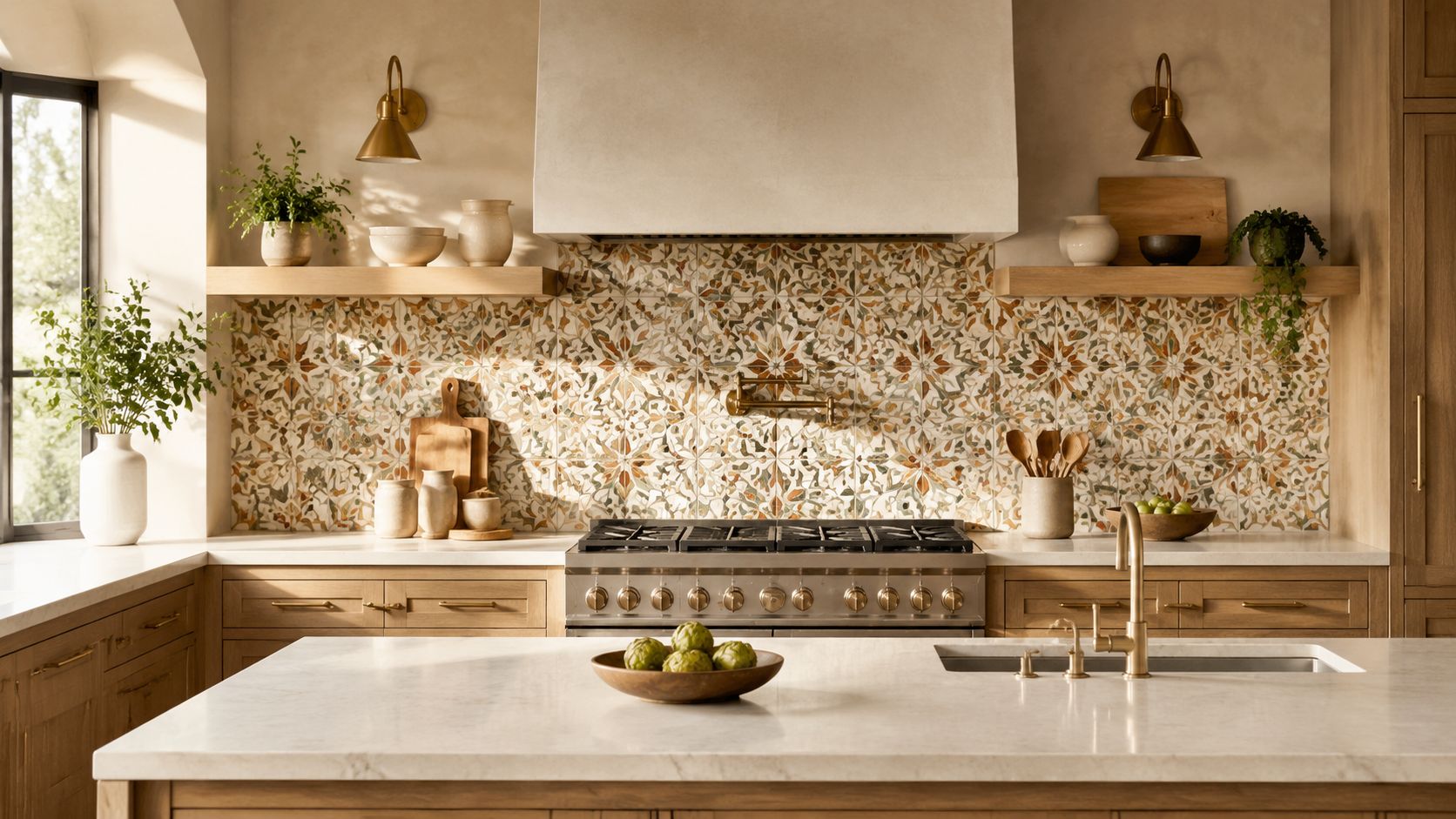
    A warm, sunlit kitchen featuring a patterned tile backsplash, natural wood cabinetry, and a marble countertop island.

    A backsplash does more than protect drywall. It sets the room's rhythm, texture, and point of view. In a refined kitchen, the wall surface between the counter and the cabinetry helps determine whether the space feels crisp, warm, polished, or relaxed.

    Jennifer Gilmer Kitchen & Bath treats the backsplash as a visual anchor from the start. The wall surface connects what happens below it, the countertop and base cabinets, with what sits above it, the uppers, hood, shelving, and lighting. If those parts do not speak the same language, the room feels assembled instead of composed.

    That coordination matters because clients are making overlapping decisions, often at the same time. In the 2025 U.S. Houzz Kitchen Trends Study, 85% of renovating homeowners identified backsplashes, countertops, and cabinets as top priorities. The backsplash is part of the room's main investment, and it deserves the same level of thought as the cabinetry selection or the countertop fabricator's finish.

    Practical rule: choose the backsplash while you are still shaping the full palette. It is easier to coordinate color, reflectivity, and pattern early than to correct a room after the major finishes are locked.

    For a kitchen that feels personal and enduring, the backsplash should also suit how the space is used day to day. A busy cook in the DC, Maryland, or Virginia area may need a surface that cleans easily and harmonizes with strong cabinetry, while another client may want the backsplash to carry more of the visual character. A curated portfolio of completed kitchen work shows how the backsplash can soften strong cabinetry, sharpen a neutral scheme, or hold its own as a focal point without overwhelming the space.

    Exploring Materials from Classic Tile to Modern Slabs
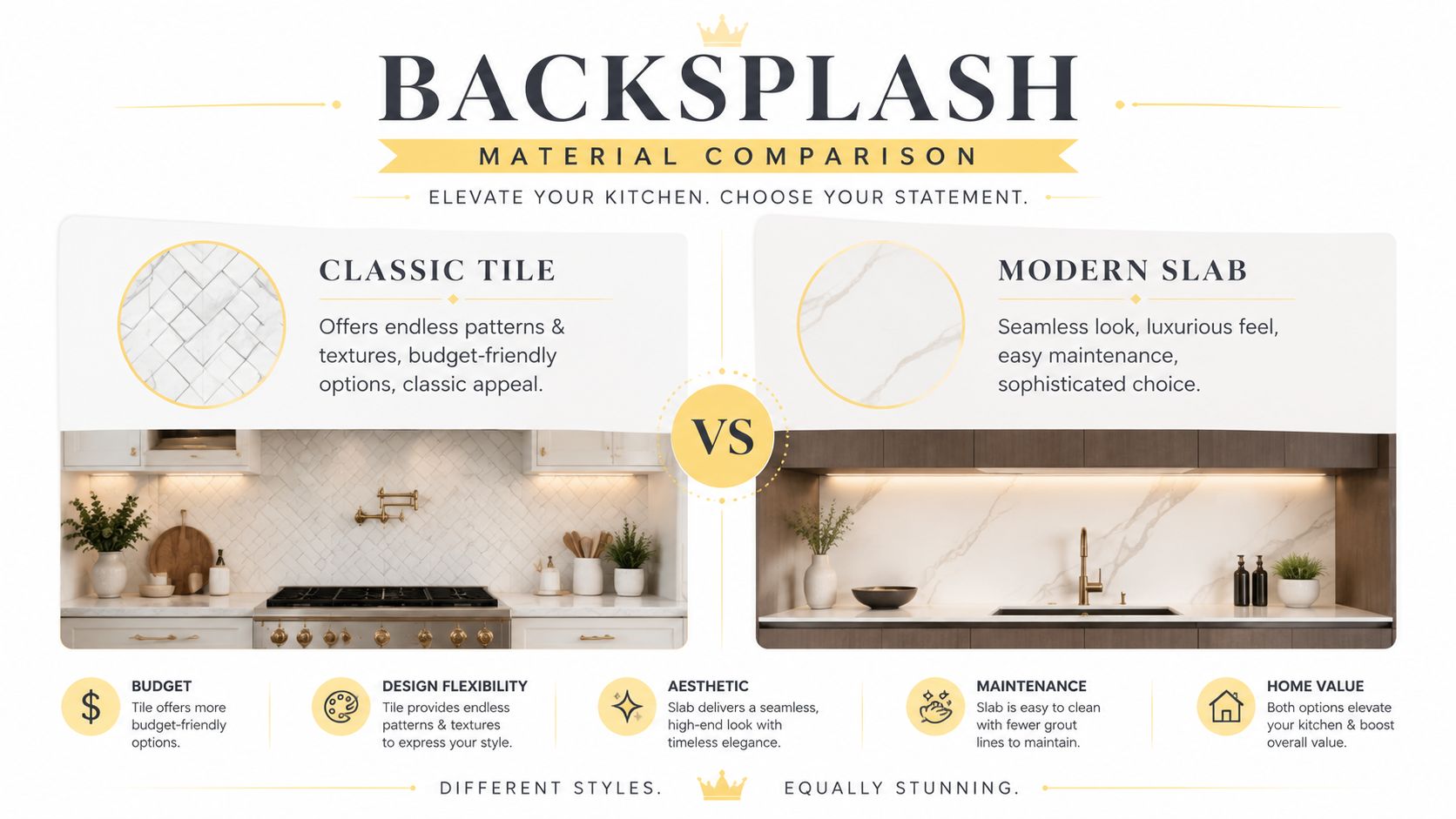
    A comparison infographic between classic tiled and modern slab kitchen backsplash designs for home renovation.

    Ceramic tile remains the benchmark for a reason. A Statista-based survey cited for 2024 and 2025 found ceramic tile was selected by 34% of homeowners who installed or planned a new backsplash, ahead of glass at 7%, marble at 6%, granite at 4%, and zellige at 4% (kitchen backsplash trends). That spread reflects how many clients still want a surface that balances design range, cost control, and long-term practicality.

    Classic tile and what it gives you

    Ceramic works because it can disappear into the background or become the feature, depending on the glaze, shape, and layout. A simple white tile can feel calm and architectural. A handmade-look square can bring texture. A patterned ceramic can introduce just enough movement to make the kitchen feel collected rather than generic.

    The trade-off is that tile always introduces joints. Those grout lines can be part of the beauty, but they also ask for more maintenance than a continuous slab. In a busy kitchen, that matters. If a household cooks often, especially with heavy splatter at the range, a low-porosity ceramic surface usually makes life easier than more porous materials.

    Slabs, stone, and cleaner sight lines

    Modern slab backsplashes appeal to clients who want a quieter, more continuous wall. A stone or engineered slab that runs from counter to upper cabinetry creates one broad plane, which can make a kitchen feel more composed. That approach is especially strong in rooms where the countertop has beautiful movement, because the same material can continue upward without breaking the visual field.

    The downside is commitment. Slabs demand more precision in planning, seam placement, and fabrication. They can also narrow the design options if the stone itself is visually loud, since the backsplash and countertop then compete for attention. In those rooms, restraint elsewhere matters more.

    Texture, handmade qualities, and glass

    Materials such as zellige or glazed artisan tile introduce surface variation that catches light in a softer way than factory-perfect tile. That quality can feel warm and personal, especially in kitchens that need a little depth. Glass, by contrast, reads cleaner and more reflective, but it can feel colder if the rest of the room doesn't balance it with warmth in wood, fabric, or finish.

    The most useful question isn't “Which material is best?” It's “How should this kitchen live?” A formal entertaining kitchen may welcome a richer, more decorative backsplash. A hardworking family kitchen may call for a quieter surface that's easy to wipe down and won't dominate the room.

    Mastering Layout Scale and Current Design Directions
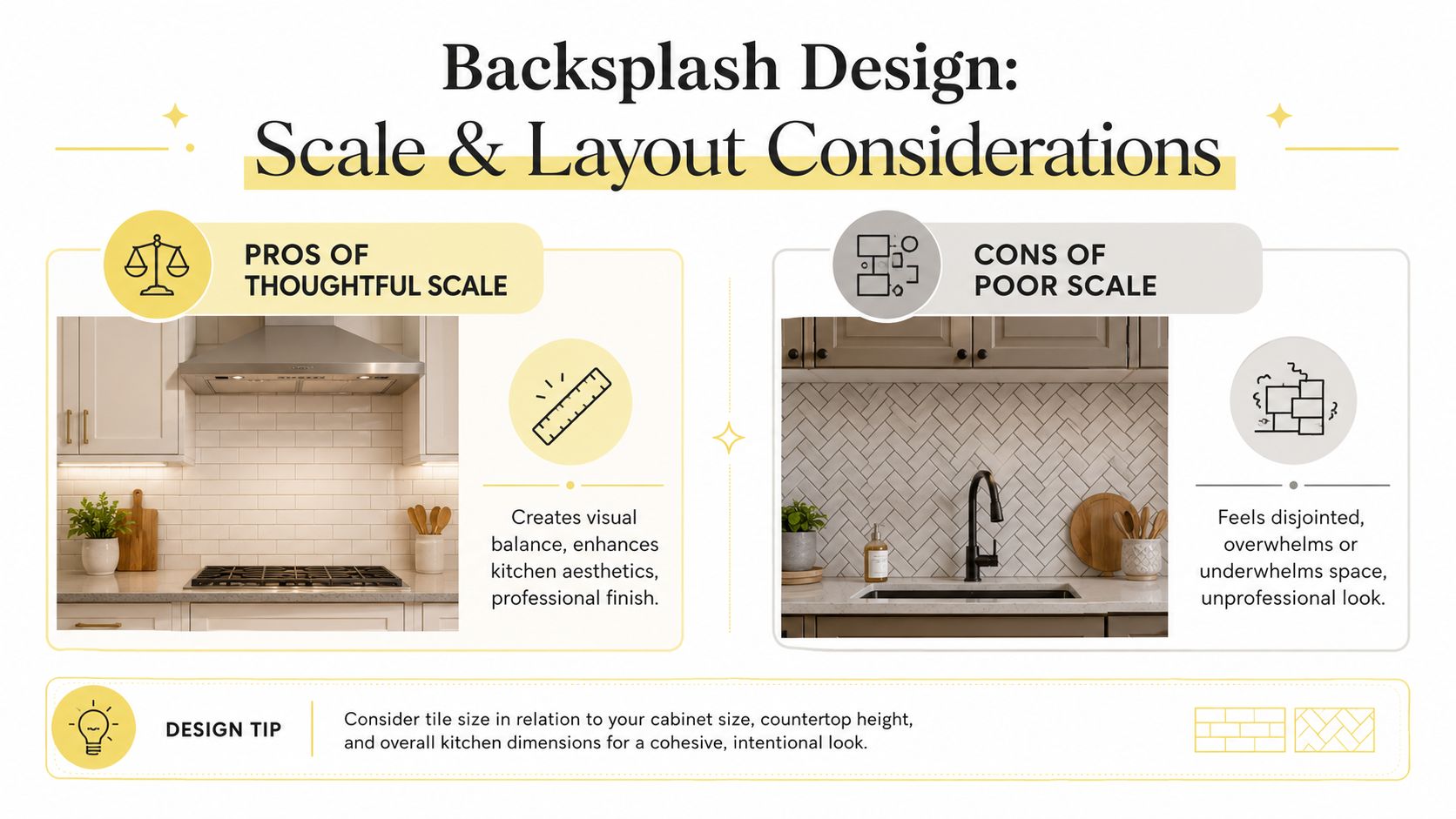
    A design infographic explaining the importance of scale and layout for a professional kitchen backsplash appearance.

    A backsplash only feels resolved when its scale fits the architecture around it and the way the kitchen is used. A 4-inch rise can work in a restrained prep zone, but many kitchens need a more deliberate decision about how high the wall treatment should go. The visual shift between a short strip and a full-height wall is substantial, even when the material stays the same.

    Where it should begin and end

    The wall behind the cooktop deserves the strongest protection and the clearest visual treatment. Design guidance often points to extending the backsplash at least to the bottom of the hood or microwave and across the width of the range, because that zone takes the most heat, steam, and splatter (backsplash height guide). A full-height run or slab often earns its place there because it protects the wall and gives the cooking area a more finished read.

    At other walls, the stop point should follow the room's geometry. Where an upper cabinet run ends, the backsplash should often end cleanly with it. Around a window, it may continue to the casing or wrap the opening, depending on how the room is detailed. Open shelves change the equation again, because they expose more wall and ask the backsplash to function like an architectural surface rather than a hidden background.

    A well-placed stop line makes a backsplash feel custom. A random stop line makes the wall look interrupted.

    Lighting changes how scale reads, which is why backsplash decisions should be considered alongside the room's illumination. A surface that looks quiet in daylight can feel much busier under strong task lighting or under-cabinet fixtures, so it helps to review kitchen lighting fixtures before confirming the final height and finish. In practice, the same tile can read refined, flat, or overly reflective depending on how the light falls across it.

    What's current in 2025 and beyond

    A 2025 trend direction is the full-wall backsplash, which extends coverage beyond the traditional space between counter and cabinet (My Style Trends). The same direction shows up in artisan-inspired square tile, irregular edges, and hand-finished surfaces that create a more integrated, custom feeling. Homes & Gardens also points to texture, glazing variation, and color variation as part of the current mood, with bolder tile murals returning in a more expressive way (Homes & Gardens).

    LEICHT Westchester describes continued momentum for larger-format and floor-to-ceiling backsplash applications, along with sculptural options such as three-dimensional and ribbed tile (LEICHT Westchester). HerdiStone also notes growing interest in taking tile or stone all the way to the ceiling, especially around range hoods and window walls (HerdiStone).

    These directions do not mean every kitchen should go tall or textured. They do mean the backsplash is being asked to do more than sit between two surfaces. It is becoming part of the room's architecture, and in homes across DC, Maryland, and Virginia, that usually calls for a designer's eye to balance proportion, durability, and the way the space will function.

    Creating Harmony with Cabinets and Countertops
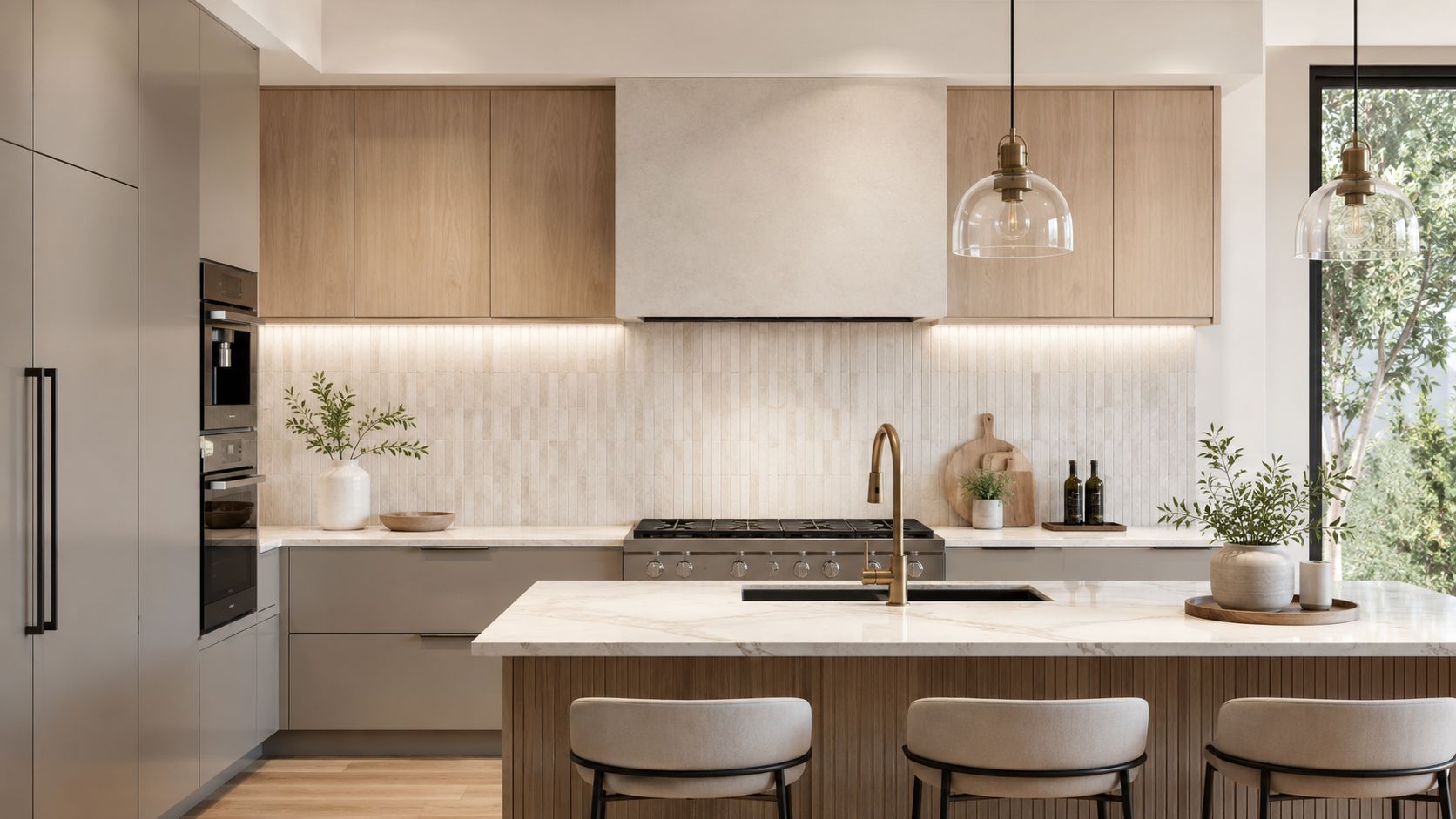
    A modern kitchen with natural wood cabinets, a marble island countertop, and a vertical stone tile backsplash.

    The most successful kitchens don't match everything. They balance it. A backsplash can either sit back and give the countertop and cabinetry room to breathe, or it can step forward and become the feature that gives the palette its energy. The key is deciding which role it should play before the material order is placed.

    Let one surface lead

    If the countertop has strong veining or bold movement, the backsplash usually works better when it's quieter. That keeps the room from feeling busy. A simple tile field, a soft glaze, or a clean slab can give the stone below it room to read properly.

    If the countertop is calm, the backsplash can carry more personality. That's where artisan tile, a richer color, or a more tactile finish can add depth without fighting the rest of the room. Nancy McCarren, AIA, LEED AP, often approaches the palette by looking at tone, finish, and pattern together so the room feels considered rather than overdesigned.

    The cabinetry matters just as much. Warm wood usually wants a backsplash with some softness, either in color, texture, or reflectivity. Painted cabinetry can go either way, depending on whether the client wants contrast or continuity. A narrow white tile wall against dark cabinets feels crisp. A taupe or cream field can feel gentler and more layered.

    A useful way to make the decision

    • Choose contrast when the room needs definition. A quieter counter with a patterned backsplash, or a richly veined counter with a plain backsplash, creates clarity.
    • Choose continuity when the room already has strong architecture. Repeating a tone from the cabinet or countertop helps the kitchen feel settled.
    • Choose texture when color is already doing enough. Surface variation can add interest without introducing another dominant hue.
    • Choose restraint when appliances and hardware already have a strong presence. The backsplash should support, not compete.

    The cabinetry conversation often includes storage planning too, because uppers, open shelving, and hood details change how much wall is visible. A thoughtful cabinet storage solution plan can affect how much backsplash you see and where the eye lands when you walk into the room.

    Designer's note: the right backsplash doesn't shout. It makes the cabinetry and countertop feel like they were always meant to live together.

    For visual harmony, consider the light as part of the composition. Matte surfaces absorb more of it. Glossy surfaces bounce it around. Under-cabinet lighting can make a color look warmer or cooler than it did in the showroom, which is why sample viewing matters so much.

    The Importance of Craftsmanship Installation and Care

    A beautiful backsplash can fail if the substrate is wrong. The wall has to be dry, flat, and solid for proper adhesion, and installers typically add about 10% extra tile to account for cuts around outlets and corners, which helps protect the finish and avoid lippage or bond failure (Tilezz installation guide). That extra planning is not waste, it's insurance for a clean, durable result.

    Preparation is where the work becomes craft. Grease, dust, old paint issues, and uneven patches all affect how tile sits and how grout performs. In a kitchen, those small misses show up later as cracked joints, uneven edges, or tiles that don't sit flush. A careful installer reads the wall before the tile ever goes up.

    What matters most at installation

    • Flatness and clean adhesion. The surface has to support the tile uniformly, especially around the range and sink.
    • Outlet and edge planning. Small cuts are where a backsplash looks either precise or clumsy.
    • Grout selection and sealing. Grout should be appropriate to the material and sealed when the system calls for it, especially in porous assemblies.
    • Transitions. Where the backsplash meets drywall, shelves, hood details, or window trim, the finish has to resolve cleanly.

    Care depends on the material. Ceramic and porcelain are generally straightforward to maintain, while natural stone and more porous grout systems need more attention. Textured surfaces can be beautiful, but they may catch more cooking residue than a smooth glaze. That's one reason design and maintenance should be discussed together, not separately.

    Jennifer Gilmer Kitchen & Bath manages these details as part of the overall project process, from selection through installation coordination. That matters because the visual decision and the technical decision are really the same decision in a kitchen that's meant to last.

    Your Design Journey with Jennifer Gilmer Kitchen & Bath

    Choosing a backsplash gets easier when you can see the materials in person, compare them under real light, and talk through the room as a whole. At Jennifer Gilmer Kitchen & Bath, that conversation begins in one of the showrooms in Chevy Chase, Easton, or Ashburn, where clients can handle samples and see how tile, stone, cabinetry, and finishes interact. That tactile step often changes the direction of the design in a good way.

    The firm serves Washington DC, Maryland, and Virginia, and the process is built to support homeowners who want guidance without losing their own point of view. Jennifer Gilmer, CKD, Nancy McCarren, AIA, LEED AP, and Marie-Josée Parisi all bring a design eye to the practical decisions that shape the finished kitchen. That can mean helping a client decide whether the backsplash should fade back or take the lead, or whether a material that looks lovely in daylight will still feel right under evening lighting.

    A strong backsplash plan also depends on the rest of the room. Appliance placement, cabinet configuration, and lighting all influence how the wall reads once the kitchen is in use. That's why the firm's work from concept through installation matters, because the backsplash can't be separated from the room around it if the goal is a cohesive result.

    Jennifer Gilmer Kitchen & Bath also includes backsplash tiling among its interior offerings, which lets the design team address the wall surface as part of the full kitchen composition rather than as a detached finish choice. For clients, that means fewer loose ends and a more grounded decision-making process. The result is usually calmer, because the choices are being made in context.

    A Thoughtful Finish for an Enduring Kitchen

    A good backsplash doesn't need to dominate the room to define it. It can be quiet, tactile, expressive, or almost architectural, as long as it belongs to the kitchen as a whole. The best kitchen backsplash design respects the cabinet lines, supports the countertop, suits the way the household cooks, and feels right under the light that fills the room every day.

    That's where professional design makes a real difference. Material, scale, layout, and craftsmanship all matter, but they matter most when they're considered together. A backsplash chosen with care won't feel dated as quickly, because it's not relying on novelty alone. It's part of a thoughtful composition built around how you live.

    For homeowners in the DC area, Maryland, and Virginia, the right next step is a conversation, not a guess. Bring your cabinet ideas, countertop samples, and kitchen questions to Jennifer Gilmer Kitchen & Bath, and begin shaping a backsplash that feels personal, practical, and lasting.


    A CTA for Jennifer Gilmer Kitchen & Bath.