.avif)
You open the drawer for a wooden spoon and find a tangle of spatulas, measuring cups, takeout chopsticks, and a gadget you forgot you owned. The deep drawer below it hides a mandoline behind mixing bowls, while the beautifully finished cabinet interior has become a catchall. The kitchen looks polished from across the room, yet everyday cooking still involves searching, shifting, and settling for the wrong tool.
The most useful kitchen drawer organization tips begin before the organizer arrives. Start with an honest inventory, then study how people move from refrigerator to prep surface to cooktop, oven, dishwasher, and table. A drawer should support that movement, not force everyone to retrace it.
That principle shapes the work at Jennifer Gilmer Kitchen & Bath, where cabinetry, storage, materials, and layout are considered together for homeowners in Washington DC, Maryland, and Virginia. From concept through installation, thoughtful drawer planning can make a finished kitchen feel calmer because every item has a sensible place, and that place remains practical after the first week of use.
Table of Contents
- 1. Divide and Conquer with Custom Drawer Dividers
- 2. Use Vertical Storage and Tiered Organizers in Deep Drawers
- 3. Give Gadgets a Dedicated Drawer with Purpose-Built Inserts
- 4. Build Cutlery Organization Around the Way You Eat
- 5. Add Drawer Liners and Non-Slip Surfaces
- 6. Organize Drawers by Zone and Workflow
- 7. Manage the Inventory and Purge with Purpose
- 8. Match Organizers to the Cabinetry and Kitchen Style
- 8-Point Kitchen Drawer Organization Comparison
- Let the Drawer Serve the Kitchen
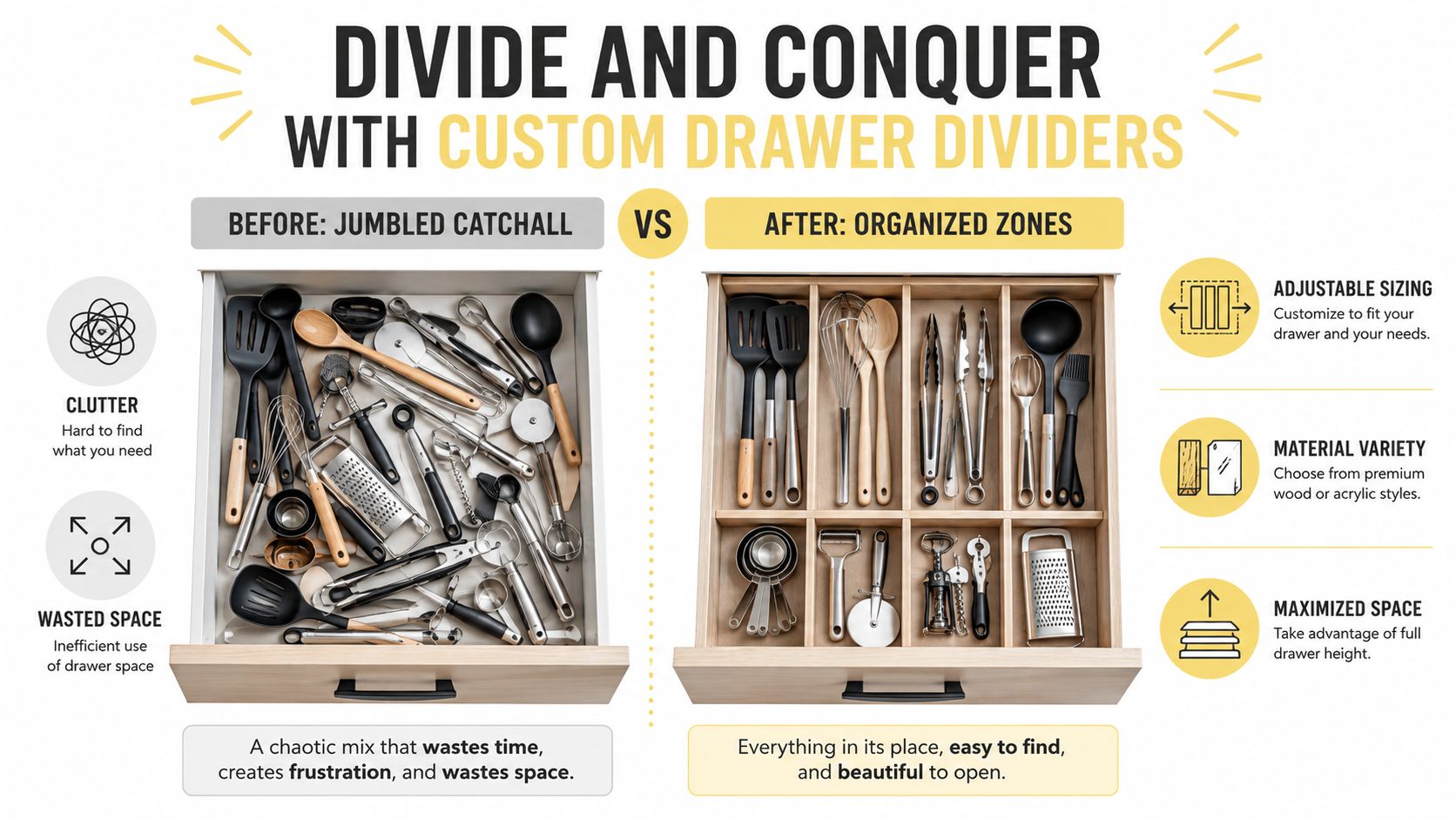
1. Divide and Conquer with Custom Drawer Dividers
A drawer becomes useful when its categories are visible. Custom dividers separate cooking utensils from measuring tools, serving pieces, or baking accessories, so the contents stop behaving like one crowded mass. A traditional utensil drawer might hold spoons, forks, knives, and serving pieces in distinct compartments. A baking drawer could give measuring cups, measuring spoons, pastry brushes, and decorating tools their own zones.
The best layout reflects the items you reach for. Before specifying an insert, place your most-used tools on a counter and note their length, width, handle shape, and natural grouping. A compartment that looks efficient on paper may feel cramped when several broad spatulas land in it.
Practical rule: Slightly generous compartments are easier to maintain than tightly packed ones. If every section is filled to its limit, the divider has created order without creating access.
Adjustable dividers are particularly sensible for a first attempt. They let you test whether serving pieces belong with cooking tools or in a separate drawer, and they accommodate a household's changing habits. Fixed inserts offer a more customized appearance, but they require more confidence about what the drawer will hold over time.
In a remodel, discuss drawer depth, internal clearances, and divider specifications with the design team before cabinetry is ordered. Jennifer Gilmer Kitchen & Bath works with cabinetry partners to coordinate those details with the way each client cooks. Their cabinet storage solutions can be considered as part of the larger plan, rather than added after installation.
2. Use Vertical Storage and Tiered Organizers in Deep Drawers
Deep drawers offer room for cookware, tools, and larger supplies, but a flat stack turns that capacity into concealment. Tiered trays, risers, and vertical organizers let you see what is behind the first layer. The difference is practical: you can reach for a back item without removing everything in front of it.
Consider a deep utensil drawer arranged by frequency. The front tier might hold daily-use wooden spoons and silicone spatulas, the middle tier seasonal gadgets, and the rear tier specialty tools used only occasionally. For baking sheets and pans, vertical or angled dividers make each piece identifiable and reduce the familiar clatter of a horizontal pile.
Measure the drawer's usable interior before choosing a system. Drawer modules commonly come in widths of 40 cm, 60 cm, or 80 cm, with base-cabinet depths of 47 to 52 cm and shallower island drawers of 30 to 35 cm, according to this drawer layout guide. Typical internal heights also vary, from 8 to 12 cm for a standard upper drawer and 16 to 22 cm for a deep drawer. Those dimensions help determine whether the drawer suits flatware, prep tools, bowls, or containers.
Leave breathing room around tiers. A system that fits perfectly but leaves no hand clearance will become frustrating, particularly when multiple people cook.
For a deeper look at using cabinetry efficiently, consider these space-saving kitchen cabinets. A well-planned deep drawer should make storage more visible, not just give clutter a larger footprint.
3. Give Gadgets a Dedicated Drawer with Purpose-Built Inserts
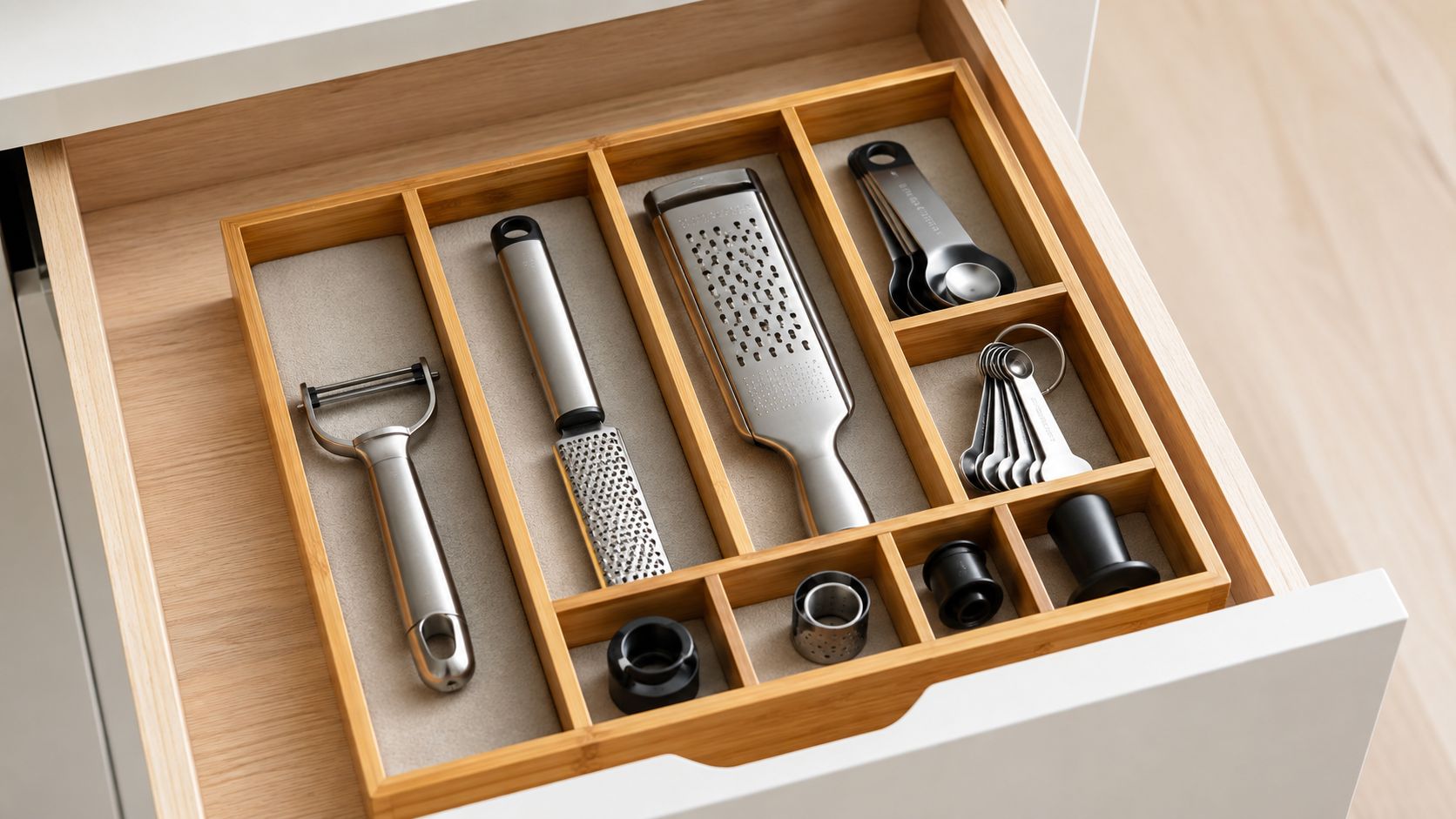
Specialty gadgets rarely behave well in a standard flatware tray. Peelers, graters, zesters, avocado tools, spiralizers, and mandolines have irregular shapes, while attachments can disappear into the back of a general-purpose drawer. A dedicated gadget drawer gives those tools a defined home and makes duplicate purchases easier to spot.
Begin by gathering every gadget from drawers, cabinets, and pantry shelves. Sort them by size and use, then keep each attachment with its main tool. A bamboo organizer might hold peelers, graters, and zesters in narrow pockets, with a larger compartment for a mandoline or hand mixer. A knife-specific tray can protect blades while separating them by width and handle size.
The drawer should serve the collection, not encourage it. If one gadget drawer overflows into several catchalls, the problem may be the inventory rather than the cabinetry. Specialty tools should earn their space through actual use, and tools that perform the same task deserve a careful comparison.
A flexible insert often outperforms a perfect-looking fixed grid when the collection is still changing.
Choose partitions that can be removed or adjusted. Your cooking habits may change, and a tool that currently belongs in a broad compartment may later need a narrower home. For a household that cooks often, leave enough clearance to return tools quickly. An organizer that requires careful repacking after every use won't last as a system.
A remodel is an ideal time to discover whether the kitchen needs one dedicated gadget drawer, a knife drawer near prep space, or a separate location for occasional equipment. The answer depends on the layout, appliance placement, and cooking style, not on the organizer's appearance alone.
4. Build Cutlery Organization Around the Way You Eat
Cutlery drawers deserve more attention than a single generic tray. They're opened constantly, and their contents reveal how a household serves meals. Dinner forks, salad forks, everyday knives, steak knives, teaspoons, espresso spoons, and serving pieces may all need different homes.
Start with an honest count of what gets used regularly. A household with children may place child-size utensils at the front, where they can be reached independently, while adult pieces sit behind them. A household that entertains may need a generous section for serving forks and carving tools rather than giving every compartment equal priority.
A five-section arrangement could separate dinner forks, salad forks, dinner knives, steak knives, and teaspoons, with an overflow area for serving pieces. That layout works only if those categories match the household's habits. If specialty utensils are rarely used, grouping them together may be more practical than giving each type its own compartment.
Place everyday pieces at the front of a deep drawer. Reach matters as much as category, particularly for children, shorter users, or anyone cooking while carrying a hot pan. The kitchen planning principle of frequency-based placement supports this approach, with daily-use items in the easiest positions and weekly-use or occasional pieces farther away. This five-zone kitchen organization framework also places cutlery and crockery within the non-consumables zone, reinforcing the value of positioning tableware near the dishwasher or dining area.
Jennifer Gilmer Kitchen & Bath treats these decisions as part of the client experience. A drawer designed around real meals feels more natural than one organized according to an arbitrary product diagram.
5. Add Drawer Liners and Non-Slip Surfaces
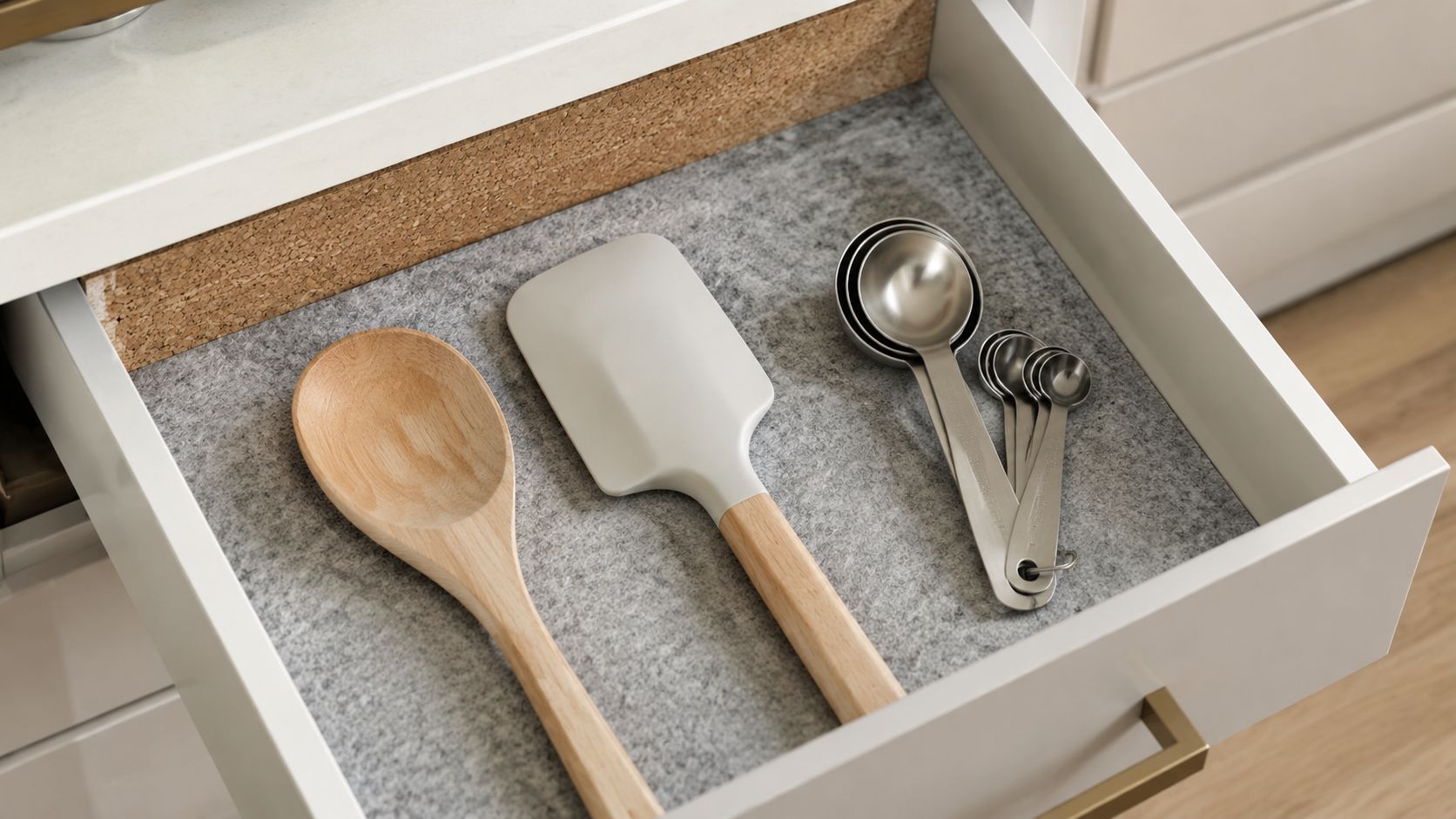
Even a carefully divided drawer can lose its order when organizers slide and utensils shift. A properly fitted liner creates a stable base, reduces movement, and protects the drawer bottom from scratches caused by metal tools or rough-edged containers. It also catches crumbs and small spills before they settle into corners.
Material choice should follow the drawer's use. Felt-backed rubber can cushion a finished walnut or mahogany drawer, while cork adds softness and helps reduce the sound of metal utensils landing together. A rubberized surface is useful where movement is the main concern. In a drawer that collects moisture, choose a water-resistant option that can be wiped clean.
Measure the usable drawer floor carefully. A liner that bunches at the sides creates its own nuisance, while gaps can leave exposed areas vulnerable to crumbs and wear. If the drawer has unusual corners or internal hardware, make a paper template before cutting the final material.
Maintenance matters more than novelty. Remove the liner occasionally, wipe it with a damp cloth, and let it dry fully before returning it to the drawer. Avoid treating the liner as a substitute for editing. A stable pile is still a pile if too many tools share the space.
The quiet details matter. A liner should protect the finish, stay in place, and disappear into the daily routine.
Jennifer Gilmer Kitchen & Bath can address drawer protection alongside cabinetry materials and interior detailing during a remodel. That coordination is especially valuable when the drawer boxes are crafted as part of a carefully selected finish package. The result should feel considered when open, but never precious to use.
6. Organize Drawers by Zone and Workflow
A drawer's ideal location depends on the task it supports. Cooking tools belong near the cooktop, prep tools near the main work surface, and baking tools near the oven or mixing area. Organizing only by item type can scatter the tools needed for one task across the room.
An island often provides an opportunity to make this logic visible. One drawer might hold spatulas, tongs, and wooden spoons beside the cooking surface. Another could keep knives, peelers, and small prep tools near the island's main work area. A drawer closest to the oven might contain measuring cups, spoons, and mixing accessories, while a drawer near the refrigerator could support serving and plating.
The five-zone model of consumables, preparation, non-consumables, cooking, and cleaning offers a useful starting point for this planning. Kitchen zoning guidance places knives, boards, bowls, and pantry ingredients in preparation; pots, pans, oil, spatulas, and seasonings in cooking; and cleaning supplies near the sink. It also emphasizes frequency, so the easiest drawers should hold items used every day.
Map the path of a typical meal before assigning zones. Note where hands move first, second, and third, then place the most-used tools within that sequence. Keep transition items, such as small cutting boards or prep towels, in a central drawer when they serve more than one area.
A thoughtful kitchen layout plan connects drawer placement with circulation, appliance locations, and the island's role. For additional ideas, compare these kitchen optimization strategies with the way your household cooks.
7. Manage the Inventory and Purge with Purpose
Organization lasts only when the contents remain appropriate. Broken handles, duplicate peelers, sticky tools, and gadgets that never leave the drawer all consume valuable space. A regular inventory check gives the system a chance to reflect current cooking habits rather than preserving every past version of the household.
Set aside a recurring time to review the drawers. Remove anything damaged, then separate clean, functional items for donation. Specialty gadgets deserve an especially honest assessment. If a tool has been waiting for a use that never arrives, moving it out of prime storage may improve the drawer more than adding another insert.
During a remodel, this editing process often changes the cabinetry plan. A family may discover that it needs a generous prep drawer rather than storage for equipment it no longer uses. Another household may realize that serving pieces need to move closer to the dining area, while baking tools deserve a drawer near the oven.
Use a simple reset ritual after each purge:
- Remove damage: Discard utensils with bent parts, broken handles, or surfaces that no longer clean well.
- Relocate occasionally used tools: Move seasonal or specialty items to less central storage.
- Keep donations visible: A designated box makes it easier to complete the edit instead of returning items to the drawer.
- Photograph the finished layout: A quick reference image can help every household member restore the arrangement.
The point isn't to create an austere kitchen. It's to reserve accessible storage for tools that support the way you live now. Flexible organization works best when the inventory remains intentional.
8. Match Organizers to the Cabinetry and Kitchen Style
The inside of a drawer is part of the kitchen's material story. Natural walnut dividers can echo walnut cabinetry, while modern acrylic or metal inserts may suit a kitchen with polished nickel or brushed stainless hardware. When the drawer is open, those details reinforce the sense that storage was designed rather than improvised.
Material should also follow use. A visible utensil drawer may justify a finely finished insert because it's opened often and contributes to the experience of the room. A less prominent drawer for occasional tools can use a simpler modular system, provided it fits securely and remains easy to clean.
Bring cabinetry samples when selecting organizers. Warm brass hardware pairs naturally with warm wood, while cool stainless finishes can sit comfortably beside acrylic or metal. The goal isn't to match every surface exactly. It's to avoid a jarring combination that makes a newly remodeled kitchen feel assembled in stages.
Aesthetics alone shouldn't dictate the system. A beautiful fixed insert that can't adapt may be less successful than an adjustable organizer that supports changing habits. Conversely, inexpensive bins that slide, stain, or leave large gaps can undermine an otherwise carefully crafted drawer.
Jennifer Gilmer Kitchen & Bath considers organizers with cabinetry finishes, hardware, layout, and daily use. That approach matters during a remodel because drawer interiors, depths, and clearances can be coordinated before installation. The broader market reflects growing interest in this kind of modular storage. A 2025 estimate valued the global drawer organizers market at $4.2 billion and projected $6.8 billion by 2034, with a 5.3% CAGR, while cutlery organizers represented 32.5% of product share and residential applications accounted for 68.4% of revenue, according to this drawer organizer market report. Those figures suggest broad consumer adoption, but the right system still has to fit your cabinetry and routines.
8-Point Kitchen Drawer Organization Comparison
| Item | Implementation (🔄) | Resources & Cost (⚡) | Expected outcomes (⭐ / 📊) | Ideal use cases (💡) | Key advantages (⭐) |
|---|---|---|---|---|---|
| Divide and Conquer with Custom Drawer Dividers | 🔄 Moderate, measuring and fit with cabinetry partners | ⚡ Low–Medium, wood/acrylic/bamboo; custom sizing raises cost | ⭐ High, clearer zones, faster retrieval | 💡 Standard utensil drawers; retrofit without major remodel | ⭐ Maximizes space; protects finishes; modular options |
| Vertical Storage and Tiered Organizers for Deep Drawers | 🔄 Moderate–High, choose riser heights and fit | ⚡ Medium, tiered trays/risers or custom inserts; uses vertical space | ⭐ High, improved visibility/access to rear items 📊 | 💡 Deep drawers holding large utensils, pans, seasonal tools | ⭐ Turns depth into usable layers; reduces extra storage needs |
| Dedicated Gadget Drawers with Purpose-Built Inserts | 🔄 Moderate, configure compartments for irregular shapes | ⚡ Medium–High, specialty inserts, cushioned materials | ⭐ High, better inventory, protects fragile finishes | 💡 Households with many specialty gadgets and attachments | ⭐ Keeps gadgets visible; prevents duplicates; easy maintenance |
| Cutlery Organization Systems That Reflect Usage Patterns | 🔄 Low–Moderate, sizing to actual utensil counts | ⚡ Low–Medium, trays/dividers; inexpensive options available | ⭐ High, faster meal prep and one-handed retrieval 📊 | 💡 Everyday utensil drawers; families and entertaining households | ⭐ Reduces search time; protects utensils; ergonomic layout |
| Drawer Liners and Non-Slip Surfaces for Stability and Cleanliness | 🔄 Low, simple install but requires correct sizing | ⚡ Low, felt, cork, rubber or silicone liners | ⭐ Moderate, stabilizes items, protects drawer finish | 💡 Any drawer prone to sliding or noise; protecting finishes | ⭐ Prevents shifting; reduces noise; catches spills |
| Zone-Based Organization for Logical Workflow and Efficiency | 🔄 Moderate–High, planning workflow and drawer placement | ⚡ Low–Medium, multiple organizers may be needed | ⭐ High, streamlines tasks and reduces steps 📊 | 💡 Kitchens with distinct work areas or multiple cooks | ⭐ Aligns tools with tasks; reduces cross-contamination; intuitive |
| Inventory Management and Regular Purging for Long-Term Organization | 🔄 Low, recurring discipline and simple audits | ⚡ Minimal, time commitment; optional donation/disposal costs | ⭐ High (long-term), prevents re-cluttering and duplicates 📊 | 💡 Anyone seeking sustainable, low-clutter storage habits | ⭐ Maintains organization; frees space; prevents duplicate buys |
| Drawer Dividers and Organizers Tailored to Your Cabinetry and Style | 🔄 Moderate, coordinate finishes and possible custom work | ⚡ Medium–High, high-end materials or custom fabrication | ⭐ Moderate–High, cohesive look encourages upkeep | 💡 Newly remodeled kitchens or visible drawers | ⭐ Aesthetic cohesion; elevates design; encourages maintenance |
Let the Drawer Serve the Kitchen
The strongest kitchen drawer organization tips don't begin with a shopping list. They begin with editing. Remove what no longer earns its space, group what belongs together, and place each category where the work happens. A drawer near the cooktop should support cooking. A drawer near the dishwasher should make unloading and setting the table easy. An island drawer should be assigned according to the island's real role, whether that's prep, cooking, serving, or a combination.
Measure the usable interior before buying inserts. Nominal cabinet dimensions can be misleading. One retailer's planning guidance shows that a 30-inch drawer has a 27-inch-wide interior, which can accommodate a 15-inch flatware tray and two 6-inch utensil trays. The example illustrates a broader rule: organizer selection should begin with the inside dimension, not the number on the cabinet plan. See this guide to organized kitchen drawers for the practical measuring logic.
Don't over-organize every drawer. A fully compartmentalized system can look orderly while adding friction if household members have to place every tool into a precise slot. Frequently used drawers often benefit from clear, slightly flexible zones, while specialized drawers can support more exact divisions. The right balance depends on who cooks, how often they cook, and whether several people share the room.
Materials deserve equal consideration. Liners should protect drawer finishes without shifting. Dividers should allow enough clearance for handles and hands. Wood, acrylic, metal, cork, and rubber each offer a different combination of appearance, cushioning, cleanability, and flexibility. These choices are small, but they contribute to the daily experience of a kitchen built with care.
Remodel planning is the time to address drawer depths, internal heights, island storage, hardware, finishes, appliance placement, and work zones. A 2025 Houzz U.S. Kitchen Trends Study found that 80% of homeowners use drawers in island storage, compared with 79% using cabinets with doors. The close relationship between those figures reinforces the design question: an island needs a storage strategy, not just more storage.
Jennifer Gilmer Kitchen & Bath serves homeowners throughout Washington DC, Maryland, and Virginia, with consultation spaces and cabinetry expertise that support projects from concept through installation. Before a design meeting, sketch your current drawer layout, mark the places where you search or reach around other items, and note which tools you use every day. Bring that list to the consultation. It will give the design team a practical foundation for shaping storage around your kitchen rather than fitting your life into a preset cabinet plan.
Jennifer Gilmer Kitchen & Bath provides full-service kitchen remodeling, custom and semi-custom cabinetry, layout planning, material selection, and integrated storage design for homeowners in Washington DC, Maryland, and Virginia. Visit Jennifer Gilmer Kitchen & Bath to explore the firm's consultation spaces and discuss drawer planning from concept through installation.