.avif)

You're probably standing in the least glamorous phase of a bath renovation right now. The tile is still a sample board, the vanity exists only on paper, and two countertop options are competing for your attention because both look good for entirely different reasons.
Many homeowners make a costly mistake. They choose the slab that photographs well, not the one that lives well.
A bathroom countertop has to do more than look refined for reveal day. It has to handle water around the faucet, cosmetics near the sink, the occasional hot styling tool, cleaning products, and the wear that comes from a room used half-awake and in a hurry. The best countertop for bathrooms depends less on a showroom label and more on how the room works in your home. That's the lens I'd use in any Washington, DC, Maryland, or Virginia bath renovation.
Table of Contents
- The three materials homeowners most often compare side by side
- Quartz earns the top spot for busy vanities
- Granite and marble work best when you choose them for the right kind of room
- A quick comparison
- Solid surface earns its place in the right bathroom
- Porcelain is strongest where water is part of the design
- Quartzite is for a bathroom that wants presence
Why the Right Bathroom Countertop Matters
In a bathroom, the countertop is the surface you touch most and think about least. Until it starts showing every bad decision.
A poor choice announces itself quickly. You see dullness around the faucet, staining where cosmetics sit too long, swelling at vulnerable edges, or a finish that looked polished in a sample and feels fussy in daily use. In a primary bath, those issues show up faster because the vanity carries the pressure of real life. Two people, two routines, not enough landing space, and a sink area that never quite dries out.
Bathrooms are harder on counters than people expect
Kitchen counters get the reputation for heavy use, but bathroom tops take a different kind of abuse. Water splashes sit beside soap residue. Toothpaste lands where skin care bottles also live. Hair products overspray onto the surface and mirror. If someone sets down a hot styling tool carelessly, the countertop becomes the test site.
That's why material choice shouldn't be treated as a line item on a remodel spreadsheet. It affects function first, then design.
Practical rule: If you want a bathroom to feel calm after six months, choose the countertop for maintenance and performance first, then refine the look.
The surface sets the room's tone
Countertops also do more visual work than most homeowners realize. They influence the vanity color, faucet finish, mirror scale, lighting mood, and even whether a backsplash feels necessary. A crisp quartz top can make cabinetry feel custom-fit. A dramatic granite slab can carry a powder room almost on its own. Marble can soften an otherwise architectural bath, but only if you accept the way it ages.
Material leadership has shifted dramatically over time. A historical review noted that plastic laminate held about 90% of the countertop market in 1979, which says a lot about how recent today's stone-forward bathroom thinking really is, while the same review describes the rise of solid surfacing and then engineered stone as buyers moved toward lower-maintenance options (historical bathroom countertop review and pricing guide).
My direct view
If you're investing in a thoughtful bath remodel, the countertop deserves the same attention as the layout. Jennifer Gilmer, CKD, has long approached bathrooms as lived spaces, not just styled ones, and that's the right instinct. A beautiful room that asks too much of you every morning isn't a luxury. It's a maintenance problem dressed well.
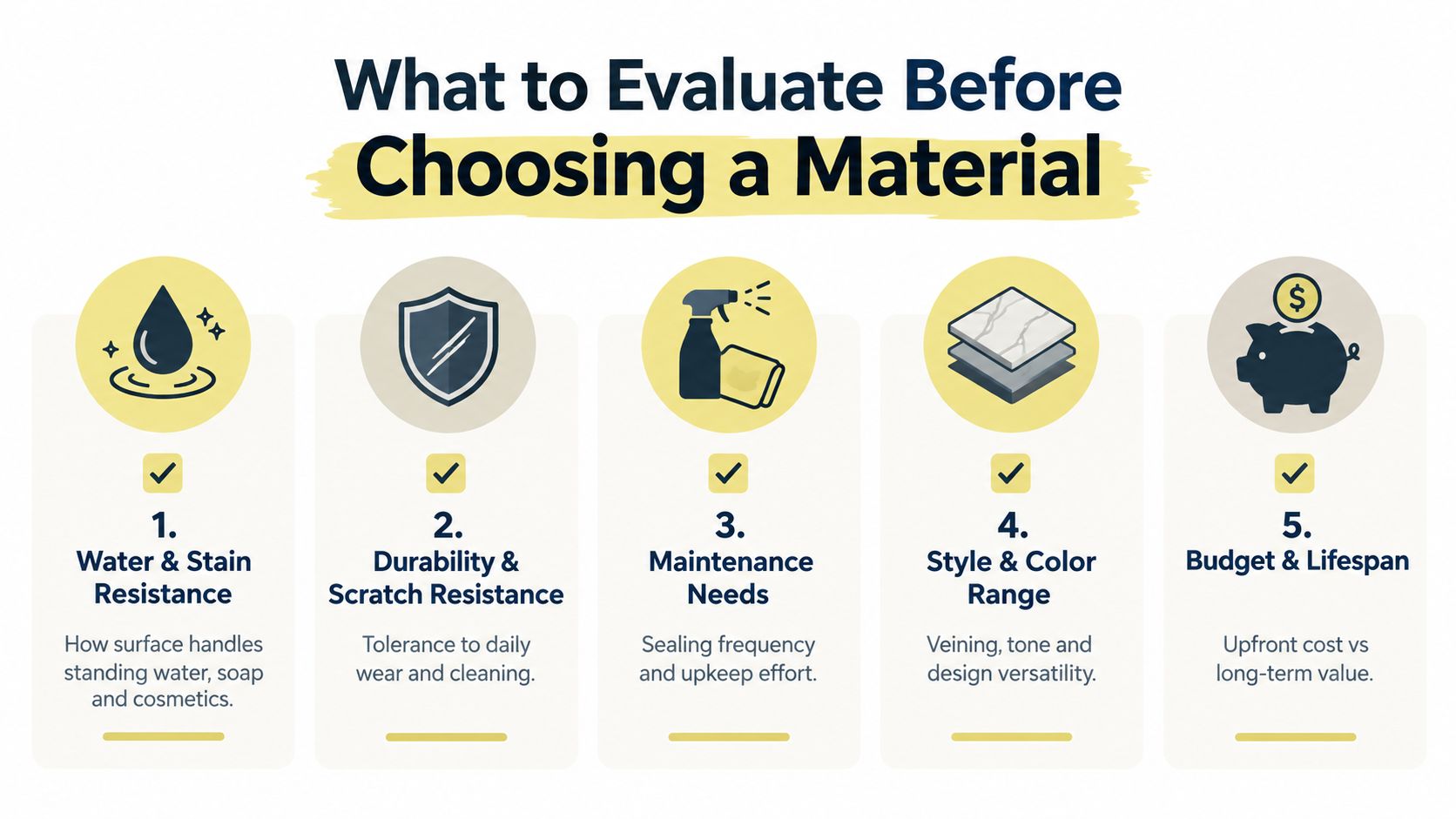
What to Evaluate Before Choosing a Material
Before you compare quartz to marble or porcelain to quartzite, get honest about how the room will be used. That answer narrows the field quickly and usually saves you from choosing a surface you'll resent later.
Here's the shortlist I use when weighing the best countertop for bathrooms.
| Evaluation point | What it really means in a bathroom | Best fit scenario |
|---|---|---|
| Water and stain resistance | How the surface handles puddling near faucets, soap, makeup, and spills | Primary baths, kids' baths |
| Durability and heat tolerance | Whether it shrugs off daily wear and the occasional hot tool | Shared vanities, makeup stations |
| Maintenance expectations | Whether you're willing to seal, baby, or polish the material over time | Powder rooms vs heavily used baths |
| Aesthetic range | Whether you want uniformity, movement, soft veining, or a monolithic look | Design-driven spaces |
| Budget reality | Material, fabrication, installation, and complexity of cuts and seams | Any renovation with tradeoffs |
Start with moisture, not color
In bathrooms, water performance comes first. Engineered quartz is a strong benchmark because it's effectively non-porous, with reported water absorption under 0.02%, while porcelain and sintered stone can go even lower at below 0.005% and are also described as having Class 5 stain resistance after extended exposure to common staining agents (countertop material comparison data).
That matters more than homeowners think. A powder room can tolerate a more precious surface because use is light and brief. A primary vanity can't.
Match the material to the behavior in the room
A kids' bath needs forgiveness. A guest bath needs easy cleanup. A powder room can be more expressive because nobody is leaving skin care bottles, electric toothbrushes, and damp hand towels all over the top. That distinction matters far more than trend color.
A few practical filters help:
- If the vanity sees constant splash choose a non-porous surface that doesn't need sealing.
- If hot tools land on the counter prioritize stronger heat performance.
- If you hate upkeep eliminate materials that depend on regular sealing or a tolerant attitude toward wear.
- If the vanity layout is tight choose a material that fabricates cleanly around sink cutouts and backsplash returns.
For layout planning, depth matters just as much as slab choice. A shallow vanity can make even a durable material feel cramped and messy in use, which is why standard proportions are worth reviewing before you finalize the top. This guide to bathroom vanity depth standards is useful if you're still refining the cabinet footprint.
The right countertop starts with behavior. How you use the room decides more than the stone yard does.
Quartz, Granite, and Marble Compared
By the time you are wiping toothpaste off the vanity, setting down a hot curling iron, or lining up skin care bottles along the sink wall, the countertop stops being a showroom sample and starts proving whether you chose well. In a bathroom that gets real daily use, these three materials perform very differently.
Here is the direct answer. Quartz is the best all-around choice for a hard-working bathroom vanity. Granite is the strongest pick if you want natural stone and expect heavier wear. Marble is the right choice for a powder room, a lower-stress vanity, or a homeowner who loves patina more than perfection.
Quartz dominates this category because it solves the problems that come up every morning. It resists moisture well, asks very little of you, and keeps a clean visual line in bathrooms where the countertop run is short and every seam, sink cutout, and backsplash return is easy to notice. Industry reporting on the bathroom countertop market also points to quartz as the volume leader in residential installations, which tracks with what designers and fabricators see in practice (bathroom countertop market estimate).
The three materials homeowners most often compare side by side
| Attribute | Quartz | Granite | Marble |
|---|---|---|---|
| Look | Consistent, available in quiet or stone-look patterns | Natural movement, more visual variation | Classic veining, soft and luminous |
| Water behavior | Non-porous, low maintenance | Good performance with sealing | More vulnerable, especially around acids and standing products |
| Heat tolerance | Fine for normal bath use, but not my first choice for repeated direct heat | Strong heat performance | Better treated carefully |
| Maintenance | No sealing | Periodic sealing | Ongoing vigilance and acceptance of patina |
| Best use | Primary baths, kids' baths, guest baths | Statement vanities, baths with hot tools in use | Powder rooms, lower-stress vanities, owners who love aged stone |
| Relative feel | Polished and practical | Rich and grounded | Refined and romantic |
Quartz earns the top spot for busy vanities
For a primary bath or family bath, quartz is hard to beat. It is the material I would recommend first if the vanity sees wet hands, skin care spills, electric toothbrushes, and the daily clutter that builds up around a sink.
It also gives you control. If the cabinetry is doing more of the visual work, quartz can stay quiet. If the room needs softness, there are convincing marble-look options without marble's maintenance burden. If you are weighing engineered stone against natural stone, this comparison of quartz vs. granite countertops lays out the tradeoffs clearly.
Granite and marble work best when you choose them for the right kind of room
Granite deserves more credit in bathrooms. It handles heat better than quartz, which matters if hot tools regularly land on the counter, and it brings the depth that only natural stone can give. A restrained slab can make a vanity feel grounded and substantial instead of busy. The catch is selection. Choose the wrong granite pattern in a small bath and the top will dominate the room.
Marble is different. You choose it because you want that glow, that softness, and the slight irregularity that makes a bathroom feel collected instead of manufactured. You do not choose it because it is carefree. Around a heavily used sink, marble will record the life of the room. In a powder room or a more formal bath, that can be beautiful. At a family vanity, it can become annoying fast.
If you want one rule to simplify the decision, use this one. Pick quartz for performance, granite for natural durability, and marble for atmosphere.
Solid Surface, Porcelain, and Quartzite in the Mix
These three come into focus once you stop treating the bathroom as one generic room. A children's bath, a hard-working vanity, a tub deck, and a powder room do not ask the same thing from a countertop. That is where solid surface, porcelain, and quartzite start to make real sense.
A quick comparison
| Material | Durability | Water & Stain Resistance | Maintenance | Finish Options | Best Bathroom Use | Relative Cost |
|---|---|---|---|---|---|---|
| Solid surface | Good for daily use, but easier to scratch than stone | Good for routine sink use | Low upkeep and repairable | Usually matte or soft sheen | Kids' baths, guest baths, integrated-sink vanities | Lower |
| Porcelain | Strong and stable for bathroom use | Excellent | Low upkeep | Matte, honed-style, polished looks | Wet rooms, tub decks, contemporary vanities | Mid to upper |
| Quartzite | Hard natural stone with pronounced movement | Good, with proper sealing | Moderate upkeep | Honed, polished, leathered | Statement vanities, select tub surrounds, natural-stone focused designs | Upper |
Solid surface earns its place in the right bathroom
Solid surface is not the glamorous pick. It is one of the most practical.
Its advantage is control. You get integrated sinks, restrained color, and a smooth visual line with fewer joints competing for attention. The International Surface Fabricators Association's solid surface overview also notes a benefit designers value in bathrooms: minor scratches and burns can often be repaired, which helps in secondary baths that see rougher daily use.
I recommend it for children's baths, guest baths, and vanity areas where you want the counter and sink to read as one clean form. It is less convincing in a primary bath built around stone drama or slab movement.
If the goal is a calm vanity with an integrated sink and very little visual noise, solid surface is hard to beat.
Porcelain is strongest where water is part of the design
Porcelain belongs in more bathrooms than it gets credit for. It handles splashy sink zones well, and it becomes even more compelling when the counter starts turning into a tub deck, wall return, or full wet-area surface.
Its visual character is different from quartz or natural stone. The thinner profile feels crisp and architectural. That works especially well in DC-area renovations where homeowners want a bathroom to feel edited, not heavy. Design coverage from slabwise on bathroom material trends and sustainability considerations also points to porcelain and sintered materials getting more attention from buyers who want performance with a cleaner, more restrained look.
Porcelain is not my default for every vanity. It is my pick when the room has a modern point of view and water exposure is constant.
Quartzite is for a bathroom that wants presence
Quartzite is the material for homeowners who want natural movement and depth, but do not want to live with marble's relative softness. It still asks for judgment. Some slabs are quiet and architectural. Others are busy enough to overpower a small vanity in seconds.
That is why quartzite works best when you choose the slab for the room, not for the showroom. On a generous primary vanity or a focal-point tub surround, it can be striking. In a compact bath with limited light and a lot of visual activity, it can feel crowded fast.
Quartzite is worth the splurge when the stone is the point. If you want the room to feel calm, disciplined, and easy to maintain, porcelain or solid surface often does the job better.
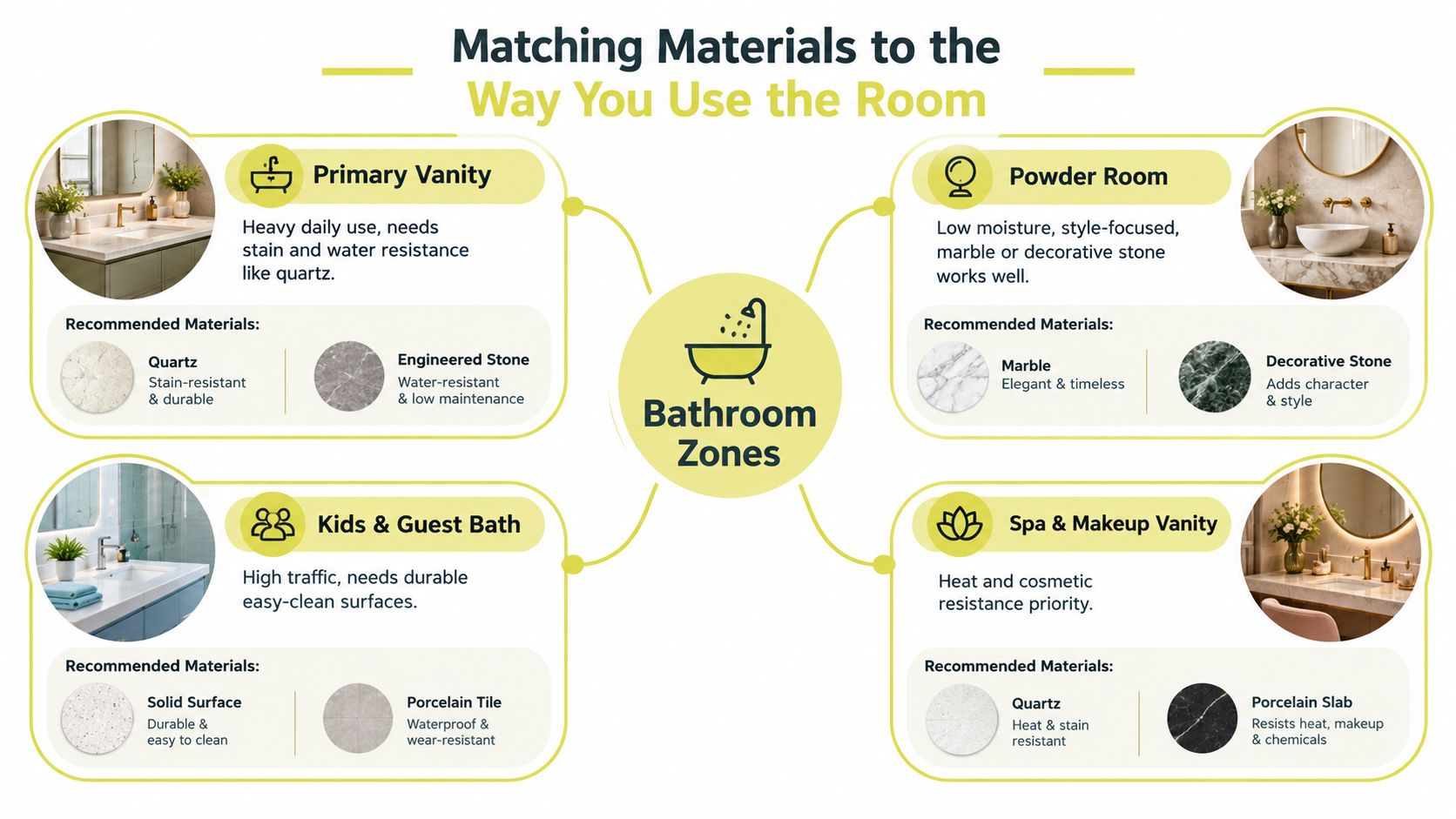
Matching Materials to the Way You Use the Room
The best countertop for bathrooms isn't one universal material. It's the right material in the right zone.
A primary vanity has different demands than a tub deck. A powder room can carry more drama than a family bath. Once you stop treating the bathroom as one flat category, decisions become easier and often more refined.
Primary vanity and daily sink zones
This is the hardest-working area in most bathrooms. Toothpaste, cosmetics, soap, water rings, hand towels, skin care, and the occasional hot tool all converge here. That's why quartz and porcelain are the two choices I recommend most often for primary vanities.
Quartz stays popular for good reason. One 2026 trend report notes that quartz remains the most popular bathroom countertop material and says it is installed in more than half of new bathroom countertop projects in some 2026 trend reporting, while also noting the rise of warm neutrals, honed finishes, and quartzite-inspired surfaces, with cold grays and high-gloss looks fading (2026 bathroom countertop trends). Trend aside, the practical advantage is what matters. These materials keep the room looking composed without asking for much in return.
Wet zones and tub surrounds
Once a horizontal surface sits close to a tub or blends into a splash-prone surround, maintenance becomes a design issue. You want something that tolerates moisture easily and won't punish you for normal cleaning.
Porcelain is excellent here. Quartzite can also work beautifully when you want more natural variation and are comfortable with appropriate care. In larger expanses, the slab's movement matters more, so seam placement and veining direction should be resolved before fabrication, not after.
Powder rooms and secondary baths
Powder rooms are where I loosen the rules. They see less moisture, fewer products, and far less wear. That makes them a good place for marble, darker granite, or another more decorative stone that might feel too precious in a primary bath.
Secondary baths sit in the middle. If they serve guests occasionally, you can be more aesthetic. If they serve children daily, choose performance. Solid surface often shines here because it cleans easily and integrated sink options simplify the whole vanity composition.
A few zone-based rules tend to hold up well:
- Primary vanity choose quartz or porcelain.
- Makeup vanity or grooming station lean toward granite if direct heat is a regular reality.
- Tub deck and wet surround choose porcelain first, quartzite if the natural look is worth the maintenance.
- Powder room use the room for personality. Marble is fair game here.
A bathroom feels more thoughtful when the material changes with the job it has to do.
Sink style matters too. An undermount sink keeps the top cleaner visually and physically. An integrated sink pairs especially well with solid surface. Vessel sinks ask more of the surrounding counter because water tends to travel farther than homeowners expect.
Why Seeing and Touching the Slab Changes Everything
Choosing from a small sample chip is one of the quickest ways to end up disappointed. A bathroom countertop isn't paint. Scale changes everything.
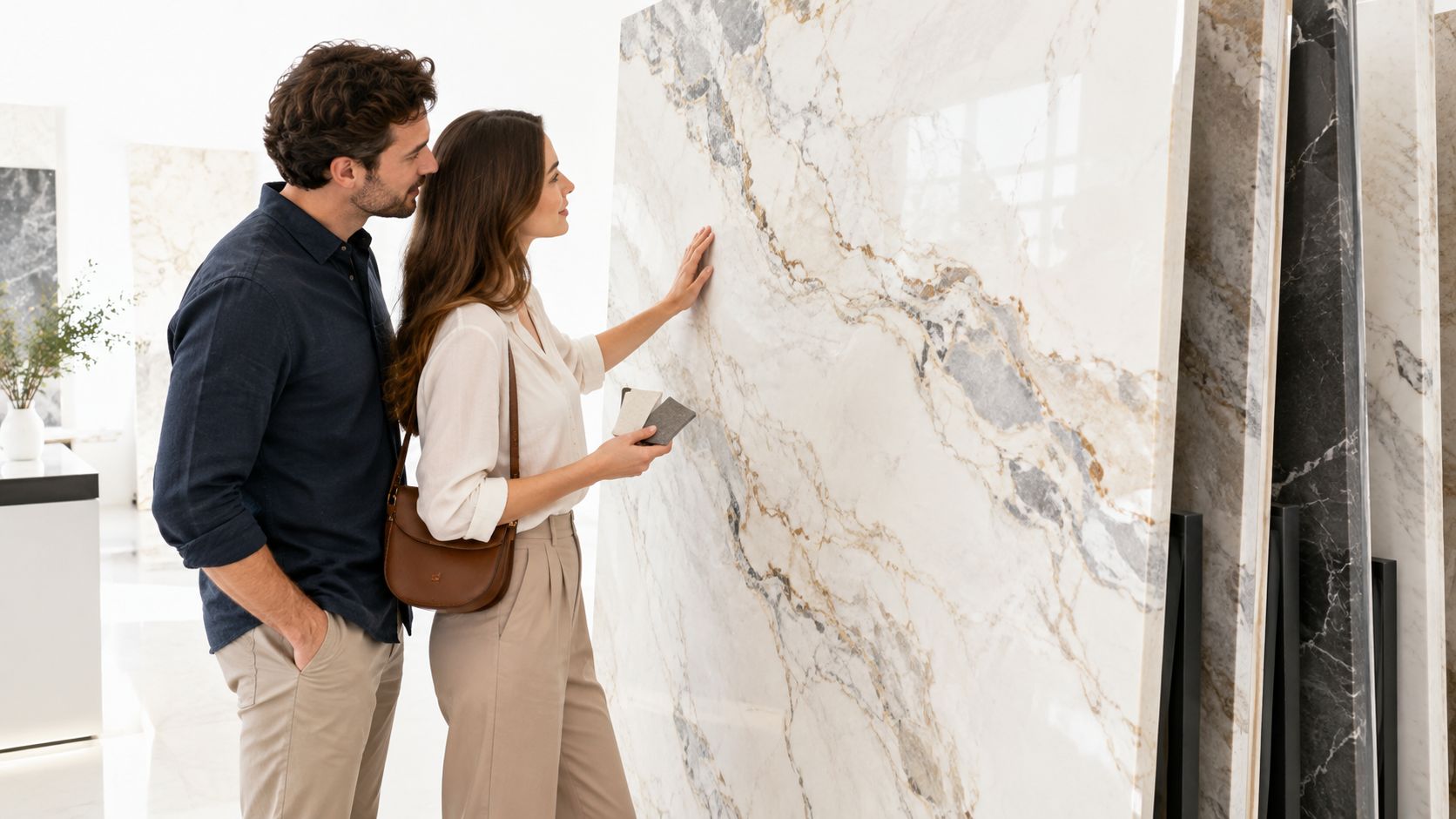
A two-inch piece can't tell you whether veining feels elegant or oversized once it spans a vanity. It can't show you where tonal shifts occur, whether the background reads creamy or gray, or how much movement will disappear once sink cutouts remove the most interesting part of the slab. It also can't show you whether a honed finish feels velvety and calm or just slightly flat.
Full slabs answer the questions samples hide
This is particularly true with natural stone and quartzite-inspired quartz. In a showroom or stone yard, you can compare multiple slabs side by side and quickly see which materials hold their character at scale. You'll also notice how lighting changes the read. What feels cool and crisp under one set of lights may turn noticeably warmer in a bathroom with softer illumination and painted cabinetry.
Hands-on viewing also helps with finish selection. A leathered quartzite, a polished granite, and a honed marble all catch light differently. In a bathroom, that difference changes not just the look but the mood.
For homeowners who want a visual primer before heading to the yard, this short video gives a helpful look at slab selection and what to notice in person.
Reserve the actual lot
A guided process matters. Nancy McCarren, AIA, LEED AP, and Marie-Josée Parisi both understand that materials don't exist in isolation. They relate to tile, lighting, mirror detailing, and cabinetry tone. If you're making a serious investment, don't stop at a label or a generic sample. View the slab. Confirm the finish. Reserve the lot that will be fabricated.
Jennifer Gilmer Kitchen & Bath handles projects from concept through installation, and for countertop decisions that kind of continuity is useful because seam placement, edge selection, sink choice, and slab orientation all affect the finished room.
Small samples help you eliminate options. Full slabs help you choose well.
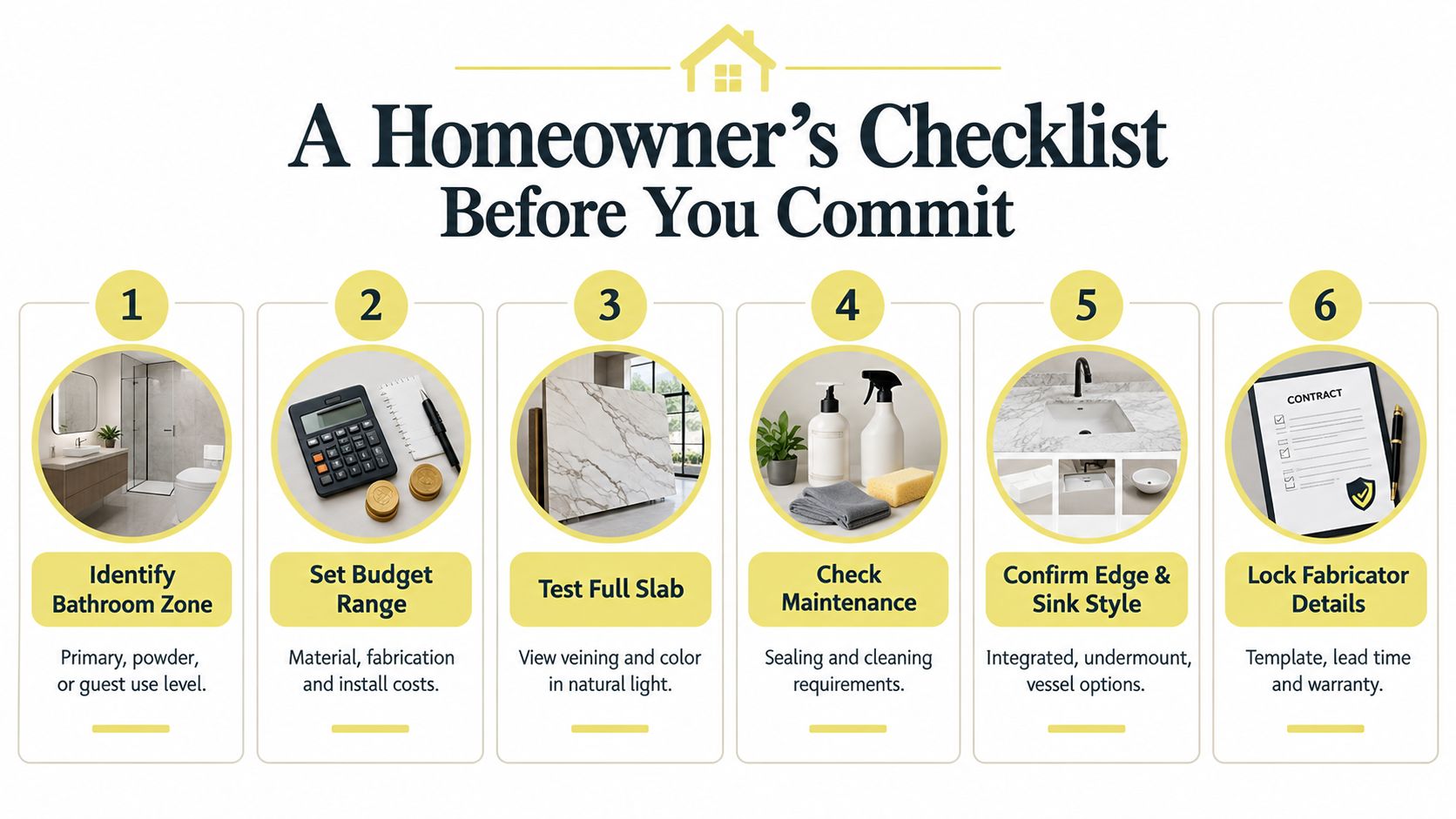
A Homeowner's Checklist Before You Commit
Good countertop decisions feel calm by the time you sign off. If the process feels vague, rushed, or overly dependent on a tiny sample, stop and tighten the details.
Lock the fundamentals first
Before you approve a material, answer these questions in order:
- Which bathroom is this for. A primary bath, powder room, and kids' bath should not be treated the same.
- What is your real budget ceiling. Include material, fabrication, and installation. The broad pricing spread in bathroom countertops is significant, so assumptions can derail the design quickly.
- How much upkeep will you tolerate. Be honest. Don't buy a surface that requires habits you know you won't maintain.
If you're still organizing the larger renovation sequence, this guide on how to plan a bathroom remodel is a helpful place to steady the process before material selections start stacking up.
Ask better questions in the showroom
Bring a sharper checklist than “Do I like this color?”
- Inspect the full slab and photograph the exact piece or lot being reserved.
- Review the finish under bathroom-like light if possible. Honed, polished, and textured surfaces shift more than people expect.
- Confirm sink and faucet coordination before template day. Cutouts should never feel like an afterthought.
- Mark seam placement on the vanity layout if the top requires more than one piece.
- Choose the edge profile deliberately. Bathrooms usually benefit from cleaner edges than kitchens do.
One detail people often overlook is backsplash strategy. A standard bathroom vanity backsplash is typically 3 to 4 inches high, and one measurement guide places the top edge at about 38 inches from the finished floor when paired with a 34-inch countertop. The same source notes that building codes do not require a vanity backsplash, which means it's a design choice, not an obligation (bathroom vanity measurement guide).
Get the care plan in writing
Practical ownership starts here. Ask what the material needs after installation, not just what it looked like in the showroom. For day-to-day upkeep language that homeowners can use, Flacks Flooring cleaning advice is a helpful example of the kind of straightforward maintenance guidance worth having on hand.
Before you pay the deposit, confirm:
- Lead time and template timing
- Who is responsible for sink and faucet specifications
- Whether sealing is required and how often
- What the warranty covers
- That your written spec matches the reserved slab, finish, and edge
The best countertop for bathrooms is the one you still like after living with it, cleaning it, and seeing it in morning light every day. That outcome rarely happens by accident.
If you're planning a bathroom renovation in Washington, DC, Maryland, or Virginia, Jennifer Gilmer Kitchen & Bath can help you make the countertop choice in the context that matters most. The firm designs bathrooms from concept through installation, with careful attention to slab selection, vanity planning, material coordination, and the way the room will be used. Visit Jennifer Gilmer Kitchen & Bath to explore the process and start the conversation.