

Installed recycled glass countertops typically run $65–$140 per square foot nationally, with many projects landing between $1,950 and $4,200 for a standard kitchen.
You may already have a sample beside your cabinet finish, a photograph saved on your phone, and a countertop quote that seems reasonable until you notice what's missing. That's the moment to pause. With recycled glass, the important question isn't what the surface costs. It's what you're buying, who will fabricate it, and what the finished installation includes.
Table of Contents
What Recycled Glass Countertops Actually Cost
At the design table, recycled glass can be the sample you keep returning to while comparing quieter alternatives. Perhaps you like its flecks of color against painted cabinetry, or you want an island with more personality than the perimeter counters. Before committing, connect that visual preference to a complete project allowance.
Angi's recycled glass countertop cost breakdown supports the opening benchmark for a 30-square-foot kitchen, places the average project near $2,700, and lists custom work at $120–$250 or more per square foot. Those figures describe different purchasing decisions, not interchangeable versions of the same installation.
Treat the benchmark as a starting allowance
A stock selection with straightforward fabrication belongs in a different budget conversation from a custom glass mixture with elaborate edges. Don't choose the more expensive specification while continuing to budget for the simpler one.
The graphic offers a broad visual introduction. Use the cited pricing in the text, rather than its illustrative figures, when setting your allowance.

For Washington, DC, Maryland, Virginia, and Delaware projects, a national figure is a planning reference, not a local quotation. Labor, transportation, fabricator availability, taxes, and contractor or showroom margins can change the invoice, particularly in a high-cost metropolitan area.
Practical rule: Approve a budget for the finished countertop, not just the slab you fell in love with.
Bring a plan to the pricing conversation, even if the layout is still preliminary. Identify the island, perimeter runs, sink, cooktop, and any backsplash you expect the countertop contractor to provide. A photograph communicates taste; a drawing communicates scope.
My recommendation is to price the actual design before treating recycled glass as your final selection. If the quote stretches the budget, simplify the specification deliberately. Don't assume an attractive material price will translate into an equally attractive installed price.
Breaking Down the Price You Are Quoted
Slab material, fabrication, and installation are separate cost layers. A proposal that compresses them into a single square-foot rate can still be useful, but only if the accompanying scope explains what that rate buys.
HomeAdvisor's recycled glass pricing guide gives a broader installed benchmark of $100–$250 per square foot, with material around $50–$175 per square foot and installation commonly adding $40–$75 per square foot. Its benchmark implies an allowance of $4,000–$10,000 for a 40-square-foot kitchen and includes a Northern Virginia comparison of approximately $92.48–$127.27 per square foot for a 3/4-inch installation.
Understand the work behind the rate
Those ranges aren't a menu to add together mechanically. Different estimates package fabrication and installation differently, so ask where each task appears before comparing totals.
| Cost layer | What you're paying for | What to clarify |
|---|---|---|
| Slab material | The selected surface and its specification | Whether the allowance matches the approved product |
| Fabrication | Templating, cutting, polishing, and finishing | Which edges, openings, seams, and shapes are included |
| Installation | Delivery, handling, placement, and site work | What access conditions and finishing tasks the price assumes |
Fabrication deserves particular attention. The fabricator must work around the glass aggregate and its surrounding matrix, not merely cut an outline. Curves, waterfall panels, thickened edges, and complicated layouts require a more involved scope than a straight run.
The following graphic illustrates the separation of cost layers. Its example dollar bands shouldn't replace the cited estimates or your fabricator's itemized proposal.

In the DMV area, ask how delivery and access have been priced. A contractor should understand the route into the home before giving you a final installation figure, rather than discovering an awkward entry during delivery.
A higher proposal may include more work, not a higher markup. Conversely, a polished presentation doesn't prove completeness. Compare the written inclusions first, then judge the price.
What Drives the Price Up or Down
The phrase recycled glass describes a category, not a complete specification. Your choice of glass, binder, thickness, and edge determines which version of that category you're purchasing.
Fixr's recycled glass installation guide reports products containing 60%–100% post-consumer recycled material and notes that blue, green, and other colored glass often costs more than clear or white material. Confirm the percentage for the exact product and color, rather than accepting a general statement about the collection.
Choose the composition before refining the details
A higher recycled-content percentage doesn't automatically make a slab a better value. Decide what matters to you visually and environmentally, then ask for documentation that describes the selected formulation.
- Glass color and distribution: Choose a stock mixture unless a custom blend serves a clear design purpose. Paying for a precise hue makes little sense if it disappears against the cabinetry.
- Binder specification: Identify the cementitious or resin system before approving the surface. Its ownership implications belong in the selection discussion, not in paperwork delivered after installation.
- Aggregate selection: Hand sorting and individualized mixtures can add production work. Reserve that expense for a surface you want to make a focal point.
Thickness also changes the comparison. Homewyse's recycled glass installation estimate places a representative 1.25-inch glass-and-resin installation at approximately $110–$146 per square foot, assuming more than 80% slab utilization; thinner regional examples based on 3/4-inch, or 2-centimeter, material fall around $91.12–$125.41 per square foot, with exclusions that can include backsplashes and fixtures.
Spend on proportion, not thickness alone
A substantial edge can look appropriate on a generous island and too heavy on a compact vanity. Make that decision with the cabinet elevations in view, not by holding a countertop sample in isolation.
Decorative profiles and custom shapes also add fabrication work. My preference is to let expressive glass remain the main detail and keep the edge restrained. If you want a more architectural profile, ask the fabricator to price it alongside the simpler option before choosing.
That comparison makes the premium tangible. You can then decide whether you're paying for a meaningful improvement in the room or a detail you'll barely notice.
How Recycled Glass Compares to Other Surfaces
Don't choose recycled glass because you expect recycled material to be inexpensive. Choose it because you want the particular surface, and then compare complete proposals for the alternatives you'd consider.
Cabstone's overview of sustainable countertop options positions recycled glass as a premium-to-midrange category, with broader installed estimates reaching $100–$250 per square foot for premium formulations and individualized designs. That spread makes a universal claim that it's cheaper than quartz, granite, marble, or concrete unhelpful.
Recycled Glass vs Common Countertop Alternatives
The alternatives below need project-specific pricing and care information. The design descriptions are selection cues, not promises about every available product.
| Surface | Installed Cost Range (per sq ft) | Maintenance Profile | Design Character |
|---|---|---|---|
| Recycled glass | Premium and individualized specifications can reach the cited $100–$250 range | Establish requirements from the binder and manufacturer's care guide | Choose it when you want visible aggregate to contribute to the palette |
| Quartz | Request a quote for the selected product and layout | Obtain the selected product's care requirements | Consider it when you want to explore a more controlled pattern |
| Granite | Request a quote for the selected slab and fabrication | Confirm requirements for the actual slab and finish | Consider it when natural variation is central to your preference |
| Marble | Request a slab-specific installed quote | Review the particular stone's care expectations before approval | Explore it when veining is the visual priority |
| Concrete | Request a finish- and design-specific quote | Confirm the specified finish, protection, and maintenance plan | Consider it when you prefer a quieter, more monolithic expression |
For a broader selection conversation, the guide to kitchen countertop types is a useful companion to your material appointments.
Choose the surface whose appearance and care routine you want to live with, not the one with the most persuasive category label.
For a kitchen with patterned flooring and detailed cabinetry, I'd first test a restrained countertop sample. For a simpler room, I'd consider allowing recycled glass to supply the movement. Neither choice is superior to the other; the relationship between materials matters.
If sustainability is part of a wider renovation strategy, you can also browse recyclable material alternatives through Hutter Architects. Keep that exploration connected to specific product documentation rather than assuming a material's name settles the environmental question.
Reading an Itemized Quote the Right Way
Read a countertop proposal beside the drawing it prices. If you can't connect the listed work to the layout, ask for clarification before signing.
A useful proposal should let you distinguish what you selected, what the fabricator will make, and what the installer will complete. It should also make exclusions easy to find.
Match the paperwork to the design
- Identify the product: Record the manufacturer, collection, color, binder, recycled-content specification, and slab thickness. Avoid approving a loosely described equivalent.
- Follow the fabrication: Look for templating, the edge profile, sink and cooktop openings, seam planning, and finishing. Ask which items are included in a package and which are separate charges.
- Confirm the site scope: Check delivery, installation, backsplash work, and any plumbing or electrical modifications. Ask who coordinates work outside the countertop contractor's scope.
- Request the ownership documents: Obtain the warranty, recommended cleaner, and written maintenance instructions before approval.
Use this checklist as a prompt for questions, not as a rule for how every contractor must structure fees.

Ask what remains your responsibility
Removal and disposal of existing counters should be addressed explicitly. So should fixture disconnection and reconnection, protection of surrounding finishes, and the handling of changes after approval. You don't need every task bundled under the countertop contractor, but you do need to know who owns it.
Before signing: Ask the contractor to identify every task you'll still need to arrange or pay for separately.
For professionals exploring estimating tools, Exayard construction estimating software is one resource to review. From the homeowner's side of the table, the important deliverable remains a readable proposal tied to an agreed scope, regardless of how the contractor prepares it.
When comparing bids, send each contractor the same drawing and specification. If someone proposes a substitution, have them identify it clearly rather than blending it into the total.
I'd rather see an honest exclusion than an ambiguous promise. A line stating that plumbing is by others gives you something to coordinate; silence leaves you guessing. The least expensive proposal is only useful if you understand what remains outside it.
A Recycled Glass Island in Practice
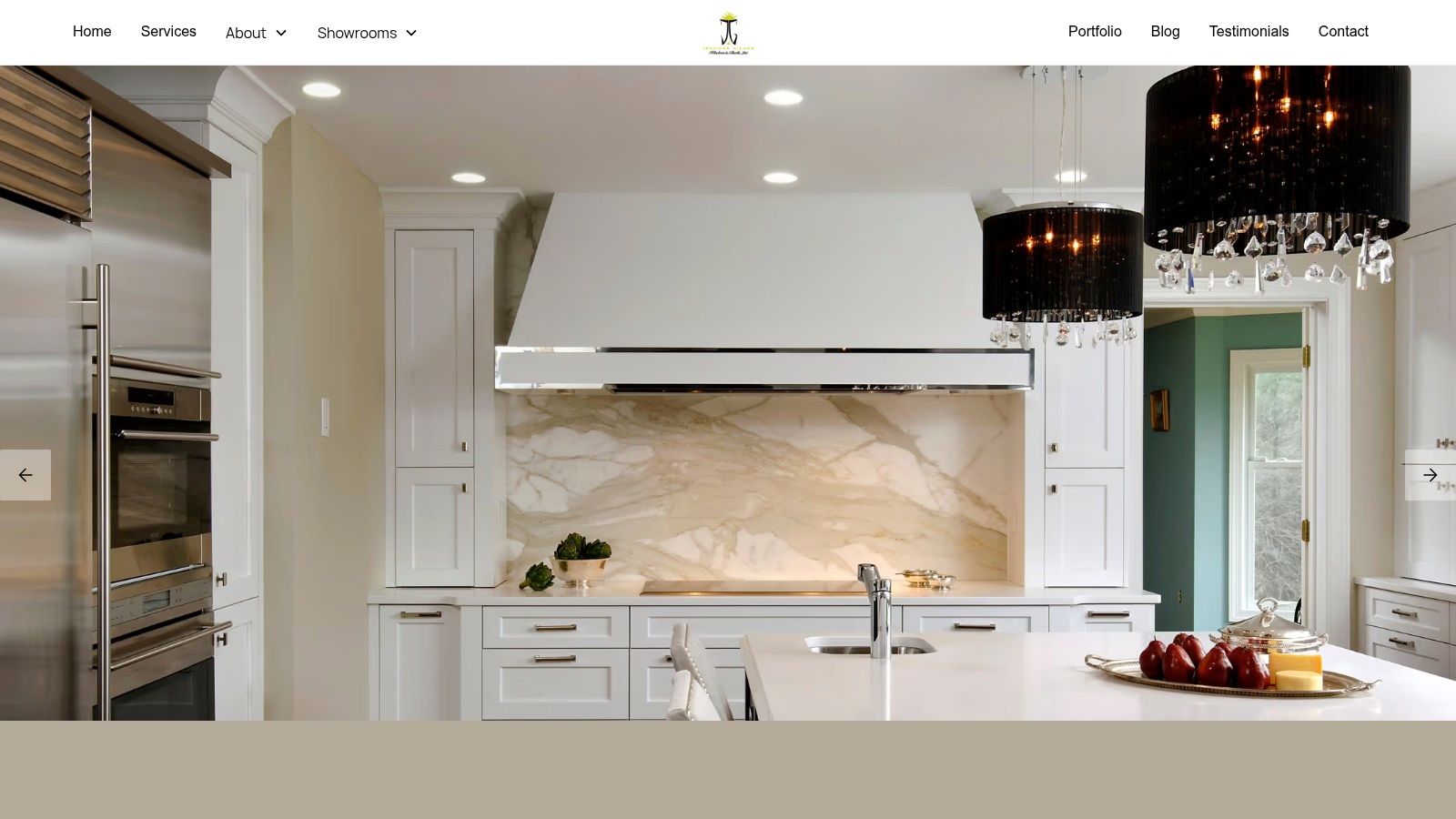
Consider an illustrative island scheme, not a documented completed project: warm wood cabinetry, a restrained perimeter surface, and recycled glass reserved for the island. The intention is to give the kitchen a focal point without asking every finish to compete.
The firm's website offers a starting point for considering the room as a whole.
Build the palette around the island
For this hypothetical scheme, I'd place the glass sample beside the actual cabinet finish, hardware, and backsplash candidate. I'd look for a shared undertone rather than trying to repeat every glass color elsewhere.
If the aggregate feels lively, I'd keep the nearby finishes composed. The hardware should support the cabinetry, and the lighting should be selected with the countertop sample present. Those are design judgments, not reasons to add more decorative elements.
The custom kitchen island design guide provides a useful starting point for thinking beyond the surface itself. Before approving the countertop, settle how the island will serve preparation, seating, storage, and circulation.
For additional visual context, view the accompanying video.
Coordinate the surface with the full plan
Jennifer Gilmer Kitchen & Bath serves Washington, DC, Maryland, Virginia, and Delaware from showrooms in Chevy Chase, MD; Easton, MD; and Ashburn, VA, handling projects from concept through installation, including cabinetry, layout engineering, lighting planning, and storage detailing.
A consultation with Jennifer Gilmer Kitchen & Bath is an opportunity to bring those choices together rather than purchase them independently. Designers such as Jennifer Gilmer, CKD; Nancy McCarren, AIA, LEED AP; and Marie-Josée Parisi belong in a conversation about the complete space, not as invented credits for an unverified recycled glass installation.
For the illustrative island, I'd resolve storage and appliance placement before approving decorative upgrades. A carefully selected countertop should complete a useful island, not compensate for a poorly planned one.
Sealing, Care, and the Cost of Ownership
Buy the care routine along with the countertop. A surface that fits the room but fights your habits will cost more than the quote shows.
Slabwise's recycled glass countertop guide separates porous cement-based products, which often need sealing approximately every 1–3 years, from generally nonporous resin-based products that typically do not require routine sealing. It also flags impact-related edge chipping, abrasive-cleaner damage, and staining in inadequately sealed cement-based slabs as practical risks.
Make maintenance an explicit decision
In our specifications, binder choice is also a staffing choice. If you choose cement, name who seals it before you approve the slab: installer, fabricator, or homeowner. Ask how you will know when resealing is due, and get the manufacturer's interval and product recommendation in writing.
- Set a reminder: Put the specified inspection or resealing routine into your home-maintenance calendar.
- Price the assistance you need: If you will not maintain the surface yourself, ask about professional resealing before purchase.
- Keep the documents: Save the care guide, warranty, and product identification where you can find them when questions arise.
Resin is the practical starting point when routine sealing is a dealbreaker. It still carries cleaning and use limits set by the manufacturer, so read those instructions before assuming the simpler binder is effort-free.
Protect the finish without making the kitchen precious
Treat ownership like a line item. Keep the approved cleaner within reach, do not substitute an abrasive product because it happens to be under the sink, and plan how heavy cookware moves around exposed edges. Ask the fabricator what a chip repair involves before you need that answer.
For cement-based products, skipped sealing can become staining that needs professional attention. Put that possible service call beside the lower bid when you compare quotes; a cheaper number can hide a recurring appointment.
Choose cement when the exact product is worth its upkeep. Choose resin when its care profile matches how you run the room.
The better purchase is the one you will maintain on schedule. A small saving at purchase stops looking smart once you know you will postpone the work it requires.
Budgeting With Confidence and Next Steps
Set your allowance around the approved surface and complete scope, then keep unresolved work visible rather than hiding it inside an optimistic total. Leave room for selections or site conditions that haven't yet been priced.
Before a showroom appointment, gather the decisions that will make the conversation productive.
- Bring the plan: Include available dimensions, appliance locations, and photographs.
- Bring the palette: Cabinet samples and finish preferences help narrow the surface selection.
- State your priorities: Explain your comfort with maintenance and where you'd simplify to protect the budget.
Use the average kitchen remodel cost guide to consider the countertop allowance within the larger renovation. Then arrange a consultation at Chevy Chase, Easton, or Ashburn with your questions and samples ready. The next step isn't choosing a color; it's turning that choice into an agreed specification and a complete price.
Jennifer Gilmer Kitchen & Bath offers coordinated kitchen and bath planning from concept through installation, connecting countertop selections with cabinetry, lighting, storage, and layout. Visit Jennifer Gilmer Kitchen & Bath to arrange a showroom consultation and discuss a recycled glass surface with a clear specification, realistic allowance, and care plan.